
Why Is My Septic Tank Alarm On? 5 Common Causes & Solutions for 2026
It’s 2:00 AM on a Tuesday, and a piercing, high-pitched siren is echoing through your backyard. You’re standing in your kitchen, staring out the window and wondering why is my septic tank alarm on at such an inconvenient hour. That sound is designed to get your attention, but it usually brings a wave of stress along with it. We know that a sounding alarm often triggers immediate fears of expensive repairs or messy backups in the house. You might be unsure if it’s even safe to take a shower or run the dishwasher while that red light is flashing.
It’s a frustrating situation, but most of the time, the alarm is doing exactly what it was built to do: give you enough warning to fix a problem before it becomes a disaster. This guide will show you how to silence the noise safely and help you pinpoint the specific trigger behind the alert. We will walk through the five most common causes for septic alarms in 2026, from pump failures to high water levels. By the end of this article, you’ll know exactly how to identify the root cause and when it’s time to call for professional emergency service.
Key Takeaways
- Learn to distinguish between high water alerts and mechanical failures to quickly identify why is my septic tank alarm on.
- Discover the immediate troubleshooting steps, including how to silence the buzzer and when to stop all water usage to prevent a backup.
- Understand the specific triggers for aerobic and conventional systems, including the impact of heavy Texas storms.
- Identify the dangerous signs that require 24/7 professional emergency service instead of a DIY fix.
Understanding Your Septic Tank Alarm: High Water vs. Component Failure
Your septic system is one of the most important utility components on your property, yet it’s often “out of sight, out of mind” until that loud buzzer starts ringing. Think of this alarm as a safety guardian for your home’s waste management. It is designed to trigger long before sewage actually enters your living space. When you find yourself wondering why is my septic tank alarm on, it’s usually because the system has detected a condition it can’t handle alone. Most modern panels use a combination of a red light and an audible buzzer to ensure you don’t miss the message.
The alarm is essentially reacting to one of two things: a high water level or a mechanical component failure. A high water alarm means the liquid in your Septic tank has risen above the safe operating limit. A mechanical failure means a part, like your pump or aerator, has lost power or broken down. We always tell our neighbors to follow the “Rule of Silence.” While you should definitely hit the “Mute” or “Silence” button to save your sanity, doing so only turns off the noise. It does not fix the underlying issue. The red light will stay on as a reminder that your system is still in a state of emergency.
How the Float Switch Triggers the Alarm
The heart of the high-water alert is the float switch. This is a small, waterproof component that hangs inside the pump tank. It works on basic physics; as the water rises, the float tips upward. Once it reaches a certain angle, an internal ball rolls and completes an electrical circuit, sending a signal to your control panel. Sometimes, these floats can get “stuck” on a pump pipe or tangled in debris. If a float is stuck in the “up” position, your alarm will stay on even if the water level is normal. If you safely open the tank lid, you can often see if the water is visibly high or if the float is simply caught on something.
The Difference Between Yellow and Red Lights
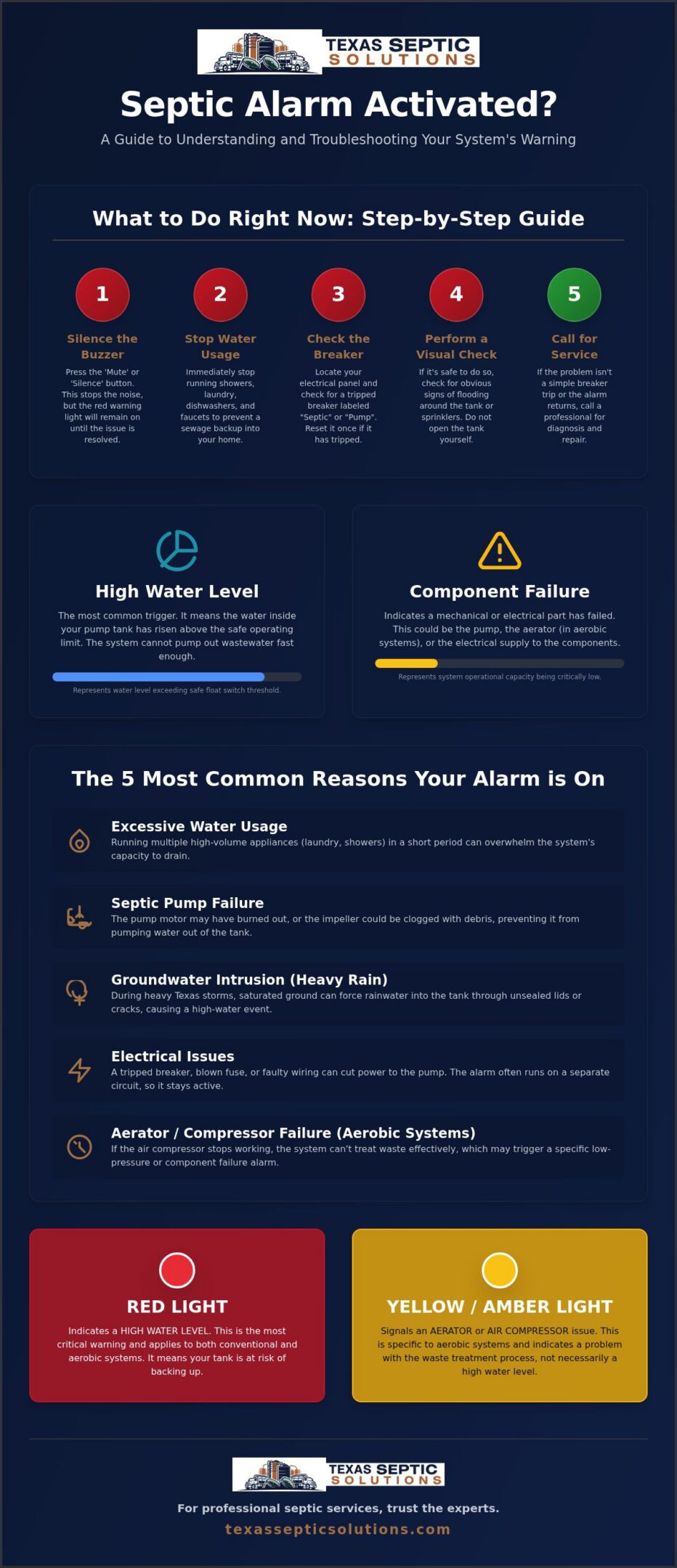
If you have an aerobic system, your control panel might have more than one light. Typically, a red light signifies a high water level, while a yellow or amber light indicates a problem with the aerator or compressor. A steady light usually means the condition is ongoing, while a flashing light might indicate a specific fault code depending on your panel’s brand. You can use the ‘Alarm Test’ switch on the side or bottom of the panel to verify that both the light bulbs and the audible buzzer are still working correctly.
The 5 Most Common Reasons Your Septic Alarm Is On
Hearing that buzzer can be unsettling, but it’s usually one of five specific issues. Understanding How Septic Systems Work helps you realize that the alarm is simply a level or pressure sensor reacting to a change in the tank environment. If you are standing at your control panel wondering why is my septic tank alarm on, the cause is likely sitting right inside the tank or at the electrical box. Here are the most frequent culprits our technicians see in the field:
- Excessive Water Usage: Running four loads of laundry while three family members take back-to-back showers can overwhelm the tank’s capacity faster than the pump can move it.
- Groundwater Intrusion: Heavy storms can force water into the tank through unsealed lids, riser joints, or even cracks in older tanks.
- Pump Failure: Motors eventually burn out or impellers get jammed by debris, leaving the water with nowhere to go.
- Electrical Issues: A tripped breaker or a blown fuse often cuts power to the pump while the alarm remains active on a separate circuit.
- Air Compressor Failure: In aerobic systems, if the aerator stops, the bacteria won’t have the oxygen they need to treat waste, triggering a low-pressure alert.
Identifying the trigger is the first step toward a solution. If you’ve just hosted a large gathering or finished a “laundry marathon,” the high water level might subside on its own once the system has a few hours to catch up. However, if the water usage has been normal, you are likely dealing with a mechanical or environmental failure that needs a closer look.
Environmental Impacts: The East Texas Rain Factor
In areas like Cleveland and Cypress, our heavy clay soil doesn’t absorb water quickly. During a typical Gulf Coast downpour, the ground becomes saturated, leading to “Inflow and Infiltration” (I&I). This is when rainwater finds its way into your septic tank through small gaps. If your gutters drain directly toward your tank or drain field, you are essentially asking your system to process your roof’s runoff along with your household waste. Diverting those downspouts can often prevent a high-water alarm during the next storm. If the rain has your system struggling, our team at Texas Septic Solutions can help with a quick inspection to seal any leaks.
Mechanical Wear and Tear
Most septic pumps have a lifespan of 5 to 10 years in our Texas climate. One of the fastest ways to kill a pump is by flushing “flushable” wipes. These don’t break down like toilet paper; instead, they wrap around the pump impeller, causing the motor to overheat and fail. In aerobic systems, the aerator is the hardest-working component. If it stops humming, your system can’t break down solids effectively, leading to odors and eventual clogs. Understanding these mechanical limits helps you realize why is my septic tank alarm on even when you haven’t used much water that day.
Aerobic vs. Anaerobic Alarms: Knowing Your System Type
Before you can solve the mystery of your buzzing control panel, you have to know what kind of system you are working with. Most homeowners in the Greater Houston area have either a conventional gravity system or an aerobic treatment unit. If you see purple sprinkler heads popping up in your yard to distribute treated water, you have an aerobic system. If your yard is just a flat expanse of grass where the water disappears underground, you likely have a conventional system. Determining this is the first step in answering why is my septic tank alarm on, as the two systems fail in very different ways.
Aerobic systems are more complex and, consequently, have more frequent alarms. While a conventional system usually only alerts you when the water level is dangerously high, an aerobic system monitors mechanical performance. It relies on a constant flow of oxygen to keep beneficial bacteria alive. This means your alarm might sound even if the water level is perfectly fine. The US Environmental Protection Agency provides a breakdown of different Types of Septic Systems, which highlights how advanced treatment units use mechanical components that require monitoring.
The primary difference lies in the triggers. Conventional systems are passive and only react to liquid levels. Aerobic systems are active, meaning they track air pressure and pump cycles. Because aerobic control panels involve high-voltage timers and air-pressure switches, they require expert handling. Attempting to rewire a complex aerobic panel without proper training can lead to electrical shocks or permanent damage to the expensive internal components.
Specialized Aerobic Alarm Triggers
On an aerobic control panel, you will often see a light labeled ‘Comp,’ ‘Air,’ or ‘Aerator.’ If this light is glowing, your air compressor has likely failed or a hose has come loose. This is a mechanical air-flow issue rather than a plumbing backup. Another common question we hear is whether a lack of chlorine tablets can trigger an alert. While most older panels don’t monitor chlorine, some newer smart systems in 2026 include sensors for disinfecting levels. If your aerobic system is acting up, you can find more detailed guidance in our Septic System Repair guide.
Conventional Gravity System Alarms
Conventional systems are much simpler, which means if the alarm is on, the situation is usually urgent. These systems typically only have one trigger: the high-water float. If this alarm sounds, it means the water has backed up because the drain field is saturated or the pump has failed. In the heavy clay soils of East Texas, drain fields can become waterlogged after weeks of rain. When the soil can’t take any more liquid, the water stays in the tank, lifts the float, and triggers the buzzer. This is a clear sign that you need to stop all water usage immediately to prevent a backup into your home.
What to Do Right Now: Step-by-Step Troubleshooting
When that buzzer starts screaming, your first instinct is likely panic. However, staying calm and following a logical process will help you determine why is my septic tank alarm on without making the situation worse. Most septic issues can be managed if you catch them early. Follow these five steps immediately to protect your home and your system.
- Step 1: Silence the alarm. Locate the “Mute” or “Silence” toggle on your control panel. This stops the noise so you can think clearly, but remember that the red light will stay on until the problem is resolved.
- Step 2: Stop all water usage. This is the most critical step. Do not run the dishwasher, stop any laundry cycles, and keep showers to an absolute minimum. You need to give the tank time to process the existing liquid.
- Step 3: Check your main electrical panel. Go to your home’s breaker box and look for a switch labeled “Septic” or “Pump.” If it has tripped to the middle position, flip it all the way off and then back on once.
- Step 4: Inspect the indicator lights. Look at your septic control panel. Is the “High Water” light on, or is it the “Aerator” or “Pump” light? Knowing which light is glowing tells you if the issue is a volume problem or a mechanical failure.
- Step 5: Monitor the system for 12 hours. If you have stopped using water and the light is still on after 12 hours, the system is not self-correcting. At this point, you need professional intervention.
Checking the Breakers and Power Supply
Your septic system should be on its own dedicated circuit. Sometimes, a power surge or a brief mechanical strain can trip the breaker. If you find the breaker tripped, you can try to reset it one time. However, if it trips again immediately, do not keep flipping it. This indicates a direct short in the pump motor or damaged underground wiring. You should also check the GFI outlet if your system is plugged into an exterior socket, as moisture from a heavy rain can often trip these sensitive outlets.
The ‘Wait and See’ Method for High Water
There are specific times when a “wait and see” approach is actually the right move. If you just finished a massive day of cleaning or hosted a dozen guests, your pump simply needs time to catch up with the surge. In these cases, the alarm should clear within a few hours of zero water use. You can find a more detailed breakdown of these immediate tasks in our guide on Septic tank alarm going off. If the light stays on despite your best efforts, it’s time to reach out to a professional for emergency septic service to prevent a messy backup.
Professional Repair and Preventing Future Alarms
While basic troubleshooting helps you understand why is my septic tank alarm on, actually fixing the system often requires professional equipment and strict safety protocols. We strongly advise against homeowners attempting to open septic tanks or handle internal electrical components themselves. Septic tanks are confined spaces that harbor dangerous gases like methane and hydrogen sulfide. These gases can be odorless and are capable of causing immediate respiratory failure. Beyond the chemical risks, there’s a serious fall hazard involved with open lids. Our technicians are trained to handle these environments safely so you don’t have to put yourself at risk.
Long-term prevention is the most cost-effective way to manage your property’s waste. Regular septic pumping is the foundation of a healthy tank. When sludge levels are allowed to rise too high, solid waste begins to enter the pump chamber. This debris clogs the impellers and forces the motor to run constantly, leading to the very mechanical failures that trigger your alarm. By removing these solids every few years, you significantly extend the life of your pump and aerator while keeping your yard free of odors.
The Value of a Septic Maintenance Plan
The best way to avoid a midnight alarm is to catch small issues before they become emergencies. During a professional inspection, we check the buoyancy of your floats, the amperage of your pump, and the cleanliness of your filters. In Texas, the TCEQ regulates on-site sewage facilities and requires owners of aerobic systems to have a licensed technician perform an inspection at least once every four months. Our Septic System Maintenance Plan ensures you stay compliant with these local regulations while protecting your investment from unexpected failures.
Emergency Service: Rapid Response in East Texas
We know that septic failures don’t always happen during convenient business hours. That’s why we provide 24/7 emergency septic service for our neighbors in Huffman, Shepherd, Cypress, and throughout the Greater Houston area. When a technician arrives at your property, they’ll begin with a comprehensive diagnostic process. We don’t just silence the buzzer; we find the electrical or mechanical root cause and provide a clear path to a permanent resolution. If you’re currently dealing with a persistent red light or a sounding buzzer that won’t stop, you can Contact Texas Septic Solutions for Emergency Service to get your home back to normal quickly and safely.
Restore Your Peace of Mind and Home Functionality
Your septic alarm is a vital tool that protects your property from messy and expensive damage. By understanding the difference between a temporary high water surge and a mechanical failure, you can react with confidence instead of panic. Remember to always start by silencing the buzzer and stopping all water flow to give your system a chance to stabilize. Knowing the specific triggers behind why is my septic tank alarm on allows you to make informed decisions about your home’s maintenance and safety.
Whether you are dealing with a tripped breaker, a failed aerator, or the aftermath of a heavy Texas storm, taking fast action prevents small issues from becoming major disasters. If your alarm light stays on or you suspect a pump failure, professional help is just a phone call away. Need help right now? Call Texas Septic Solutions for 24/7 Emergency Repair. Our team of licensed and insured technicians serves as your local Cleveland and Houston experts, providing 24/7 emergency response to keep your utility systems running smoothly. You don’t have to navigate these repairs alone; we are here to support your home’s long-term health.
Frequently Asked Questions
Is a septic alarm an emergency?
A septic alarm is considered a “pre-emergency” that requires prompt action to prevent a total system failure. While your home isn’t flooding yet, the alarm indicates that you have a limited reserve capacity before waste begins backing up into your drains. It’s best to treat it with urgency to avoid the health risks and property damage associated with raw sewage overflows.
Can I still flush my toilet if the septic alarm is on?
You can flush the toilet sparingly, but you must stop all other non-essential water usage immediately. Every gallon of water you send down the drain adds to the volume that triggered the alert in the first place. Avoid running the dishwasher or washing machine until a professional identifies why is my septic tank alarm on and clears the system for normal use.
How do I silence my septic tank alarm?
You can silence the audible buzzer by pressing the “Mute” or “Silence” button located on the exterior of your control panel. This will stop the piercing noise so you can think clearly, but the red warning light will remain illuminated. Don’t simply ignore the light; the silence doesn’t mean the problem has been resolved or that the system is safe to use.
Will my septic alarm reset itself?
A septic alarm will reset itself only if the cause was a temporary high water surge that the pump was eventually able to clear. If the water level drops back to a safe range, the light and buzzer will turn off automatically. However, if the alarm was triggered by a mechanical failure like a seized motor or a broken aerator, it will stay on until the part is repaired or replaced.
Why does my septic alarm go off after it rains?
Rain often triggers alarms due to groundwater intrusion or saturated soil conditions common in East Texas. If your tank lids or risers aren’t perfectly sealed, heavy runoff can leak into the system and overwhelm the pump. Additionally, if the drain field is underwater, the system can’t discharge liquid effectively, causing levels to rise and trigger the high-water sensor.
How much does it cost to fix a septic tank alarm?
The cost to resolve an alarm depends heavily on whether the issue is a simple sensor adjustment or a total component failure. Replacing a small part like a float switch is a routine fix, while a full pump replacement or aerator repair involves more significant labor and material expenses. We recommend a professional diagnostic to get an accurate assessment of your specific system’s needs and parts requirements.
What does the red light on my septic tank mean?
The red light on your control panel is the universal signal for a high water level in your pump tank. It means the liquid has risen past the normal operating point and has reached the “alarm float.” This light is your primary indicator when wondering why is my septic tank alarm on, signaling that the pump isn’t moving water out of the tank as fast as it’s coming in.