
What to Expect During Septic Pumping: A 2026 Texas Homeowner’s Guide
Most homeowners view septic pumping as a messy, necessary evil that disrupts their weekend and smells up the neighborhood. In reality, a professional pump-out is the single most important diagnostic tool you have to prevent a total drain field collapse. It is the one time you get a clear look at the engine of your home’s waste management system, and missing the signs of trouble now can lead to massive headaches later.
It’s natural to feel some anxiety about heavy trucks on your lawn or the fear of a technician finding a hidden, expensive repair. You want to know that the job is being done right without your yard being torn apart in the process. This guide covers exactly what to expect during septic pumping in 2026, from the initial arrival of the pumper truck to the final health report. You’ll discover how to prepare your property, the difference between pumping and cleaning, and how to verify your tank was actually emptied.
We’ll walk you through the entire timeline so you can feel like a confident partner in your home’s maintenance. Whether you’re in Houston, Cleveland, or Cypress, you’ll gain the peace of mind that comes from knowing your system is healthy, compliant with Texas regulations, and built to last.
Key Takeaways
- Save time and avoid extra labor fees by locating your septic tank lids and clearing a wide path for the heavy vacuum truck before the service team arrives.
- Understand exactly what to expect during septic pumping, including the deployment of high-powered suction hoses and the thorough removal of the settled sludge layer.
- Discover how a professional inspection of your tank’s baffles and walls can identify early signs of root intrusion or corrosion before they cause a system failure.
- Ensure long-term property health by verifying that your technician properly reseals the tank lids to prevent surface water and debris from contaminating the system.
- Learn why the unique soil conditions in Houston and Cleveland make regular pumping a critical diagnostic tool for maintaining your home’s functionality.
Preparing Your Property for a Septic Pumping Visit
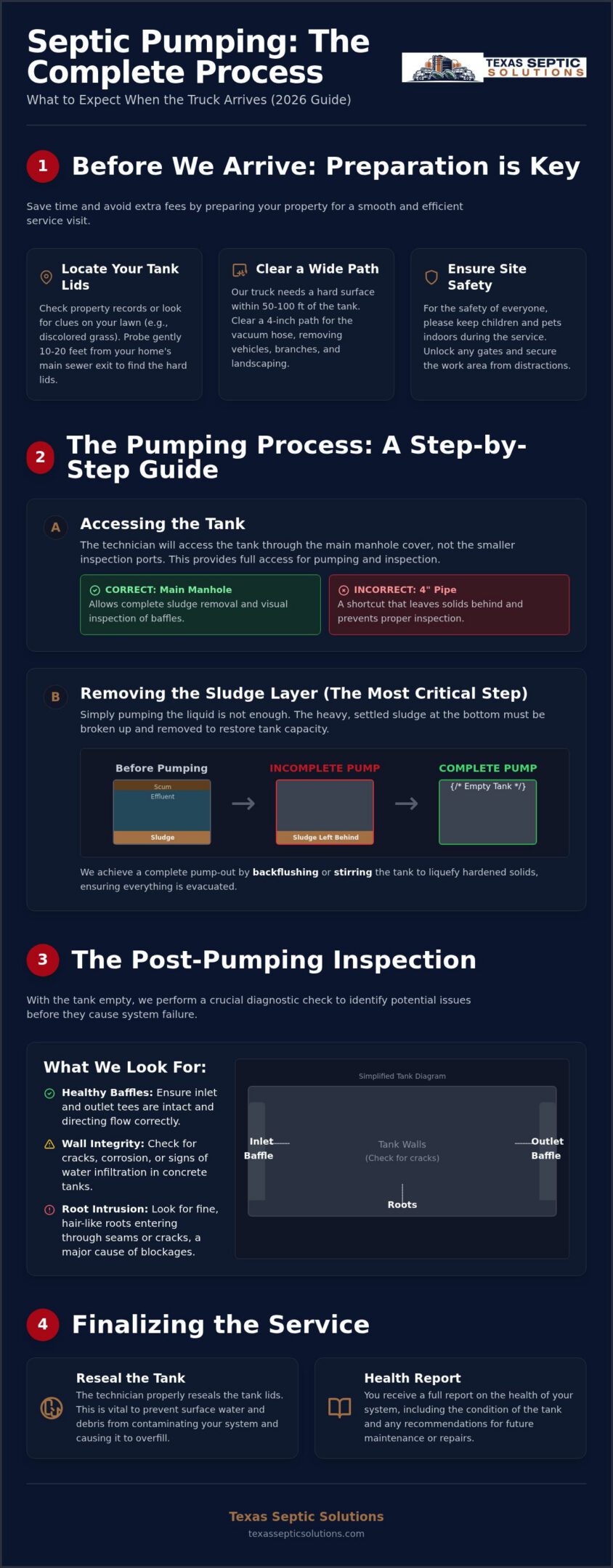
Preparing your property before the service truck arrives ensures a smooth visit and helps you avoid unexpected labor charges. When you understand what to expect during septic pumping, you can take simple steps to make the process efficient for both you and the technician. A little bit of legwork on your end prevents the “hidden” costs often associated with locating and uncovering a forgotten system.
Finding Your Tank in the Texas Landscape
Texas soil can be tricky. In the heavy clay of Cleveland or the sandy loam near Huffman, your tank might be buried deeper than you think. Start by checking your property’s “as-built” drawing or county permit records. These documents usually provide exact coordinates from the foundation of your house. If you don’t have paperwork, look at your lawn for clues. During dry Texas summers, the grass over a tank often turns brown faster, creating a “dead spot.” Conversely, if a tank is overfull, the area might look unusually lush and green. You can use a probe tool, which is a long metal rod, to gently feel for the hard surface of concrete or plastic lids about 10 to 20 feet from where the main sewer line exits your home.
Access Requirements: Risers vs. Digging
Once you’ve found the location, you need to determine how the technician will get inside. If your lids are buried more than six inches underground, prepare for a “dig fee” as the crew will need to manually uncover the ports. Installing septic tank risers is a smart long-term investment to eliminate this recurring expense. Risers bring the access ports to ground level, making future maintenance and what to expect during septic pumping much more straightforward. You should also clear any debris, heavy potted plants, or decorative landscaping that might obstruct the 4-inch vacuum hose. The truck needs to park on a hard surface, like a driveway or a stabilized road, within 50 to 100 feet of the tank to operate effectively.
Safety and Site Coordination
The pumping process involves high-powered machinery and heavy-duty suction hoses that can be dangerous if not respected. For the safety of your family and the service crew, keep pets and children indoors while the vacuum truck is running. This isn’t just about the noise; it’s about keeping the workspace clear of distractions. Ensure any locked gates are opened and that the path from the street to the tank is free of vehicles or low-hanging branches that could snag the truck. Taking these steps positions you as a prepared homeowner and allows the technician to focus entirely on the health of your system.
The Step-by-Step Septic Pumping Process Explained
Once the vacuum truck pulls into your driveway, the systematic process of clearing your waste system begins. Understanding what to expect during septic pumping helps you monitor the quality of the service and ensures you aren’t paying for a partial job. It isn’t just about sticking a hose in a hole; it’s a technical procedure that requires the right equipment and a methodical approach to waste removal.
The Role of the Vacuum Truck
The vacuum truck is a specialized vehicle equipped with a high-cfm (cubic feet per minute) pump designed to handle thousands of gallons of septage. You’ll hear a loud, rhythmic hum or thumping sound as the pump engages. While there is a temporary odor when the tank is first opened, modern high-powered equipment works quickly to contain the air. A professional technician will always pump through the large main manhole rather than the small inspection ports. Pumping through those smaller 4-inch pipes is a shortcut that prevents the crew from seeing the tank’s interior or reaching the corners where sludge accumulates.
Breaking Up the Sludge Layer
Simply removing the liquid effluent is an incomplete and failed service. The real goal is to evacuate the sludge, which is the heavy, settled solid waste at the bottom of the tank. To do this, the technician uses a process called backflushing or “stirring.” By pumping some of the liquid back into the tank or using a “pumper’s paddle” and high-pressure water, they liquefy the hardened solids. This ensures the heavy sludge is fully evacuated rather than left behind to harden. If this step is skipped, the remaining solids will quickly take up tank capacity and eventually push out into your drain field, leading to a catastrophic system failure.
The full sequence typically follows these steps:
- Deployment: Heavy-duty suction hoses are run from the truck directly to the tank’s main access manhole.
- Initial Pump-Down: The liquid effluent layer is removed first to gain access to the deeper solids.
- Agitation: The sludge is broken up using backflushing or manual stirring tools to create a pumpable slurry.
- Final Evacuation: All remaining solids and liquids are vacuumed out until the tank is completely empty.
After the bulk of the waste is gone, the technician performs a final “polishing” of the tank walls. This involves spraying down the sides to remove any thick residue or “scum” that didn’t initially flow into the hose. Before the lids are resealed, you should be able to see the bottom of the concrete or plastic tank clearly. This visual confirmation is your best proof that the job was done thoroughly. If you aren’t sure when your system was last cleared of these heavy solids, it’s a good idea to schedule a professional septic pumping to reset your maintenance clock and protect your property.
The Critical Inspection: What Technicians Look for Inside the Tank
Once the vacuum truck has finished the evacuation, the most valuable part of the service begins. An empty tank provides a rare, clear view of the system’s interior health. This is a diagnostic window that allows a technician to spot minor issues before they turn into a total system failure. When considering what to expect during septic pumping, you should look for a professional who treats the visit as a comprehensive health check, not just a waste removal task.
The technician first examines the structural integrity of the tank walls. In the shifting clay soils of Cleveland and Houston, concrete tanks can develop cracks over time. They look for “weeping,” which occurs when groundwater seeps into the tank, or signs of root intrusion from nearby trees. Perhaps most critically, they check for “backflow.” If water begins rushing back into the tank from the outlet pipe once it’s empty, it’s a clear signal that your drain field is saturated and failing to process liquid effluent correctly.
Baffle and Filter Health
Your tank relies on internal components to keep solids where they belong. A missing or corroded septic tank baffle is a leading cause of premature drain field failure. These T-shaped pipes ensure that only liquid, and not floating scum or heavy sludge, exits the tank. If your system includes an effluent filter on the outlet side, the technician will pull and clean it. A clogged filter is often the reason for slow drains or backups into the home. For homeowners who want constant peace of mind, this is a good time to ask about a septic tank alarm, which provides an early warning if water levels rise unexpectedly between service dates.
Texas-Specific Needs: Aerobic vs. Anaerobic
In East Texas, aerobic treatment units (ATUs) are incredibly common due to the high water table and dense soil. These systems are essentially mini-wastewater treatment plants and require a more detailed inspection than a standard gravity system. During what to expect during septic pumping for an aerobic unit, the technician must check the aerator motor and air stones to ensure the bacteria have enough oxygen to break down waste. They also verify the chlorination system is functioning. Texas law requires aerobic systems to have a maintenance contract with a licensed provider for three inspections per year, but the pump-out visit remains the best time to verify the mechanical components are standing up to the Texas heat and humidity.
Post-Service Care and Keeping Your Septic System Healthy
The vacuum truck is packed up, and the tank is empty. Now, the focus shifts to restoring your property and planning for the future. Understanding what to expect during septic pumping includes the final wrap-up steps that happen before the technician leaves your driveway. A professional will always ensure the access lids are properly resealed and backfilled. In the heavy rain cycles common in Houston and Cleveland, a poorly sealed lid allows surface water to flood the tank, which can lead to hydraulic overload and system backups.
Once the technician provides their final report, take a moment to review it carefully. This document should highlight any recommended septic system repairs, such as fixing a cracked baffle or replacing a worn-out pump. Addressing these small mechanical issues now is much cheaper than waiting for a total failure. If you have questions about the findings, the technician can walk you through the specifics while they are still on-site.
Record Keeping for Texas Homeowners
You should immediately update your septic system maintenance plan with the current date, the volume of waste removed, and the technician’s notes on component health. In Texas, having a clear pumping log is an asset during property sales. It proves to potential buyers that you’ve been a responsible steward of the home’s infrastructure. Use this data to set your next reminder. Most conventional systems need service every 3 to 5 years, but larger households in areas like Cypress or Huffman might require a shorter interval based on water usage.
Long-Term Drain Field Protection
Be mindful of your water usage in the first 24 hours after a pump-out. Your tank needs time to refill to its normal operating level. Avoid running multiple loads of laundry or back-to-back showers immediately after the truck leaves. This prevents “hydraulic overload,” where a sudden surge of water can stir up the remaining settled particles and push them into the drain field. Stick to “septic-safe” cleaners to help the beneficial bacterial colony recover quickly. Routine maintenance is the best defense against catastrophic failure, as regular pumping prevents your septic system replacement cost from skyrocketing.
If you are ready to secure your home’s future, schedule your next service with Texas Septic Solutions to ensure your system remains a reliable asset for years to come.
Professional Septic Pumping Services in Cleveland and Houston, TX
Managing septic care in East Texas requires more than just a vacuum truck. The region’s unique blend of heavy clay and sandy loam creates specific challenges for drainage and tank stability. When you choose a local partner, you’re hiring someone who understands how these conditions affect your system’s longevity. Texas Septic Solutions provides a grounded, professional approach to maintenance that prioritizes the long-term health of your property. We don’t just empty the tank; we provide a full diagnostic review so you know exactly where your system stands.
Our commitment to thorough, “no-shortcut” pumping means we always access the tank through the main manhole. This allows our technicians to perform the critical stirring and backflushing steps needed to liquefy heavy solids. By removing the sludge that others might leave behind, we protect your drain field from premature failure. We also understand that utility issues don’t always happen during business hours. That’s why we offer 24/7 emergency septic service for those times when a backup simply cannot wait for a scheduled appointment.
Serving Cleveland, Houston, and the Surrounding Communities
We are proud to serve homeowners across Cypress, Huffman, Shepherd, and the greater Houston area. Each of these communities has specific TCEQ (Texas Commission on Environmental Quality) regulations, especially for aerobic systems. As a “Reliable Local Authority,” we stay current on all state and county requirements to ensure your home remains compliant. Our comprehensive maintenance plans are designed to take the guesswork out of your hands. We track your service history, monitor your system’s components, and remind you when it’s time for your next visit, so you never have to worry about an unexpected utility crisis.
Ready for Your Next Pump-Out?
If you’re unsure about the last time your system was serviced, it’s better to be proactive than to wait for a failure. During your first consultation, we’ll discuss your household size, water usage, and the specific type of system you have. We’ll then provide a clear explanation of what to expect during septic pumping based on your property’s layout. Our goal is to leave you with total confidence that your system is healthy and functioning exactly as it should. Don’t wait for a slow drain to become a major repair. Schedule your professional septic pumping today and let our team of experts handle the rest.
Take Command of Your Home’s Utility Health
Owning a septic system in East Texas doesn’t have to be a source of stress. By preparing your property and understanding what to expect during septic pumping, you transform a routine chore into a powerful diagnostic check-up. You now know how locating your lids saves time, why thorough sludge removal is non-negotiable, and how a professional inspection of your baffles prevents catastrophic drain field failures. Whether you manage a standard anaerobic tank or a complex aerobic treatment unit, staying ahead of maintenance is the best way to avoid messy, expensive emergencies.
We are ready to help you navigate your system’s needs with local expertise and a commitment to “no-shortcut” service. From routine pump-outs to 24/7 emergency care, our team serves Cleveland, Houston, Cypress, Huffman, and Shepherd with the reliability you expect from a neighbor. Schedule Your Professional Septic Pumping in Cleveland or Houston today to keep your home running smoothly. Your system is a vital investment; let’s work together to protect its future.
Frequently Asked Questions
How long does a typical septic pumping appointment take?
A typical appointment takes between 45 and 90 minutes. This timeline depends on the tank size and how easily the technician can access the manhole. If the lids are already uncovered, the process moves faster. However, if the technician needs to probe the soil or dig through heavy clay to find the ports, the visit will take longer. We ensure every gallon is removed before we pack up.
Will my yard be a mess after the pumper truck leaves?
Your yard should remain in good condition if you prepare the path beforehand. Professional vacuum trucks use long hoses to reach the tank from your driveway or a stabilized road. This prevents the heavy vehicle from driving over your lawn and causing ruts. If digging was required to reach the lids, there will be a small area of disturbed soil, but a quality technician will backfill and level the ground before leaving.
Do I need to be home when the septic tank is being pumped?
You don’t necessarily need to be home if the technician has clear access to the tank and any gates are unlocked. However, many homeowners prefer to be present to review the inspection findings in person. Being on-site allows you to see the empty tank and discuss any recommended repairs immediately. If you can’t be there, we can provide a detailed digital report of the system’s health.
How often should I have my septic tank pumped in Texas?
Most conventional systems in Texas should be pumped every 3 to 5 years. For aerobic systems, the pumping frequency depends on usage and the results of your mandatory three-times-a-year inspections. Factors like the number of people in your home and the use of garbage disposals can shorten this interval. Regular service is the best way to understand what to expect during septic pumping and avoid unexpected backups.
Can I pump my own septic tank to save money?
No, you cannot safely or legally pump your own septic tank. Texas law requires that septage be handled and disposed of by a TCEQ-licensed professional at an authorized facility. Beyond the legal risks, the gases inside a tank are toxic and can be fatal. Professional equipment is also required to break up the heavy sludge layer, which a standard utility pump simply cannot handle.
What happens if I wait too long to pump my septic tank?
Waiting too long allows sludge to build up and overflow into your drain field. Once solids enter the soil pipes, they clog the system and cause a total failure. This often leads to sewage backing up into your home or pooling in your yard. Recovering from a neglected system is much more expensive than routine maintenance and can involve a complete replacement of the drain field.
Is there a specific time of year that is best for septic pumping?
Spring and autumn are generally the best times for service in East Texas. During these seasons, the ground is usually firm enough to support the truck without causing yard damage. Pumping before the heavy rains of late spring or the freezing temperatures of winter ensures your system is at maximum capacity when it faces the most environmental stress. It also helps you avoid the rush of emergency calls during holiday periods.
What are the signs that my septic tank is full and needs immediate pumping?
Common warning signs include gurgling sounds in your pipes, slow-draining sinks, or persistent foul odors near the tank. You might also notice patches of unusually lush, bright green grass over the drain field or actual water pooling on the surface. These symptoms indicate that the system is struggling to process waste. Knowing what to expect during septic pumping helps you act quickly when these red flags appear to prevent a full backup.