
What Not to Flush Down the Toilet: A Septic System Checklist for 2026
With over 2.5 million septic systems across Texas, our state leads the nation in onsite wastewater treatment, yet many homeowners are unknowingly flushing their way toward a total system failure. Understanding exactly what not to flush down the toilet septic system owners need to protect is the most effective way to avoid the stress of a smelly backup or a costly emergency repair. It’s easy to feel overwhelmed by “flushable” labels that don’t actually break down, especially when a mistake can lead to thousands of dollars in damage.
We believe your home should be a place of comfort, not utility-related anxiety. In this guide, you’ll learn which common household items are secretly destroying your tank’s delicate bacterial balance and how to keep your system running smoothly. We’ll provide a clear, updated checklist for 2026 that separates marketing myths from septic realities, giving you the tools to extend your system’s lifespan and keep your property safe. From the truth about the WIPPES Act labeling to kitchen hazards, we’ve got you covered.
This commitment to a worry-free home extends to all your major systems, and for residents in the Houston metro area, HomeFix offers the professional appliance repair services necessary to keep your household equipment in peak condition.
Key Takeaways
- Understand why your septic tank is a living biological engine that requires healthy bacteria to process waste effectively.
- Discover the truth about “flushable” marketing labels and learn exactly what not to flush down the toilet septic system owners often mistake for safe.
- Identify common household cleaners and biocides that can unintentionally sanitize your tank and stall the treatment process.
- Learn how to manage kitchen hazards like fats, oils, and grease that cause hidden blockages and system backups.
- Recognize the early warning signs of a struggling system and how proactive maintenance can significantly extend its functional lifespan.
The Golden Rule: Why Your Septic System Isn’t a Trash Can
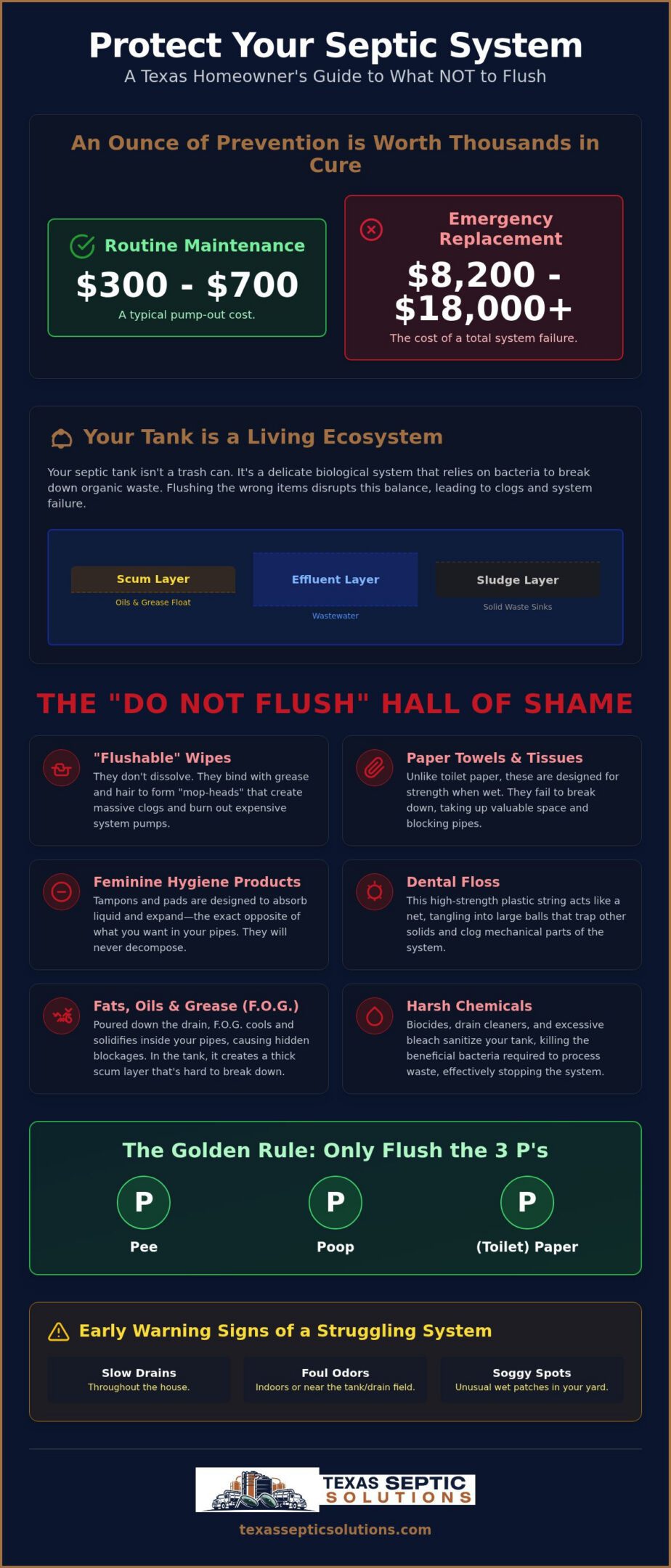
Living on a septic system in East Texas is a completely different experience than being connected to a municipal sewer line. When you’re on a city grid, your waste travels miles away to a massive treatment facility designed to handle high volumes. On a septic system, your home is its own treatment plant. This makes understanding what not to flush down the toilet septic system owners rely on a matter of financial survival. While a routine pump-out in 2026 typically costs between $300 and $700, a full system replacement averages over $8,200. Some complex installations can even climb toward $18,000. Treating your toilet like a trash can is the fastest way to turn a manageable maintenance task into a high-stakes financial emergency.
How Your Septic Tank Works (The Biological Balance)
To keep your home running smoothly, you have to think of your tank as a living ecosystem. How a septic system works depends entirely on a delicate biological balance. Inside the tank, waste naturally separates into three distinct layers. The “scum” layer of fats and oils floats on top; the “effluent” or watery liquid sits in the middle; and the “sludge” or solid waste sinks to the bottom. Beneficial anaerobic and aerobic bacteria live in these layers, working 24/7 to break down organic matter. When you flush items that aren’t biodegradable, you disrupt this separation. These solids can’t be digested by bacteria, so they take up valuable space or, worse, flow out into your drain field and cause a permanent clog.
Why Texas Soil and Drainage Matter
In areas like Cleveland, Cypress, and Shepherd, we deal with a specific type of heavy clay often called “Gummo.” This soil doesn’t drain as easily as sandy loam. Because our local ground is so dense, your drain field has to work much harder to process liquid waste. If you flush the wrong items, you’re sending “dirty” effluent into that stubborn clay, which leads to surface backups and soggy spots in your yard. This is why septic system maintenance Texas homeowners can trust must focus on protecting the soil’s ability to absorb water. When the ground is already saturated from a Gulf Coast rainstorm, even a few “flushable” wipes can be the breaking point that causes a total system failure.
The “Flushable” Myth: Items That Cause Immediate Physical Blockages
The word “flushable” is one of the most misleading terms in home maintenance. While a product might physically disappear down your drain, that doesn’t mean it belongs in your tank. Manufacturers use “flushable” as a marketing term rather than a technical performance standard. In fact, as of 2026, there is still no federal regulatory definition for what constitutes a flushable product in the United States. This lack of oversight means homeowners often learn what not to flush down the toilet septic system the hard way, usually through a backed-up pipe or a failed pump.
According to the U.S. Environmental Protection Agency (EPA), septic systems are only designed to process human waste and toilet paper. Anything else creates a physical obstacle. These items often snag on the inlet or outlet baffles of your tank. Once a single wipe or paper towel catches on a baffle, it acts as an anchor, collecting more debris until the entire pipe is obstructed. If you suspect a blockage is already forming, our team provides expert septic system repair to clear the lines before they cause a home backup.
The Danger of “Flushable” Wipes and Paper Towels
You can see the problem yourself with a simple “shake test.” If you put a piece of toilet paper in a jar of water and shake it, the paper dissolves into tiny fibers within seconds. A “flushable” wipe will remain completely intact. These synthetic fibers don’t break down in your tank’s biological environment. Instead, they create a “mop-head” effect. This happens when wipes bind with hair and grease to form a heavy, indestructible mass. In aerobic systems, these masses are notorious for wrapping around aerator shafts and burning out expensive pumps, leading to repairs that can cost anywhere from $600 to $6,000.
Maintaining clear pipes is the first step in preventing these issues; specialists like Emerson Plumbing Repair & Drain Cleaning, LLC provide professional drain cleaning to ensure that grease and debris don’t trap non-biodegradable items in your household lines.
Feminine Hygiene Products and Dental Floss
Cotton swabs, pads, and tampons are designed to absorb liquid and expand, which is exactly what you don’t want inside a plumbing line. These items are permanent residents in your tank; they will never decompose. Dental floss is equally dangerous because it’s essentially high-strength plastic string. It acts like a net, tangling around mechanical components and trapping other solids. To keep your system healthy, place a small wastebasket in every bathroom and use this simple “Never Flush” checklist for guests:
- Baby wipes and cleaning wipes (even if labeled “flushable”)
- Paper towels and facial tissues
- Feminine hygiene products and applicators
- Dental floss and hair from brushes
- Condoms and latex gloves
- Cigarette butts and bandages
By keeping these physical hazards out of your pipes, you ensure that your tank’s bacteria can focus on their actual job: treating wastewater and protecting your East Texas property.
Chemical Killers: Protecting the Bacteria in Your Tank
A healthy septic tank should be a teeming ecosystem of microscopic workers. When you use harsh chemicals, you’re essentially sending a “biocide” into your yard that kills the very organisms responsible for treating your waste. Many homeowners strive for a “sterile” home, but a sterile septic tank is a failing one. If your tank has no odor at all or smells strongly of bleach, the biological engine has likely stalled. Understanding what not to flush down the toilet septic system owners rely on means recognizing that your cleaning habits directly impact your tank’s health. This is especially true during hot East Texas summers. High temperatures can accelerate chemical reactions within the tank, making even small amounts of toxins more lethal to your bacterial colony.
Harsh Cleaners, Bleach, and Drain Openers
Liquid drain openers are perhaps the single most destructive substance you can put down a septic line. A single cup of high-strength sulfuric acid or lye can wipe out the bacterial population in a 1,000-gallon tank instantly. Once these bacteria are gone, solids stop breaking down and begin to flow directly into your drain field. “Blue” toilet bowl cleaners and automatic clip-on dispensers are equally problematic because they provide a constant drip of antimicrobial agents into the system. To stay safe, consult this checklist of what not to flush and consider these alternatives:
- Use a mix of baking soda and white vinegar to clear slow drains.
- Opt for citrus-based or biodegradable cleaners labeled “septic safe.”
- Limit bleach use to one small load of laundry per day to allow the tank to recover.
- Avoid “antibacterial” hand soaps in high volumes.
Prescription Medications and Antibiotics
Your septic system isn’t designed to filter out complex pharmaceuticals. When you flush expired medications, especially antibiotics, they do exactly what they were manufactured to do: kill bacteria. This creates a “dead tank” scenario where waste just sits and accumulates. Beyond the damage to your system, there’s a significant environmental risk. In areas like Cleveland and Houston, where groundwater levels can be high, these chemicals can leach out of the drain field and into the local water table. If you’ve recently flushed a large amount of chemicals or medications, you may need professional septic system repair in Texas to restore the biological balance. Proper disposal at a local pharmacy or hazardous waste site is the only way to keep these “chemical killers” out of your home’s wastewater treatment process.
Kitchen Hazards That Sneak Into Your Septic System
While many homeowners are careful about what not to flush down the toilet septic system health is often compromised right at the kitchen sink. We view the sink as the “back door” to your septic tank. Every drop of water and every scrap of food that goes down that drain ends up in the same biological engine. Fats, oils, and grease (FOG) are particularly dangerous because they change state as they cool. What looks like liquid in your pan quickly becomes a solid mass once it hits the cooler pipes or the septic tank environment. These substances are the leading cause of stubborn blockages and long-term system failure.
Why Grease is Your Drain Field’s Worst Enemy
Grease is a major threat to your drain field’s longevity. Unlike organic waste that bacteria can digest, grease often bypasses the settling process in the tank. It can flow out through the outlet pipe and into the soil of your absorption area. Once there, it acts as a sealant, coating the soil particles and preventing water from soaking into the ground. This process creates an overgrowth of “biomat,” which is a slimy layer of anaerobic bacteria that eventually chokes off the entire system’s ability to breathe. In our local East Texas clay, this sealing effect happens even faster. To protect your investment, always scrape pans into the trash and pour used cooking oil into a sealable container rather than down the sink.
The Problem with Garbage Disposals and Food Scraps
Most septic experts recommend avoiding garbage disposals entirely. Using one can increase the amount of sludge in your tank by up to 50%, which means you’ll need to pay for pumping much more frequently. Many common food items simply won’t break down in a septic environment. Coffee grounds, for example, are highly acidic and settle at the bottom of the tank like sand. Eggshells, pasta, and rice are equally problematic. Pasta and rice continue to expand in the moisture of your pipes, creating thick clogs that are difficult to clear. Eggshells don’t decompose; they add to the heavy grit layer at the bottom of the tank that can only be removed through mechanical pumping.
If you choose to use a disposal, you must be prepared for a more rigorous maintenance schedule. The heavy load of solids requires more frequent professional intervention to prevent the tank from overfilling and pushing solids into the distribution box. If you’ve been using your disposal heavily and notice slow drains or gurgling sounds in your pipes, it’s time to schedule professional septic system pumping to clear out the excess sludge before it reaches your drain field and causes permanent damage.
Maintaining Your System: Beyond the Flush
Adopting a strict “toilet paper only” policy is the first step toward a healthy home, but real peace of mind comes from proactive oversight. Even if you’re diligent about what not to flush down the toilet septic system health depends on regular professional attention to manage the inevitable buildup of solids. Your tank is designed to hold a specific volume of sludge, and once that limit is reached, the risk of a system failure increases exponentially. Moving from a reactive “fix it when it breaks” mindset to a proactive maintenance strategy is the most effective way to protect your property and your wallet from unexpected disasters.
Routine Pumping and Inspection Schedule
For most families in Cleveland, Houston, and the surrounding East Texas areas, we recommend a professional pump-out every 3 to 5 years. This frequency can vary based on your household size and whether you use a garbage disposal. During a routine visit, a technician does much more than just empty the tank. We perform a comprehensive check of the system’s vital components. This includes inspecting the inlet and outlet baffles to ensure they aren’t clogged with wipes or grease and checking the health of the effluent pump in aerobic systems. If you ever hear your septic tank alarm going off, it’s a clear signal that something is wrong. Often, this is caused by a high-water situation triggered by a blockage of non-flushables that has stopped the flow of wastewater.
When to Call Texas Septic Solutions
Your septic system will usually tell you it’s struggling long before a total backup occurs. You just have to know what to look for. Common warning signs include toilets that flush slowly, gurgling sounds in your drains, or persistent sewage odors near the tank or drain field. You might also notice patches of bright green, spongy grass over your absorption area, even during a dry Texas summer. These signs indicate that your system is no longer processing waste correctly. To avoid these stressors entirely, many homeowners choose a septic system maintenance plan. This serves as your ultimate safety net, ensuring regular check-ups that catch minor issues before they escalate.
We pride ourselves on being a reliable local authority, and we’re ready to help whether you need a routine check or emergency care. We offer 24/7 service because we know that a backup doesn’t wait for business hours. Don’t let a small clog turn into a massive septic system replacement cost. Give us a call to discuss your system’s needs and keep your home’s wastewater treatment running smoothly for years to come.
Secure the Future of Your Home’s Wastewater System
Your septic system is a critical piece of home infrastructure that works best when it’s left alone to do its biological job. By staying vigilant about what not to flush down the toilet septic system health remains stable, and you avoid the stress of unexpected backups. We’ve seen how “flushable” wipes, harsh chemicals, and kitchen grease can quickly lead to expensive repairs or even total system failure. Small changes in your daily habits today will pay off in a longer, more reliable system lifespan for years to come.
We are here to support your home’s functionality with dependable local expertise. Whether you’re in Cleveland, Houston, or the surrounding East Texas areas, our team provides the expert maintenance and installation services you need to keep things running right. If you’ve already experienced a backup, don’t worry; we offer 24/7 emergency service to handle those high-pressure moments. Schedule your routine septic pumping with Texas Septic Solutions today! Taking this one simple step now is the best way to ensure your wastewater treatment stays worry-free. Your home’s health is our top priority.
Frequently Asked Questions
Can I flush “flushable” wipes if I have a septic tank?
No, you should never flush wipes even if they are labeled “flushable.” These products are a leading cause of physical blockages because they don’t dissolve like toilet paper. The 2026 WIPPES Act now mandates “Do Not Flush” labels on many non-flushable wipes to help protect home infrastructure. If these wipes enter your system, they can snag on baffles or burn out pumps in aerobic systems.
Is it okay to use bleach to clean my toilets with a septic system?
You can use small amounts of bleach occasionally, but excessive use will kill the beneficial bacteria in your tank. A single cup of harsh cleaner can disrupt the biological balance of a 1,000-gallon tank. We recommend using septic-safe alternatives or simple vinegar and baking soda to keep your bathrooms clean without risking a “dead” tank scenario.
How much grease can I safely pour down the drain?
You should never pour any amount of grease, oil, or fat down your drain. Grease solidifies as it cools and creates a waterproof seal in your drain field soil. This buildup eventually stops wastewater from soaking into the ground, leading to surface backups and expensive repairs. Always scrape your plates into the trash instead.
What happens if I accidentally flush a feminine hygiene product?
A single accidentally flushed item likely won’t cause an immediate disaster, but it will remain in your tank until the next pump-out. These products are made of cotton and plastic that will not decompose. If they get stuck in the inlet or outlet pipes, they can cause an immediate backup into your home, requiring a professional to clear the line.
Can I use a garbage disposal with my septic system?
While you can use a garbage disposal, it’s generally not recommended for septic owners. Disposals increase the sludge layer in your tank by up to 50 percent. If you choose to use one, you must be prepared to schedule professional pumping more frequently to prevent solids from overflowing into your drain field.
How often should I have my septic tank pumped in Texas?
Most Texas families should have their septic tank pumped every 3 to 5 years. This timeframe depends on the number of people in your home and your specific water usage habits. Regular pumping is your best defense against the buildup of items on the what not to flush down the toilet septic system checklist that might have accidentally entered your tank.
Will septic tank additives fix the damage from flushing the wrong things?
No, additives cannot dissolve physical clogs like wipes, plastic, or grease. While some additives claim to boost bacteria, they are not a substitute for regular maintenance or proper flushing habits. If your system is already struggling with a clog, the only reliable solution is a professional inspection and a mechanical pump-out to remove the obstruction.
What are the first signs of a septic backup caused by a clog?
The most common early signs include gurgling sounds in your pipes, slow-draining sinks, and foul odors in your yard. You might also notice toilets that require multiple flushes to clear. If you see water pooling over your tank or drain field, your system is likely already in a state of failure and needs immediate attention from a technician.