
What Happens If You Don’t Pump Your Septic Tank? (2026 Guide)
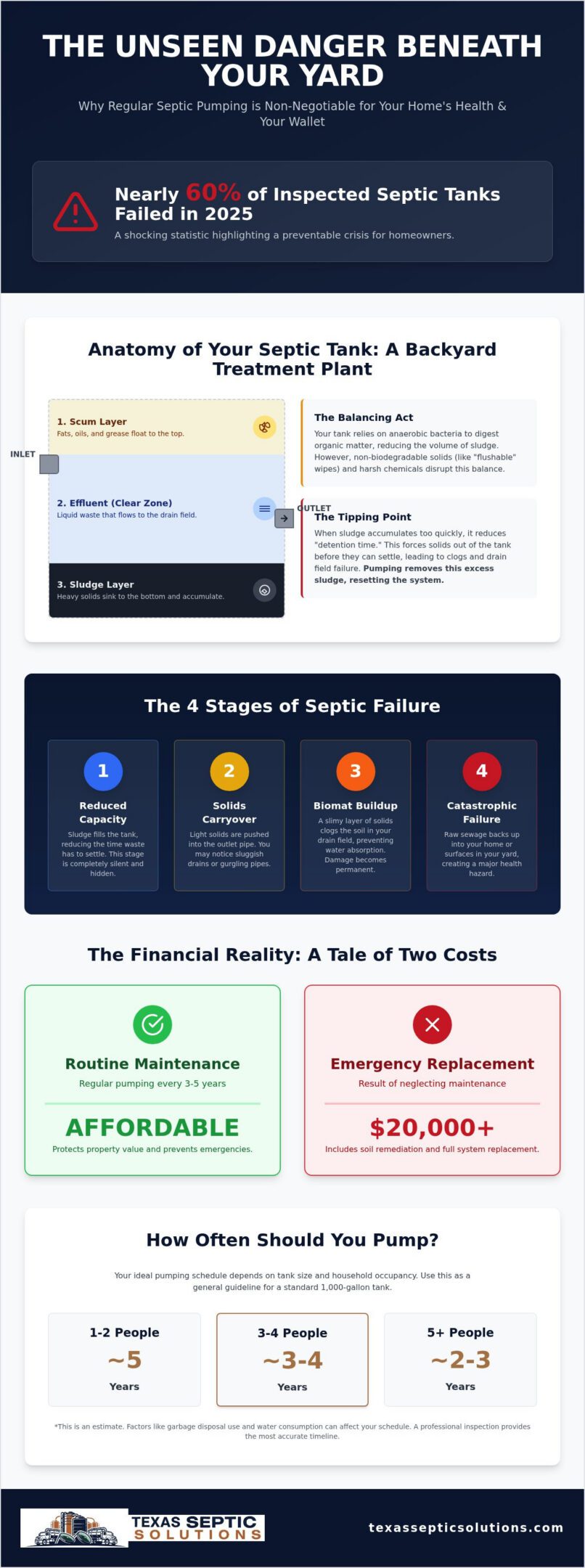
Did you know that in 2025, nearly 60% of septic tanks inspected by local authorities actually failed? It’s a staggering number that highlights a common problem for homeowners from Cypress to Huffman. You likely don’t think about your waste management system until a foul odor hits your backyard or a drain starts gurgling. However, understanding what happens if you don’t pump your septic tank is the difference between a routine maintenance visit and a catastrophic $20,000 replacement bill.
We understand that septic maintenance feels like a chore you’d rather put off. It’s easy to assume everything is fine if the toilets are flushing, but beneath the surface, solids are slowly filling your tank and threatening the health of your drain field. This 2026 guide is designed to give you total peace of mind. You’ll discover the hidden biological risks of an unpumped system, the specific warning signs to watch for, and a clear timeline to keep your property safe. We’re here to help you protect your home and your wallet from avoidable emergencies by explaining why that regular pumping “reset” is so vital for your land.
Key Takeaways
- Learn how your tank functions as a biological settling chamber and why managing the scum and sludge layers is critical for long-term system health.
- Identify the four stages of failure to understand exactly what happens if you don’t pump your septic tank before solids clog your outlet pipes.
- Discover the financial breakdown between affordable 3-5 year maintenance and the massive costs of soil remediation or full system replacements.
- Determine your specific maintenance timeline by calculating tank capacity against your household occupancy for a more accurate pumping schedule.
- Recognize the signs of a thorough professional cleaning so you can avoid “splash and dash” services that leave dangerous sludge behind.
The Hidden Lifecycle of Your Septic Tank: Why Pumping is Non-Negotiable
Your septic tank is far more than a storage container; it’s a sophisticated biological settling chamber designed to separate waste. To understand how septic tanks work, you have to view them as a treatment facility right in your backyard. When everything is functioning correctly, gravity and time do the heavy lifting. However, every system has a finite capacity for solids. Septic pumping is the mechanical removal of non-biodegradable solids to restore hydraulic capacity, ensuring the tank can continue to process waste without overflowing.
The Scum, the Sludge, and the Clear Zone
Inside the tank, waste naturally separates into three distinct layers based on density. This separation is vital because it protects the rest of your property from contamination.
- The Scum Layer: This top layer consists of fats, oils, and grease. Because these materials are lighter than water, they float. This layer acts as a natural seal, keeping oxygen out to help the anaerobic bacteria below thrive.
- The Clear Zone (Effluent): This middle layer is the liquid waste. In a healthy system, this is the only part that should ever exit the tank and enter your drain field for final soil treatment.
- The Sludge Layer: Heavier solids sink to the bottom. This is where the “problem” starts if maintenance is ignored, as bacteria cannot digest every material that enters the system.
How Bacteria Manage (and Fail) to Process Waste
Anaerobic bacteria live in your tank and work around the clock to digest organic matter, effectively reducing the volume of solids. They are efficient but delicate. If you use harsh household chemicals or flush “flushable” wipes, you kill this biological balance. These wipes don’t break down; they just add to the sludge. When the sludge layer grows too high, you experience “sludge bulking.” This reduces the “detention time,” which is the amount of time liquid has to sit and settle before moving out. This is exactly what happens if you don’t pump your septic tank: the clear zone disappears, and raw solids are pushed into your outlet pipes. Once those solids leave the tank, they can cause permanent damage to your soil and drain field. We often see this in local areas like Cypress or Huffman where heavy clay soils make it even harder for the ground to recover once solids clog the pores of the earth.
The 4 Stages of Septic Failure: What Happens When You Skip Pumping
Wait until the toilet overflows and you’ve waited too long. In 2025, 59% of inspected septic tanks failed, often because homeowners didn’t realize they were already in the middle of a progressive breakdown. Understanding what happens if you don’t pump your septic tank helps you catch issues before they turn into a professional septic system repair. Failure isn’t a single event; it’s a four-stage process that moves from hidden sludge accumulation to a full-blown environmental crisis in your backyard.
Stage 1 & 2: The Silent Warning Signs
Stage 1 begins with reduced capacity. As sludge fills the bottom of the tank, the “settling time” for new waste drops. This leads directly to Stage 2, where solids begin to carry over into the outlet pipe. If your system has an effluent filter, it will clog to protect the drain field. You might hear gurgling pipes or notice toilets that seem sluggish. The EPA provides detailed guidelines on septic system inspection and pumping frequency to help you identify these stages before the damage becomes permanent.
Stage 3 & 4: Catastrophic System Failure
Stage 3 is the point of no return: biomat buildup. Biomat is a dense, slimy layer of bacteria and solids that “seals” the soil in your drain field. In areas like Cypress and Huffman, our heavy Texas clay soil already has low absorption. When solids escape the tank and create biomat, they effectively kill the soil’s ability to process water. Stage 4 is the visible disaster. This is when raw sewage surfaces in your yard or backs up into your home. Surfacing sewage is a major health hazard for families in Houston or Cleveland. It’s important to remember that while a tank is always “full” of liquid, a tank clogged with solids is an immediate threat to your property and your wallet.
By the time you reach the later stages, the soil is often too compacted or contaminated to recover. Early maintenance is the only way to ensure the “clear zone” in your tank remains large enough to keep solids where they belong. If you haven’t had a check-up in a few years, catching these stages early can save you from a total system collapse.
The Financial Reality: Pumping Maintenance vs. Full System Replacement
Choosing to skip maintenance is a gamble with your bank account. While a standard pump-out every three to five years is a manageable expense, ignoring it often leads to a total system collapse. If you’re wondering what happens if you don’t pump your septic tank, the most immediate financial impact is the loss of your drain field’s soil absorption. This is exactly what happens if you don’t pump your septic tank: the clear effluent zone disappears, solids migrate into the soil, and you face the high costs of septic system replacement. Beyond the hardware, you’ll deal with hidden expenses like soil remediation, professional landscaping to restore your yard, and local permit fees in Liberty or Harris County. A failing system also drastically lowers Texas property values, as most lenders and buyers require a clean inspection before a sale can proceed.
Think of septic system maintenance plans as a low-cost insurance policy for your home’s most essential utility. These plans ensure you never miss a pumping cycle, keeping your system in the “clear” and protecting your property from the environmental contamination that follows a backup.
The True Cost of a New Septic System in Texas
Replacing a system isn’t as simple as swapping a tank. The septic system replacement cost depends on tank size, soil type, and current TCEQ regulations. In 2026, Texas law requires precise soil testing and engineering to ensure your system doesn’t contaminate the local groundwater. You can’t simply dig a new hole and hope for the best; unlicensed installations lack the proper permits and can result in heavy fines. Modern systems often require specialized components like aerobic pumps or advanced filters, which add to the total investment. When you factor in the labor of excavating a failed system and prepping the ground for a new one, the price tag far outweighs a lifetime of routine maintenance.
Why Pumping is the Best ROI for Your Home
The return on investment for routine pumping is undeniable. Spending a few hundred dollars every few years is a small price to pay to avoid a $15,000 or $20,000 replacement bill later. Regular pumping keeps solids from entering the drain field, which can extend your system’s life by twenty years or more. At Texas Septic Solutions, we provide transparent rates because we want to help you avoid the high-pressure stress of an emergency failure. We believe in proactive care that keeps your home functional and your yard clean. By staying ahead of the sludge, you ensure your property remains a safe, valuable asset for decades to come.
How Often Should You Pump? Factors for Texas Homeowners
Many homeowners rely on a generic “every five years” rule of thumb, but that’s a dangerous simplification. Your maintenance schedule isn’t just a suggestion; it’s a calculation based on how you live and where your home is located. If you’re wondering what happens if you don’t pump your septic tank on a timeline that fits your specific needs, the answer usually involves a messy, expensive backup at the worst possible time. To stay ahead of trouble, you need to look at five critical factors.
- Step 1: Determine your tank size. Most residential systems in Texas range from 1,000 to 1,500 gallons. Smaller tanks naturally reach their sludge limit faster.
- Step 2: Account for household occupancy. A family of five will fill a tank much quicker than a retired couple. More people means more water and more solid waste.
- Step 3: Evaluate your input habits. What you put down your drains determines how fast the sludge layer grows.
- Step 4: Factor in local environmental conditions. Heavy rain and specific soil types change how your system handles liquid.
- Step 5: Schedule a professional inspection. The only way to know your exact status is to have a technician measure the actual sludge and scum levels.
The “Garbage Disposal” Factor
Garbage disposals are a major convenience, but they are brutal on septic systems. Using one can increase the solid waste load in your tank by up to 50%. These ground-up food particles don’t break down as easily as human waste, leading to rapid sludge accumulation. If your kitchen has a disposal, you should plan to pump every 1 to 2 years instead of the standard 3 to 5 year cycle. To protect your system, consider composting food scraps or simply scraping plates into the trash instead of the sink.
Texas Soil and Climate Considerations
In areas like Cypress and Cleveland, we deal with heavy clay soil. This “black gumbo” doesn’t drain quickly, which is why your system’s health is so vital. When East Texas rainstorms arrive, they saturate the ground. If your tank is already over-capacity because you’ve skipped pumping, the system has no “buffer” and will likely back up into the house. While our intense Texas summer heat can slightly boost bacterial activity inside the tank, it won’t dissolve the inorganic sludge at the bottom. Only a professional pump-out can remove those solids. If you’re overdue for a check-up, it’s time to book septic system pumping to ensure your system can handle the next big storm.
Protecting Your Property: Professional Pumping and Maintenance Solutions
Professional maintenance is the final line of defense against the high costs and health hazards we have discussed throughout this guide. Understanding what happens if you don’t pump your septic tank correctly is just as important as knowing when to call for help. Not all pumping services are created equal. Some providers perform what we call a “splash and dash,” where they only remove the liquid effluent and leave the heavy, compacted sludge at the bottom. This shortcut means your tank is still half-full of solids the moment the truck pulls away. A thorough cleaning from Texas Septic Solutions involves pumping both the liquid and the sludge, followed by a back-flush to break up any remaining solids. This ensures your tank’s hydraulic capacity is fully restored.
During a professional visit, we also inspect the structural integrity of your tank. This includes checking the inlet and outlet baffles to ensure they aren’t corroded or blocked. If you don’t know where your tank is located, we can help find it using electronic locating equipment. Many modern systems feature risers, which are lids that sit at or just above ground level, making access easy and preventing the need for digging up your lawn every few years. If your system is older, installing a riser is one of the best upgrades you can make for long-term maintenance. Even with the best care, components can wear out over time. Having access to septic system repair experts gives you the peace of mind that any mechanical failures will be handled quickly and professionally.
Signs You Need an Emergency Pump-Out Right Now
Sometimes your system gives you a loud and clear warning. If you hear your septic tank alarm going off, it’s a signal that the water levels in your tank or pump chamber have reached a critical height. This is an immediate red flag that your system isn’t processing waste fast enough. Other signs are more visual. If you notice patches of lush, bright green grass over your drain field during dry Texas months, it often means the soil is being “over-fertilized” by surfacing sewage. If you smell foul odors inside your home or see wet spots in the yard, don’t wait for the next business day. These issues require our 24/7 emergency septic service to prevent a total backup into your living spaces.
The Texas Septic Solutions Difference
We take pride in being the “neighborly expert” for families in Cleveland, Houston, Cypress, Huffman, and Shepherd. We don’t just pump and leave; we provide a comprehensive inspection with every service to identify potential issues before they become emergencies. Our team understands the local environmental standards and the specific challenges of East Texas soil. We can help you get started with a customized maintenance plan that takes the guesswork out of your pumping schedule. By partnering with us, you aren’t just buying a service; you’re securing a guardian for your home’s functionality and your property’s value.
Secure Your Home’s Future with Proactive Septic Care
Your septic system is the most critical utility on your property. By understanding the biological lifecycle of your tank and the specific risks of our local Texas clay soil, you’ve taken the first step toward long-term home security. Remember that regular pumping isn’t just about avoiding a mess; it’s a strategic “reset” that protects your drain field and preserves your property value. Now that you understand what happens if you don’t pump your septic tank, the path forward is clear. Proactive maintenance is always more affordable and less stressful than a catastrophic emergency replacement.
At Texas Septic Solutions, we’re here to be your reliable maintenance partner. Whether you need a routine check-up or 24/7 emergency service in Cleveland or Houston, our expert technicians understand exactly how to navigate local environmental conditions. We provide transparent pricing with no hidden fees, ensuring you get the comprehensive care your system deserves. Don’t wait for a gurgling drain or a yard backup to catch you off guard. Schedule your professional septic pumping with Texas Septic Solutions today! We look forward to helping you keep your home running smoothly for years to come.
Frequently Asked Questions
How do I know if my septic tank is full and needs pumping?
You’ll notice signs like sluggish toilets, gurgling sounds in your plumbing, or sewage odors in your yard. However, a septic tank is always full of liquid; the real concern is the sludge level at the bottom. If you haven’t pumped in three to five years, it’s likely time for service. Professionals use specialized tools to measure solids and determine if your system is nearing its capacity limit. Catching this early prevents what happens if you don’t pump your septic tank, such as permanent drain field clogging.
Can a septic tank “clean itself” with additives or bacteria?
No, a septic tank cannot clean itself. While anaerobic bacteria break down some organic matter, they can’t digest inorganic materials, hair, or “flushable” wipes. These solids settle at the bottom as sludge that must be mechanically removed. Additives might temporarily boost bacterial activity, but they never replace professional pumping. Over-reliance on additives often leads to a false sense of security, allowing sludge to build up until it reaches the outlet pipe and causes expensive damage to your system.
What is the average cost to pump a septic tank in Texas?
General industry data for 2026 shows that the average cost to pump a 1,000-gallon septic tank in Texas typically ranges from $250 to $400. Prices vary based on your specific city, tank accessibility, and the volume of solids removed. While this is a small recurring investment, it’s significantly cheaper than the thousands of dollars required for a full system replacement. We recommend getting a clear quote that includes disposal fees and a basic inspection to ensure your system remains healthy.
What happens if raw sewage starts backing up into my house?
A sewage backup is a serious health emergency that requires immediate 24/7 service. Raw sewage contains harmful pathogens and bacteria that can contaminate your flooring, walls, and air quality. If this occurs, stop using all water immediately and call a professional technician. This is the final stage of what happens if you don’t pump your septic tank, indicating that the system is completely overwhelmed and can no longer process household waste safely or effectively.
Will a full septic tank cause my drains to gurgle?
With consistent maintenance and pumping every three to five years, a well-designed septic system can last 25 to 30 years or even longer. The key to longevity is protecting the drain field from solid carryover. By removing sludge before it escapes the tank, you ensure the soil stays porous and capable of treating effluent. Regular care effectively doubles or triples the lifespan of your system compared to a neglected one that fails prematurely and requires excavation.
Can I pump my own septic tank to save money?
You should never attempt to pump your own septic tank. It’s a dangerous task that involves exposure to toxic gases like methane and hydrogen sulfide, which can be fatal in enclosed spaces. Additionally, Texas law requires that septic waste be transported and disposed of by TCEQ-licensed professionals at approved facilities. Attempting a DIY pump-out can lead to heavy fines, environmental contamination, and serious personal injury. It’s always best to hire a licensed expert for this specialized maintenance.
Does heavy rain affect how often I need to pump my tank?
Heavy rain doesn’t fill your tank with waste, but it saturates the soil in your drain field. When the ground is soaked, it can’t absorb effluent from your tank as easily. If your tank is already overdue for pumping and full of sludge, this extra hydraulic pressure can cause a total system failure or backup. In flood-prone areas of East Texas, keeping your tank clear is essential to give the system “breathing room” during the wet seasons.