
Understanding Septic System Load Calculations in Texas: A 2026 Homeowner Guide
Your home’s square footage doesn’t actually dictate your septic system’s size, but the dirt in your backyard certainly does. It’s a common misconception that more bathrooms or a larger floor plan automatically require a massive tank. In reality, Texas regulations focus on entirely different metrics that can leave even seasoned property owners feeling a bit lost. You might be worried about installing an undersized system that fails early or feel confused by how the “gumbo” clay in East Texas impacts your design. We’ve helped countless neighbors navigate these exact hurdles, and we know that clarity is the best tool for a successful build.
By understanding septic system load calculations Texas residents must follow in 2026, you can ensure your property remains compliant and your utility investment stays protected. This guide is designed to help you master Gallons Per Day (GPD) requirements and navigate the specific TCEQ rules that define modern OSSF sizing. We’ll break down how soil absorption rates dictate your drainfield size and explain why bedrooms matter more than square footage. This knowledge gives you the confidence to work with a licensed installer to build a system that handles your household’s needs for the long haul.
Key Takeaways
- Learn how the Texas Commission on Environmental Quality (TCEQ) sets the standards for On-Site Sewage Facilities (OSSF) to ensure your system operates safely and legally.
- Master the “Texas Bedroom Rule” to see how occupancy and daily water usage are the primary foundations for understanding septic system load calculations Texas requires for 2026 compliance.
- Identify how your local soil texture, from sandy loam to heavy East Texas clay, dictates the specific application rate and the total footprint of your drainfield.
- Recognize how organic load factors, such as the frequent use of garbage disposals, can significantly impact your system’s capacity and long-term health.
- Gain clarity on why professional site evaluations and engineered designs are necessary to navigate the complex permitting process and prevent early system failure.
The Fundamentals of Texas OSSF Load Calculations
In Texas, we don’t just call it a septic system. The official regulatory term is an On-site Sewage Facility (OSSF). This includes any system that treats and disposes of wastewater on the property where it’s generated. Because our state has over 2.6 million of these systems in operation, the Texas Commission on Environmental Quality (TCEQ) maintains strict oversight. Their role is to protect our groundwater and public health by setting rigorous standards for how these systems are sized and maintained. Understanding septic system load calculations Texas property owners must follow is the first step in building a system that lasts for decades rather than failing in a few years.
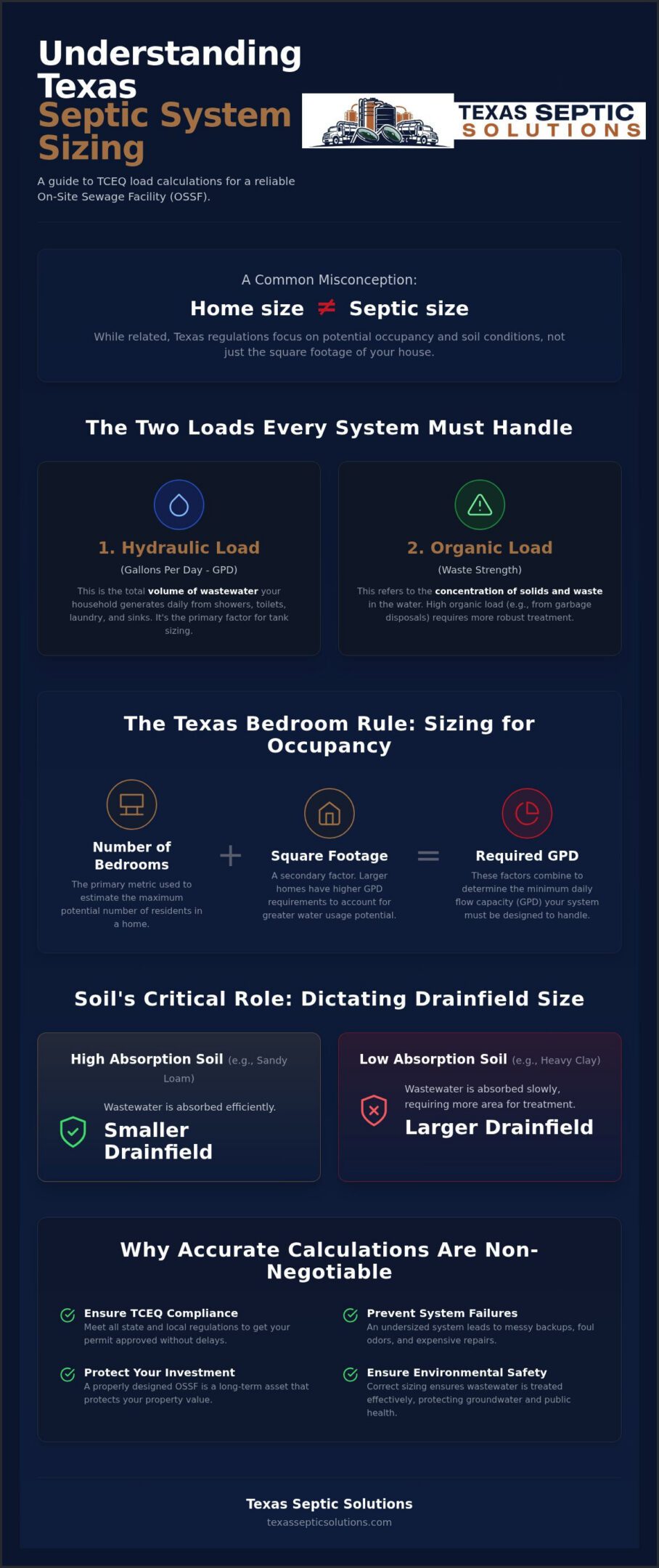
When we talk about “load,” we aren’t just looking at the volume of water moving through the pipes. A professional calculation considers two distinct factors: hydraulic load and organic load. Hydraulic load is the physical amount of water, measured in Gallons Per Day (GPD). Organic load refers to the “strength” of the waste, often measured by how much oxygen is needed to break it down. If you have too much water, you’ll flood the system. If the waste is too concentrated, the beneficial bacteria won’t be able to treat it effectively. Balancing these two ensures long-term environmental safety for your land and your community.
Why Load Calculations Are Non-Negotiable
Accurate math is your best defense against a saturated drainfield. If a system is undersized, you’ll eventually deal with messy yard backups and foul odors that decrease your property value. Following the Texas Administrative Code (TAC) Title 30, specifically Chapter 285, isn’t just a legal hoop to jump through. It’s a technical blueprint for success. In 2026, permitting authorities are stricter than ever regarding these requirements. A precise calculation ensures your permit gets approved the first time and protects the significant investment you’ve made in your home’s infrastructure.
The Difference Between Daily Flow and Peak Load
Designers look at two different types of water movement to keep your system stable. Average Daily Flow is what you use on a typical Tuesday afternoon. Peak Hydraulic Surge is what happens when you host a holiday dinner or run four loads of laundry back-to-back. Texas systems are built for the “worst-case” scenario. We don’t size a tank for your quietest days; we size it to handle the stress of guest visits and heavy usage periods. This buffer prevents the system from being overwhelmed when life gets busy. A proper design accounts for several factors:
- Average Daily Flow: Your standard routine of showers, toilets, and dishes.
- Peak Hydraulic Surge: Sudden spikes from houseguests or heavy cleaning days.
- Organic Strength: The concentration of household waste that requires bacterial treatment.
Designing for these peaks keeps the system from failing when you need it most. It ensures that even during a busy weekend, the wastewater has enough time to be treated before it reaches the soil. This methodical approach is what separates a reliable system from one that requires constant, expensive repairs.
The Texas Bedroom Rule: How Home Size Dictates GPD
In Texas, your septic system’s capacity is built on a specific calculation of potential occupancy. While you might focus on the number of bathrooms in your floor plan, state regulators look primarily at bedrooms. This is the core principle of understanding septic system load calculations Texas homeowners must grasp before breaking ground. The logic is simple: more bedrooms mean more potential residents, which leads to higher daily water usage. Using bedrooms as a metric provides a standardized way to estimate the hydraulic load your system must process every single day.
The Texas Commission on Environmental Quality guidelines provide the baseline for these figures. For most residential properties, sizing is determined by looking at the bedroom count alongside the total square footage of the living area. This ensures the system isn’t just “big enough” for your current family, but robust enough for the home’s maximum potential capacity. If you’re planning a build in 2026, getting these numbers right early prevents the headache of a failed inspection or a system that hits its limit within the first year.
Standard GPD Requirements for Texas Homes
Most standard residential homes fall into predictable brackets. A 1 to 3 bedroom home is typically designed to handle a flow rate of 225 to 300 Gallons Per Day (GPD). Once you hit that fourth bedroom, the requirements jump significantly. For example, a 3-bedroom home usually requires a minimum 1,000-gallon tank, while a 4-bedroom home necessitates a 1,250-gallon tank. It’s important to know that Texas defines a “bedroom” broadly. If a room has a closet and a secondary exit like a window, the county will likely count it as a sleeping space, even if you plan to use it as a home office or a gym.
Square Footage Thresholds
Square footage acts as a secondary safety net in the sizing process. If you have a 4,500 square foot home with only two bedrooms, the state recognizes that the home’s potential usage and guest frequency are higher than a standard 1,500 square foot cottage. Standard design brackets often shift at the 1,500 and 2,500 square foot marks. A professional septic system design and installation will evaluate these crossovers to ensure the system is sized correctly. We also look at luxury additions like oversized soaking tubs or multi-head shower systems. These features create a “hydraulic surge” that can overwhelm a standard system if not accounted for in the initial math. If you’re feeling stuck on the numbers, consulting with a local specialist can help clarify exactly which bracket your new home falls into.
Soil Texture and Absorption: The East Texas Factor
The soil beneath your feet is just as important as the number of bedrooms in your home. While the bedroom count determines your daily water volume, the soil’s texture dictates how quickly that water can safely return to the earth. This is where the Texas Administrative Code for septic systems comes into play. It categorizes soil into four primary classes, ranging from Class Ia (coarse sand) to Class IV (heavy clay). For those living in East Texas, these classifications are the difference between a simple gravity system and a more complex aerobic installation.
Grasping these nuances is a critical part of understanding septic system load calculations Texas regulators require for permit approval. If you’re in a sandy area like parts of Liberty County, your soil might absorb water rapidly. However, if you’re dealing with the “gumbo” clay common in the Houston area, the water moves much slower. This speed is known as the Application Rate (Ra). It’s the specific number that tells us how many square feet of drainfield you need for every gallon of water produced. In 2026, getting this rate wrong can lead to a system that simply won’t drain.
Class IV Clay: The Common Houston Challenge
In places like Cleveland and Houston, Class IV heavy clay is the standard. This soil is dense and doesn’t allow water to percolate easily. Because clay holds onto moisture, a traditional drainfield can quickly become saturated, leading to swampy spots in your yard. This is why many new builds in these regions shift toward aerobic treatment units (ATUs). These systems treat the waste more thoroughly before it ever touches the ground, often using spray irrigation. A professional Texas soil testing for new septic systems is the only way to accurately identify these zones. It’s a foundational step that protects your property value and long-term comfort.
Calculating the Absorption Area
The math behind your drainfield size is a direct reflection of your soil quality. The standard formula involves taking your total GPD and dividing it by the Soil Application Rate (Ra). If you have a 300 GPD load in a sandy Class I soil, you might only need a small footprint. Take that same 300 GPD load to a clay-heavy site in Cypress, and your required absorption area could double or triple. We calculate the exact linear footage for drainfield trenches or the square footage for spray areas based on these results. It ensures the ground can actually handle the hydraulic load you’re putting on it. This technical step prevents future failures and keeps your system running smoothly through every season.
Managing Organic Load and Modern Water Usage
Calculating how much water your home uses is only half the battle. You also have to consider what is in that water. In the industry, we measure the “strength” of wastewater using a metric called Biochemical Oxygen Demand (BOD). This represents the amount of oxygen required by bacteria to break down the organic matter in your tank. A home with high BOD has a heavier organic load, which requires more time and space to treat. Understanding septic system load calculations Texas regulators enforce means looking beyond just the volume of water and focusing on the concentration of waste your household produces.
Modern living has changed the chemistry of residential sewage. High-efficiency appliances and water softeners play a significant role in system balance. While a water softener helps protect your plumbing, the backwash brine can sometimes disrupt the bacterial colonies in your tank if the system isn’t sized to handle the chemical shift. Balancing these factors is a key part of ensuring your system doesn’t require frequent, expensive repairs.
The Garbage Disposal Dilemma
Garbage disposals are a major contributor to organic load. TCEQ guidelines often recommend increasing your septic tank capacity by 25 percent or more if you plan to use a disposal regularly. Food scraps don’t break down as easily as human waste; they often stay in suspension, leading to a phenomenon called “sludge bulking.” This occurs when solids fail to settle at the bottom of the tank, eventually pushing through to the drainfield and causing a clog. To manage this higher load, you might need to increase your pumping frequency or opt for a larger primary treatment tank during the design phase.
2026 Water Efficiency Standards
By 2026, low-flow toilets and high-efficiency showerheads have become the standard for new Texas builds. While these fixtures reduce your hydraulic footprint, they actually increase the concentration of the organic load. Because there is less water to dilute the waste, the bacteria in your tank have to work harder. You should never downsize a system just because you have efficient appliances. A smaller tank with highly concentrated waste is more prone to failure than a properly sized one. Linking these usage habits to a comprehensive septic system maintenance plan is the best way to keep your system in peak condition.
If you are worried that your current household habits are putting too much stress on your system, we can help you evaluate your current setup. Schedule a professional system assessment with Texas Septic Solutions to ensure your load calculations match your actual daily needs.
Professional Calculations for a Fail-Safe System
While it’s helpful to grasp the basics of GPD and soil classes, the actual design phase requires a higher level of technical precision. DIY load calculations are one of the most common reasons for permit rejection in 2026. Local health departments and the TCEQ require a high degree of accuracy to ensure public safety. A Licensed Site Evaluator or a Professional Engineer (PE) must perform the site evaluation and design the system to meet specific state standards. These professionals act as the bridge between your home’s needs and the legal requirements of the Texas Administrative Code. understanding septic system load calculations Texas authorities demand is a specialized skill that protects your property from future liability.
From Design to Permitting
Once the math is finalized, the design must be submitted to local authorities in areas like Cleveland or Huffman. This isn’t just a formality. The permitting office reviews every detail of your load calculations to ensure the system won’t fail under pressure. Many cases of early septic system repair in Texas can be traced back to poor initial sizing. If the system was designed for a 3-bedroom house but the home actually functions as a 5-bedroom residence, the drainfield will eventually give out.
After construction is complete, a final inspection ensures the installation matches the approved plans. We provide the “as-built” drawings that serve as a permanent record of your system’s location and specifications. This documentation is vital for future maintenance and is often required if you ever decide to sell your home. Having a professional handle this transition from paper to physical installation ensures that your system is built to last.
Why Texas Septic Solutions Is Your Local Partner
We understand the unique challenges of Southeast Texas geography. Our team has extensive experience with the diverse soil profiles found in Cleveland, from sandy loam to heavy gumbo clay. We don’t just provide a set of numbers; we offer a comprehensive service model that covers your system’s entire lifecycle. understanding septic system load calculations Texas property owners need for a fail-safe build is our specialty. We ensure your system is sized correctly for your specific household habits, protecting your investment for decades to come.
Whether you need a brand-new installation or emergency septic service to resolve a sudden failure, we are built to respond quickly. Our goal is to be your long-term maintenance partner, providing the calm reliability you expect from a local expert. By starting with professional calculations, we eliminate the guesswork and ensure your home remains functional and compliant through 2026 and beyond.
Build Your Texas Home on a Solid Foundation
Your septic system is the most critical piece of infrastructure on your property. Getting the sizing right isn’t just about passing a one-time inspection; it’s about protecting your home’s functionality and value for decades. By understanding septic system load calculations Texas requires, you’ve taken the first step toward a system that won’t fail when your household is at its busiest. Remember that your bedroom count and the specific clay or sand in your backyard are the two biggest variables in this technical equation.
At Texas Septic Solutions, we take the stress out of the permitting and design process. Our TCEQ Licensed Installers have deep experience with the unique soil diversity found across Cleveland, Houston, and all surrounding areas. We don’t just crunch the numbers; we build systems designed for long-term reliability. Whether you’re starting a new build or need help with a complex site, our team is here to guide you. We even offer 24/7 emergency support to give you total peace of mind. Contact Texas Septic Solutions for a Professional Site Evaluation today and let’s get your project started on the right foot. You’ve got a reliable partner in us.
Frequently Asked Questions
How many gallons per day does a 3-bedroom house use in Texas?
A standard 3-bedroom home in Texas is typically designed to handle a flow rate of 225 to 300 Gallons Per Day (GPD). This figure serves as the baseline for understanding septic system load calculations Texas regulators require for permit approval. While your actual daily usage might be lower, the system must be sized for this potential occupancy to prevent hydraulic overload during guest visits or heavy laundry days.
Can I use a smaller septic tank if I live alone in a large house?
No, you cannot downsize your tank based on your current household size. Texas sizing regulations are tied to the home’s potential capacity, measured by bedroom count and square footage, rather than the number of people living there today. This ensures the system remains compliant and functional for future owners. A smaller tank would likely lead to permit rejection and could cause significant issues if your usage patterns ever change.
Does a home office or “bonus room” count as a bedroom for septic sizing?
In many Texas counties, a home office or bonus room counts as a bedroom if it features a closet and a secondary exit like a window. Local authorities in areas like Huffman and Cleveland look at the potential for a room to be used as a sleeping space. If your floor plan includes these flexible rooms, they will likely increase your required GPD calculation and the overall size of your septic tank.
What happens if my septic system is undersized for the actual load?
An undersized system often leads to surfacing sewage, foul odors, and premature drainfield failure. When the hydraulic load exceeds the tank’s capacity, solids don’t have enough time to settle and instead flow into the absorption area. This causes clogs that require expensive repairs or total system replacement. If you notice swampy spots in your yard in Cypress or Shepherd, it’s a sign that your system is struggling to process the daily waste.
How does a garbage disposal affect my septic tank size requirements?
Installing a garbage disposal significantly increases the organic load, or BOD, entering your system. Because food scraps take longer to break down than standard waste, TCEQ guidelines often require a septic tank that is at least 25 percent larger than a standard installation. Without this extra capacity, your system will accumulate sludge much faster, necessitating more frequent pumping and increasing the risk of clogs in your drainfield pipes.
Why does the soil type in Houston change the size of my drainfield?
The heavy Class IV clay common in Houston and Cypress absorbs water very slowly compared to sandy loam. Because the soil’s application rate is lower, you need a much larger drainfield to spread out the wastewater so it can safely soak into the ground. A professional site evaluation identifies these soil limitations early, ensuring your drainfield is large enough to prevent saturated spots and messy backups in your yard.
Do I need a new load calculation if I add a bathroom to my home?
You typically need a new load calculation if an addition increases the home’s potential occupancy or total square footage. While adding a single bathroom might not always change the GPD requirement, it often coincides with home expansions that do. In Cleveland and Shepherd, any modification to your plumbing footprint should be reviewed by a professional to ensure your existing OSSF can handle the increased hydraulic stress without failing or violating local codes.
Is an aerobic system required for heavy clay soils in Texas?
Aerobic systems are frequently required in heavy clay regions like Southeast Texas because conventional gravity systems often fail in dense soil. Since clay doesn’t allow for rapid percolation, an aerobic treatment unit (ATU) is used to treat the waste to a higher standard before it’s distributed, often through spray irrigation. This approach is the most reliable way to manage wastewater in areas where the ground simply cannot support a traditional drainfield.