
Toilet Paper for Septic Tanks: How Biodegradable Options Compare
The plushest roll isn’t automatically the best toilet paper for septic tanks. Lightweight paper that disperses quickly is generally a better fit, and single-ply often breaks down faster. Paper that separates after flushing is less likely to contribute to clogs.
It makes sense to choose paper that feels soft and holds together during use. But thickness, strength, and additives can affect how readily it breaks apart in water, so “septic-safe” on the label isn’t the only factor to consider.
This guide explains how toilet paper behaves in a septic system and how to compare biodegradable options with conventional rolls. You’ll learn what ply, softness, strength, and additives can mean for compatibility, plus a simple water test to assess how readily paper disperses. That makes it easier to choose with your system’s needs in mind, not just the feel of the roll.
Key Takeaways
- Flush toilet paper and human waste only; paper towels can create clogs in pipes and sewer lines.
- Compare softness and strength with how readily a roll breaks apart, rather than relying on a label alone.
- Biodegradable and recycled-content descriptions offer useful context, but they’re not the only factors in choosing toilet paper for a septic system.
- Septic systems rely on bacteria to break down waste, so keeping unnecessary materials out of the tank helps support its normal process.
- If concerns persist despite mindful flushing, septic maintenance, pumping, or repair may address issues a change in toilet paper won’t solve.
1. Is Toilet Paper Safe For Sewers and Septic Systems?
Yes, toilet paper is generally suitable for sewers and septic systems when it breaks apart and disperses after flushing. In a septic tank, bacteria help break down waste, while solids settle and wastewater moves onward. Paper that stays intact can collect in plumbing or septic components instead of dispersing. A fast “flush” is not the whole test: flushability describes whether paper goes down the toilet, while dispersibility describes how it separates in water afterward. The best toilet paper for septic tanks is one that disperses readily, not simply one with a reassuring label.
Flushable wipes are different from toilet paper. Even if a package calls wipes “flushable,” that wording doesn’t show that they break apart like toilet tissue in a septic system. Stick to toilet paper and human waste in the toilet; put wipes in the trash. The same rule applies to paper towels, which don’t disperse like toilet paper and can clog pipes or local sewer lines. A wipe that disappears from sight may still travel through pipes as a largely intact sheet.
Items to keep out of the toilet include paper towels, wipes, facial tissues, cotton swabs, dental floss, and hygiene products. These materials can hold together, tangle, or accumulate instead of dispersing. A practical household rule is simple: if an item isn’t toilet paper or human waste, place it in a waste bin. This also keeps everyday objects, such as cleaning cloths and food scraps, from entering the plumbing by mistake.
To compare a roll, try a simple water test. Fill a clear jar halfway with water, add a few sheets, then shake it vigorously for about 10-15 seconds. Look for paper that separates into smaller pieces rather than remaining in one sheet. This test gives a useful comparison between rolls, though it doesn’t reproduce every condition inside a septic tank or sewer pipe.
Perfumes, lotions, and dyes are additives septic-system owners may want to avoid, since they can affect the tank’s bacterial balance. A “septic-safe” claim alone does not prove independent certification, so look for clear information about how the paper breaks down rather than treating the label as certification. Compare rolls by usable quantity, dispersibility, softness, and strength. There’s no single best choice for every household.
Can toilet paper cause septic clogs or drain-field problems? Paper that breaks down slowly can contribute to clogs, especially when combined with wipes or other unsuitable materials. Drain-field problems involve the system as a whole, so toilet paper alone doesn’t identify the cause. Slow drains or wastewater backups warrant attention to the septic system.
2. Balancing softness and strength
Comfort matters, but a thick, plush sheet can take longer to break apart after flushing. Fibers, layers, and added treatments all affect how toilet paper feels and behaves in water. A practical choice balances comfort with easy dispersal. Compare how a roll feels with how its sheets separate when wet, rather than judging softness alone.
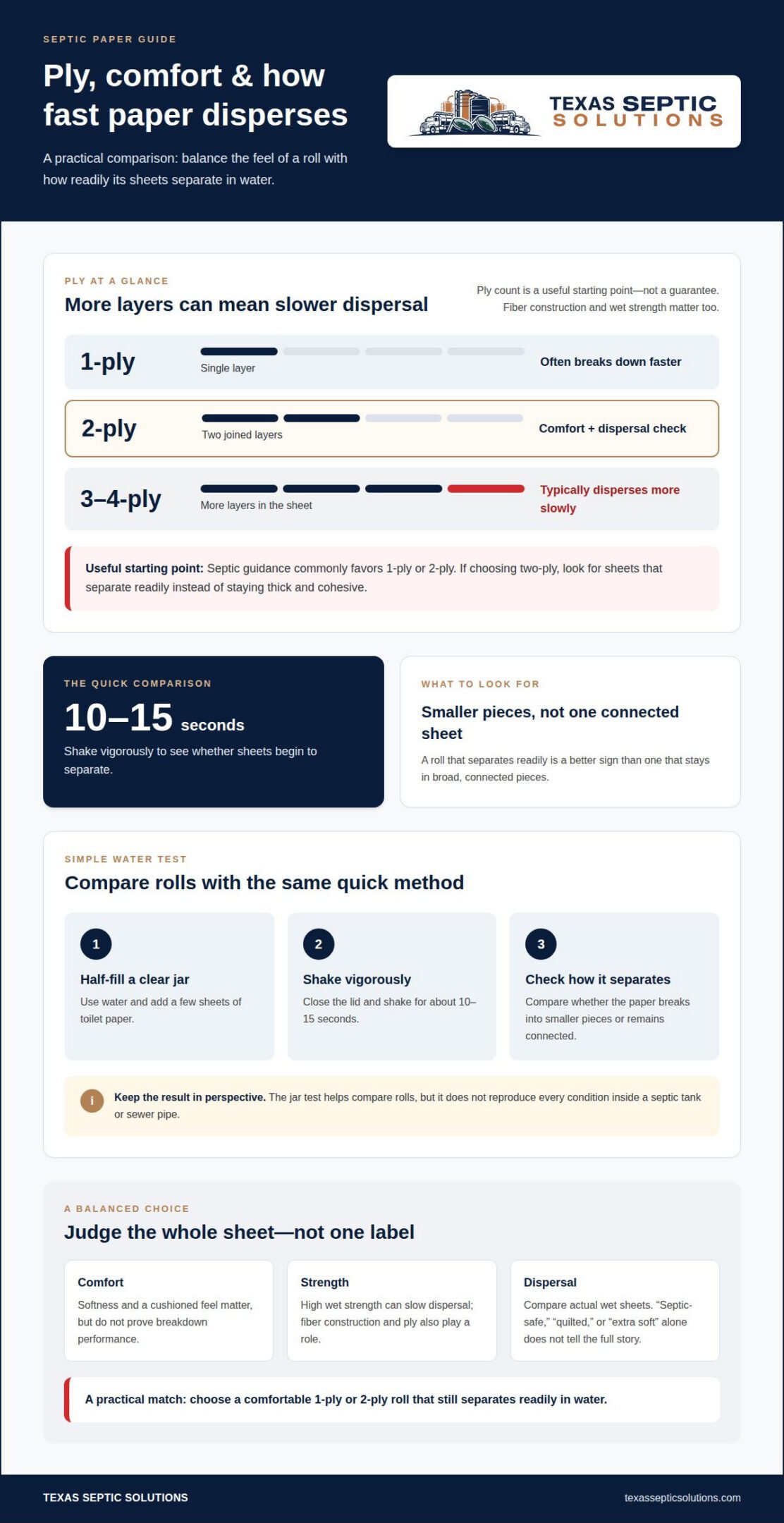
Two-ply paper joins two layers into one sheet, often creating a softer, sturdier feel than thin single-ply. That extra layer can also make the paper slower to break down. Septic guidance commonly favors 1-ply or 2-ply paper, while 3-ply and 4-ply products typically disperse more slowly. If you prefer two-ply, choose a roll that separates readily instead of one that stays thick and cohesive.
Strength helps paper hold together during use, but high wet strength can slow dispersal. Paper designed to stay intact when damp may resist breaking into smaller pieces after flushing. Not all strong or quilted rolls behave the same way, though. Fiber construction and ply matter too, so use the water test to compare actual sheets instead of relying on words like “strong” or “soft.”
Try this simple comparison with the rolls you’re considering: place a few sheets in a jar filled halfway with water, close the lid, then shake vigorously for about 10-15 seconds. Observe whether the paper separates or remains in broad, connected pieces. You can repeat the same steps with a single-ply and a two-ply roll. Treat the result as a practical comparison, not a full simulation of a septic tank.
Brands often describe comfort with terms such as “cushioned,” “quilted,” or “extra soft.” Those words describe feel, not necessarily breakdown performance. Check the package for ply and additives, then compare the sheet’s texture and how it disperses in water. A plain two-ply roll that breaks apart may suit someone seeking more comfort, while quick-dispersing single-ply may better prioritize breakdown.
Household preferences matter, too. A roll that feels rough may lead someone to use more sheets, while a thick sheet may encourage using fewer. Neither pattern guarantees that less paper enters the system. Choose a comfortable option that disperses well, and don’t treat softness, strength, or ply count alone as a measure of septic compatibility.
For a balanced choice, start with 1-ply or 2-ply, then compare comfort and dispersal. A 3-ply or 4-ply roll may feel plush, but its additional layers can slow breakdown. The best match is the one your household will use comfortably without sacrificing how readily the paper separates after flushing.
3. Biodegradable toilet paper
Biodegradable toilet paper is designed to break down through natural processes, but that label alone doesn’t say how quickly it separates in water. For septic use, both breakdown and dispersal matter: paper should separate readily rather than remain in large, connected pieces. A product can be biodegradable over time yet disperse slowly after flushing. Assess how the paper behaves in water, not just the wording on the package.
Material is one useful comparison. Seventh Generation Toilet Paper is made from 100% recycled materials, providing an example of a recycled-content option. Recycled content and biodegradability describe different product qualities, though: one identifies the source material, while the other describes how material breaks down. Neither phrase alone tells you how the sheets will separate in water. Consider both the material claim and the product’s dispersal behavior.
Tree-free toilet paper uses fibers other than conventional wood pulp. Bamboo is one example; recycled paper may also reduce reliance on newly sourced tree fibers. These options may appeal to households considering material sourcing, but tree-free doesn’t automatically mean septic-compatible. The finished sheet’s thickness, fiber structure, and treatments also affect how it feels and disperses.
Compare a biodegradable roll with another option using the same simple method: place a few sheets in a jar filled halfway with water, then shake vigorously for about 10-15 seconds. Notice whether the paper breaks into small pieces or remains in larger sections. The test won’t reproduce the conditions inside a tank, but it can help distinguish products that look similar on the shelf.
Labels also need context. “Natural,” “tree-free,” “recycled,” and “biodegradable” don’t all mean the same thing, and none replaces a clear description of the paper’s breakdown behavior. For example, a tree-free roll could still be thick, while a recycled roll could feel thinner. Compare ply and texture alongside the material claim, then consider whether the product is free of added perfumes, lotions, or dyes.
For a balanced choice, look for biodegradable toilet paper that disperses readily and has no unnecessary additives. Single-ply may break down faster, while some two-ply options balance comfort and strength differently. Your preferred material can narrow the choices, but the water test helps you compare the finished products themselves.
Make the decision in two steps: choose the material you prefer, then assess how the paper behaves in water. A recycled or tree-free label can guide your selection, but quick dispersal is a more direct clue to septic compatibility. This distinction keeps environmental preferences and system performance in view without assuming one guarantees the other.
4. How septic-safe toilet paper breaks down
After flushing, toilet paper travels through the drain line with wastewater into the septic tank. Water and agitation from incoming flow help loosen fibers and separate sheets. Paper that breaks into smaller pieces can mix more readily with tank contents than a sheet that stays intact. “Septic-safe” is most useful when it describes dispersal behavior, not just intended use.
Inside the tank, heavier solids settle, and septic bacteria help break down waste. Toilet paper becomes part of the tank’s solids, and its construction affects how readily it separates. Thin, single-ply paper tends to disperse faster than thicker paper. Two-ply may also be suitable if it breaks apart readily, while three- or four-ply typically takes longer to break down.
Dispersal and biodegradation are related but different processes. Dispersal means sheets separate into smaller pieces in water. Biodegradation is natural breakdown over time, supported by bacteria in a septic system. Paper can be biodegradable without dispersing immediately after flushing. For practical selection, consider both properties rather than treating either label as a complete measure of performance.
Which toilet paper brands are septic-safe and break down quickly? Brand names alone don’t establish how a specific roll disperses; compare its ply, additives, and breakdown behavior. Seventh Generation Toilet Paper is made from 100% recycled materials, but recycled content by itself doesn’t show how quickly its sheets separate in water.
A jar test offers a simple way to compare products. Fill a clear jar halfway with water, add a few sheets, close it, and shake vigorously for about 10-15 seconds. Look for paper that breaks into smaller pieces instead of staying connected in a large sheet. If two rolls behave differently in the same test, the one that disperses more readily is the clearer choice for septic use.
Even quick-dispersing paper works within a larger system. Excessive water use can overwhelm a septic system, and wipes or paper towels can add materials that don’t break apart like toilet tissue. For example, a household that flushes wipes alongside toilet paper adds a separate clog risk, regardless of the paper brand. Flush toilet paper and human waste only.
Think of septic-compatible toilet paper as a combination of product behavior and sensible use. A thin roll with few additives may disperse well, but the septic tank also depends on bacteria and appropriate water flow. Choose paper that separates readily, and keep unsuitable items out of the toilet to support the system’s normal breakdown process.
5. Toilet paper compatibility with septic systems
Compatibility depends on how a roll behaves in water and what it adds to the tank. The best toilet paper for septic tanks is typically thin, quick-dispersing, and free of unnecessary additives. A “septic-safe” label can help narrow the options, but ply, fibers, and dispersal are more useful when comparing products.
What toilet paper is safest for septic tanks? Choose 1-ply or 2-ply paper that separates readily, without perfumes, lotions, or dyes. Thinner single-ply generally dissolves fastest, while a well-dispersing two-ply roll can balance comfort with system compatibility.
Septic professionals recommend 1-ply or 2-ply toilet paper because it tends to dissolve more easily. Three-ply and four-ply rolls typically break down more slowly. A practical comparison is to inspect the ply count, then test a few sheets in water. A roll that remains in large, connected pieces is less compatible than one that separates.
How much toilet paper can a septic system safely handle? There isn’t one sheet count that fits every system. The amount depends on the system’s condition, household use, and how much water enters the tank. Use only what’s needed, and keep all unsuitable materials out of the toilet.
Additives also affect compatibility. Perfumes, lotions, and dyes can affect the bacterial balance in a septic tank. Pay attention to these ingredients when choosing between otherwise similar rolls. Paper without added chemicals, parabens, or chlorine may also be worth considering, alongside its ply and dispersal behavior.
Compatibility isn’t only about the roll. Even with appropriate toilet paper, flushing wipes or paper towels can strain a septic system. Excessive water use can also overwhelm it. Spreading laundry loads across the week rather than running several in quick succession can help avoid a sudden surge of household wastewater.
Consider the whole system if changing paper doesn’t resolve symptoms. Slow drains, recurring backups, or wastewater surfacing outdoors can point to issues beyond toilet paper choice. Tree roots can enter cracked drain lines and impede flow, so persistent symptoms call for attention to the plumbing and septic system.
To support system performance, choose paper that disperses readily, flush only toilet paper and human waste, and use water mindfully. If recurring clogs or backups continue, request help with septic system concerns so the underlying issue can be addressed.
Texas Septic Solutions
Texas Septic Solutions helps homeowners address septic concerns that persist despite choosing quick-dispersing toilet paper and following careful flushing habits. Recurring slow drains or backups may point to a system issue rather than a paper choice. Septic system maintenance and pumping support routine care, while repair addresses problems that need attention. Installation is also available for properties that need a new system.
Toilet paper selection is one part of septic care, not a fix for every symptom. If you’re concerned about your system, contact Texas Septic Solutions to discuss the situation and possible next steps.
Make a confident choice for your household
Make your next toilet paper purchase a practical household decision, not a permanent guess. Keep a note of the roll’s name, ply, and performance for comfort and dispersal. That record gives you a useful basis for comparing options next time, especially if household preferences change.
The best toilet paper for septic tanks balances household comfort with how readily the paper breaks apart. If system concerns continue, don’t assume a different roll will solve them. A septic professional can help identify whether the issue needs broader attention.
Texas Septic Solutions provides septic system maintenance, repair, and new system installation. Contact Texas Septic Solutions to discuss your septic system concerns and consider a sensible next step. A clear understanding of the system can help you move forward with confidence.
Frequently Asked Questions
Is Toilet Paper Safe For Sewers and Septic Systems?
Toilet paper is designed for toilet use in sewer plumbing, but septic-system instructions may be stricter. The septic-use warning here says to flush human waste only, not toilet paper. Follow the instructions that apply to your system rather than assuming sewer guidance applies to every septic setup. If you’re unsure how your system should be used, a septic professional can help clarify its operating requirements.
Is there anything I should not flush down the toilet?
Yes. Only human waste should be flushed; never flush wipes (even “flushable” ones), paper towels, toilet paper, feminine hygiene products, grease, garbage-disposal food scraps, or harsh chemicals. Keep a waste bin near the toilet for wipes and hygiene products, and dispose of grease with household waste. This routine helps keep unsuitable materials out of pipes and septic components.
Why do toilets or drain lines sometimes get blocked?
Blockages can result from unsuitable materials, buildup, or a physical obstruction in a line. Tree roots, for example, can enter cracked drain lines and impede flow. If several fixtures drain slowly, the problem may extend beyond one toilet. Homeowners in Cleveland, Houston, Cypress, Huffman, and Shepherd can contact Texas Septic Solutions for septic repair when recurring backups or slow drainage suggest a system problem.
Is 1-ply or 2-ply toilet paper better for septic systems?
Both 1-ply and 2-ply can be options, but single-ply tends to break down faster. If comfort leads your household to prefer two-ply, compare how the actual product separates rather than relying only on the ply label. Use the same amount of paper your household needs, and follow the septic system’s use instructions. More layers can mean slower breakdown.
Does recycled or bamboo toilet paper work well with septic tanks?
Recycled or bamboo content alone doesn’t establish how a finished roll behaves in a septic tank. Seventh Generation Toilet Paper, for example, is made from 100% recycled materials, but material sourcing and dispersal are separate considerations. For bamboo or recycled options, assess the finished paper’s ply, additives, and tendency to separate in water. The material label is a starting point, not a performance guarantee.
What are the best septic-safe toilet papers by price and value?
There’s no single price-based winner for every household. Compare package cost with the amount of usable paper, dispersibility, softness, and strength.