
The Ultimate Septic System Checklist for Property Managers in Houston (2026)
It’s 2 AM on a humid Houston Tuesday when your phone rings with a tenant reporting a sewage backup in Cypress. You already know that managing a portfolio with on-site sewage facilities often feels like a ticking time bomb, especially with the “black gumbo” clay soil we deal with across the Greater Houston area. Between the high cost of emergency repairs and the strict TCEQ reporting requirements that demand electronic filing within 14 days, the pressure to keep every system compliant is constant. It’s frustrating when tenant negligence, like flushing the wrong items, turns a routine day into an expensive disaster.
We’ve developed this professional-grade septic system checklist for property managers Houston to help you move from reactive repairs to proactive asset management. You’ll gain a comprehensive framework designed to protect your property value, keep your tenants satisfied, and ensure you’re always ready for a Harris County inspection. This guide covers everything from mandatory aerobic maintenance contracts to tenant education strategies, providing you with a repeatable system to reduce emergency call-outs and maintain clear documentation for your property owners.
Key Takeaways
- Stay compliant with 2026 TCEQ mandates and understand how Houston’s unique “black gumbo” clay soil impacts your system’s longevity.
- Master the art of early detection by using our septic system checklist for property managers Houston to identify surface indicators before they become expensive failures.
- Reduce costly emergency repairs by implementing a “Septic Addendum” in your lease agreements to educate tenants on the “flushable” myth.
- Optimize your maintenance budget by switching to occupancy-based pumping schedules and professional sludge layer testing instead of generic calendar dates.
- Protect your reputation and property value by partnering with a single-source expert for 24/7 emergency response and portfolio-wide maintenance.
The Property Manager’s Guide to Houston Septic Regulations
Houston property management involves more than just oversight; it’s about managing high-stakes infrastructure under strict legal eyes. In 2026, the Texas Commission on Environmental Quality (TCEQ) has increased its focus on reporting accuracy and environmental safety for on-site sewage facilities. If your portfolio includes properties in Harris County, you’re likely battling “Black Gumbo” clay soil. This dense material doesn’t allow for the same easy drainage found in sandy regions, making a comprehensive septic system checklist for property managers Houston an absolute necessity for your daily operations. A documented maintenance trail is your best defense against liability. If a system fails and causes a health hazard, having proof of professional upkeep protects you and the property owner from legal fallout and expensive fines.
In Harris County, there’s a clear legal distinction between residential and commercial septic management that you must track. Commercial systems often face higher scrutiny from the local health department and may require different permit types depending on the daily flow. While a residential failure is a headache, a commercial failure can shut down an entire business or multi-family complex, leading to massive lost revenue. Keeping separate, detailed documentation for each property type ensures you remain compliant with the specific codes that apply to your assets.
TCEQ Compliance and Aerobic System Contracts
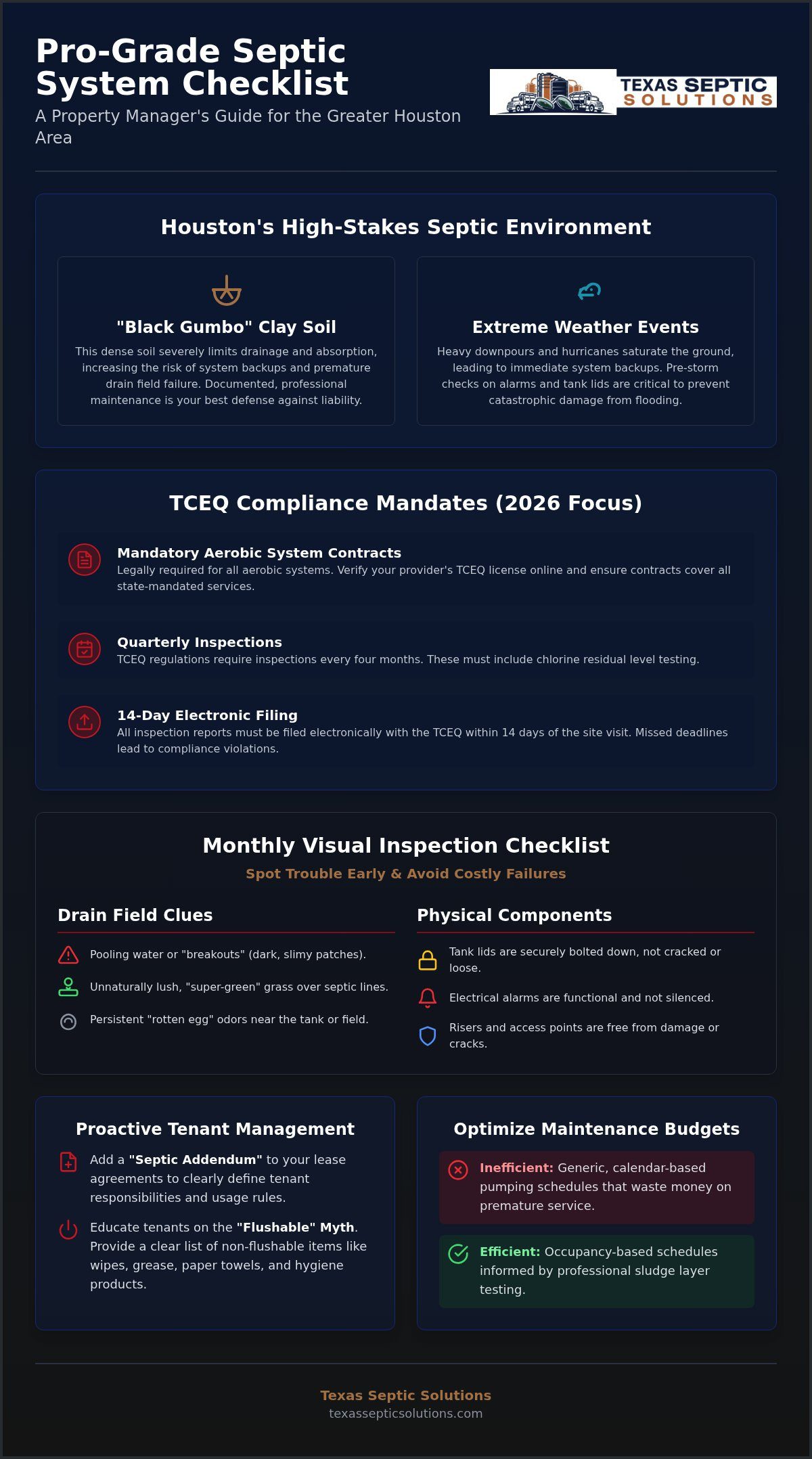
Aerobic systems are the standard for many newer Houston properties, but they come with mandatory maintenance provider (MP) contracts. These systems are essentially small-scale treatment plants that require professional oversight to function correctly. You need to understand how septic systems work to appreciate why these contracts are legally required by the state. Before signing a deal for your entire portfolio, verify the provider’s TCEQ licensing through the state’s online database. Current 2026 regulations require inspections every four months. These reports must include chlorine residual levels and be filed electronically within 14 days of the site visit. Missing these deadlines can lead to compliance violations that quickly eat into your management margins.
Houston Weather Factors: Flooding and Saturation
Our local weather patterns, characterized by sudden heavy downpours and hurricanes, create unique challenges for drain field absorption. When the ground is saturated, the system has no place to discharge treated water, which can lead to immediate backups. Your pre-storm checklist should involve verifying that all electrical alarms are functional and that every tank lid is securely bolted. This prevents debris from entering the system and alerts you immediately if the water levels rise too high. After a flood event, resist the urge to pump the tank immediately. Pumping a tank while the surrounding soil is still waterlogged can cause the entire unit to “float” or shift, leading to catastrophic structural damage. Always wait for the ground to dry and consult a professional before scheduling service.
Monthly Visual Inspection Checklist: Spotting Trouble Early
Catching problems before they escalate into five figure repairs is the primary goal of any effective septic system checklist for property managers Houston. While you don’t need to be a certified technician to spot a failing system, you do need to know what “wrong” looks like during your routine site visits. A quick visual scan can tell you more about the health of the underground infrastructure than a dozen tenant emails. By staying proactive, you protect the property owner’s investment and prevent the localized environmental hazards that come with a total system collapse.
Your first stop should always be the drain field. In our region, the heavy clay soil often struggles with absorption during wet seasons. Look for “breakouts,” which appear as dark, slimy patches or areas where the grass is unnaturally lush and green compared to the rest of the yard. While a green lawn is usually a good thing, a “super-green” patch directly over the septic lines often indicates that effluent is rising to the surface rather than filtering down. If you see pooling water or smell a persistent “rotten egg” odor, the system is likely overtaxed or failing to process waste correctly.
Next, examine the physical and electrical components. Check that all tank lids are securely bolted and that risers haven’t been cracked by a tenant’s lawnmower. Any opening in the tank allows surface water to rush in during a Houston downpour, which can quickly flood the system. Glance at the control panel to ensure no breakers are tripped. If the housing is damaged or the vent pipes are leaning, it’s a safety hazard and a direct violation of Houston Septic Regulations. Addressing these small physical issues now prevents the entry of debris that can ruin expensive pumps later.
The “Walk-By” Inspection for Multi-Unit Properties
During your monthly property visits, incorporate a five minute routine into your walk-through. Check the clean-out pipe located near the building foundation; if you see standing water inside it, there’s a blockage between the house and the tank. This septic system checklist for property managers Houston helps you identify “septic breakouts” before they reach the surface and become a health department issue. If you manage multiple properties, having a professional maintenance plan in place ensures these small signs are caught by experts who know exactly what to look for.
Managing the Septic Alarm System
A ringing alarm or a glowing red light on the control panel is an immediate call to action. If a tenant reports a septic tank alarm going off, you must determine if it’s a “fix it today” or a “fix it this hour” emergency. A red light usually means the high water float has been triggered, often due to a pump failure or a stuck float. Instruct the tenant to stop all water usage immediately, including laundry and showers, to prevent a backup into the home while you dispatch a repair team.
Tenant Education and Lease Agreement Requirements
Tenant behavior is the single most significant variable in the lifespan of an on-site sewage facility. While you can control the mechanical maintenance, you can’t always control what goes down the drain once the keys are handed over. This is why your septic system checklist for property managers Houston must include a robust “Septic Addendum” within every lease agreement. This legal framework sets clear expectations and protects the property owner from the high costs associated with preventable failures. A well-drafted addendum addresses everything from laundry habits to chemical usage, ensuring the biological balance of the tank remains healthy.
One of the biggest hurdles is the “flushable” myth. Many tenants believe that if a product is labeled flushable, it’s safe for the pipes. In reality, wet wipes, feminine products, and paper towels do not break down like toilet paper. They snag on baffles and clog pumps, leading to immediate backups. You should also restrict the use of heavy chemicals. Excessive bleach or commercial “septic additives” can actually kill the beneficial bacteria that process waste. Instead, encourage tenants to follow Professional Pumping and Maintenance Schedules to keep the system naturally balanced without harsh additives.
Hydraulic overloading is another common issue, especially in older systems. If a tenant runs five loads of laundry on a Saturday while the dishwasher is going, the system may become overwhelmed. This is particularly risky in Houston’s clay soil, which drains slowly. Encourage residents to spread out water-heavy tasks throughout the week to give the drain field time to recover between uses.
Creating a Tenant Welcome Packet for Septic Homes
Education is your first line of defense. Provide a simple, one-page visual guide in your welcome packet that lists prohibited items like cooking grease, chemicals, and non-biodegradable solids. Using icons or photos makes these rules easy to digest at a glance. Clearly outline the emergency contact procedures so tenants know exactly who to call at the first sign of a backup or alarm. This prevents them from attempting “DIY” fixes that could cause further damage to the sensitive internal components.
Enforcing Maintenance Through Lease Compliance
Distinguishing between “Tenant Negligence” and “Normal Wear and Tear” is vital for your bottom line. If a technician pulls a toy or a bundle of wipes out of a pump, that’s negligence. Your lease should allow you to charge back the cost of that service call to the tenant. Documenting these incidents is essential if you eventually need to perform a major septic system repair. Having a clear paper trail of tenant education and previous misuse provides the evidence needed to justify repair costs or security deposit deductions.
Professional Pumping and Maintenance Schedules
Don’t rely on a generic calendar to decide when a tank needs service. While many industry guides suggest a standard three to five year window, high occupancy rentals in Houston often require a much more aggressive schedule. A four bedroom home with six occupants will fill its 1,000 gallon tank twice as fast as a property with a single resident. Your septic system checklist for property managers Houston should prioritize actual occupancy data over simple tank size. A professional technician uses a “sludge layer” test to measure solid accumulation accurately. If the bottom sludge layer or the top scum layer gets too close to the outlet pipe, solids will escape into the drain field. This leads to permanent soil clogging, making a septic system replacement cost an inevitable reality rather than an avoidable expense.
The maintenance requirements also shift significantly between conventional and aerobic systems. Conventional systems are largely passive and may only need a professional look every few years. Aerobic systems, however, are essentially small scale wastewater treatment plants. They have mechanical aerators, pumps, and disinfection systems that require frequent oversight. In Texas, these systems generally require a maintenance contract with three inspections per year. Failing to keep up with these checks doesn’t just risk a breakdown; it puts you out of compliance with local health department mandates.
Routine Maintenance vs. Emergency Pumping
The ROI of a septic system maintenance plan is found in the disasters it prevents. Scheduled pumping ensures that the effluent entering your leach field is clear of heavy solids, which preserves the absorption capacity of Houston’s dense clay soil. If you wait for a backup to call for help, you’re looking at emergency rates. A Sunday evening emergency call-out can cost significantly more than a scheduled weekday visit. Proactive pumping keeps your costs predictable and your tenants happy.
Documentation and Owner Reporting
Property owners want to see that their assets are being protected. Keep a digital log for every property in your portfolio, tracking pumping dates, sludge levels, and any minor repairs made during inspections. This documentation is invaluable when you need to justify capital expenditures for system upgrades. Standardizing these service records across your Houston properties allows you to spot trends, such as specific neighborhoods or tenant types that may require more frequent care. If you need to streamline your portfolio oversight, contact Texas Septic Solutions to discuss a professional maintenance strategy for your properties.
Partnering with Texas Septic Solutions for Portfolio Management
Managing a diverse real estate portfolio in the Greater Houston area requires more than just a list of contractors; it requires a reliable local authority that understands the specific environmental challenges of Southeast Texas. When you work with multiple vendors, you often deal with inconsistent reporting and varying service standards. Switching to a single-source provider streamlines your operations and ensures that every property, whether in Houston, Cleveland, or Cypress, receives the same high level of care. We leverage over 20 years of hands-on experience to help you implement a septic system checklist for property managers Houston that actually works. Our family-owned business has been operating since 2010, and we treat your properties with the same accountability we would our own.
Custom maintenance plans are the backbone of a successful management strategy. We don’t believe in one-size-fits-all solutions because a duplex in Huffman has different needs than a commercial site in Cypress. By tailoring our services to the specific occupancy and system type of each unit, we help you extend the life of these expensive assets. This proactive approach moves you away from the stress of constant failures and toward a predictable, documented maintenance model that owners value. Our team remains unfazed by the challenges of Houston’s soil and weather, providing the steady reliability you need to maintain your professional reputation.
Emergency Response for Property Managers
Midnight backups are more than a nuisance; they’re a threat to your property’s physical integrity and your relationship with your tenants. Our 24/7 emergency service is built to handle these high-pressure moments with speed and precision. We arrive ready to perform rapid diagnostics, identifying the root cause of the failure to minimize tenant displacement and the potential for high hotel costs. During the repair process, we maintain professional communication with your residents, explaining the situation clearly to alleviate their stress. This expert handling protects your flooring from water damage and ensures that a temporary utility failure doesn’t turn into a long-term management crisis.
Starting Your Maintenance Plan Today
The transition from a reactive “fix it when it breaks” mindset to a proactive care model is the most effective way to reduce your long-term overhead. A comprehensive septic system maintenance Texas plan provides the peace of mind that comes with knowing every tank in your portfolio is being monitored by licensed professionals. We invite you to contact Texas Septic Solutions for a portfolio-wide assessment. We’ll walk through your properties, evaluate the current state of each system, and help you finalize a septic system checklist for property managers Houston that ensures compliance and functionality for years to come. Our goal is to be your long-term partner in maintaining home functionality across every asset you manage.
Take Control of Your Property’s Infrastructure
Managing a property portfolio in the Greater Houston area is a high-stakes responsibility. You’ve seen how our local “black gumbo” soil and heavy rainfall demand a specialized approach to utility management. By implementing a consistent septic system checklist for property managers Houston, you move from the stress of reactive repairs to a professional model of proactive asset protection. Whether you’re educating tenants on the “flushable” myth or scheduling pumping based on actual occupancy, your focus on documentation and routine care keeps your owners’ investments safe.
Texas Septic Solutions is ready to be your dependable local partner. Our TCEQ licensed experts provide the steady oversight needed to keep your systems compliant and functional. We serve Houston, Cleveland, and Cypress with 20 plus years of hands-on experience and a commitment to neighborly service. If a midnight crisis occurs, our 24/7 emergency response team is just a call away to protect your tenants and your reputation. Let’s work together to ensure your properties remain a source of pride and profit. Get a Professional Septic Maintenance Quote for Your Property Portfolio today.
Frequently Asked Questions
How often should a rental property septic tank be pumped in Houston?
Rental properties need pumping every 2 to 3 years on average, but high-occupancy units often require more frequent service. You should base the schedule on the number of residents rather than just the tank’s gallon capacity. A family of six in a Cypress rental will fill a 1,000 gallon tank much faster than a single tenant. Using a professional sludge layer test during routine checks is the most accurate way to prevent overflows.
Can I charge tenants for septic repairs caused by flushing wipes?
Yes, you can typically charge tenants for repairs if the failure is caused by negligence rather than normal wear and tear. If a technician removes non-biodegradable items like wet wipes or feminine products from a clogged pump, this constitutes a lease violation in most standard “Septic Addendums.” Documenting the service call with photos and a technician’s report provides the necessary evidence to justify a charge-back or security deposit deduction.
What are the TCEQ requirements for aerobic systems in Harris County?
All aerobic systems in Texas must be covered by a mandatory maintenance provider contract. These regulations require a licensed professional to inspect the system at least once every four months. In Harris County, these inspection reports must be filed electronically within 14 days of the site visit. This ensures the system is properly disinfecting effluent with chlorine and that all mechanical components like aerators and pumps are functioning within state environmental standards.
Do I need a separate septic inspection when taking over a new management contract?
You should always perform a comprehensive septic inspection when adding a new property to your portfolio. This establishes a baseline for the system’s current health and identifies existing issues before you assume management responsibility. It also ensures you have a septic system checklist for property managers Houston tailored to that specific site. Knowing the tank’s sludge levels and mechanical condition on day one prevents you from being blamed for pre-existing failures.
What is the most common cause of septic failure in Houston rental properties?
Tenant negligence is the leading cause of system failure in local rental properties. This usually manifests as flushing prohibited items or hydraulic overloading from excessive water use. In areas like Cleveland and Huffman, “black gumbo” clay soil makes systems less forgiving of these mistakes. When tenants run multiple heavy laundry loads back to back, the slow-draining soil can’t absorb the water fast enough, leading to immediate backups and surface breakouts.
How does Houston’s clay soil affect my property’s drain field?
Houston’s “black gumbo” clay soil has very low permeability, which significantly slows down the drain field’s absorption rate. During rainy seasons in Cypress or Shepherd, this soil becomes saturated and stops accepting treated water altogether. This lack of drainage can cause the system to back up into the home or pool on the lawn. Proper system design and a strict maintenance schedule are essential to manage these difficult soil conditions without causing premature failure.
Should I provide septic-safe toilet paper to my tenants?
Providing septic-safe toilet paper isn’t a requirement, but it’s a smart preventative measure for many managers. High-ply, “ultra-soft” brands often don’t break down quickly enough for septic bacteria to process them, leading to thicker scum layers. Including a few rolls of septic-safe paper in your tenant welcome packet, along with a list of prohibited items, sets a clear standard for the home’s care and can reduce the frequency of service calls.
What should a property manager do if the septic alarm goes off at 2 AM?
You should immediately instruct the tenant to stop all water usage and then contact a 24/7 emergency service provider. A ringing alarm usually indicates a high water level in the tank, often caused by a pump failure. Since you’re using a septic system checklist for property managers Houston, you’ll have our number ready. We provide rapid response to Houston and surrounding cities to resolve the issue before sewage enters the living space.