
Texas Septic Tank Property Line Setback Requirements: A Homeowner’s Guide
A septic tank that appears close to a property line may not be the component, or the boundary, you think it is. If you’re researching septic tank property line setback requirements Texas applies, a visual estimate alone can’t establish whether a system meets the rules.
It’s reasonable to be concerned when a tank or treatment area appears close to neighboring land, especially when setback information conflicts. Texas has statewide standards, but local requirements may be more specific, and a property’s approved plans can help show what was permitted. The tank, drain field, and other system components also need to be identified separately because different rules may apply to each.
This guide explains how to identify the component in question, locate approved system records, and confirm which state and local rules apply. You’ll also learn how to document a possible boundary concern and raise it with the appropriate local authority without treating an estimate as proof or escalating a neighbor disagreement.
Key Takeaways
- Setback rules depend on the septic component involved. Identify whether you’re looking at the tank, treatment unit, piping, or disposal area before comparing distances.
- To check septic tank property line setback requirements Texas applies to your property, compare the approved system records with the rules enforced by the local authorized agent.
- Permits, site plans, and documented observations help assess a concern. A visual estimate alone doesn’t establish a violation.
- Before making claims to a neighbor, ask the relevant authority to clarify the applicable requirements.
- A septic professional can assess system components and site conditions, but property boundaries require separate verification.
Texas septic tank property line setbacks: what the requirement actually applies to
If a septic component appears close to a property line, check the records before deciding there’s a problem. A visual estimate can be misleading: the feature may be underground, a visible lid may not show the tank’s full location, or the boundary may not be where you assume. The septic tank property line setback requirements Texas homeowners need to check depend on the component, the applicable rule, and the property’s approved plans.
A setback is a required separation between a specific septic component and a feature such as a property line. Don’t treat the whole system as one object. A tank stores wastewater before treatment; a treatment unit may process it; connecting lines carry it between components; and the disposal area receives treated effluent. For a general introduction to how septic tanks work, see Septic tank.
Which septic system components may have separate setbacks?
Start by identifying what’s near the boundary. A tank lid, treatment unit, buried pipe, and disposal area are different features. A distance that applies to one shouldn’t automatically be applied to another. Approved plans may label the components and show their intended locations. Check the drawing’s legend and component labels rather than relying on a marker or lid in the yard.
Simple site-plan example: Imagine a drawing with the property line on the right, the tank near the house, a treatment unit farther across the lot, a connecting line between them, and a disposal area behind the treatment unit. Identify each feature separately before comparing its position with a setback rule. This example illustrates how to read a plan, not a standard layout or required distance.
Why one Texas setback number may not answer your question
The Texas Commission on Environmental Quality (TCEQ) sets statewide standards for on-site sewage facilities (OSSFs). Consult current TCEQ rules in 30 TAC Chapter 285, then verify how the local authorized agent administers requirements for the property’s jurisdiction. Local requirements may be more specific, and the approved plans can show the conditions used when the system was permitted.
A number quoted online may refer to a different component, a different nearby feature, or a local rule that doesn’t apply to your address. Before relying on a distance, verify it against the current rule and the authorized agent for the property. Compare like with like: identify the component, establish which property line is relevant on the plan, and check the rule that applies to that component. If the drawing and visible conditions don’t seem to match, gather records and clarify the facts rather than treating the mismatch as proof of a violation.
How to verify the septic setback rule for your Texas property
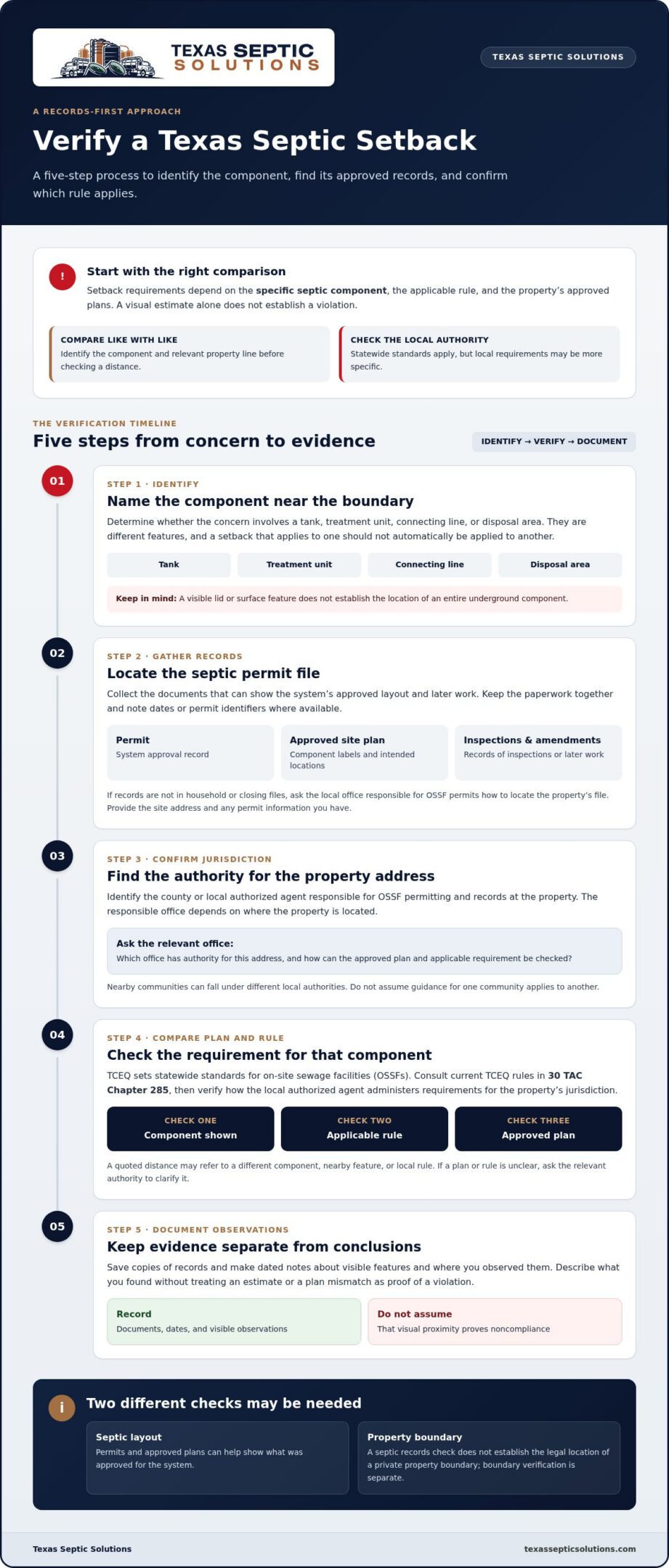
Use a records-first process to assess a suspected setback. Identify the component, locate the system paperwork, and confirm which authority and rule apply to the property. TCEQ guidance is a useful starting point, but it doesn’t replace the approved records for a specific installation.
- Identify the component. Note whether the concern involves a tank, treatment unit, connecting line, or disposal area. A visible lid or other surface feature doesn’t establish the location of an entire underground component.
- Locate the septic records. Gather the permit, approved site plan, inspection records, and any later amendments you can find. Keep them together and note dates or permit identifiers.
- Confirm the jurisdiction. Identify the county or local authorized agent responsible for OSSF permitting and records at the property. The responsible office depends on the property’s location.
- Compare the plan and applicable rule. Check which component the plan depicts and which requirement applied to that approval. Ask the relevant authority to clarify an unclear plan or rule.
- Document what you find. Save copies of records and make dated notes about visible features and where you observed them. Keep observations separate from conclusions about compliance.
Find the approved site plan and septic permit records
Start with the property’s septic permit file. Look for the approved site plan, inspection records, and amendments that may show later work. The Texas Commission on Environmental Quality (TCEQ) OSSF Basics explains the statewide framework, while the property file can show what was approved for this system. A drawing may show buried components that aren’t obvious at the surface or use labels that need explanation.
If the records aren’t with your closing documents or household files, contact the local office responsible for OSSF permits and ask how to locate the property’s records. Provide the site address and any permit information you have. Keep your request focused on septic documentation. This checks the system’s approved layout, not the legal location of a private property boundary.
Confirm the rule with the authority for the property
Local authorized agents may administer OSSF permits, inspections, and records. Confirm which office has authority for the specific address, then ask how to compare the approved plan with the rule that applied when the system was approved. Houston-area properties, including those in Cleveland, Houston, Cypress, Huffman, and Shepherd, may fall under different local authorities. Don’t assume guidance for one nearby community applies to another.
To verify a setback, match the approved septic permit and site plan to the applicable rule, then confirm the interpretation with the authorized agent for the property’s jurisdiction. If you’re planning an installation or need system repair after reviewing the records, professional septic system installation and repair can help address system-related site concerns. It does not determine a private boundary.
Tank, drain field, or property boundary? Compare the evidence before alleging a violation
A concern is easier to assess when you separate what you can see from what the records show. A lid, cleanout, or patch of wet ground is a clue, not a complete system map. An informal distance estimate also doesn’t establish the exact location of a component or property boundary. Before describing a situation as a violation, compare the correct component with the approved plan and the requirement that applies to it.
| Component | What to locate in the records | What rule to verify |
|---|---|---|
| Septic tank | Tank label, location, and outline on the approved site plan; related permit or inspection notes. | The requirement that applies specifically to the tank and the relevant property line. |
| Treatment component | The treatment unit’s label and location, including any notation that distinguishes it from the tank. | The applicable separation requirement for that particular treatment component. |
| Piping | Any lines shown between the home, tank, treatment unit, and disposal area. | Whether a rule applies to that line or feature. Don’t assume a tank or disposal-area rule also governs piping. |
| Disposal area | The designated disposal area’s location and limits as drawn on the approved plan. | The requirement for the disposal area, which may differ from requirements for other system components. |
What a map, visible feature, and measurement can, and cannot, show
A tank lid can help you identify a possible access point, but it doesn’t show the tank’s full footprint. A cleanout may indicate access to piping, not the location of a disposal area. Wet ground can signal a system or drainage concern, but it doesn’t prove where a component lies or that a setback rule has been violated.
Keep dated photos and copies of available septic records. Note where you stood, what you observed, and when you took each photo. Treat any distance estimated from visible features as a preliminary observation, not a survey or regulatory finding. A property boundary and a system component’s approved or actual location are separate facts that require reliable evidence.
How to compare a suspected location with approved documentation
First, match the component label on the approved plan to the feature being discussed. Then note any mismatch between the drawing and visible conditions without moving, opening, or disturbing septic equipment. If the plan is unclear or the features don’t appear to align, a qualified site review can help assess the system’s components and condition. It can’t determine a private legal boundary.
If wet areas, odors, or other observations raise concerns about system condition, document those separately from the setback question. Septic system repair may address a system problem, while the applicable authority and records are needed to clarify a setback concern. Keeping the issues distinct helps prevent a visual clue from becoming an unsupported accusation.
How to handle a suspected septic setback issue with a neighbor
A concern near a shared boundary can feel personal, but starting with records and neutral questions helps keep the conversation focused on facts. A visible feature or rough estimate alone doesn’t establish a setback violation. Check the approved septic documents and ask the authority responsible for OSSF permitting to clarify the requirements before drawing conclusions or confronting a neighbor.
Start with records and a neutral conversation
Gather the approved site plan, permit details, inspection records, and any dated photos or notes about what you observed. Keep a short timeline. Describe the feature plainly, such as “a lid appears near the side boundary,” rather than calling it an illegal tank. Don’t enter a neighbor’s property or open, move, or disturb septic equipment without permission.
If you speak with your neighbor, keep the request calm and specific. You could say, “I’m trying to understand which septic component is shown near the boundary. Would you be open to clarifying the approved plan with the local authority?” This invites a fact-finding conversation without treating an estimate as proof. If direct discussion feels unproductive, seek an official clarification instead of escalating the disagreement.
When to involve the local OSSF authority
Contact the county or local authorized agent that handles OSSF permits for the property’s jurisdiction. The authority can address permitting and OSSF compliance questions and explain which records or requirements apply. Provide the property location, the component you’re asking about, and copies or details of any permit and site plan you have. Ask a focused question: does the approved documentation show this component, and which requirement applies to it?
Keep separate issues separate. Septic setbacks concern the system and its applicable requirements. A disagreement about the legal property line or whether an easement exists is a private boundary or property-right question. A septic professional can assess system components and condition, but that assessment doesn’t determine a legal boundary or resolve an easement dispute. For formal legal questions, seek independent legal guidance rather than relying on a septic professional’s conclusion.
If your concern is about system performance, keep that separate from the boundary question too. Odors, wet ground, or signs of malfunction are observations about system condition that may call for maintenance or repair, not proof of a setback violation. Use septic system maintenance and repair support for system-care concerns, while directing setback and permitting questions to the local authority. A measured, documented approach gives everyone a clearer basis for deciding what to do next.
Get a professional septic review when the site plan and conditions do not match
If the approved plan doesn’t seem to match what you can observe, a septic professional can help assess the system itself. A review can clarify which components are present, what their visible condition suggests, and where site conditions appear different from available records. It can provide useful system information, but it can’t establish a private property line or settle a boundary dispute.
What a septic system review can help clarify
A professional can compare accessible system features with the plan you provide, identify components, and note apparent differences or signs of damage or malfunction. Share the permit documents and your observations so the review is grounded in records and site conditions. Any compliance conclusion must also account for the applicable requirements, which the responsible local authority interprets for permitting and setback questions.
Installation experience can be useful when a plan uses labels that aren’t obvious in the yard or visible features don’t tell the full story. A septic professional may explain how components relate to one another and what further system assessment may be needed. That perspective is practical, not a legal or regulatory ruling. The septic tank property line setback requirements Texas applies to a property still need to be checked against the correct approval and local rules.
Keep the roles clear. A septic professional evaluates the system and its condition; the authorized OSSF authority addresses permitting and regulatory setback questions. If a private boundary or easement is disputed, neither a septic inspection nor an installation plan alone decides that legal question. Separate, documented answers help you avoid treating a system observation as proof of a property-line violation.
Choose a clear next step for installation or repair concerns
If you’re planning a new system or need installation work, account for site requirements alongside the approved plans and applicable local regulations. Texas Septic Solutions provides septic system installation designed to meet applicable local regulations and environmental standards. Its septic system repair service addresses system concerns, while setback determinations remain with the relevant authority.
Before discussing work, gather the site plan, permit records, and a brief description of what seems different on the property. That gives the conversation a useful starting point and helps distinguish an installation or repair need from a boundary question. Texas Septic Solutions provides septic installation and repair to address system-related needs. Keep the records close and take the questions one at a time.
Take the next step with a clear plan
A boundary concern doesn’t have to become a neighbor dispute. Resolve it in stages: keep the system records together, follow up with the responsible authority on compliance questions, and address any system work separately. This gives you a practical path forward without asking a septic review to settle a private property matter.
If your review points to installation planning or a system repair need, professional support can help move that work forward. Texas Septic Solutions serves homeowners in Cleveland, Houston, Cypress, Huffman, and Shepherd with septic installation and repair. For questions about the septic tank property line setback requirements Texas applies to your specific property, use the local authorized agent and the relevant approval records.
Contact Texas Septic Solutions about septic installation or repair. The company also provides septic system pumping and maintenance to help address system-care needs. With the right records and a clear understanding of the issue, you can move forward calmly and make decisions based on facts.
Frequently Asked Questions
What is the required distance between a septic tank and a property line in Texas?
The applicable distance depends on the current TCEQ rule, the component involved, the approved permit or plan, and the local authorized agent for the property. To check septic tank property line setback requirements Texas applies to your site, use the records for that system rather than relying on a number from a general online source. Confirm that you’re checking the tank itself, not the separate wastewater disposal area.
Does the same Texas setback apply to a septic tank and a drain field?
Not necessarily. A tank and a drain field are different system components, and their separation requirements may differ. Find each feature on the approved plan before applying a rule. A visible tank lid won’t show the drain field’s full layout, and a patch of grass won’t reliably identify either component. If the plan’s labels are unclear, ask the relevant local authority which requirement applies.
Who enforces septic system setback requirements in Texas?
TCEQ provides statewide rules for on-site sewage facilities, while local authorized agents may handle permitting and compliance for a particular property. The responsible office depends on the location, so a process used in one area may not apply elsewhere. Check the permit file for the issuing authority or ask the local office which records it maintains. This is especially useful when a property has changed owners or older paperwork is incomplete.
Can I report a neighbor’s septic tank if I think it is too close to the property line?
You can raise a compliance concern with the appropriate local OSSF authority, but don’t present a visual estimate as proof of a violation. Record what you observed, when you saw it, and any relevant details from available documents. Don’t enter the neighbor’s property or inspect equipment without permission. Keep the discussion respectful, and treat boundary or easement disagreements separately from questions about septic rules.
How can I find the approved location of a septic tank on my property?
Look for the OSSF permit and approved site plan in your property or closing records, then check the plan’s labels and drawing notes. A tank lid or cleanout may help you orient yourself, but it won’t necessarily reveal every component or the system’s full layout. If paperwork is missing, contact the local office that keeps OSSF records. If the drawing is hard to interpret, a professional system review may help.
Can a septic contractor determine whether a system violates a property-line setback?
A septic professional can help identify components, assess visible system condition, and compare site observations with available plans. That review can clarify what may need further attention, but the responsible authority handles regulatory compliance determinations. A private boundary or easement question is separate and may require other professional or legal guidance. Share records and documented observations rather than relying on an informal estimate from a lid or surface feature.