
Texas Guest House Septic Requirements: 2026 Guide
Did you know that owning ten acres in Texas no longer guarantees you a “free pass” when it comes to installing a second septic system? Many homeowners assume adding a small guest cottage is as simple as running a pipe to their existing tank, only to find themselves facing unexpected fines or a messy backup in their main home. It’s stressful to navigate the maze of local county rules and state laws when you just want to provide a comfortable space for family or renters. Understanding the specific septic system requirements for guest house Texas properties is the first step toward a successful and legal build.
We’re here to help you protect your investment and your peace of mind. In this 2026 guide, you’ll discover the essential TCEQ regulations, sizing rules, and permitting steps required to add a guest house to your Texas property without compromising your septic health. We’ll explore whether you should repair, expand, or replace your current setup while providing a clear roadmap for the entire permitting and installation process. From navigating the disappearing 10-acre exemption to understanding bedroom-based design flows, you’ll have the facts needed to build with confidence.
Key Takeaways
- Learn why TCEQ calculates septic capacity based on bedroom counts rather than current residents or square footage.
- Understand the specific septic system requirements for guest house Texas properties to ensure your secondary dwelling stays fully compliant with 2026 regulations.
- Discover why the “10-acre rule” is often a myth and how to identify the permitting authority for your specific county.
- Compare conventional and aerobic systems to determine which technology is best suited for your property’s soil type and lot size.
- Identify the warning signs that your existing system is at capacity before you risk a backup by connecting a new guest house.
Texas Septic Sizing Rules: Why Bedrooms Matter Most
TCEQ Title 30 TAC Chapter 285 sets the rules for how we design every septic system in the state. Regulators use a concept called “Design Flow,” which is an estimate of the maximum daily wastewater a home might produce. You might think your guest house is just for one person, but the state looks at the potential occupancy. They use bedroom counts because bedrooms indicate how many people could live there, regardless of who is currently on the lease or visiting for the weekend.
Square footage doesn’t dictate the size of your tank or drain field. A 500-square-foot studio and a 1,200-square-foot guest house both count as one-bedroom units if they only have one sleeping area. Adding a secondary dwelling significantly shifts your property’s total water usage estimate. If you try to hook a new guest house into an older system designed only for the main house, you risk “undersizing.” This leads to saturated soil, foul odors, and eventually, a total system failure that affects both buildings.
Calculating Design Flow for Secondary Dwellings
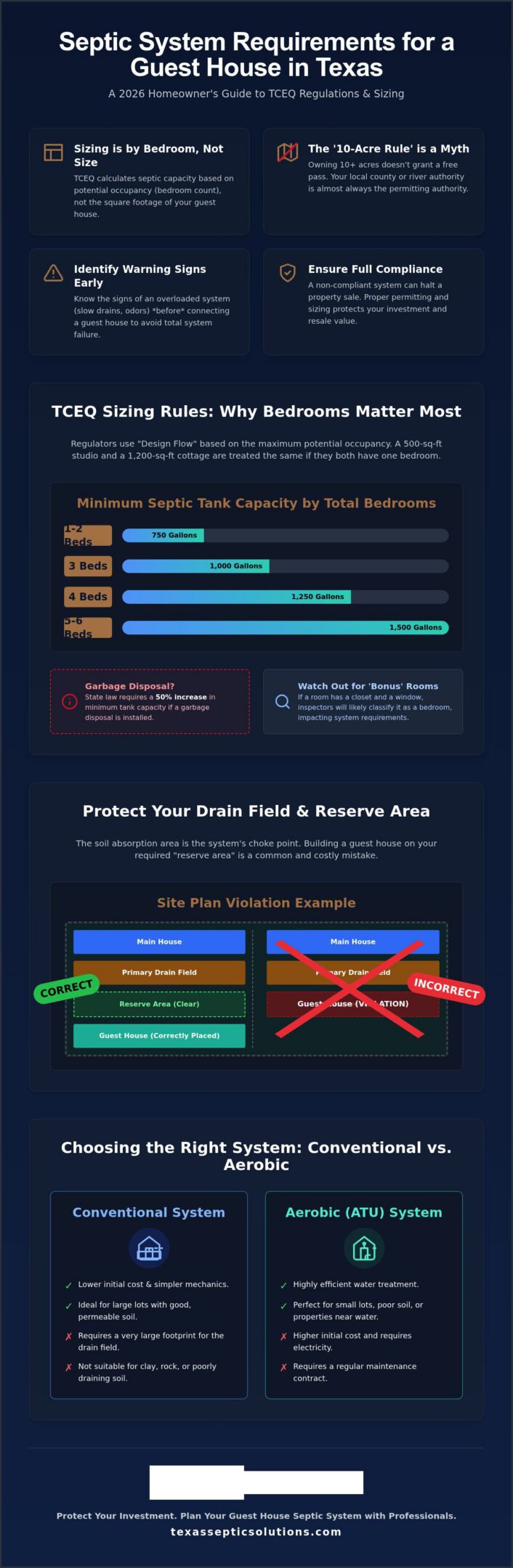
Texas sets minimum septic tank liquid capacities based on total bedroom counts across the property. For 2026, the standard requirements include:
- 1-2 Bedrooms: 750 gallons
- 3 Bedrooms: 1,000 gallons
- 4 Bedrooms: 1,250 gallons
- 5-6 Bedrooms: 1,500 gallons
If you add a garbage disposal to that guest house kitchen, the state requires a 50% increase in these minimum tank capacities. While installing low-flow toilets is a great idea for water conservation, these fixtures don’t always reduce your legal sizing requirements. Regulators prioritize the maximum possible load to prevent environmental contamination. Be careful with “bonus rooms” or home offices. If a room has a closet and a window, Texas inspectors will likely classify it as a bedroom, which directly impacts the septic system requirements for guest house Texas projects.
The Impact of Guest Houses on Property Resale
A non-compliant septic system is a major red flag during a property sale. Modern appraisers and home inspectors are thorough; they cross-reference the number of bedrooms in your home and guest house with the original septic permits on file. If the math doesn’t add up, the sale can stall or collapse entirely. Buyers want the security of knowing their utilities can handle the load. Investing in a fully compliant, multi-dwelling design ensures your property value stays high and your closing process stays smooth. We’ve seen many sales fall through because a DIY guest house addition wasn’t properly permitted. Doing it right the first time protects your equity.
Can Your Current Septic System Handle a Guest House?
Before you break ground on that guest cottage, you must determine if your current setup can handle the extra load. Most Texas homeowners hope to simply “tie in” to their existing tank to save money. However, the Texas Commission on Environmental Quality has strict guidelines to prevent hydraulic overloading. This occurs when the volume of water entering the system exceeds its ability to process and disperse it. If your tank is already pushing its limits, adding a guest house will cause a backup that impacts both structures.
Look for warning signs before you commit to a design. Are your drains slow or do your pipes gurgle after a heavy laundry day? These are red flags. You might also notice lush, green patches of grass over the drain field even during a Texas drought. If you see standing water or smell foul odors, your system is already struggling. Adding more “design flow” from a secondary dwelling will likely lead to a total failure. It’s much cheaper to address these issues now than to dig up a brand-new landscape later.
Evaluating Your Existing Drain Field
The drain field is usually the biggest hurdle for property additions. While it’s relatively simple to install a larger tank, the soil absorption area is the real “choke point.” Every septic permit requires a specific amount of “reserve area” where a secondary drain field can be built if the first one fails. If your guest house footprint sits on top of this reserve area, you’ll violate the septic system requirements for guest house Texas properties. A professional septic system repair expert can evaluate the health of your soil and determine if your current field can actually absorb more wastewater.
Tie-ins vs. Separate Systems: Pros and Cons
Choosing between a tie-in and a separate system depends on distance and capacity. A tie-in is often more cost-efficient because you maintain only one set of components. However, if the guest house is located far from the main house, the plumbing slope might require a lift pump, which adds complexity and maintenance. Separate systems offer a “fail-safe” advantage. If the guest house system needs maintenance, the main house remains unaffected. Shared systems often require more frequent pumping and stricter monitoring to avoid clogs from guest usage. If you aren’t sure which path is right for your lot, we can help you evaluate your current system capacity before you finalize your blueprints.
Navigating Texas Permits and the ’10-Acre Rule’ Myth
Navigating the red tape of Texas property development can feel overwhelming, but the permitting process follows a specific sequence designed to protect your land and local groundwater. Before you dig a single hole, you must follow the TCEQ On-Site Sewage Facilities rules to ensure your project stays legal. The process generally follows these five steps:
- Determine Authority: Identify if your permit is handled by your city, your county, or the state. Most rural projects fall under the county’s jurisdiction.
- Site Evaluation: Hire a professional to conduct a soil test. This determines what kind of system your land can actually support.
- Professional Design: A licensed designer must create a formal OSSF plan that accounts for the combined flow of your main house and guest house.
- Authorization to Construct: Once the county approves your design, they’ll issue this document. Only then can construction begin.
- Notice to Operate: After a final inspection by a county official, you’ll receive this legal green light to begin using the system.
Debunking the 10-Acre Exemption for Guest Houses
Many owners believe that owning more than ten acres exempts them from all septic system requirements for guest house Texas projects. This is a common and costly misunderstanding. While state law historically offered an exemption for a single-family dwelling on large tracts, that exemption rarely applies to guest houses. Adding a second kitchen or bathroom typically classifies the property as a multi-dwelling site, which voids the “single-family” status. Furthermore, counties like Harris, Montgomery, and Liberty have largely eliminated the 10-acre exemption altogether to protect the environment. If you build without a permit on a large lot, you still face heavy fines and potential legal action from the TCEQ.
Working with Local Permitting Authorities
Your local Authorized Agent (AA) is the person who will ultimately sign off on your project. They require specific documentation, including a detailed plat map showing the location of all structures, wells, and property lines. You’ll also need to provide the results of your professional soil analysis. We’ve seen homeowners try to bypass this step to save time, but it always backfires. You should never start construction without an approved septic tank installation permit. Without it, you can’t get a permanent power connection in most counties, and you certainly won’t be able to sell the property later. We handle this paperwork for our clients because we know exactly what local inspectors are looking for in a multi-dwelling design.
Choosing the Right System: Conventional vs. Aerobic
The specific technology you select for your property depends heavily on your land’s geography and soil composition. Conventional systems are the traditional choice for large lots with deep, sandy soils. These systems rely on gravity and natural soil filtration to treat wastewater. However, you must consider strict setback requirements. Texas law mandates that your system stays at least 5 feet from property lines and 50 to 100 feet away from any water wells. If your guest house is positioned in a tight corner of your lot, these distances might dictate your system type before you even break ground.
Aerobic Treatment Units (ATUs) function like a miniature municipal sewage plant. They use an oxygen-rich environment to help bacteria break down waste much faster than a standard tank. These units are often the only way to meet septic system requirements for guest house Texas projects on smaller lots or areas with poor drainage. While they are more complex, they provide a versatile solution for property owners who want to add a secondary dwelling without needing a massive, pristine leach field.
Soil Testing in Houston, Cypress, and Cleveland
Homeowners in the Houston area, including Cypress and Cleveland, deal with “black gumbo” clay. This heavy soil expands when wet and shrinks when dry, which makes it nearly impossible for traditional leach fields to function properly. A professional site evaluation includes a percolation test, commonly called a “perc test,” to measure how quickly your soil absorbs water. If your soil is too dense, a conventional leach field will fail and cause a backup. In these cases, we typically design aerobic spray or drip systems that safely disperse treated water across the surface or just below the turf.
Aerobic Maintenance Contracts
If your site evaluation requires an aerobic system, you must prepare for ongoing legal obligations. The TCEQ requires all aerobic systems to be under a continuous maintenance contract with a licensed provider. As of 2026, these contracts generally cost between $300 and $500 per year and include mandatory inspections every four months. Maintaining a septic system maintenance plan is a legal necessity to keep your permit in good standing. Many modern systems now feature remote monitoring and alarms that alert you if a pump fails or if your guests are overloading the system with excessive water use.
Don’t guess when it comes to your property’s soil health. Contact Texas Septic Solutions for a new septic system installation and let our experts handle the design and soil testing for your new guest house.
Professional Planning for Your Guest House Septic
Adding a guest house is a significant engineering challenge that goes beyond simple carpentry. You aren’t just adding a room; you’re doubling the potential load on your land’s natural resources. Hiring a licensed OSSF installer is non-negotiable for these multi-dwelling projects. We handle the heavy lifting of calculating flow rates and ensuring your project meets all septic system requirements for guest house Texas properties. Our team acts as the bridge between your architectural dreams and the strict environmental realities of the TCEQ.
We manage the entire lifecycle of your project, from the initial soil analysis to the final inspection. By taking a proactive approach, we help you avoid the common pitfalls that stall construction or lead to expensive retrofits. We treat your property as a complete system, ensuring that the new addition doesn’t compromise the functionality of your primary residence. This comprehensive care is what makes us a trusted partner for homeowners throughout the region.
The Design and Installation Timeline
In the Houston area, the permitting process typically takes between two and four weeks, depending on the current backlog in Harris, Liberty, or Montgomery County offices. You should coordinate your septic installation early in the build process. Ideally, we install the tank and lines after the heavy machinery for the guest house foundation has finished its work but before the final landscaping begins. Careful planning prevents the massive septic system replacement cost spikes that occur when a system is poorly designed or accidentally crushed by construction vehicles.
Integrating Your Maintenance Strategy
Once your system is in the ground, it must become part of your overall maintenance Texas strategy. Treating your main house and guest house as a single ecosystem ensures that a problem in one dwelling doesn’t cause a failure in the other. We recommend a unified pumping schedule and regular inspections to keep everything flowing smoothly. Before you sign a contract with a guest house builder, use this final checklist:
- Has a professional soil test been completed for the specific area of the guest house?
- Does the site plan leave a clear path for septic trucks to access the tanks for future pumping?
- Are the guest house plumbing exits high enough to maintain the necessary gravity slope to the tank?
- Have you confirmed that the building footprint doesn’t sit on the existing drain field or the designated reserve area?
Contacting Texas Septic Solutions
We provide expert service across Cleveland, Cypress, Huffman, Shepherd, and the surrounding communities. Our team stays current on the latest local codes to ensure your project passes inspection the first time. We’re ready to help you navigate the red tape and get your project moving without the stress of regulatory fines. Consult with our local experts today to schedule your site evaluation and start your guest house build on solid ground.
Build Your Texas Guest House on a Solid Foundation
Adding a secondary dwelling to your property is an exciting investment, but it’s one that requires technical precision. You’ve learned that bedroom counts, not just square footage, dictate your design flow and that the “10-acre rule” rarely applies to multi-dwelling sites. Whether you need a conventional system for sandy soil or an aerobic unit for East Texas clay, following the law protects your property value and your family’s health. Navigating the septic system requirements for guest house Texas projects doesn’t have to be a headache when you have a local partner handling the red tape.
Our team of TCEQ Licensed Installers is ready to guide you through every soil test and permit application. We provide 24/7 emergency support and proudly serve Cleveland, Houston, Cypress, and the surrounding areas. Don’t risk a costly backup or a failed inspection by guessing on your design. Request a Site Evaluation for Your Guest House Project today and let’s get your build moving safely.
Frequently Asked Questions
Do I need a separate septic tank for a guest house in Texas?
Not necessarily, but it depends on your current tank’s capacity. If your existing system was designed for a three-bedroom home and you add a one-bedroom guest house, the total load increases to a four-bedroom design flow. If your current tank is too small, you’ll either need to upgrade the main tank or install a dedicated one for the guest house. We often recommend separate tanks if the buildings are far apart.
Can I install my own guest house septic system in Texas?
In most Texas counties, you cannot. While state law allows homeowners to install their own systems on their primary residence in some rural areas, adding a secondary dwelling usually requires a licensed OSSF installer. Most local authorities in Harris or Liberty County mandate professional installation to ensure environmental safety. It’s best to hire a professional to handle the complex design and permitting process for multi-dwelling sites.
How far must a guest house septic tank be from a water well?
You must maintain a minimum distance of 50 feet between the septic tank and any water well. The drain field or spray area requires a larger setback of at least 100 feet from the well. These statewide rules protect your drinking water from contamination. If your lot is small or crowded with existing structures, these setbacks might determine exactly where your guest house can be built on the property.
What is the minimum lot size for two septic systems in Texas?
Most counties require at least one-half to one full acre for a single septic system, but adding a second system for a guest house often requires more space. The total acreage must be large enough to accommodate the primary drain fields and the mandatory reserve areas for both systems. If you’re on a lot smaller than one acre, local health departments may require an aerobic system to meet the tight space constraints.
Does a guest house count as a bedroom for septic sizing?
Yes, every sleeping area in a guest house counts toward your total property bedroom count. Regulators don’t look at the building’s name; they look at the potential occupancy. A one-bedroom guest house added to a three-bedroom main home creates a four-bedroom load. Even a studio with a closet and window is usually classified as a bedroom when determining the septic system requirements for guest house Texas permits.
What happens if I build a guest house without a septic permit?
You face significant legal and financial risks. An initial offense can result in fines between $50 and $200, while subsequent convictions can reach $1,000. The TCEQ can also levy administrative penalties up to $25,000 per day for violations. Perhaps most importantly, you won’t be able to legally sell the property later because the unpermitted addition will fail the mandatory real estate septic inspection required by most buyers.
How often should a guest house septic tank be pumped?
You should pump a guest house tank every three to five years, similar to a main home. However, if the guest house is used frequently by different visitors, solids can accumulate faster. If you have a shared system, the increased load means you’ll likely need to pump the main tank more often than you did before the addition. Regular pumping is the best way to prevent expensive backups in both dwellings.
Is an aerobic system better for a small guest house?
An aerobic system is often the best choice for guest houses on smaller lots or in areas with poor soil. Since aerobic units treat wastewater more thoroughly, they often require smaller dispersal areas than conventional leach fields. If your property in Cypress or Cleveland has heavy clay soil, an aerobic system might be your only legal option for meeting the septic system requirements for guest house Texas regulations.