
Small Septic System for Cabin Texas: A 2026 Buyer’s Guide
Did you know that the smallest septic system you can legally install for your Texas cabin isn’t actually determined by the size of your tank, but by how much water your soil can handle? It’s a common misconception that small lots automatically mean simpler, cheaper setups. Finding a reliable small septic system for cabin Texas projects is about balancing size with performance while staying within the law. Dealing with strict TCEQ regulations and heavy East Texas clay often feels like an expensive headache when you just want a simple weekend getaway.
We understand the stress of balancing permit requirements with a limited budget and a tiny footprint. This guide shows you how to secure a legal, low-maintenance setup that works with your specific land. We will break down the 2026 regulatory updates, compare the efficiency of aerobic versus conventional units, and help you choose a system that passes inspection the first time. Whether you are building in the piney woods or the Hill Country, you’ll find the most cost-effective path to a functional cabin utilities plan.
Key Takeaways
- Learn how to navigate TCEQ regulations and county-specific rules to ensure your cabin system is fully permitted and legal from day one.
- Compare compact aerobic units against traditional gravity systems to find the most efficient fit for your specific lot size and power availability.
- Identify how East Texas clay soil impacts your drain field options and which designs prevent failure in difficult ground.
- Discover specific maintenance strategies for a small septic system for cabin Texas properties to handle seasonal usage without “shocking” the tank.
- Avoid the high costs of oversized residential systems by sizing your setup correctly for low-occupancy or part-time cabin life.
The Challenge of Finding a Small Septic System for a Cabin in Texas
Finding a small septic system for cabin Texas projects often feels like trying to fit a square peg in a round hole. Most property owners want something simple, discreet, and affordable for their weekend getaway. However, the Texas Commission on Environmental Quality (TCEQ) has strict standards that apply regardless of whether you’re building a mansion or a one-room hunting shack. A “small” system in this context is generally defined as an Onsite sewage facility (OSSF) optimized for low-occupancy or seasonal use.
Standard residential systems are often total overkill for a cabin meant for one or two people. These larger setups are designed to handle the massive daily wastewater output of a suburban family, including multiple showers, loads of laundry, and constant dishwasher cycles. For a cabin owner, installing a full-sized system means paying for capacity you’ll never use and losing valuable space on a small lot. Texas environmental challenges, such as the dense clay found in East Texas or the rocky terrain of the Hill Country, make the search for a compact solution even more difficult.
Usage vs. Capacity: How Texas Defines “Small”
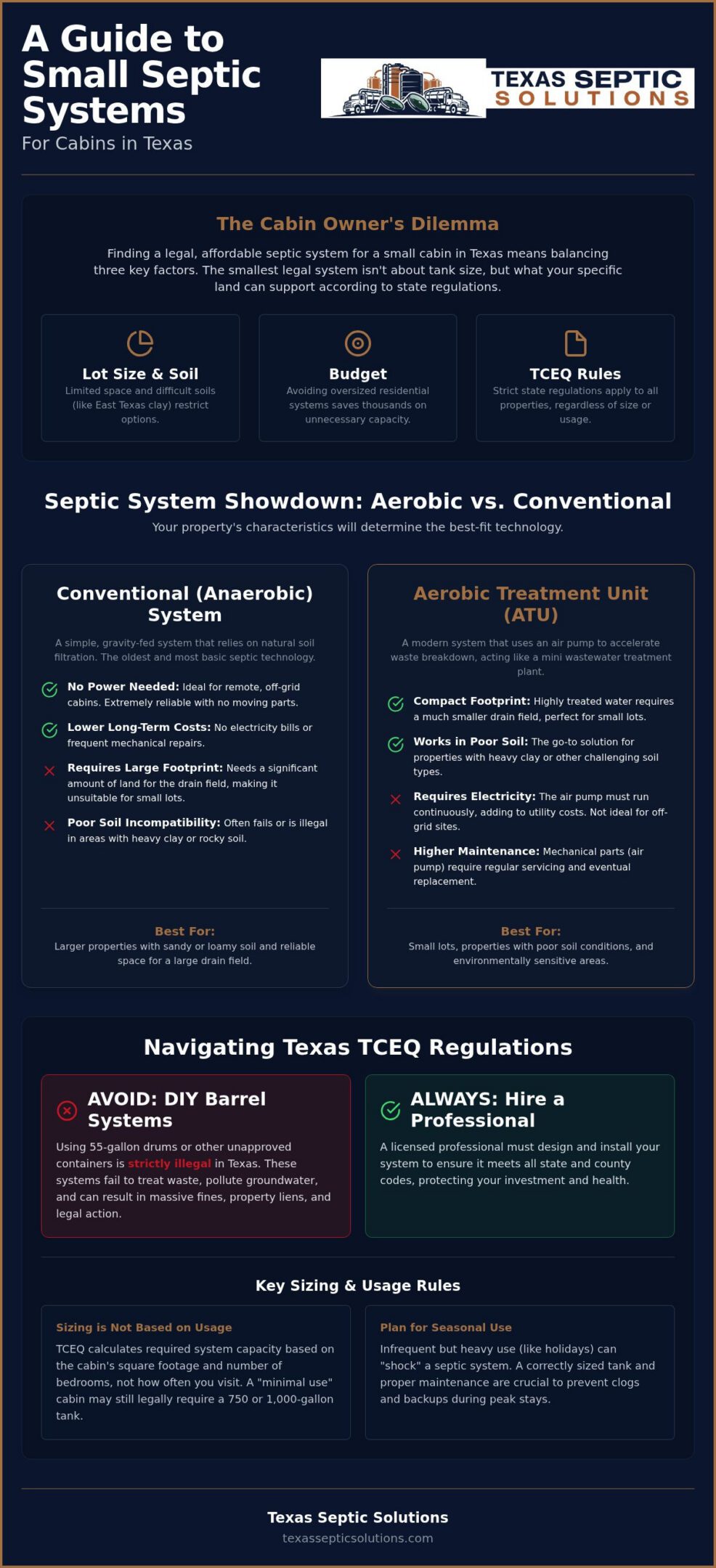
Texas regulations don’t usually care if you only visit your cabin two weekends a month. The state typically calculates the required capacity based on the number of bedrooms and the total square footage of the dwelling. This determines the daily gallon flow rate. Even if you’re a minimal user, modern appliances like high-efficiency toilets or small washing machines still impact the design requirements. We’ve seen many owners surprised to find that a “minimal use” cabin still requires a 750 or 1,000-gallon tank to meet the minimum legal threshold. Sizing the system correctly ensures the tank has enough volume to allow solids to settle, preventing clogs in your drain field during those high-usage holiday weekends.
The Legal Reality of DIY Barrel Systems
It’s tempting to follow old online forums that suggest using 55-gallon plastic drums as a makeshift septic tank. In Texas, this is a recipe for disaster. Unpermitted systems are illegal and can lead to massive fines, property liens, and even criminal charges in some counties. Beyond the legal trouble, these “barrel systems” rarely treat wastewater effectively. They often leak untreated sewage into the groundwater, creating health risks for you and your neighbors. To keep your property safe and your title clean, you must invest in professional septic system design and installation. A legal system protects your investment and ensures your cabin remains a place of relaxation rather than a regulatory nightmare.
Comparing Small Septic Options: Aerobic vs. Anaerobic
Choosing a small septic system for cabin Texas requires a clear understanding of how different technologies handle waste. You generally have two primary paths: anaerobic (conventional) or aerobic (advanced treatment). Both types must comply with Texas septic system laws, which dictate setback distances and soil suitability. Your choice will ultimately depend on your lot size, soil quality, and how often you plan to stay at the property.
Conventional Gravity Systems for Cabins
Conventional anaerobic systems are the oldest and simplest technology available. They rely on gravity to move wastewater from the tank into a drain field. Since they have no moving parts or electrical requirements, they are incredibly reliable for remote cabins where power might be spotty. The long-term maintenance costs are generally lower because you aren’t paying for electricity or frequent mechanical repairs.
However, these systems require a large footprint. You need enough land for a significant drain field, and the soil must be porous enough to filter the water naturally. If your cabin is on a tiny lot or sits on heavy clay, a conventional system often isn’t a legal option. They are best suited for larger properties with sandy or loamy soil where the ground can do the heavy lifting of filtration.
Aerobic Systems: The Small Lot Solution
Aerobic Treatment Units (ATUs) act like a miniature city sewage plant. They use an air pump to circulate oxygen, which allows aerobic bacteria to break down waste much faster and more thoroughly than anaerobic systems. This high level of treatment means the liquid coming out is cleaner, allowing for a much smaller footprint. It is the go-to choice for cabins in areas like Cypress or Houston where heavy clay soil prevents traditional drainage.
The trade-off is complexity. These systems require electricity to run the aerator and a mandatory septic system maintenance plan to ensure the mechanical parts stay in working order. For seasonal owners, this means keeping the power on year-round to keep the bacteria alive. If you are building on a small, clay-heavy lot, the aerobic system is often your most reliable path to a permit. If you’re unsure which technology fits your property, you can always consult with a local expert to evaluate your specific site conditions.
Alternative Systems and Cost-Benefit
In extremely tight spaces or environmentally sensitive areas, you might consider biofilters or evapotranspiration (ET) beds. Biofilters use materials like peat or foam to treat water in a very compact space, while ET beds rely on evaporation and plant transpiration in areas where the soil won’t absorb water at all. While these alternatives solve space issues, they often come with higher initial installation costs compared to standard units. For most Texas cabin owners, the cost-to-benefit ratio favors conventional systems for large lots and aerobic systems for small or clay-heavy lots.
Navigating Texas TCEQ Regulations for Cabin Septic Systems
The Texas Commission on Environmental Quality (TCEQ) oversees every small septic system for cabin Texas project through a set of rules known as 30 TAC Chapter 285. While the state sets the minimum standards, many counties act as “Authorized Agents,” meaning they handle their own permitting and enforcement. This creates a patchwork of rules where requirements in Cleveland might differ slightly from those in the Houston area. Understanding these regulations before you buy land or start construction is the only way to avoid costly red flags later.
One common point of confusion for cabin owners is the “10-acre exemption.” If your property is 10 acres or larger, you might be exempt from the permit application process for a single-family home. However, you are never exempt from following the actual design and installation standards. For smaller cabin lots, a permit is always mandatory. A professional site evaluation serves as your roadmap, determining exactly what type of system the law allows on your specific piece of dirt.
Permitting and Inspections: What to Expect
The process starts with a site and soil evaluation performed by a licensed professional. You cannot skip the soil “perc” test; it’s the data that proves your land can safely process wastewater. Once the design is finalized, it’s submitted to the county for review. You’ll receive a “Permit to Construct,” which allows the physical installation to begin. After the system is in the ground but before it’s covered, an inspector must visit the site for a final walk-through. In East Texas, permits are frequently denied because of high water tables or dense clay soil that doesn’t meet absorption standards. Getting a pro involved early ensures your design accounts for these local hurdles.
Distance Requirements (Setbacks)
Setbacks are the invisible “buffer zones” that often dictate the maximum size of your cabin on a small lot. Texas law requires very specific minimum distances to protect public health and water quality. Your septic tank and drain field must stay at least 5 feet from property lines and 10 feet from any habitable building. If you have a private water well, the system must be at least 50 feet away, while public wells require a 100-foot gap. Streams, creeks, and rivers also require a 50-foot setback. On a wooded or uneven lot, these requirements can quickly eat up your buildable space. Mapping these out during the design phase prevents the nightmare of discovering your cabin is too close to your septic field to be legal.
Choosing the Right System Based on Your Texas Soil
Your soil is the single most important factor in determining which small septic system for cabin Texas projects can actually use. Texas land varies wildly, from the deep sands of the Piney Woods to the thick “Blackland” clays of the central and coastal regions. If you don’t account for what is under your feet, you risk a system that backups or fails to drain during the first heavy rainstorm. We’ve seen many property owners fall in love with a lot, only to find the ground won’t support the simple system they originally planned.
In many East Texas cabin spots, you’ll encounter Class IV clay. This soil is dense and holds water like a sponge, making traditional gravity drain fields nearly impossible to permit on small lots. For these tough spots, Evapotranspiration (ET) beds can be a lifesaver. These systems use a lined pit filled with sand and topped with specific vegetation to pull moisture out of the system through evaporation rather than soil absorption. Because soil conditions are so specific, professional soil testing for septic systems is non-negotiable before you ever break ground.
Sandy Soil Solutions for Cabins
Sandy soil is a cabin owner’s best friend. It drains quickly and filters wastewater efficiently, which usually allows for the simplest and most cost-effective system designs. You can often use standard trench designs or chamber systems, which are easier to install in remote wooded areas. Chamber systems are particularly popular for cabins because they provide more storage capacity in a smaller footprint than traditional gravel trenches. This is a huge advantage when you are trying to preserve as many trees as possible on your lot.
Even with perfect sand, you must maintain the leach field. If you allow hair, grease, or solids to escape the tank, they will eventually clog the pores of the sand and ruin your drainage. Regular inspections ensure your field stays porous and functional for decades, protecting the natural beauty of your property.
Clay Soil Challenges (Houston and Cleveland Areas)
If your cabin is near Houston or Cleveland, you are likely dealing with heavy clay. Clay particles are tiny and flat, meaning they pack together tightly and stop water flow. This often forces a move toward aerobic treatment. If you want to avoid a full aerobic setup, a “mound system” is another alternative for small lots with poor drainage. These systems involve building an artificial hill of sand and topsoil above the natural ground level to provide a medium for treatment before the water ever hits the clay.
Ignoring these soil limitations is the fastest way to end up needing an expensive septic system repair. When clay becomes saturated, the water has nowhere to go but back into your cabin. If you are ready to see what your land can handle, schedule a professional site evaluation today to get a custom plan for your property.
Installation and Maintenance: Ensuring Cabin System Longevity
Maintaining a small septic system for cabin Texas properties requires a different strategy than a standard suburban home. Many owners mistakenly believe that less usage means less maintenance. The reality is that intermittent use is often harder on the biological health of your tank. When a cabin sits empty for months, the beneficial bacteria can starve. If you then show up with a dozen guests for a holiday weekend, you “shock” the system with a sudden volume of waste it isn’t ready to process. This biological imbalance is a leading cause of premature failure and odors.
Properly planned installation is the best way to avoid a high septic system replacement cost down the road. At Texas Septic Solutions, we specialize in sizing these systems to handle the peaks and valleys of cabin life. We focus on long-term reliability by ensuring every component is accessible for future service. Partnering with a local expert who understands the Houston and Cleveland climate means your system is built to survive both the summer droughts and the spring floods.
The Installation Process for Remote Cabins
Getting heavy equipment into a wooded or off-grid site takes careful planning. We prioritize preserving your property’s natural landscape while ensuring the installation meets all TCEQ standards. It’s vital to protect the drain field area during the cabin’s construction phase. Heavy trucks or building materials parked over your leach field will compact the soil and ruin its ability to absorb water. We also ensure that the tank lids are positioned for easy access. If a pumper truck can’t get within 50 to 75 feet of your tank, your future maintenance costs will skyrocket.
Seasonal Maintenance Tips
Winterizing is a critical step for Texas cabin owners, especially in areas prone to hard freezes. While our winters are generally mild, a sudden cold snap can freeze lines that aren’t buried deep enough or lack proper insulation. Before the first freeze, check for any exposed pipes and ensure your tank is properly sealed. When you have guests visiting, remind them that a small system has limits. Spreading out laundry loads and taking shorter showers helps prevent the system from becoming overwhelmed.
Monitoring your system while you are away is also easier than ever with modern telemetry. If your septic tank alarm goes off, it’s usually a sign of a pump failure or a high-water event. Having a maintenance partner who offers 24/7 emergency service provides peace of mind that your property is protected, even when you’re back in the city. Regular inspections every few years will catch small issues before they become expensive disasters.
Build Your Texas Cabin Retreat with Confidence
Building a getaway in the woods should be about relaxation, not worrying about wastewater. As we have explored, the right small septic system for cabin Texas projects depends entirely on your soil type and local county rules. Whether you are dealing with East Texas clay or sandy plots near the coast, skipping the professional design phase isn’t worth the legal or environmental risk. A permitted, properly sized system protects your land and ensures your property remains a valuable asset for decades to come.
Our team at Texas Septic Solutions serves as your local expert in Cleveland, Houston, and Cypress. We provide TCEQ-compliant designs tailored to your specific lot and offer 24/7 emergency support for rural properties. Don’t let utility hurdles slow down your construction timeline or lead to expensive repairs later. Get a Professional Quote for Your Cabin Septic Installation to ensure your system is legal, efficient, and reliable. We’re here to help you get it right the first time so you can focus on enjoying your cabin.
Frequently Asked Questions
Can I install my own small septic system for a cabin in Texas?
You generally cannot install your own system unless you are a licensed professional or meet very specific county level exemptions for a primary residence. Most Texas counties require a licensed installer to ensure the system meets 30 TAC Chapter 285 standards. Attempting a DIY installation often leads to failed inspections and expensive red flags during property sales. It’s much safer to hire a professional who understands the local soil and permitting process.
What is the smallest legal septic tank size for a 1-bedroom cabin?
The smallest legal septic tank size for a 1-bedroom cabin in Texas is typically 750 or 1,000 gallons. Even for a tiny home, the TCEQ sets these minimums to ensure proper wastewater treatment and settling time for solids. Your specific county might have stricter requirements that override state minimums. Sizing a small septic system for cabin Texas projects correctly prevents backups and ensures you pass the mandatory final inspection.
How much land do I need for a small septic system in Texas?
You typically need at least half an acre if you have a public water supply, or one full acre if you use a private water well. These minimum lot sizes are designed to accommodate the necessary setbacks from property lines and water sources. If your lot is smaller than these standards, you may face significant challenges getting a permit unless you utilize an advanced treatment unit with a smaller footprint.
Do I need an aerobic system if I only use my cabin on weekends?
Your usage frequency doesn’t determine if you need an aerobic system; your soil type and lot size do. If your cabin sits on heavy clay or a small lot, an aerobic system is often the only legal option. While these units require constant electricity to keep the bacteria alive, they provide the high quality treatment required in difficult terrain. Weekend-only use actually makes maintenance more critical to prevent biological shock when you arrive.
What happens if I install a septic system without a permit in Texas?
Installing a system without a permit can lead to heavy daily fines, property liens, and a mandatory order to remove the unpermitted equipment. You’ll also find it nearly impossible to sell your property later, as title companies and lenders require proof of a legal OSSF. Beyond the legal trouble, unpermitted systems often fail quickly because they weren’t designed for the specific soil conditions on your land, leading to environmental contamination.
How often does a small cabin septic tank need to be pumped?
A small cabin septic tank generally needs pumping every three to five years, though this depends on how often you stay there. Even with seasonal use, solids accumulate over time and can eventually clog your drain field. Regular pumping is the cheapest way to extend the life of your small septic system for cabin Texas setup. If you host large groups frequently, you might need to pump more often to handle the increased load.
Is a composting toilet a legal alternative to a septic system in Texas?
A composting toilet is legal in Texas, but it doesn’t exempt you from needing a septic system. While the toilet handles blackwater, you still produce graywater from sinks, showers, and laundry. TCEQ regulations require a permitted system to treat and dispose of this graywater safely. Many cabin owners find that by the time they install a graywater system, it’s more practical and cost-effective to install a standard septic unit that handles everything.