
Septic Tank Pumping Cost in Texas: 2026 Homeowner Price Guide
Pumping your septic tank isn’t just a routine chore; it’s the only thing standing between your home and a five-figure replacement bill. Most homeowners understand that maintenance is necessary, but the fear of being overcharged by emergency services or hit with hidden digging fees makes the process stressful. You want a fair price and a system that works, not a surprise bill for labor you didn’t expect. It’s frustrating to feel like you’re at the mercy of a service provider when you just want to keep your household running smoothly.
This guide provides a clear look at the septic tank pumping cost Texas residents are facing in 2026. We’ll show you how to avoid predatory pricing while protecting your property’s long-term health. You’ll learn how to prepare your site to lower your bill, find out exactly how often your tank requires service based on current TCEQ standards, and discover how to find a reliable local expert for immediate help. By the end, you’ll have a solid plan to maintain your system without breaking the bank.
Key Takeaways
- Get a clear breakdown of 2026 market rates to ensure you’re paying a fair price for professional service.
- Learn how factors like tank depth and sludge levels impact the septic tank pumping cost Texas residents pay for routine maintenance.
- Find out how to prepare your property before the truck arrives to avoid common surcharges like lid digging fees.
- Understand why a small investment in pumping prevents catastrophic drain field damage and replacement costs reaching $15,000.
- Discover how local geography in Southeast Texas, from Houston to Cleveland, influences the final bill on your service invoice.
Understanding Septic Tank Pumping Costs in Texas for 2026
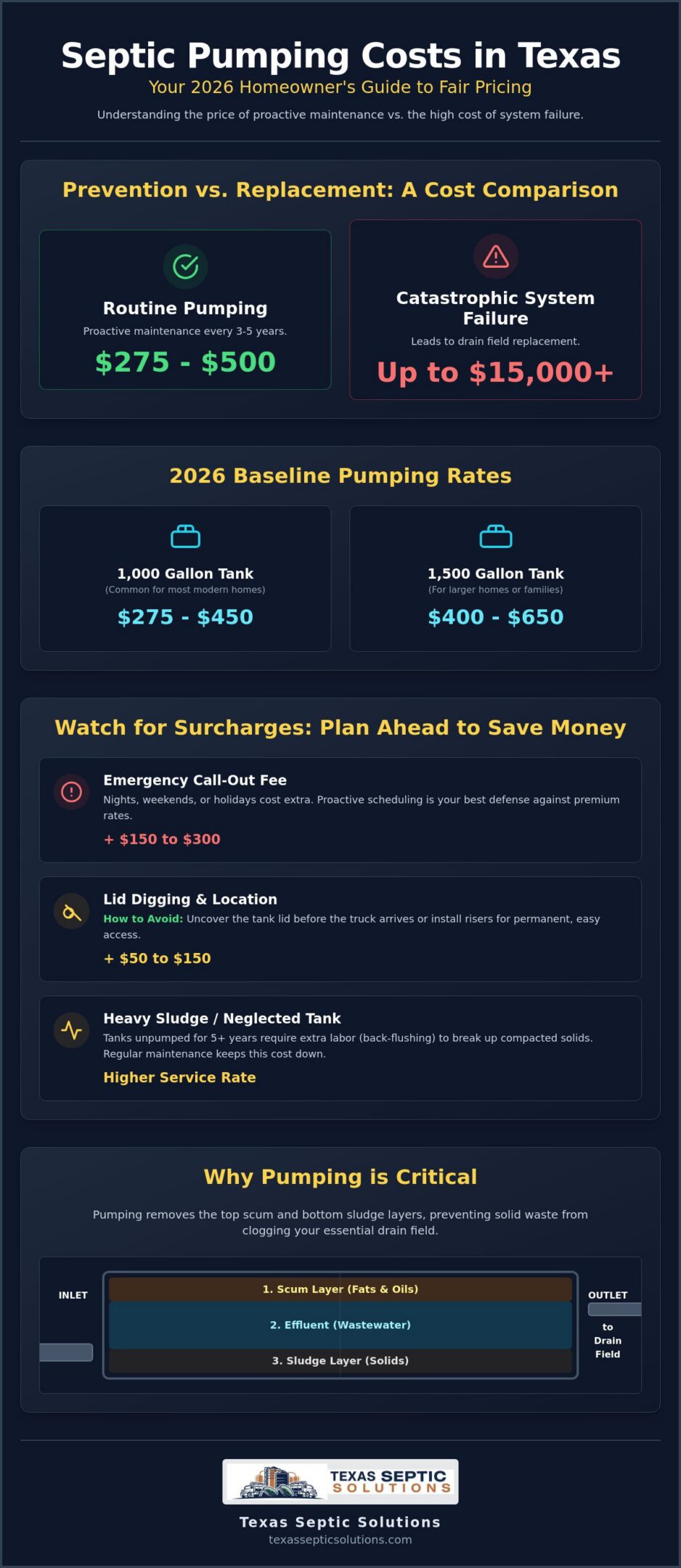
A standard septic pumping service is more than just a quick vacuum job. When a professional arrives at your property, they are performing a critical extraction of two distinct layers: the floating scum at the top and the heavy sludge that settles at the bottom of the tank. To understand why maintenance is necessary, it helps to know what a septic tank is and how it functions as a living biological filter for your home. Without this regular removal, those solids eventually migrate into your drain field, which often leads to total system failure.
As we move through 2026, the septic tank pumping cost Texas homeowners encounter has shifted. Market averages for a standard residential pump-out currently range between $275 and $500. This increase reflects rising fuel costs and higher disposal fees at local treatment facilities. It’s also vital to distinguish between a “pump-out” and a “cleaning.” A standard pump-out focuses on removing the liquids and solids so the tank can continue to function. A full cleaning involves scrubbing the walls and high-pressure water jetting to remove every bit of residue, which naturally carries a higher price tag due to the extra labor and equipment involved.
The Baseline: 1,000 vs. 1,500 Gallon Tanks
Tank size remains the primary factor in determining your base rate. Most modern homes in Texas utilize either a 1,000-gallon or a 1,500-gallon tank. Since disposal fees are calculated by the volume of waste treated, a larger tank requires more time on-site and higher fees at the dump station. For a 1,000-gallon tank, you’ll typically see market rates between $275 and $450. If you have a larger 1,500-gallon system, expect those averages to sit between $400 and $650. Knowing your tank’s capacity before you call helps ensure your initial estimate is as accurate as possible.
Routine Maintenance vs. Emergency Pumping Rates
Timing is the biggest variable you can control. Scheduling your service during normal business hours allows for a predictable, flat-rate experience. Emergency calls, especially those at 2:00 AM on a holiday weekend, come with significant premiums. You can generally expect an emergency surcharge of $150 to $300 on top of the standard pumping fee. While 24/7 availability is a vital safety net when a backup threatens your home’s interior, proactive planning is the best way to keep your costs low. Regular maintenance ensures you’re never the person paying “after-hours” prices for a problem that could have been handled on a Tuesday afternoon.
Variables That Impact Your Total Pumping Bill
While the base septic tank pumping cost Texas homeowners pay is relatively predictable, the physical reality of your property can shift the final invoice. Several on-site factors influence the amount of labor and time required to complete the job safely. Understanding how septic systems work helps explain why a technician might need to charge more for specific challenges. When a professional arrives, they aren’t just moving liquid; they’re managing a complex biological system that requires clear access and specific handling to remain functional.
The “Hidden” Cost of Buried Lids
Finding the tank is often the most time-consuming part of the service. If your tank’s access point is buried beneath several inches of soil or landscaping, a technician must spend extra time probing and digging. This labor typically results in a surcharge ranging from $50 to $150. You can easily avoid this fee by uncovering the lid yourself before the service truck arrives. For a more permanent solution, installing septic tank risers is a smart investment. Risers bring the access point to the surface, allowing for instant service and eliminating future digging fees entirely.
Sludge Levels and Tank Condition
The state of the waste inside your tank also dictates the level of effort required. If a system hasn’t been pumped in five years or more, the sludge at the bottom can become extremely dense and compacted. This “heavy sludge” often requires a process called back-flushing; the technician pumps some liquid back into the tank to break up the solids so they can be fully extracted. Because this takes more time and uses more equipment, neglected tanks often incur higher service rates. Regular maintenance prevents this compaction and ensures the pump-out remains a straightforward, low-cost task.
Other logistical factors include the distance from your driveway to the tank. Most standard pump trucks carry approximately 100 feet of hose. If your tank is located far back on a large rural lot or behind difficult terrain, you might see a “long-hose” fee to cover the additional equipment and setup time. Additionally, many modern systems include an effluent filter that needs cleaning during every pump-out. While some providers include this in the base price, others list it as a vital add-on. Neglecting this filter can lead to backups, so it is a service you should never skip. If you are concerned about your current system status, scheduling a professional septic system pumping is the best way to get an accurate assessment of your property’s needs.
Local Price Trends: Houston, Cleveland, and Cypress
Geography plays a significant role in the septic tank pumping cost Texas residents see on their service quotes. In densely populated areas like Houston and Cypress, the high concentration of service providers generally keeps base rates stable. However, the logistical challenge here isn’t distance; it’s traffic. A pump truck idling in I-45 traffic costs the company money, which is why local providers who understand the rhythm of Harris County are often more efficient. They know how to time their routes to avoid the worst delays, ensuring your service stays on schedule.
Moving toward Cleveland, Shepherd, and Huffman, the dynamics change. These rural communities require longer travel distances between the job site and the disposal facility. Because pump trucks get low fuel mileage and disposal fees are tied to specific regional treatment plants, rural homeowners might see slightly higher base rates to cover that transit time. In Huffman, particularly around Lake Houston, environmental protection is a top priority. Systems near water sources require meticulous care to prevent runoff, and local experts know how to handle these sensitive zones with the necessary precision.
Local expertise also matters when navigating the diverse soil types of Southeast Texas. The heavy clay found around Houston and Cypress holds moisture longer, putting different stresses on a system compared to the sandier soils found further north in Liberty County. A seasoned technician knows exactly how these conditions affect your tank’s health and can spot potential drainage issues before they become expensive repairs. This localized knowledge is what separates a basic pump-out from a professional maintenance visit.
Service Area Dynamics in Southeast Texas
Your proximity to disposal sites in Harris and Liberty counties directly affects your bottom line. Choosing a provider that understands specific septic system maintenance Texas standards ensures your paperwork is handled correctly. Beware of “cheap” out-of-town companies. They often lure you in with a low base price only to add heavy mileage surcharges once they see your address. Sticking with a local authority who already has trucks in Cleveland or Shepherd is the best way to avoid these hidden fees. According to EPA data on septic maintenance costs, spending a few hundred dollars on local professional service every few years is a fraction of the price of a total system failure.
Regulatory Compliance in the Lone Star State
In Texas, the TCEQ (Texas Commission on Environmental Quality) sets strict rules for waste disposal. Every gallon of waste removed from your property must be documented with a waste manifest and taken to a licensed facility. If a provider offers a price that seems too good to be true, they might be cutting corners on disposal. Illegal dumping carries massive fines for both the provider and, in some cases, the property owner. Verify your service provider is licensed and insured in the state of Texas before they start work. This isn’t just about following the law; it’s about protecting your property and the local environment from the consequences of improper waste management.
The Hidden Cost of Waiting: Pumping vs. System Failure
Waiting too long to service your system turns a predictable maintenance task into a high-stakes financial emergency. The math is simple but sobering. Spending a few hundred dollars every three years for a professional pump-out is a small price to pay compared to a full system failure that can exceed $15,000. Many homeowners see the septic tank pumping cost Texas providers charge as an optional expense, but it’s actually the most effective insurance policy you have for your home’s infrastructure. When you ignore the schedule, you aren’t just saving money today; you’re risking a catastrophic bill tomorrow.
When you neglect your pumping schedule, the settling process inside the tank fails. Instead of solids staying at the bottom, they begin to flow out into your drain field. This is the most expensive component of your entire system. Once those solids clog the soil, the field loses its ability to process waste, leading to soggy yards and foul odors. You might notice your grass looks unusually lush and green over the tank area. While it looks nice, it’s actually a sign that your system is leaking nutrient-rich effluent where it shouldn’t be.
If your drains are gurgling or you find your septic tank alarm going off, your system is already in distress. Don’t fall for “miracle” additives or chemicals that promise to dissolve waste. These products often do more harm than good by suspending solids in the liquid, allowing them to migrate into the leach field and cause permanent damage. There is no substitute for the physical removal of waste through professional pumping. It’s the only way to clear out the inorganic materials that bacteria simply cannot break down.
Drain Field Protection
Your leach field is a delicate biological filter. It relies on specific soil porosity to treat wastewater before it returns to the groundwater. When inorganic waste and heavy sludge enter this area, they act like glue, sealing off the soil. While some companies offer field “rejuvenation” or jetting, these services are often just temporary fixes for a much larger problem. Pumping the tank ensures that only liquid effluent reaches the field, extending its lifespan by decades and avoiding the massive environmental and financial costs of a field collapse.
When Pumping Isn’t Enough: Identifying Repairs
A professional pump-out is the best time to inspect the structural integrity of your tank. Technicians look for cracked baffles, which are designed to keep solids in their place, and check for signs of groundwater infiltration. Catching a failing baffle during a routine visit can save you thousands in future labor. However, if the system has been neglected for too long, you might need to look at a septic system replacement cost estimate. Proactive repairs during a pumping visit are always more affordable than a total system overhaul.
If you’re worried about the state of your system, don’t wait for a backup to happen. Schedule a professional septic pumping visit now to protect your home’s value and your peace of mind.
Fast, Reliable Septic Pumping with Texas Septic Solutions
At Texas Septic Solutions, we understand that maintaining your home’s infrastructure is a balance of performance and budget. Our team serves the Cleveland, Houston, and Cypress communities with a focus on honesty and readiness. We don’t believe in surprise fees or hidden surcharges. When you call us to discuss the septic tank pumping cost Texas properties require, you get a straightforward answer backed by years of local experience. We’ve seen every soil condition from the heavy clays of Harris County to the sandy loams of Liberty County; we bring that expertise to every driveway we pull into.
Proactive care is the most effective way to keep your long-term costs low. By choosing a septic system maintenance plan, you eliminate the guesswork of scheduling and the fear of a sudden backup. These plans ensure your system is inspected and pumped on a timeline that matches your actual usage, preventing the sludge overflow that destroys drain fields. Our goal is to be your long-term partner in home health, providing the calm reliability you need to forget about your septic system and focus on your family.
Why Our Neighbors Trust Us
We’ve built our reputation on being a “neighborly expert” who is ready for anything. Whether you need a routine pump-out or find yourself in the middle of a 24/7 emergency septic failure, our trucks are equipped to handle the job immediately. We are a full-service provider, which means we don’t just pump and leave. We understand the mechanics of your system from installation to complex repairs. This comprehensive knowledge allows us to spot small issues, like a worn baffle or a clogged filter, before they turn into a crisis. We treat every residential and commercial job with the same high level of accountability and professional care.
Schedule Your Service in Southeast Texas
Don’t wait for your drains to slow down or your yard to become a swamp. If you are in Houston, Shepherd, Alvin, or any of the surrounding areas, contact us today for a free estimate on your next service. You can save time and money on your visit by taking a few simple steps to prepare your yard. Clear away any debris or heavy landscaping near the tank and, if possible, uncover the access lids to avoid digging fees. Taking these small actions helps our technicians get right to work, ensuring your service is fast and efficient. Regular pumping is the single best investment you can make for your property’s longevity; let us provide the peace of mind that comes with a job done right.
Secure Your Home’s Health for 2026 and Beyond
Managing your property shouldn’t feel like a series of expensive surprises. By understanding the septic tank pumping cost Texas homeowners face this year, you can plan ahead and keep your system running without interruption. Remember that regular maintenance is the only way to protect your drain field from the heavy solids that lead to catastrophic failures. Whether you’re prepping your site to avoid digging fees or choosing a maintenance plan for long-term savings, taking action today prevents the stress of a midnight emergency tomorrow.
Texas Septic Solutions is here to help you navigate every maintenance need with 24/7 emergency service and licensed Texas technicians. We’re proud to serve our neighbors in Cleveland, Houston, Cypress, and the surrounding areas with dependable, professional care. Don’t let a small maintenance task turn into a major repair bill. Get a Professional Septic Pumping Estimate Today and ensure your home remains a safe, functional space for your family. We look forward to being your trusted partner in property maintenance.
Frequently Asked Questions
How much does septic tank pumping cost in Texas on average?
Market averages for a standard 1,000-gallon tank typically range between $250 and $450 depending on your specific county and current disposal fees. Residents in metropolitan areas like Houston often see slightly higher rates because regional treatment plants charge higher intake prices for waste. It’s best to request a quote that includes both the labor and the waste disposal manifest fee to avoid any unexpected surcharges on your final bill.
How often should I pump my septic tank in Texas?
You should pump your tank every three to five years to prevent solids from reaching your drain field and causing permanent damage. This frequency depends on the number of people in your household and your daily water usage. Larger families or homes with high-volume garbage disposal use may need service closer to the three-year mark. Routine inspections help you determine the exact timing based on the sludge and scum levels in your tank.
Is $500 too much for a standard septic pump-out?
A $500 fee is within the normal market range for a 1,500-gallon tank or a job that requires significant digging to access a buried lid. While a basic 1,000-gallon pump-out might cost less, factors like heavy sludge buildup or long-distance travel for the technician can justify this price point. It’s a fair rate for professional service that includes proper legal disposal and a thorough extraction of all settled solids.
What factors increase the cost of septic pumping in Houston?
Heavy traffic and high disposal fees at Harris County treatment facilities are the main drivers of the septic tank pumping cost Texas homeowners pay in the Houston area. If your tank is buried deep or located far from a paved surface, the extra labor and hose length will also add to the bill. Scheduling routine service instead of an emergency call is the best way to keep these costs manageable and predictable.
Do I need to be home when the septic company arrives?
You don’t necessarily need to be present if the technician has clear access to the tank and the lids are already uncovered for them. However, being home allows you to discuss any concerns and observe the tank’s condition once it’s empty. If your system requires an indoor control panel check or has a locked gate, you’ll need to coordinate access in advance to ensure the job can be finished.
Can I pump my own septic tank to save money?
You cannot legally pump your own septic tank because Texas law requires waste to be transported and disposed of at a licensed facility by a professional. Specialized vacuum trucks are needed to remove the heavy sludge and scum layers effectively. Attempting to do this yourself is hazardous to your health and the environment; it also risks heavy fines from the TCEQ for illegal waste handling and transport.
Does the type of system (Aerobic vs. Conventional) affect the pumping price?
The septic tank pumping cost Texas residents pay is generally based on the volume of waste rather than the system type. However, aerobic systems often have smaller trash tanks that may fill faster, requiring more frequent service. While the pumping process is similar, aerobic systems have mechanical components that should be inspected by a professional during the pump-out to ensure the aerator and pumps are functioning properly for the next cycle.
What happens if I never pump my septic tank?
If you never pump your tank, the accumulated solids will eventually flow into your drain field and clog the soil permanently. This leads to sewage backing up into your home or surfacing in your yard. Once the drain field is ruined, you’ll face a total system replacement, which can cost upwards of $15,000 depending on your local soil conditions. Regular pumping is the only way to avoid this catastrophic expense.