
Septic Tank for 5 Bedroom House Texas: 2026 Sizing & Cost Guide
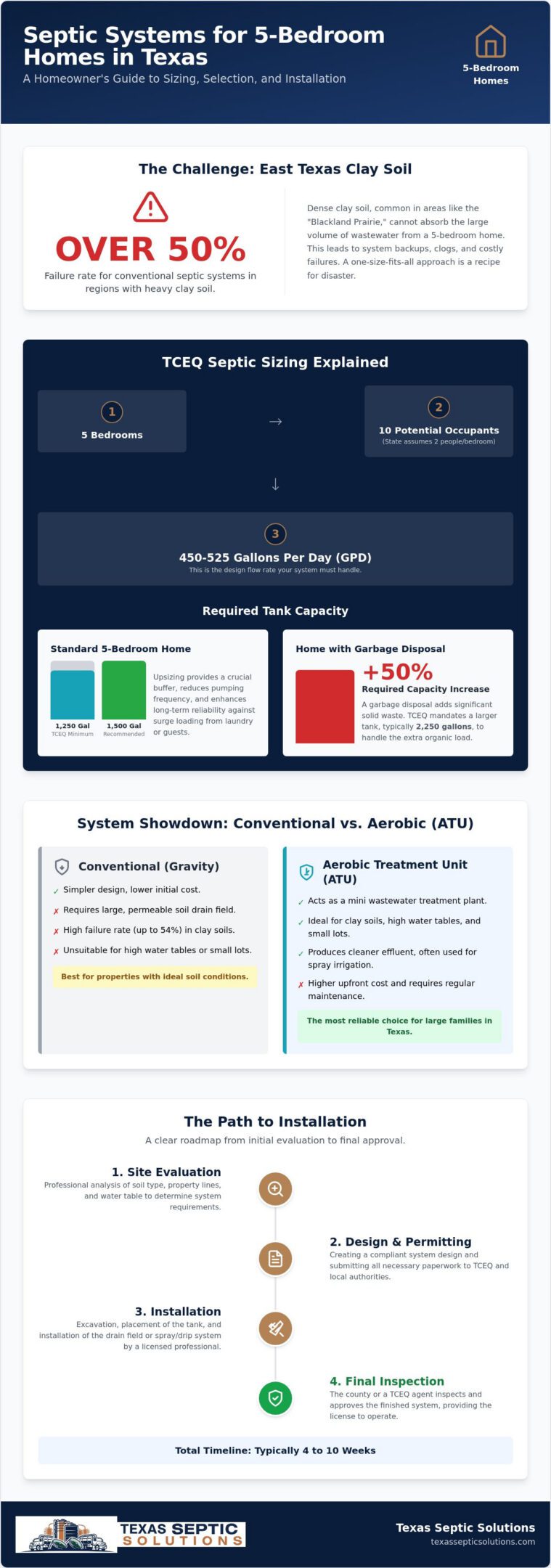
Did you know that over 50% of conventional septic systems in certain East Texas regions fail because of heavy clay soil? When you are designing a septic tank for a 5 bedroom house Texas, these statistics are more than just numbers; they are a warning that a one-size-fits-all approach doesn’t work for large families. It’s completely normal to feel overwhelmed by TCEQ sizing rules or the fear of a system backing up during a holiday gathering. You need a setup that handles heavy daily usage without the constant threat of a messy, expensive failure.
This guide will show you exactly how to size your system correctly, whether you need a 1,500-gallon tank or a larger 2,250-gallon unit for homes with garbage disposals. We’ll walk through the current 2026 permitting process, explain how local soil dictates your installation type, and help you understand the 4 to 10-week timeline for approval. By the end, you’ll have a clear roadmap to a reliable, compliant system that protects your property and your peace of mind.
Key Takeaways
- Understand the mandatory TCEQ sizing requirements for a septic tank for 5 bedroom house Texas, including why a garbage disposal can increase your required tank capacity by 50%.
- Learn how East Texas clay soils and high water tables dictate whether you need a conventional gravity system or an Aerobic Treatment Unit (ATU).
- Get a clear roadmap for the 4 to 10-week permitting and installation process, from the initial site evaluation to the final county inspection.
- Discover why high-flow households require specialized engineering to prevent premature leach field failure and ensure long-term system health.
- Identify the essential maintenance steps and professional pumping schedules needed to keep a large-scale residential system running without backups.
Texas Sizing Requirements for a 5-Bedroom Septic System
Texas Commission on Environmental Quality (TCEQ) Chapter 285 governs every private wastewater system in the state. If you are building or upgrading, following these rules is the only way to avoid legal headaches and system failures. For a large residence, the state focuses on the potential number of occupants rather than just the number of bathrooms. This is why a septic tank for 5 bedroom house Texas must meet specific Gallons Per Day (GPD) flow rates to stay compliant. A septic tank serves as the primary treatment stage where solids separate from liquids; for a five-bedroom home, that tank has to be large enough to handle significant volume without overflowing.
Surge loading is a common issue for large Texas families. This happens when your household generates a massive amount of wastewater in a short window, like during the morning rush or on a heavy laundry day. If your tank is too small, that rush of water can push untreated solids directly into your soil treatment area. This leads to clogs and expensive repairs that could have been avoided with proper initial sizing.
Calculating Daily Usage for Large Households
Texas regulators use a standard assumption of two people per bedroom to calculate potential usage. For a five-bedroom home, the system is designed to handle the waste of up to ten people. This usually results in a design flow of 450 to 525 GPD. While high-efficiency fixtures like low-flow toilets can reduce your actual water footprint, the state still requires the system to be built for the home’s maximum potential capacity. It is a safety net that ensures the system won’t fail if your family grows or you have guests staying over for the weekend.
TCEQ Minimums vs. Real-World Reliability
The absolute minimum tank size allowed for five bedrooms is 1,250 gallons. However, many homeowners find that just meeting the code isn’t enough for long-term peace of mind. If you include a garbage disposal, the TCEQ requires a 50% increase in tank capacity. This requirement often moves the tank size up to 2,250 gallons to handle the extra organic load. Upsizing to a 1,500-gallon tank even without a disposal is often a smart move for reliability. It gives the bacteria more time to break down waste and reduces how often you need professional pumping. On-Site Sewage Facilities (OSSF) is the legal term for Texas septic systems that you will see on all your official permit paperwork.
Aerobic vs. Conventional: Which is Best for Your 5-Bedroom Home?
Choosing between an aerobic or conventional system is the biggest decision you’ll make for your property. While a conventional system is simpler, it relies entirely on your soil’s ability to absorb wastewater. For a septic tank for 5 bedroom house Texas, the volume of water produced daily puts immense pressure on that soil. If your land doesn’t have the right “perc” rate, which is the speed at which water drains through the earth, a conventional setup will likely fail. This is why a professional site evaluation is the first step in any project.
The Conventional System Limit
Conventional gravity systems use a tank and a series of underground pipes called a drain field. For a 5-bedroom home, this drain field must be massive to handle the 450-plus gallons of water your family uses daily. In areas with “Blackland Prairie” clay, which is common across parts of Texas, the soil is too dense to absorb this volume. In fact, studies show that conventional systems in heavy clay areas have a failure rate as high as 54%. If you’re dealing with a system that’s already struggling, you can learn more about septic system repair to see if your current setup is salvageable.
The Aerobic Advantage for Large Families
Aerobic Treatment Units (ATUs) act like a small-scale municipal waste plant in your backyard. They use an air pump to circulate oxygen, which allows aerobic bacteria to break down waste much faster than a standard tank. This makes them ideal for high-occupancy homes. You can consult the TCEQ septic system suitability table to see how these systems match different soil types. Most aerobic systems use spray irrigation to distribute treated water over your lawn, though drip emitters are an option if you have a smaller yard or specific landscaping needs. When planning a septic tank for 5 bedroom house Texas, the aerobic option often provides the most reliable long-term performance for large households.
While aerobic systems are highly effective, they do require more attention. You’ll need to add chlorine tablets regularly to disinfect the water and maintain a steady power supply for the aerator. Texas law also requires owners of aerobic systems to maintain a service contract with a licensed provider, which includes at least three inspections per year. If you’re unsure which path is right for your land, our team can help you with a New Septic System Installation plan that fits your specific soil conditions.
Local Soil and Site Factors in East Texas
East Texas presents a unique set of challenges for any On-Site Sewage Facility. In communities like Houston, Cypress, and Cleveland, the soil is often dominated by heavy clay. This “Blackland Prairie” soil acts like a sponge, holding onto moisture instead of letting it filter through. When you’re planning a septic tank for 5 bedroom house Texas, this soil reality is the most important factor in your design. If the ground can’t absorb the 450 to 525 gallons of water your household produces daily, the system will back up into your home or pool on the surface of your yard.
Beyond the soil type, high water tables in coastal areas create a risk called tank buoyancy. If a large tank is installed in an area with a high water table and then pumped empty, the surrounding groundwater can actually push the tank out of the ground. This is a catastrophic failure that requires specialized installation techniques, such as anchoring the tank, to prevent. A Licensed Site Evaluator is the professional who identifies these risks before any dirt is moved. They look at the topography and the slope of your lot to ensure that water moves away from the system rather than collecting on top of it. A septic tank for 5 bedroom house Texas needs a stable environment to function correctly, and the evaluator ensures the site can provide that.
Soil Testing and the “Perc” Test
Professional soil profile analysis involves more than just looking at the dirt. The evaluator digs “test pits” to observe the different layers of soil and how they interact with water. In Shepherd and Huffman, you might find a mix of sandy loam and dense clay lenses that complicate drainage. If your property fails a standard percolation (perc) test, you cannot install a conventional system. A failed test automatically moves your project into an engineered aerobic design, which uses different methods to treat and distribute wastewater.
Protecting the Drain Field from Compaction
Planning the footprint of your 5-bedroom home is a balancing act. You have to ensure that the house, driveway, and any future structures like pools don’t encroach on the OSSF area. Soil compaction is a silent killer for septic systems. If heavy construction equipment drives over your drain field, it crushes the soil pores, making it impossible for the ground to absorb water. If you are dealing with a property where the soil has already been compromised, you should review the septic system replacement cost to prepare your budget for the necessary upgrades. Always keep your septic area clear of heavy vehicles and permanent structures to ensure the system lasts for decades.
The Texas Septic Permit and Installation Roadmap
Installing a septic tank for 5 bedroom house Texas isn’t just about digging a hole; it’s a multi-step legal process that requires precision. We’ve seen many homeowners get frustrated by the “red tape,” but having a clear roadmap makes the journey much smoother. The process begins with hiring a licensed site evaluator and a professional designer. These experts assess your soil and topography to create a plan that meets TCEQ standards. Once the design is ready, you submit the OSSF application to your local county authority, such as the health departments in Harris, Montgomery, or Liberty County.
After the county reviews your plans, they issue an “Authorization to Construct.” This is a critical green light. You cannot move a single shovel of dirt until you have this document in hand. Once construction begins, there are several inspection phases where county officials visit the site to verify the installation matches the approved design. Finally, after the system is in the ground and covered, you receive a “Notice of Approval.” This is the official document that says your system is safe and legal to use. The entire process, from application to final inspection, typically takes between 4 and 10 weeks.
Who Handles the Paperwork?
Managing county relations can be a full-time job. In fast-growing areas like Cypress and Cleveland, permit offices are often backed up, which can lead to delays in the review process. We take that burden off your shoulders by handling the “permit headache” from start to finish. OSSF permits are tied to the property deed and must be transferred during a sale. This ensures the next owner knows exactly what kind of system they are inheriting and that it remains fully compliant with state law.
Timeline Expectations for New Construction
Timing is everything when building a large home. You should always plan your septic system before the home foundation is poured. If you wait, you might find that your dream house footprint leaves no room for the massive drain field required for a 5-bedroom residence. Seasonal weather also plays a huge role in Texas. Heavy spring rains can halt installation for days or weeks because we can’t properly compact soil or set tanks in muddy conditions. If you’ve just moved in and your septic tank alarm goes off, don’t panic. It’s common for new systems to have minor sensor adjustments during the first few months of use. If you are ready to start your project, we can provide a turn-key New Septic System Installation that handles every step of this roadmap for you.
Why Expert Design is Vital for 5-Bedroom Septic Systems
Expert design is the only way to avoid the “undersized system” trap. When a septic tank for 5 bedroom house Texas is built to the bare state minimum, it often struggles under the heavy pressure of a full household. If your leach field receives more water than it can process, it will eventually saturate and fail. A professional designer looks beyond the basic TCEQ requirements to ensure your system handles the actual flow of your family. This foresight prevents early failures and ensures your system remains a quiet, reliable part of your home’s infrastructure. We’ve seen how a few extra gallons of capacity can be the difference between a system that lasts thirty years and one that fails in five.
Beyond functionality, a well-designed OSSF adds significant value to your Texas property appraisal. Homebuyers in the Greater Houston area are increasingly savvy about septic health. They want to see a system that is properly permitted, sized for the home, and backed by a history of professional care. An engineered aerobic system, when installed correctly, projects a sense of stability and modern utility that protects your long-term investment. It’s a “silent” feature that becomes very loud if it isn’t handled by an expert from day one.
Long-Term Care for Large Systems
A five-bedroom house generates a high volume of waste, which means you can’t afford to “set it and forget it.” We recommend a strict 2-3 year pumping schedule to remove solids before they can escape into your drain field or spray area. Following a septic system maintenance plan is especially vital for aerobic units, where mechanical parts like aerators and pumps need regular check-ups. At Texas Septic Solutions, we support our neighbors from the initial installation through years of routine care and even emergency repairs. Having a partner with 24/7 emergency availability means you’re never left stranded if a high-volume weekend puts your septic tank for 5 bedroom house Texas to the test.
Ready to Design Your 5-Bedroom System?
There’s a major advantage to working with a local expert who understands the specific clay and water table challenges in Houston or Cleveland. We don’t just see you as a project; we see you as a neighbor who deserves a system that works every time you flush. Getting started is simple. We can guide you through a professional site evaluation to determine the best design for your specific lot and household needs. Contact Texas Septic Solutions for a professional site evaluation and installation quote. We’ll handle the engineering, the permits, and the installation so you can focus on enjoying your home.
Secure Your Home’s Long-Term Functionality
Building or upgrading a large residence requires a wastewater strategy that matches your family’s lifestyle. You now understand that a septic tank for 5 bedroom house Texas needs careful sizing, often reaching 1,500 to 2,250 gallons, to handle high daily flow and surge loading. Whether your land requires a conventional gravity system or an engineered aerobic unit, matching the technology to your specific soil is the only way to prevent costly backups and property damage. Professional design and permitting are not just legal hurdles; they are the foundation of a system that adds value to your property for decades.
Texas Septic Solutions is here to take the stress out of the process. As Licensed Texas OSSF Installers, we serve Cleveland, Houston, Cypress, and the surrounding communities with expert care. We offer 24/7 Emergency Service to ensure your household stays running smoothly, no matter the situation. Don’t leave your home’s health to chance. Request an Installation Quote from Texas Septic Solutions today to get started with a partner you can trust. We look forward to helping you build a system that stands the test of time.
Frequently Asked Questions
What is the minimum septic tank size for a 5-bedroom house in Texas?
The minimum required septic tank capacity for a 5-bedroom house in Texas is 1,500 gallons. If you have a garbage disposal installed, state regulations require a 50% increase in capacity, bringing the minimum to 2,250 gallons. This ensures the system can handle the extra organic load without clogging the treatment area or requiring excessive maintenance during the first few years of use.
Can I install a conventional septic system for a 5-bedroom house in Houston?
It depends on your soil, but it’s often difficult to install a conventional system in Houston due to the heavy clay content. Conventional systems require specific percolation rates that the “Blackland Prairie” clay rarely meets. Most new 5-bedroom builds in the Greater Houston area utilize aerobic treatment units because they can safely distribute treated water even in dense, non-absorbent soil conditions.
How much does a new septic system for a 5-bedroom house cost in Texas?
The cost of a septic tank for 5 bedroom house Texas depends on several variables, including the type of system required by your soil and the complexity of the design. Aerobic systems generally involve a higher upfront investment than conventional systems because they include mechanical components like aerators and pumps. You should also factor in the mandatory site evaluation and engineering fees that accompany any new installation.
How long does the septic permit process take in Texas?
The septic permit process in Texas typically takes between 4 and 10 weeks from the initial application to the final inspection. This timeline includes the design phase, county review, and the “Authorization to Construct.” Delays can occur in fast-growing counties like Montgomery or Liberty if the local health department is experiencing a high volume of applications or if weather prevents a timely site evaluation.
Do I need a different septic system if I have a 5-bedroom house on 10 acres?
Texas law provides a permit exemption for single-family homes on properties of 10 acres or larger. To qualify, the system must be located at least 100 feet from all property lines. However, even with this exemption, we strongly recommend a professional installation. A poorly designed system on a large lot can still fail and contaminate local groundwater, leading to expensive repairs and environmental hazards later.
How often should a 5-bedroom septic tank be pumped in Texas?
For a large 5-bedroom household, you should have your septic tank pumped every 2 to 3 years. High water usage from multiple bathrooms and laundry loads causes solids to accumulate faster than in smaller homes. Regular pumping prevents these solids from overflowing into your drain field or spray irrigation heads, which is the most common cause of total system failure in large septic tank for 5 bedroom house Texas installations.
What is the setback requirement for a septic tank from a well in Texas?
TCEQ regulations require a minimum setback of 50 feet between a septic tank and a private water well. Additionally, the drainfield or spray area must be at least 100 feet away from any well. These distances are strictly enforced to protect your drinking water from potential contamination. Always verify these setbacks with your local county authority, as some regions have even stricter requirements based on local geography.
Is an aerobic system mandatory for new 5-bedroom builds in East Texas?
While not legally mandatory for every property, aerobic systems are effectively the standard for new builds in East Texas due to the soil conditions. The expansive clay and high water tables found in Cleveland and Cypress make conventional drainfields prone to failure. An aerobic system provides the higher level of treatment needed to handle these environmental challenges and ensures your large household waste is processed safely and efficiently.