
Septic Tank Deep Pumping: Expert Solutions for Deeply Buried Systems
Most standard septic trucks are physically incapable of cleaning a tank buried more than a few feet underground, making specialized septic tank deep pumping a necessity for many local homeowners. If your system sits deep beneath the Texas soil, a routine service call can quickly turn into a logistical nightmare of half-emptied tanks and ruined landscaping. We understand the stress of higher service fees and the fear that a backhoe might be the only way to reach your system. You deserve a solution that doesn’t involve tearing up your yard just to handle routine maintenance.
We’re here to help you understand exactly what this specialized process involves and when it’s required for your property. You’ll learn how high-vacuum equipment ensures a complete clean even when depth makes standard suction fail. We’ll also provide a clear plan to help you manage your deeply buried system and share strategies to avoid expensive excavation costs in the future.
Key Takeaways
- Understand why systems buried more than four feet deep need specialized high-lift vacuum technology for a thorough clean.
- Discover how professional septic tank deep pumping uses high-CFM blowers to overcome the suction limits of standard service trucks.
- Learn the technical differences between routine maintenance and deep extraction, including why depth affects service costs.
- Find out how installing septic risers provides a permanent solution to deep-tank access issues and helps you avoid future excavation fees.
- Get a clear maintenance plan from local experts who specialize in the difficult jobs that standard pumpers can’t handle.
What is Septic Tank Deep Pumping?
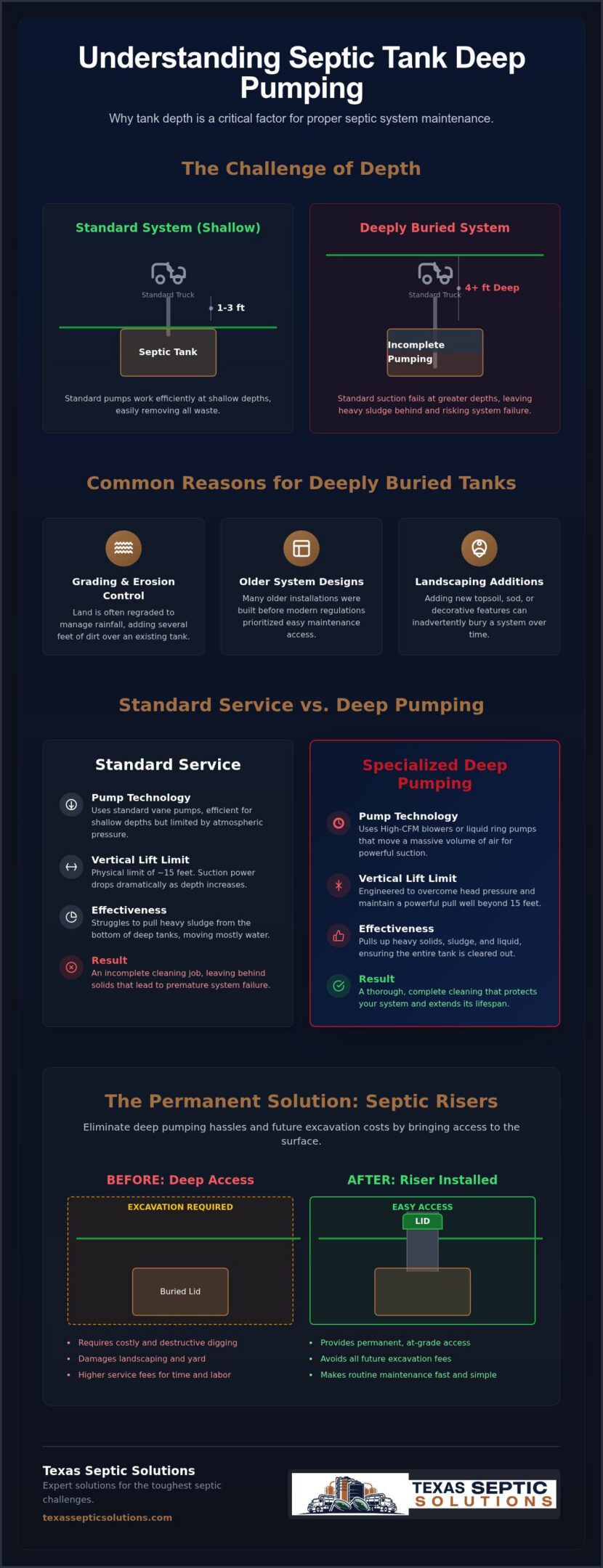
Septic tank deep pumping is a specialized technical operation for systems where the access lids sit four feet or more below the ground surface. While a standard septic tank is typically buried within 12 to 24 inches of the topsoil, many Texas properties feature systems that are significantly deeper. This isn’t a job for a standard pumper with extra hose. It requires specialized high-lift vacuum technology to effectively remove heavy sludge from depths that would stall out basic equipment.
Common Reasons for Deeply Buried Tanks
Several factors can lead to a tank being buried beyond the reach of standard tools. Property owners often discover this issue after years of gradual changes to their land. Common causes include:
- Grading and Erosion Control: In areas like Houston and Cleveland, land is often regraded to manage heavy rainfall, which can add several feet of dirt over an existing tank.
- Older System Designs: Many older septic installations predated modern regulations that prioritize easy access for maintenance.
- Landscaping Additions: Adding new topsoil, sod, or decorative features can inadvertently bury a system deeper than its original design intended.
The Limits of Standard Septic Pumping
Standard vacuum trucks operate using basic suction lift, which is heavily limited by atmospheric pressure. As the vertical distance between the truck and the waste increases, the pump’s efficiency drops. Physics doesn’t play favorites. Most standard equipment reaches a physical limit around 15 feet of vertical lift. At this point, the pump might move water, but it lacks the force to pull up the heavy solids settled at the bottom.
This is where professional septic tank deep pumping becomes essential. Without high-CFM (Cubic Feet per Minute) blowers, the thickest waste remains in the tank. You’re essentially paying for a service that’s only half-finished. We use specialized equipment to ensure the entire tank is cleared, preventing the premature failures that come from left-behind sludge. If your system is buried deep in the Texas clay, standard suction isn’t enough to get the job done right.
The Technical Challenges of High-Lift Pumping
Pumping a tank that’s buried deep underground isn’t just about having a longer hose. It’s a battle against physics. The primary obstacle is head pressure, which is the resistance created by the weight of the waste column as it moves upward. As the depth increases, the vacuum must work significantly harder to overcome this weight. Without the right equipment, the vacuum seal will fail, and the waste simply won’t move.
Effective septic tank deep pumping relies on maintaining an airtight system from the tank lid all the way to the truck. Even a tiny leak in a hose coupling can cause a total loss of suction when you’re pulling from six or eight feet down. This is why we use heavy-duty, reinforced hoses and specialized seals designed for high-vacuum environments. It’s also why these jobs typically require a two-person crew. One technician manages the truck’s vacuum levels while the other handles the “stinger” pipe in the tank to ensure we’re pulling up solids, not just water.
Vacuum Technology for Deep Systems
Most routine pump trucks use vane pumps. These are great for standard depths, but they lack the raw power needed for high-lift operations. For deeper systems, we utilize high-CFM (Cubic Feet per Minute) vacuum blowers or liquid ring pumps. These systems move a much larger volume of air, creating a more powerful and consistent pull. Suction lift is the vertical distance a pump can move fluid. When that distance exceeds the capabilities of a standard truck, these high-output blowers are the only way to ensure a thorough clean.
Safety Protocols for Deep Access
Safety is our top priority when dealing with deeply buried systems. Digging a hole four or five feet deep to reach a lid creates a significant risk of soil cave-ins, especially in the loose or sandy soils found in parts of the Houston area. Proper septic system maintenance shouldn’t put anyone in danger.
Deep tanks also tend to trap higher concentrations of methane and hydrogen sulfide gases because they aren’t as well-ventilated as shallower systems. These gases are toxic and highly flammable. You should never attempt to uncover or inspect a deep tank lid on your own. If you suspect your system is buried too deep for a standard service, let our professionals at Texas Septic Solutions handle the heavy lifting and the risks for you.
Deep Pumping vs. Standard Service: A Comparison
Standard septic service is like a routine oil change. It’s quick, predictable, and relies on standard tools. However, septic tank deep pumping is a more intensive technical operation. When your tank sits under four or more feet of Texas soil, the logistics change completely. You aren’t just paying for waste removal. You’re paying for specialized machinery and the extra labor needed to reach that depth without hurting your property or the system’s integrity. Following standard septic system maintenance guidelines is simple when the tank is shallow. Deep systems require a much more robust approach to make sure that bottom sludge layer is actually gone.
Comparing Service Logistics
The differences start with how we access the tank. At a standard depth of 12 to 24 inches, a technician can usually clear the lid with a hand shovel in minutes. Once the burial depth hits 48 inches or more, manual digging becomes impractical and unsafe. We often bring in a mini-excavator to reach the lids efficiently. This prevents hours of back-breaking labor and keeps the service window manageable. While a standard vacuum truck works perfectly for shallow tanks, septic tank deep pumping requires high-vacuum specialized units. These trucks use powerful blowers to maintain the suction needed to pull heavy solids up a vertical distance that would stall out a standard pump.
When to Call for Specialized Deep Pumping
How do you know if your property requires this specialized level of care? One major red flag is a history of incomplete cleanings. If a previous pumper told you they “got what they could” or if your tank seems to fill back up unusually fast, they likely didn’t have the vacuum power to reach the bottom. You should also look at your property’s layout. If your tank is located at the bottom of a steep slope or in an area where significant fill dirt was added for leveling, it’s almost certainly a candidate for deep pumping. We see this often in newer developments around Houston where land grading has changed the original depth of the system. If you can’t see your lids and you know they’re deep, don’t settle for a standard service that might leave the most harmful solids behind.
Eliminating Deep Pumping Hassles with Septic Risers
If you’re tired of the logistical headaches and higher costs associated with septic tank deep pumping, septic risers are the definitive solution. A riser is a vertical extension that brings your tank’s access point from several feet underground up to the surface. Instead of paying for heavy excavation every few years, you simply unscrew a lid. This modification is a cornerstone of effective septic system maintenance Texas homeowners use to keep their systems accessible. When a tank is easy to reach, inspections happen more often, and problems are caught before they become emergencies.
The Riser Installation Process
Installing a riser requires precision to protect your system’s integrity. We start by excavating the soil to reveal the original tank lids. After removing the old covers, we seal the new riser pipes directly to the tank. While some older systems use concrete, we prefer high-density polyethylene (HDPE). HDPE is resistant to soil chemicals and creates a much tighter seal. We focus on making the connection completely watertight. This prevents groundwater from leaking into your tank, which can flood your system and cause the drain field to fail.
ROI: Calculating the Savings
The financial benefits of risers become obvious after just one or two service cycles. You’ll stop paying the premium labor rates required for septic tank deep pumping and the mechanical excavation fees that come with it. Beyond the direct costs, you’ll protect your landscaping. You won’t have to worry about a backhoe tearing up your grass every time the tank needs a pump. If your tank shows signs of wear from the weight of deep soil, we can address those issues with a septic system repair during the installation. It’s a one-time investment that pays for itself through lower maintenance bills and a longer-lasting system.
Stop digging up your yard and start saving money on your utility maintenance. Contact Texas Septic Solutions to schedule your riser installation and simplify your septic care for good.
Expert Septic Pumping in Cleveland and the Houston Area
Texas Septic Solutions specializes in the complex scenarios that standard service providers often avoid. We provide expert care across Cleveland, Houston, Cypress, Huffman, and Shepherd, bringing the heavy-duty equipment required for successful septic tank deep pumping. Deeply buried systems shouldn’t be a source of constant anxiety for property owners. We combine our technical expertise with a commitment to our local community; we’re your neighbors, and we treat your property with the same respect we’d show our own.
Local Knowledge of Texas Soil and Grading
East Texas soil presents unique challenges, particularly the heavy clay common in the Houston area. This clay is incredibly dense and heavy, making deep excavation for lid access a delicate process. If handled incorrectly, the pressure from surrounding soil can damage the tank walls or cause the excavation site to collapse. We understand these local drainage patterns and how they contribute to systems being buried deeper over time. Our team ensures that every job stays in compliance with Texas environmental standards, protecting both your property and the local ecosystem.
Schedule Your Deep Pumping Assessment
Before we send a truck to your property, we perform a thorough evaluation of your system’s specific needs. We avoid guesswork by discussing your tank’s history, any previous service issues, and the estimated depth of your lids. When we arrive for your first professional septic tank deep pumping service, you can expect a clear explanation of the work being performed and a transparent assessment of your system’s health. We don’t just pump and leave; we provide a complete look at your system’s functionality.
Our 24/7 availability is a critical lifeline for owners of deep systems. Because these tanks are harder to monitor, backups can feel like they happen out of nowhere. We’re ready to respond at any hour, ensuring a deep-seated problem doesn’t lead to a total system failure. Whether you need an emergency pump or you’re ready to transition to a more manageable maintenance plan with risers, we provide the straightforward, reliable solutions you need to keep your home running smoothly. That’s our “neighborly expert” promise to you: straight talk and solutions that last.
Secure Your System’s Future with Professional Care
Managing a deeply buried septic system doesn’t have to be a source of stress or property damage. You now understand how specialized high-lift equipment overcomes the physical limits of standard suction, ensuring that heavy sludge is fully removed rather than left to accumulate at the bottom. By choosing a provider with the right tools and local expertise, you protect your drain field and extend the life of your entire system. Installing risers remains the smartest move to simplify future maintenance and eliminate the need for costly excavation every few years.
Our expert local technicians in Cleveland and Houston bring specialized high-lift pumping equipment to every job, ensuring your tank is serviced correctly the first time. We’re always ready to help with 24/7 Emergency Service if your deep system faces an unexpected backup. Don’t let a deeply buried tank lead to incomplete cleaning or yard destruction through standard methods. Professional septic tank deep pumping is the only way to guarantee a truly clean system.
Schedule your professional deep pumping service with Texas Septic Solutions today! We’re ready to help you take the guesswork out of your septic maintenance and keep your home running smoothly.
Frequently Asked Questions
How do I know if my septic tank is considered ‘deep’?
A septic tank is generally considered deep if the access lids are buried four feet or more below the ground surface. You might notice your property has high-grade slopes or that significant fill dirt was added during construction. If a previous service provider couldn’t find your lids with a standard probe or mentioned they were too deep to reach, your system requires specialized care.
Can any septic company handle deep tank pumping?
No, not every provider has the machinery needed for these jobs. Most routine service trucks use vane pumps that lose suction at significant depths. Effective septic tank deep pumping requires high-CFM vacuum blowers that can overcome head pressure. Without this specific technology, the truck won’t be able to pull heavy solids from the bottom of a deep tank, leaving your system partially full.
Why is deep pumping more expensive than a standard service?
The higher cost reflects the specialized equipment and increased labor involved. Deep jobs often require mechanical excavation with a mini-excavator rather than simple hand-digging. Additionally, we typically deploy a two-person crew to manage the high-vacuum equipment and ensure safety. These factors, combined with the extra time needed to maintain an airtight seal at depth, contribute to the premium service rate.
Will deep pumping damage my lawn or landscaping?
Accessing a deeply buried lid usually requires some excavation, which will temporarily impact your yard. We use compact, specialized machinery like mini-excavators to keep the footprint as small as possible. To avoid this disruption in the future, we recommend installing septic risers during your service. Risers bring the lids to the surface, so we never have to dig up your grass again.
How often should a deeply buried septic tank be pumped?
You should follow the same 3 to 5 year interval recommended for standard systems. However, because deep tanks are much harder to inspect, you can’t easily check the sludge levels yourself. This makes sticking to a strict maintenance schedule even more important. Neglecting a deep system often leads to more severe backups because the early warning signs are hidden under several feet of soil.
Is it possible to raise the level of a deep septic tank?
Yes, you can permanently solve the depth problem by installing septic risers. These are durable extensions made of HDPE or concrete that attach to your tank and bring the access point to ground level. Once installed, the lids are easily accessible for both pumping and routine inspections. It’s the most effective way to eliminate the need for heavy excavation and specialized pumping equipment in the future.
What equipment is needed for septic tank deep pumping?
This process requires high-output vacuum blowers or liquid ring pumps rather than standard vane pumps. We also use reinforced, heavy-duty hoses that won’t collapse under the intense vacuum pressure needed for a high lift. Airtight seals and specialized “stinger” pipes are mandatory to ensure we can pull up the thick sludge layers that settle at the bottom of these deeply buried systems.
Can a deep tank cause more frequent septic backups?
A deep tank doesn’t cause backups on its own, but incomplete cleaning certainly does. If a standard pumper only removes the liquid and leaves the heavy solids behind, your tank reaches capacity much faster. This reduced volume leads to frequent plumbing issues and potential drain field damage. Professional septic tank deep pumping ensures the tank is completely emptied, restoring its full capacity and preventing premature backups.