
Septic Tank Abandonment Procedure in Texas: A 2026 Homeowner’s Guide
What if that “soft spot” in your backyard isn’t just a patch of bad grass, but the first sign of a collapsing underground void? Many Texas homeowners transitioning to city sewer lines don’t realize that simply turning off the old pump isn’t enough. Following the official septic tank abandonment procedure Texas requires is a legal necessity to prevent dangerous sinkholes and environmental contamination. Since roughly 20% of new homes in the state still use on-site sewage facilities according to 2026 TCEQ data, knowing how to close them down correctly is more important than ever for your family’s safety.
It’s frustrating to deal with complex state regulations when you just want a stable yard for your kids and pets to play in. We know you want this done right the first time so you can avoid property sale delays or “surprise” inspections during a future title search. In this guide, you’ll learn the exact legal requirements under Texas Administrative Code Section 285.36 and the step-by-step safety procedures for decommissioning your system. We will walk you through the entire process, from the mandatory professional pumping to the final backfill with approved materials, ensuring your property remains safe and fully documented.
Key Takeaways
- Learn why properly decommissioning your tank prevents dangerous yard sinkholes and protects you from legal liability during future property sales.
- Understand the specific septic tank abandonment procedure Texas requires under the Administrative Code to ensure your property meets 2026 environmental standards.
- Compare the cost and benefits of filling your tank in place versus total removal to determine the best fit for your future landscaping plans.
- Discover why professional pumping is the non-negotiable first step to safely clearing hazardous residuals before any structural work begins.
- See how partnering with a licensed expert streamlines the documentation process and keeps your sewer conversion project on schedule.
What is Septic Tank Abandonment and Why is it Required in Texas?
Septic tank abandonment is the formal, legal process of decommissioning an on-site sewage facility (OSSF) so it no longer poses a threat to people or the environment. It isn’t as simple as just stopping the use of your system or cutting off the power to an aerobic pump. To understand the complexity, it helps to first know What is a Septic Tank? and how its heavy components interact with the ground. In Texas, this procedure is strictly regulated to ensure that old, buried structures don’t become hidden hazards for future generations.
The septic tank abandonment procedure Texas mandates is designed to address three primary concerns: structural integrity, environmental health, and legal liability. When a tank is left in the ground without being properly filled or removed, it eventually weakens. Over time, the lid or walls can fail, creating a sudden void. This “sinkhole effect” is a particular concern in East Texas and the Greater Houston area, where shifting clay soils put immense pressure on aging concrete or steel tanks. Without the correct decommissioning steps, these old systems become ticking time bombs buried just a few feet beneath your lawn.
Most homeowners encounter this requirement when they’re finally able to connect to a municipal sewer line. While moving to city utilities is a great upgrade, Texas law doesn’t allow you to leave the old infrastructure behind in an unsafe state. Whether you’re upgrading to a new aerobic system or moving to city water, the abandonment process ensures your property remains stable and compliant with state standards.
The Dangers of an Improperly Abandoned Tank
An unsealed, empty tank is a significant safety risk. The most immediate danger is a structural collapse. A standard riding lawnmower or a parked vehicle can provide enough weight to cave in a corroded tank lid, leading to serious injury or property damage. Beyond the physical risk, unused tanks can trap toxic methane gases. If the tank wasn’t pumped out correctly, remaining sludge can leak into the groundwater, leading to environmental contamination that you, as the property owner, could be held liable for during a future sale.
When is Abandonment Legally Required?
In Texas, abandonment isn’t usually optional. If a public sewage system becomes available within a certain distance of your property, local ordinances often require you to connect and abandon your old system within 30 to 60 days. You’ll also need to follow the septic tank abandonment procedure Texas rules if your current system has failed beyond repair and must be replaced. We frequently see this in growing areas like Cypress, Huffman, and Shepherd, where property redevelopment or subdivisions require clearing out old utility footprints to make way for new construction.
Texas Administrative Code: The Legal Framework for Decommissioning
Understanding the legal side of decommissioning a system doesn’t have to be overwhelming. The Texas Administrative Code (TAC) provides the specific rulebook every homeowner must follow. Specifically, Title 30, Part 1, Chapter 285, Section 285.36 outlines exactly how to handle old tanks to protect the public and the local environment. While the Texas Commission on Environmental Quality (TCEQ) sets these statewide standards, they often delegate enforcement to local “Authorized Agents.”
In counties like Harris, Liberty, or Montgomery, your local environmental health department acts as the primary authority. They ensure the septic tank abandonment procedure Texas requires is followed to the letter. This coordination means you might need to pull a local permit even though the rules are written at the state level. These permits typically cost between $200 and $500 as of 2026, depending on your specific jurisdiction. This fee covers the administrative review and the final inspection that closes out your property’s septic record.
TCEQ Requirements for Abandoned Systems
The state’s requirements are very specific to prevent future accidents. First, you must have all wastewater, sludge, and residuals pumped from the tank by a registered waste transporter. This is a non-negotiable safety step. Once the tank is empty, the top of the tank or the lid must be removed or crushed into the tank. This prevents the structure from ever holding water or air again. Finally, the remaining cavity must be filled to ground level with clean material. Under state law, this fill material must be less than three inches in diameter and completely free of organic matter or construction debris, like wood or scrap metal. Using the right fill ensures the ground stays stable and won’t settle or sink over time.
Documentation and Reporting
Once the physical work is done, the paperwork begins. You must submit a formal abandonment report to your local authorized agent or the TCEQ. This report confirms that the tank was pumped by a pro and filled according to code. It’s also wise to record the exact GPS coordinates or a detailed map of the decommissioned tank’s location on your property deed. Failure to document abandonment can stall a home sale in Texas, as title companies and buyers will want proof that the old system isn’t a hidden liability. If you’re currently navigating a sewer conversion, our team can provide the professional pumping and site prep required to keep your documentation clean and your project on track.
Removal vs. Filling in Place: Which Method is Best?
When deciding how to decommission your old system, you generally have two choices under state law: filling the tank or pulling it out of the ground entirely. Both methods satisfy the septic tank abandonment procedure Texas requires, but they serve very different goals for your property. For the average homeowner in the Greater Houston area, the decision usually comes down to what you plan to do with that patch of yard in the future. We often see neighbors in Cleveland or Shepherd choose the method that minimizes disruption to their existing landscaping while still checking all the legal boxes.
For most residential situations, abandonment in place is the preferred route. This method is straightforward and keeps your costs manageable. Since the tank stays where it is, you don’t have to worry about the massive mess that comes with deep excavation. However, if you have plans to build an addition to your home, install a swimming pool, or put in a heavy driveway over that specific spot, physical removal is the only way to go. Removing the tank ensures that the soil can be properly compacted to support new structures without the risk of the ground shifting later. Following the right Professional Assistance for Texas Abandonment guidelines ensures that regardless of the method you choose, the environmental impact remains zero.
Option 1: Abandonment in Place (Filling)
This is the most common choice for a reason. It’s efficient and cost-effective. By pumping the tank, crushing the lid, and filling the cavity with sand or gravel, you create a stable underground “plug.”
- Pros: It’s much less disruptive to your grass and trees. It’s also significantly more affordable than a full excavation.
- Cons: The concrete or plastic structure remains in the ground forever. If it’s not filled with the correct material, the ground above it might settle over time.
- Best for: Established yards where you don’t plan on building any new structures.
Option 2: Physical Removal of the Tank
Removing a tank is a heavy-duty construction project. It requires bringing in backhoes and dump trucks to haul away several tons of concrete or fiberglass.
- Pros: It completely clears the land. You’ll never have to disclose an “abandoned tank” on future property documents because it’s simply gone.
- Cons: The labor and disposal fees make this a much more expensive option. It also leaves a large hole that requires professional backfilling and compaction.
- Best for: Property redevelopment, pool installations, or new home additions.
If you’re abandoning an old tank because you’re upgrading your property, it’s helpful to look at the bigger picture. The cost of decommissioning is often bundled when you’re looking at the overall Septic system replacement cost in Texas. Whether you’re filling or removing, our team handles the heavy lifting so you can focus on enjoying your new lawn or home improvements without worrying about what’s buried underneath.
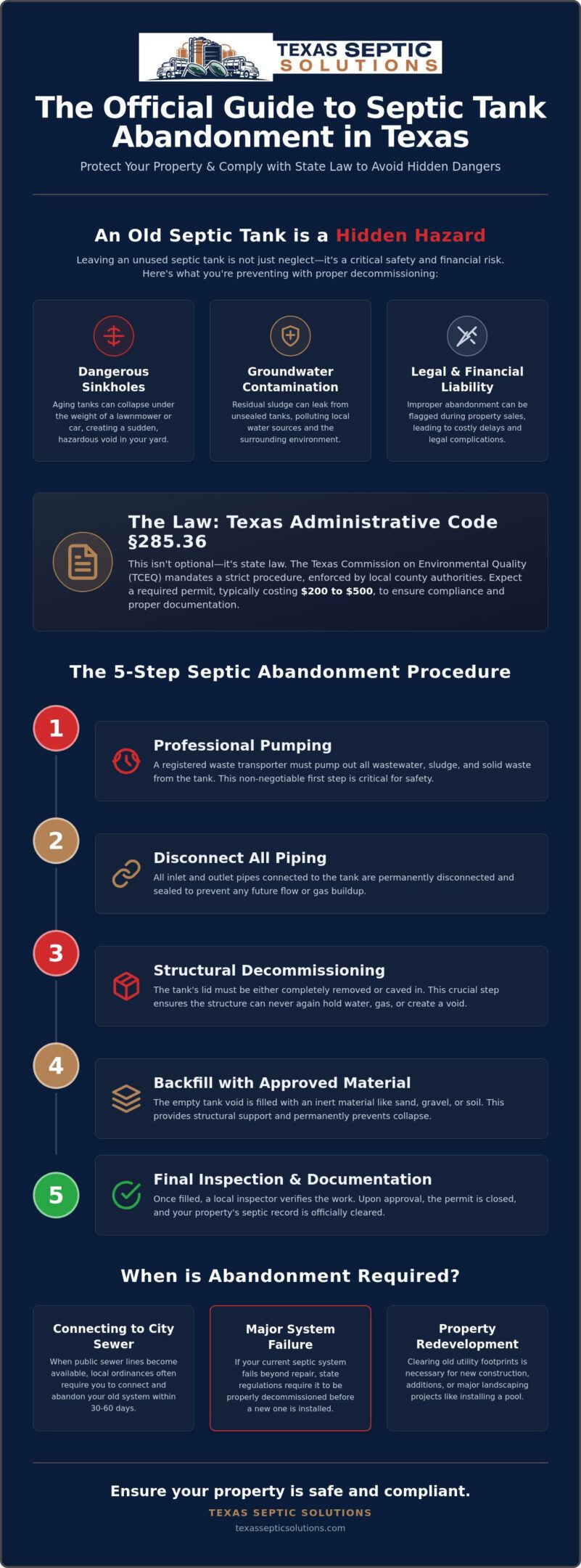
The 5-Step Septic Tank Abandonment Procedure
Executing the septic tank abandonment procedure Texas requires is a methodical process that turns a buried liability into a stable piece of land. While the legal framework sets the rules, the physical work ensures your yard remains safe for decades. This sequence moves from sanitation to structural stabilization, ensuring no hazardous voids are left behind. Most homeowners can expect the initial pumping phase to cost between $350 and $600 depending on the tank size and location.
- Step 1: Professional Pumping. A registered waste transporter must remove all liquids and solids. This is the non-negotiable first step to eliminate biohazards and odors.
- Step 2: Disconnection. We cut and cap the inlet and outlet pipes. This prevents any future water from entering the abandoned structure from the house or the old drain field.
- Step 3: Crushing or Punching. The tank lid is removed or crushed into the bottom. In many cases, we also punch holes in the bottom of the tank to ensure that groundwater can drain through rather than collecting inside.
- Step 4: Filling. The empty cavity is filled with approved materials. Texas law requires fill material to be less than three inches in diameter and free of organic debris.
- Step 5: Grading. The final layer consists of topsoil mounded slightly above the surrounding grade. This allows for natural settling and prevents water from pooling over the old tank site.
The Critical Role of Professional Pumping
You shouldn’t ever skip the professional pump-out. Residual sludge is a concentrated biohazard that can contaminate the surrounding soil if left to rot in a sealed tank. Our team ensures a “clean” tank before any fill material is added, which prevents the buildup of toxic methane gases. If you’re currently dealing with a system that’s failing but not yet ready for abandonment, you might find our guide on septic system repair in Texas helpful for managing the transition.
Filling and Compacting in East Texas Clay
Homeowners in areas like Cleveland and Houston face a unique challenge: heavy clay soil. If you try to fill an abandoned tank with local clay, you risk a phenomenon called “bridging.” This happens when the thick clay clumps together, creating large air pockets at the bottom of the tank. Over time, these pockets collapse, leading to sudden sinkholes in your lawn. We prefer using clean sand or pea gravel for the bottom layers because these materials flow into every corner of the tank. This prevents the “bowl effect,” where a poorly filled tank acts like an underground swimming pool, collecting rainwater and destabilizing the ground above it.
Ready to clear your property of old utility risks? You can schedule your professional pumping and abandonment prep with our team to ensure every step meets 2026 Texas safety standards.
Professional Assistance for Texas Abandonment
While understanding the septic tank abandonment procedure Texas requires is the first step, executing it safely is a different matter. Attempting to decommission a system yourself is more than just a difficult chore; it’s a significant safety and legal risk. Unfilled tanks are structural hazards that can fail without warning, and the methane gases trapped inside old systems are both toxic and flammable. Most Texas counties require that the initial pumping phase be performed by a registered waste transporter to ensure that biohazards are handled according to state health standards.
Hiring a licensed professional provides a layer of accountability that protects your property value. When you eventually sell your home, the buyer’s inspector and the title company will look for documented proof that the OSSF was retired correctly. A “handyman special” abandonment often lacks the necessary permits and pumping receipts, which can lead to expensive delays or requirements to dig the tank back up for verification. By working with experts, you ensure that the job is done right the first time and that your yard remains a stable, safe environment for your family.
Working with Texas Septic Solutions
We take the stress out of utility transitions by providing the specialized pumping and site preparation required for a legal abandonment. Our team has deep roots in the Greater Houston area, serving neighbors in Cleveland, Cypress, and Shepherd with a focus on local compliance. We handle the heavy lifting of Step 1, ensuring every gallon of residual waste is removed before you begin the filling process. If you’re in the middle of a sewer conversion and your old system suffers a sudden failure, our 24/7 service availability ensures you aren’t left in a bind during the transition period.
Next Steps for Your Property
Getting started is a straightforward process. We recommend scheduling an initial site inspection, especially if you’re dealing with a “forgotten” tank on a newly purchased property. We can help you locate the old lid, assess the tank’s condition, and provide a clear quote for the professional pumping required by the TCEQ. Whether you’re filling a tank to make room for a new lawn or removing it entirely for a home addition, our goal is to provide the reliable support you need to close this chapter of your home’s maintenance. Don’t leave your property’s safety to chance. Contact Texas Septic Solutions for expert abandonment services and ensure your decommissioning project meets every 2026 state requirement.
Secure Your Property with a Compliant Decommissioning
Moving away from an old septic system is a major milestone for your home’s infrastructure. By following the 2026 standards, you ensure your yard remains stable and your property records stay clean for a future sale. Remember that professional pumping is the legal foundation of the entire process, and choosing between filling in place or removal depends entirely on your future building plans. Completing the septic tank abandonment procedure Texas mandates protects your family from the hidden risks of structural collapse and toxic gas buildup.
As licensed Texas OSSF professionals, we’re ready to help you navigate these regulations with ease. Whether you’re in Houston, Cleveland, or Shepherd, our team provides the specialized pumping and site prep you need to get the job done right. We even offer 24/7 emergency response if you face a system failure during your sewer conversion. Don’t leave your property’s safety to chance. Get a Quote for Professional Septic Abandonment Pumping and take the first step toward a safer, worry-free backyard today.
Frequently Asked Questions
Can I just fill my old septic tank with dirt myself?
No, you cannot legally or safely fill a tank without following state protocols. Texas law requires that a registered waste transporter pumps the tank first to remove all hazardous sludge and liquids. Attempting to fill a tank that hasn’t been professionally cleaned can lead to environmental contamination and dangerous methane gas buildup under your lawn.
How much does it cost to abandon a septic tank in Texas?
Homeowners should budget for both local permit fees and professional service costs. In 2026, permit fees in many Texas counties typically range from $200 to $500. While the total price for the physical work depends on the tank’s size and your location, professional pumping and decommissioning are mandatory expenses to ensure your property meets state safety codes.
What happens if I don’t abandon my septic tank properly?
Improperly abandoned tanks become significant physical and legal liabilities. Over time, an empty, unreinforced tank can collapse under the weight of a vehicle or lawnmower, creating a sudden sinkhole. Additionally, undocumented tanks often cause major delays during property sales, as title companies and buyers will require proof that the system isn’t an environmental hazard.
Do I need to notify the county when I abandon my septic system?
Yes, you must notify your local Authorized Agent or the TCEQ to remain in legal compliance. The septic tank abandonment procedure Texas requires isn’t complete until you file a formal abandonment report. This paperwork confirms the tank was pumped and filled correctly, which is essential for maintaining accurate property records and ensuring a smooth future home sale.
How do I find an abandoned septic tank on my property?
You can often locate an old tank by looking for green vent pipes or slight depressions in the ground where the soil has settled. If there are no visible markers, check your original property deed or contact the county health department for old permit maps. If those records aren’t available, a professional can use a probing rod or electronic locating tools to find the lid.
Can I build a deck or shed over an abandoned septic tank?
It is generally not recommended to build heavy structures like decks or sheds over a tank that was abandoned in place. Even with the best fill materials, the ground inside the tank can settle slightly over several years, which may cause your structure to tilt or crack. If you have major construction plans for that area, physical removal of the tank is the safest route.
Is a permit required for septic tank abandonment in Harris County?
Yes, Harris County requires a specific permit to modify or abandon any on-site sewage facility. Local authorities enforce these rules strictly to protect the region’s groundwater and prevent structural accidents in residential neighborhoods. You should always secure this permit before the pumping and filling process begins to avoid potential fines or legal issues during a property inspection.
How long does the abandonment procedure take?
The physical septic tank abandonment procedure Texas professionals follow usually takes one full business day to complete. This timeframe includes the arrival of the pump truck, the structural preparation of the tank, and the final backfilling with sand or gravel. However, you should plan for additional time for your local county office to process your permit application and conduct any required final inspections.