
Septic System Regulations for Small Business in Texas: 2026 Compliance Guide
A single TCEQ fine or a permit delay can keep your doors locked for months, turning your business launch into an expensive regulatory headache. You’ve worked hard to get your venture off the ground, and the last thing you need is a surprise inspection or a “stop work” order because of a simple paperwork error. It’s easy to feel overwhelmed when you realize that septic system regulations for small business Texas are significantly more complex than standard residential rules.
We understand the pressure of meeting 2026 compliance standards while trying to manage your daily operations. This guide provides a clear roadmap through current OSSF laws and commercial requirements so you can focus on your customers instead of your plumbing. We’ll cover everything from calculating daily flow rates to choosing the right system for your specific soil and business type. You’ll learn exactly how to secure your permits and set up a maintenance plan that prevents costly service interruptions, keeping your business legal and running smoothly for years to come.
Key Takeaways
- Identify how TCEQ Chapter 285 applies to your facility and why professional site evaluations are non-negotiable for new business permits.
- Master the specific septic system regulations for small business Texas to ensure your system handles the unique flow rates of employees and customers.
- Learn why commercial kitchens require specialized components like grease traps to remain compliant with state waste-strength standards.
- Protect your investment by understanding the mandatory maintenance contracts and reporting schedules required for aerobic treatment units.
- Navigate the permitting process with confidence by leveraging local expertise tailored to the specific soil types found in East Texas.
What Are OSSF Regulations for Texas Small Businesses?
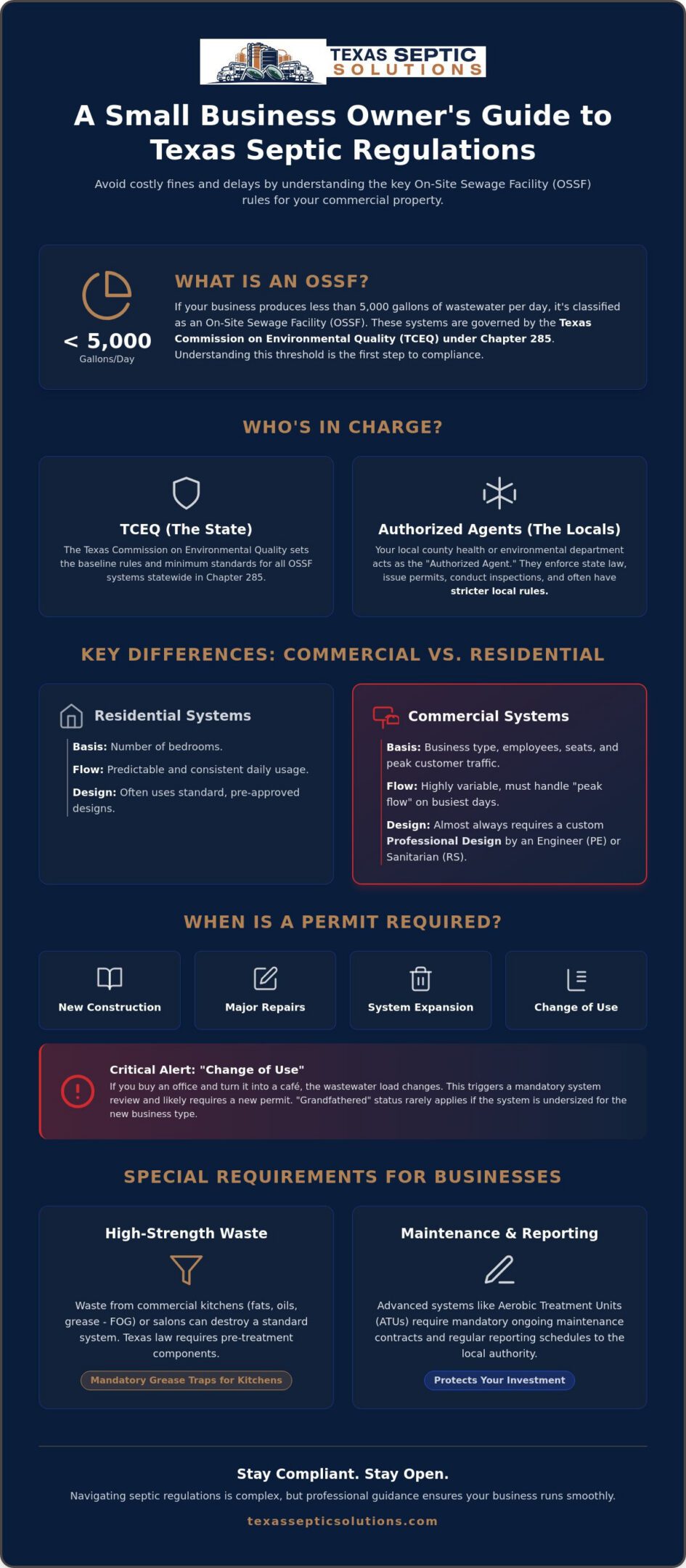
In Texas, your business’s wastewater system is legally classified as an On-site Sewage Facility if it treats and disposes of sewage on your property. These On-site sewage facilities (OSSF) are governed by the Texas Commission on Environmental Quality (TCEQ). Specifically, small businesses fall under Chapter 285 of the Texas Administrative Code. Understanding septic system regulations for small business Texas starts with knowing your daily flow. If your business produces less than 5,000 gallons of wastewater per day, you’re in the OSSF category. If you exceed that, you’re looking at much more complex large-scale permitting requirements. Most retail shops, offices, and small restaurants fit comfortably under the 5,000-gallon limit, but the way you’re regulated depends heavily on your local county.
The Role of TCEQ and Local Authorized Agents
While the state sets the baseline, the “Authorized Agent” is the one who actually knocks on your door. In areas like Liberty or Harris County, the local health or environmental department acts as the TCEQ’s hands and eyes. These agents enforce state standards but often add their own stricter local rules. For instance, a specific municipality might require larger setbacks from property lines than the state minimum. You’ve got to identify your specific Authorized Agent before you even think about digging. They’re the ones who will approve your design, issue your permit, and conduct the final inspection. Working with a team that knows these local inspectors personally can save you weeks of back-and-forth delays.
Permit Requirements for New and Existing Businesses
You’ll need a permit for almost any work beyond basic maintenance. This includes building a new facility, expanding an existing one, or performing major repairs. One thing that catches many owners off guard is a “change of use.” If you buy an old office building and turn it into a high-traffic cafe, your sewage load changes. That shift triggers a mandatory review of your septic system regulations for small business Texas compliance. Operating a system that hasn’t been updated for your current business type is a major legal risk. “Grandfathered” status is rarely a shield if your system is failing or undersized for your new customer volume. Staying ahead of these rules keeps your business operational and avoids the heavy fines that come with unpermitted systems.
Commercial vs. Residential Septic Rules: Key Differences
Residential septic systems are generally predictable because they’re based on the number of bedrooms in a house. However, septic system regulations for small business Texas operate on a completely different scale. State inspectors don’t look at how many rooms you have; they look at how many people walk through your doors and what those people are doing while they’re there. A small retail shop has a much lighter environmental footprint than a restaurant or a dog grooming salon. Because the stakes are higher for commercial properties, the design requirements are significantly more rigorous to prevent system failure and groundwater contamination.
Calculating Wastewater Flow for Small Businesses
In Texas, commercial flow rates are calculated differently than residential bedroom-based metrics. The TCEQ uses specific flow tables in Chapter 285 to estimate daily water usage. For example, an office building might be calculated at 5 to 20 gallons per employee, while a restaurant could be 7 to 10 gallons per seat. Peak flow matters more than average flow here. If your business sees a massive surge of customers on Saturday nights, your system must be sized to handle that specific “peak” rather than a weekly average. Designing for the busiest day ensures you won’t face a backup during your most profitable hours.
Most small businesses in Texas cannot use a standard “off-the-shelf” design. State law often mandates a “Professional Design,” meaning you must hire a licensed Professional Engineer (PE) or a Registered Sanitarian (RS) to create your plans. This is especially true if your business produces high-strength waste or if the daily flow exceeds certain thresholds. These professionals ensure your system meets strict setback requirements, which are often more demanding for commercial lots where parking areas and heavy equipment can’t be placed over the drain field.
High-Strength Waste and Pre-treatment Rules
The type of waste your business produces is just as important as the volume. “Non-domestic” waste, such as fats, oils, and grease (FOG) from a kitchen or chemicals from a hair salon, can quickly destroy a standard septic system. Texas law requires commercial kitchens to install grease traps to capture these materials before they reach the main tank. Without this pre-treatment, the organic loading on your drain field becomes too high, leading to soil clogging and system failure. If you’re dealing with specialized waste, you’ll likely need an aerobic treatment unit (ATU) or a similar pre-treatment system to clean the water to “domestic” levels before it’s dispersed. If you’re unsure which category your business falls into, getting a professional septic system design is the best way to avoid future compliance issues.
The Site Evaluation and Permitting Process in Texas
The road to a legal, functioning septic system starts with a thorough site evaluation. This isn’t just a suggestion; it’s a core part of septic system regulations for small business Texas. Before you can break ground, a licensed Site Evaluator must visit your property to determine if the land can actually handle the wastewater your business will generate. This phase is critical because it dictates the type of system you’ll need and where it can be placed on your lot. Skipping this step or rushing through it can lead to design failures that the county will not approve.
Soil Testing for Commercial Site Suitability
East Texas is famous for its heavy clay soils, which can be a major hurdle for traditional septic designs. During the evaluation, we look for “limiting layers” like rock or high groundwater that might prevent proper drainage. If your soil doesn’t absorb water quickly enough, you’ll likely need an alternative system, such as an aerobic treatment unit. Understanding the specific soil testing for septic systems process helps you anticipate whether you’ll need a standard lateral line or a more advanced spray distribution setup. This initial test determines the legal footprint of your system and ensures you don’t waste money on a design that isn’t suited for your specific acreage.
Beyond the soil itself, the evaluator checks the physical layout of your property. They’ll measure the slope of the land and the distance to property lines, wells, and existing structures. Commercial properties often have tighter constraints than residential lots due to parking requirements and heavy equipment traffic. These factors are all part of the setback rules that keep your wastewater safe from your drinking water and your neighbors’ land. We make sure every component is placed in a spot that meets state law while still allowing your business to function efficiently.
Required Documentation for Business OSSF Permits
Once the evaluation is complete, the design phase begins. You’ll need to submit a detailed site map that shows every structure, well, and proposed septic component on your property. For businesses using aerobic systems, you’re also required to file an “Affidavit to the Public” with the county clerk. This document acknowledges that you have a mandatory maintenance contract in place. Because the paperwork is so specific, professional septic system design and installation is vital for getting your application approved the first time without costly revisions.
The permitting process follows a strict sequence. After you submit your plans and fees, the Authorized Agent reviews everything. If it passes, they issue a “Notice to Proceed,” which is your green light to start construction. However, you can’t start using the system yet. Once construction is finished, the inspector performs a final walkthrough. Only after they confirm the system matches the approved design will you receive your “Permit to Operate.” Following these septic system regulations for small business Texas ensures your company stays compliant and ready for opening day.
Ongoing Maintenance and Compliance Standards
Securing your “Permit to Operate” is a major milestone, but it’s only the beginning of your regulatory journey. To stay on the right side of septic system regulations for small business Texas, you must commit to a strict maintenance schedule. For businesses using aerobic treatment units (ATUs), the TCEQ mandates a continuous maintenance contract with a licensed provider. This isn’t just a recommendation; it’s a legal requirement that ensures your system effectively treats wastewater before it returns to the environment. If your contract lapses, your local Authorized Agent has the power to revoke your operating permit, which could lead to an immediate business closure.
Compliance also involves a rigorous reporting process. Most commercial aerobic systems require inspections every four months. Your service provider must check the chlorine levels, air compressors, and spray heads to ensure everything meets state standards. These inspection results are then submitted directly to the county or city authorities. Keeping a meticulous service history is your best defense against environmental liability and heavy TCEQ fines, which can reach thousands of dollars per day for unresolved violations. We recommend keeping a digital and physical folder of every service visit, pump-out, and repair to prove your commitment to local health standards.
The Importance of Routine Pumping for Businesses
High-traffic businesses like convenience stores or restaurants put significantly more stress on a septic system than a typical household. You can’t rely on the standard three to five year residential pumping cycle. Depending on your customer volume, you might need professional pumping every year or even every six months to prevent solids from migrating into your drain field. Look out for signs like slow-clearing drains, gurgling pipes, or unusually lush patches of grass over your distribution area. These are early warnings that your tanks are reaching capacity. For a better understanding of how to structure your service intervals, you can review our septic system maintenance plan for 2026.
Repairing Systems to Maintain Compliance
In the business world, a septic failure is more than an inconvenience; it’s a revenue-killing emergency. If a major component like a secondary treatment tank or a pump fails, Texas law often views the fix as a significant alteration. This means you may need to go through a condensed re-permitting process to ensure the repair meets current septic system regulations for small business Texas. Because a backup can lead to a health department shutdown, having access to 24/7 emergency service is a operational necessity. If you’re facing a system malfunction, refer to our guide on septic system repair to understand which fixes require county notification. If you need to schedule a compliance inspection or an emergency pump-out, reach out to our team for reliable commercial septic services today.
Navigating Small Business Septic Solutions in East Texas
Managing a company in the Houston or Cleveland area means dealing with more than just state-level paperwork. You’ve got to understand the specific personalities and preferences of local county inspectors. Navigating septic system regulations for small business Texas is much easier when you work with a partner who knows exactly what the Authorized Agent in Liberty County or Harris County expects to see on a design plan. We specialize in providing that local bridge, ensuring your project moves from the drawing board to the Authorization to Construct without hitting avoidable roadblocks. Our team understands the unique challenges of the Texas Gulf Coast, where high humidity and varying soil types can complicate even the most straightforward installations.
Why Local Expertise Wins for Small Businesses
Designing a system for a business in Cypress is different than designing one in Liberty. The soil composition changes, and so do the municipal ordinances. We design systems that are built for commercial reliability, taking into account the heavy rainfall and drainage issues common in our region. Because we operate daily in Harris, Montgomery, and Liberty counties, we stay ahead of any local regulatory shifts that might impact your business continuity. Texas Septic Solutions acts as a direct bridge between busy business owners and the complex world of environmental regulators, handling the technical details so you can focus on your grand opening. This local insight prevents the “trial and error” approach that often leads to failed inspections and wasted capital.
Our integrated service model means we’re with you for the long haul. We don’t just install a tank and disappear. We provide a comprehensive care package that includes initial soil testing, expert design, professional installation, and the long-term maintenance contracts required by law. If a pump fails or an alarm sounds at 2:00 AM, our 24/7 emergency service ensures your business doesn’t have to close its doors. We treat your commercial septic system as a vital piece of your infrastructure, protecting your investment with the same care we’d use for our own business.
Getting Started with Your Commercial Septic Project
The first steps are always the most critical. We begin with a site consultation and a precise flow rate estimation based on your specific business model. This early accuracy helps you avoid the most common permitting mistakes, such as underestimating wastewater volume or failing to account for property line setbacks. By getting the design right the first time, you save weeks of waiting on revised approvals. Whether you’re building a new retail space or repairing an existing system to meet 2026 standards, we provide the dependable, straightforward guidance you need. Contact Texas Septic Solutions for a professional commercial site evaluation today and let us help you stay compliant and operational.
Secure Your Business Future with Expert Septic Compliance
Understanding the nuances of septic system regulations for small business Texas is the first step toward long-term operational success. By focusing on accurate flow calculations and committing to mandatory maintenance contracts, you ensure your facility stays compliant with both TCEQ and local county standards. You’ve worked hard to build your business; don’t let a preventable permitting error or a maintenance lapse stand in your way.
Texas Septic Solutions offers the local expertise you need, from licensed OSSF installers in Cleveland and Houston to 24/7 emergency service for business continuity. We handle the comprehensive maintenance and compliance reporting that keeps your permit active and your doors open. Our team is ready to act as your reliable partner in navigating the 2026 regulatory landscape with straightforward, professional guidance.
Take the next step today. Schedule Your Commercial Septic Site Evaluation with Texas Septic Solutions to ensure your system is built for reliability. We’re proud to support our local business community and look forward to helping yours thrive.
Frequently Asked Questions
Do all small businesses in Texas need a septic permit?
Yes, nearly all small businesses in Texas require a permit for new installations, alterations, or extensions of a septic system. While there is a rare exception for single-family homes on properties larger than 10 acres, businesses must comply with TCEQ Chapter 285. You’ll need to work with your local Authorized Agent to secure approval before any construction begins. This ensures your system is safely designed for your specific business needs.
How often does a commercial aerobic septic system need to be inspected?
Commercial aerobic systems typically require inspections every four months as part of a mandatory maintenance contract. These regular checks ensure that chlorine levels and mechanical components like air compressors meet state standards. Your licensed maintenance provider will submit these reports directly to your local permitting authority to keep your business in compliance. This consistent reporting is vital for maintaining your Permit to Operate and avoiding unexpected regulatory shutdowns.
Can a small business owner install their own septic system in Texas?
No, business owners cannot legally install their own septic systems in Texas. State law requires that all OSSF installations, site evaluations, and maintenance be performed by TCEQ-licensed professionals. Hiring a licensed installer ensures your system meets the specific septic system regulations for small business Texas and passes the final state-mandated inspection. This professional requirement protects both the local environment and your long-term business investment.
What happens if my business septic system fails an inspection?
If your system fails an inspection, the Authorized Agent will issue a list of required corrections that must be addressed before a permit is granted. You’ll also likely be charged a re-inspection fee by the county health department. In severe cases of failure for an existing business, you might face a temporary service interruption until the repairs are completed and the system is brought back into full legal compliance.
Are grease traps required for all business septic systems in Texas?
Grease traps aren’t required for every business, but they are mandatory for any facility producing high-strength organic waste, such as commercial kitchens or cafes. These traps prevent fats, oils, and grease from entering the septic tank and clogging the drain field. If your business involves any type of food preparation, a grease trap is a standard requirement for your OSSF permit to ensure the longevity of your system.
How long does it take to get a commercial OSSF permit in Texas?
The timeline for a commercial OSSF permit varies by county but usually takes several weeks from the initial design submission to the Notice to Proceed. Factors like the complexity of your site evaluation and the current backlog at the local health department play a major role. Planning for a 30 to 60 day window for the entire permitting and inspection process is a safe bet for most East Texas business owners.
Is there a difference between a residential and commercial septic tank?
Yes, the primary difference lies in the sizing and the way flow rates are calculated. Residential systems are based on bedroom counts, while commercial tanks are sized based on occupancy, square footage, and waste strength. Commercial systems often require heavier-duty components or pre-treatment units to handle the higher organic loads typical of a business environment. This ensures the system doesn’t fail under the pressure of daily customer and employee use.
What are the penalties for operating a septic system without a permit?
Operating without a permit can lead to heavy TCEQ fines that may reach thousands of dollars per day for ongoing violations. Local authorities also have the power to issue a cease-and-desist order or revoke your certificate of occupancy, effectively closing your business. Following septic system regulations for small business Texas is the only way to protect your company from these serious legal and financial risks while ensuring community safety.