
Septic System Installation Near Me: The 2026 Texas Homeowner’s Buying Guide
Did you know that Texas adds approximately 45,000 new septic systems every single year? If you’re currently searching for “septic system installation near me,” you already know that this isn’t just another home improvement project; it’s a critical investment in your property’s long-term health and safety. It’s natural to feel some stress over the choice between aerobic and conventional systems or the complexities of county permits. You want a system that works without you having to think about it, and you want to avoid the nightmare of a failure just months after the backhoe leaves your yard.
We’ve built this 2026 guide to strip away the confusion and provide you with a clear, professional path to a worry-free waste management system. Whether you’re building a new home in Cleveland or upgrading a property in Cypress, we’ll help you handle the latest TCEQ standards and local requirements. We will cover everything from how East Texas soil morphology dictates your system type to what you should expect during the permitting process in Harris or Liberty County. By the end of this guide, you’ll have a complete roadmap for choosing a trusted installer and maintaining a compliant, reliable system for years to come.
Key Takeaways
- Understand how Texas soil morphology, ranging from East Texas sand to heavy clay, determines if a conventional gravity-fed system or an aerobic treatment unit is right for your property.
- Identify the specific criteria for evaluating “septic system installation near me,” including verifying TCEQ licensing and ensuring initial quotes cover permits, site evaluations, and design fees.
- Navigate the 2026 permitting process with a clear roadmap of the site evaluation, professional engineering, and final inspection steps required by local authorized agents.
- Learn why aerobic systems require mandatory annual service contracts and how a one-stop-shop model from installation to maintenance protects your long-term investment.
- Gain peace of mind by understanding the 24/7 support options available to homeowners, ensuring you’re never left stranded if a septic tank alarm sounds.
Why Local Expertise Matters for Septic System Installation Near Me
Your septic system is the most important utility you’ll never see. In Texas, a properly functioning system is vital for maintaining property value and protecting your family’s health. When you start searching for “septic system installation near me,” you aren’t just looking for a crew with a backhoe. You need a partner who understands how septic systems work within the specific constraints of East Texas geology. Our region’s soil varies significantly, shifting from the sandy loams of the Piney Woods to the heavy, expansive clays found closer to Houston. A system that works in one county might fail miserably in the next if the installer doesn’t understand these local nuances.
Climate is another factor that general contractors often overlook. The Houston area’s intense rainfall patterns and high humidity levels can easily overwhelm a poorly designed leach field. If an installer doesn’t account for our local drainage challenges and hydraulic loading, your backyard could become a saturated, swampy mess after the first major Gulf storm. Hiring a non-specialized contractor is a gamble you don’t want to take with your home’s foundation and sanitation. Septic work is a specialized trade that requires a deep understanding of soil morphology and environmental engineering.
The Dangers of Improper Installation
A botched installation leads to more than just a bad smell. In the Gulf Coast region, improper drainage can lead to groundwater contamination, which poses serious risks to local aquifers. The financial consequences are equally steep. Early system failure often requires a complete and costly replacement, which far exceeds the initial investment of a professional install. Beyond the money, you face legal liabilities. The Texas Commission on Environmental Quality (TCEQ) maintains strict standards for On-Site Sewage Facilities (OSSF). Non-compliant systems can lead to heavy fines, property liens, or even the inability to sell your home in the future.
Service Areas: From Cleveland to Cypress
Texas Septic Solutions provides dedicated, localized support across Cleveland, Houston, Cypress, Huffman, and Shepherd. We don’t just work in these communities; we are part of them. This local presence means we have established working relationships with county inspectors in Harris and Liberty counties. We know their specific expectations and typical turnaround times, which helps us move your project through the permitting phase more efficiently. Choosing a neighborly expert for your septic system installation near me ensures your system is designed for our unique environment and built to provide decades of reliable service.
Choosing the Right System: Aerobic vs. Conventional Septic
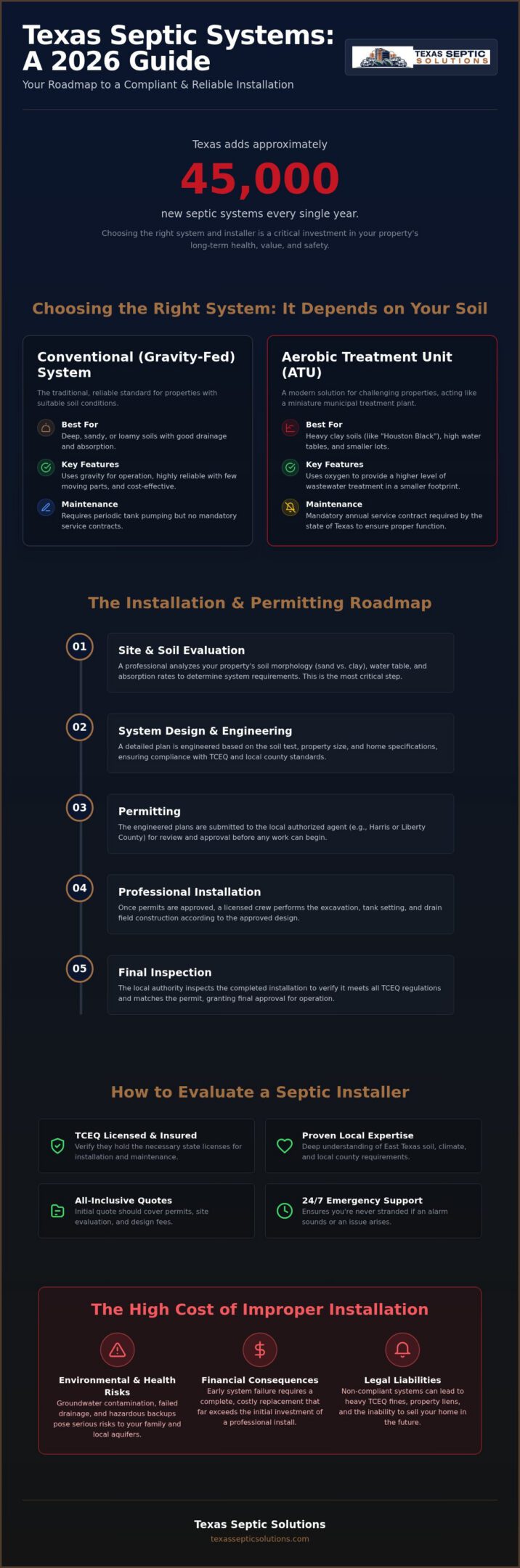
Selecting the right equipment for your property depends on two main factors: the size of your lot and the results of your soil morphology test. When you search for septic system installation near me, you’ll generally find two categories of types of septic systems. Conventional systems are the traditional standard. They rely on gravity to move waste into a septic tank and then out to a drain field. They’re incredibly reliable and cost-effective, but they require deep, sandy soil to filter the effluent properly before it reaches the groundwater.
If your property sits on heavy clay or has a high water table, a conventional system usually isn’t an option. In these cases, we install an Aerobic Treatment Unit (ATU). An ATU is a system using oxygen to break down waste faster than traditional methods. Think of it like a miniature version of a city’s municipal waste plant right in your backyard, providing a higher level of treatment in a much smaller area.
The Impact of East Texas Clay Soil
East Texas is famous for its “Houston Black” and other heavy clay soils. These soils are expansive and dense, meaning they don’t allow water to drain quickly. If you try to put a conventional drain field in heavy clay, the water has nowhere to go. This leads to surface ponding, foul odors, and eventual system backups. This is why the soil morphology test is the most critical step in the design phase. We analyze the specific layers of your soil to match the absorption rate with local percolation data, ensuring your system doesn’t fail when the ground gets saturated during our heavy rainy seasons.
Pros and Cons of Each System Type
Each system has its trade-offs. Conventional systems offer a lower upfront cost and don’t require electricity to operate. However, they have a larger footprint and are only viable in specific geological conditions. Aerobic systems can be installed almost anywhere and take up much less space, making them ideal for smaller lots. The trade-off is that they require an air pump, which uses a small amount of electricity; additionally, Texas law requires you to maintain a septic system maintenance plan. While the initial investment is higher, an ATU prevents the massive septic system replacement cost associated with putting the wrong system in the wrong soil. If you’re unsure which one your lot requires, our team can review your site evaluation to guide you toward the most durable choice for your property.
Homeowner’s Buying Guide: How to Evaluate Septic Installers
Hiring the right team for a septic system installation near me requires looking past the initial price tag. You’re installing a complex piece of infrastructure that must protect your groundwater for decades. The first step is verifying that your installer holds a current license from the Texas Commission on Environmental Quality (TCEQ). Without this, you have no guarantee the work meets state safety standards or will pass county inspections. Licensed professionals are held accountable for their designs and must follow the specific regulations outlined in Title 30 of the Texas Administrative Code.
A comprehensive quote should be transparent and all-encompassing. It must include the cost of the professional design, soil morphology testing, county permit fees, and all necessary materials like gravel and tanks. If a quote seems unusually low, the installer might be planning to cut corners on the depth of the drain field or the quality of the components. Ask for local references in areas like Shepherd and Huffman. A contractor who has worked in your neighborhood will already know the local soil challenges and the specific requirements of your county’s health department. What happens after the dirt is moved matters just as much. A reliable installer provides a clear warranty and explains their post-installation support to ensure your investment stays in peak condition.
Questions to Ask Your Potential Installer
Don’t be afraid to interview your contractor. Their answers will reveal their level of professionalism and care for your property. Use these specific questions to vet their expertise:
- Are you a licensed OSSF Installer II? An Installer II designation is required for complex systems like aerobic units. It shows they’ve completed advanced training and have the experience to handle more than just basic gravity systems.
- Do you handle the permitting process with the county? A professional shop should manage the paperwork from the initial application to the final inspection. This saves you from the stress of navigating local government offices.
- What is your plan for protecting my landscape? Installing a septic system involves heavy machinery. A good installer will discuss how they’ll minimize damage to your trees, driveway, and existing lawn during the process.
Red Flags to Watch Out For
Keep an eye out for these warning signs during the bidding process to avoid costly mistakes:
- Quotes significantly lower than average: This often suggests the use of sub-standard materials or the omission of required fees that you’ll have to pay later.
- Skipping the soil test: Any installer who says they “know the dirt” without a formal morphology test is violating state law and risking your system’s failure.
- No local physical address: Out-of-state contractors don’t have a stake in our community. If your system fails in six months, you need a neighborly expert who will actually answer the phone and show up to help.
The Installation Roadmap: Permits, Soil, and Groundbreaking
A successful septic system installation near me follows a logical, step-by-step progression to ensure long-term reliability. The process begins with a formal site evaluation. During this phase, a professional performs a soil morphology test to determine exactly how your land handles wastewater. This data is essential for the second step: professional system design and engineering. A designer creates a blueprint that matches your household’s size and water usage with your property’s specific geological capacity.
Once the design is finalized, we navigate the county permitting process. In areas like Harris, Liberty, and Montgomery counties, this involves submitting the design for review by local health authorities. After receiving the “Authorization to Construct,” we move to excavation and hardware installation. This is the physical phase where we set the tanks and install the treatment components. The roadmap ends with a final inspection and system commissioning. A county official must sign off on the work before we backfill the site and turn the system on for your use.
Navigating Texas Permitting Requirements
In Texas, your local Authority Having Jurisdiction (AHJ) is usually the county health department or a city environmental office. These local agents enforce state standards while adding their own specific requirements. In the Houston metro area, typical timelines for permit approval generally range from 4 to 10 weeks. During the final inspection, the county official verifies that the tank depth, pipe slopes, and drain field materials exactly match the permitted design. This strict oversight ensures your system is compliant and safe for the surrounding environment.
Site Preparation and Excavation
Before any heavy machinery arrives, we clear the designated area and manage existing utility lines. We always coordinate with 811 to mark underground cables and pipes to ensure a safe groundbreaking. The logistics of tank delivery require a clear path for large trucks and cranes. During excavation, we focus heavily on the slope and bedding of the pipes and tanks. Ensuring proper leveling and stable soil support is the most effective way to prevent future septic system repair issues, such as pipe shearing or tank settling. If you’re ready to break ground on a new project, schedule your initial site evaluation with our team to get the process moving.
Why Texas Septic Solutions is the Local Choice for 2026
Choosing a partner for your utility needs is about more than just finding a contractor; it’s about finding a reliable authority who will stand by their work for years. At Texas Septic Solutions, we take a “neighborly expert” approach to every project. We understand that a septic system installation near me is a significant investment for your home. That’s why we prioritize clear communication and accountability from the moment we first walk your property to the day we finish the final grade. We don’t just move dirt; we build the infrastructure that keeps your home functional and safe.
Our commitment to you doesn’t end when the installation is complete. We provide 24/7 emergency support because we know that utility failures don’t wait for business hours. If your septic tank alarm goes off in the middle of the night, you can count on us to respond promptly. Additionally, we offer transparent pricing with no hidden “dirt work” or disposal fees. You’ll know exactly what to expect on your final invoice before we even start the excavation process. Our goal is to provide a stress-free experience that transitions naturally into long-term septic system maintenance in Texas.
Our Comprehensive Service Model
We operate as a true one-stop shop for all your wastewater needs. Our service model covers every stage of the system’s lifecycle, from the initial site engineering to routine pumping and emergency repairs. We specifically select high-quality materials and components that are designed to withstand the unique challenges of our Texas climate, such as high humidity and shifting clay soils. Whether you’re a residential homeowner in Shepherd or a commercial property manager in Cypress, you’ll receive dedicated customer support tailored to your specific situational needs. We build systems to last, using the most dependable hardware available.
Ready to Start Your Project?
Starting your project is a straightforward process when you have the right team behind you. You can schedule your initial site evaluation in Cleveland, Houston, or any of our surrounding service areas by contacting our office directly. To make your first consultation as efficient as possible, try to gather your property survey and any records of historical water usage if you’re replacing an existing unit. We’ll review your land’s topography and soil morphology to provide a professional, straightforward quote. When you’re looking for a septic system installation near me that combines local pride with industry-leading expertise, we’re ready to get to work for you.
Secure Your Property’s Future with a Trusted Local Expert
Investing in a new septic system is one of the most important decisions you’ll make for your property’s long-term health. It’s clear that a successful outcome depends on a deep understanding of East Texas soil morphology and strict adherence to TCEQ regulations. Whether your land requires a conventional gravity-fed system or an advanced aerobic treatment unit, the technical precision of the design and permitting process is non-negotiable. You shouldn’t have to navigate these regulatory and geological hurdles on your own. When you search for a septic system installation near me, look for a partner who offers both technical expertise and local accountability.
Our team of licensed TCEQ OSSF Installers is standing by to guide you through every phase of the process. We provide the safety net of 24/7 emergency support and have served homeowners in Cleveland, Houston, and the surrounding communities since our inception. We take pride in being more than just a contractor; we’re your neighbors and long-term maintenance partners. Ready to ensure your home has a waste management system built for the future?
Schedule Your Professional Site Evaluation with Texas Septic Solutions Today
Frequently Asked Questions
How much does a new septic system installation cost in Texas?
Industry data for 2026 suggests conventional systems generally range from $4,500 to $12,000, while aerobic systems can range from $10,000 to over $25,000. These figures depend heavily on your property’s soil morphology and specific county permit fees. While we don’t provide flat-rate pricing without a site evaluation, we focus on transparent quotes that include all necessary permits and materials. Your final investment reflects the system’s design complexity and local environmental requirements.
How long does the installation process typically take from start to finish?
The entire process typically takes between 4 and 10 weeks to complete from the initial consultation. This timeline includes the site evaluation, professional engineering design, and the mandatory waiting period for county permit approval. Once we receive the “Authorization to Construct” from local health authorities, the physical excavation and hardware installation usually take only a few days. Final inspections and site backfilling conclude the project, ensuring your system is fully operational and compliant.
Do I need a permit to replace an existing septic tank in Harris County?
Yes, you must obtain a permit from the Harris County Public Health department or the relevant authorized agent for any septic tank replacement. Texas law requires an “Authorization to Construct” before any work begins on an on-site sewage facility (OSSF). This ensures the new tank meets current TCEQ setback requirements and capacity standards. We handle the entire permitting process for our clients in Harris and Liberty counties to ensure full legal compliance and safety.
What is the difference between an aerobic and a conventional septic system?
Conventional systems use gravity to move waste into a tank and then out to a soil-based drain field for filtration. Aerobic systems use an electric pump to inject oxygen into the waste, allowing bacteria to break down solids much faster. Aerobic units are often required on smaller lots or in areas with heavy clay soil, like Huffman or Cypress, where traditional drainage isn’t possible. Each system type has specific site requirements and unique maintenance needs.
How often will my new system need to be pumped or maintained?
Most septic tanks require professional pumping every 3 to 5 years to remove accumulated solids and protect the drain field. If you have an aerobic system, Texas law also requires you to maintain a continuous service contract with a licensed provider for quarterly inspections. Regular maintenance prevents environmental contamination and extends the life of your hardware. Our team provides scheduled maintenance programs to keep your system performing at peak efficiency year after year.
Can I build a deck or driveway over my septic tank or drain field?
No, you should never build a permanent structure like a deck or driveway over any part of your septic system. Covering the tank or drain field prevents essential access for pumping and repairs while potentially crushing pipes under the weight of the structure. Additionally, covering a drain field prevents the soil from “breathing,” which is necessary for the final treatment of effluent. Always maintain clear, vegetated space over your entire septic footprint for proper function.
What happens if my septic system fails shortly after installation?
If your system experiences issues shortly after a professional installation, you should contact your installer immediately to utilize your warranty. We stand by our work with a “neighborly expert” level of accountability and provide 24/7 emergency support for critical failures. Most early issues are related to soil settling or minor component adjustments. Because we follow strict TCEQ standards and perform comprehensive site evaluations, we ensure your system is built to provide decades of service.
Does Texas Septic Solutions offer financing for new installations?
We focus on providing straightforward, transparent quotes that cover every aspect of your project with no hidden fees. While we don’t currently offer in-house financing programs, we’re happy to provide the detailed documentation and engineering plans you might need if you’re seeking a home improvement loan through your bank. Our priority is ensuring you receive a high-quality septic system installation near me that fits your property’s technical requirements and your long-term budget needs.