
Septic System Cost: 3 Bedroom House 2026 Texas Price Guide
Did you know that your soil’s ability to “perc” matters more than the number of bathrooms when it comes to your budget? Most homeowners assume the cost for septic system for 3 bedroom house is a fixed number, but in Texas, the ground beneath your feet often makes the final call. It’s frustrating to plan a project when you’re met with vague estimates or confusing jargon about aerobic versus conventional setups.
We understand that you need clear answers to protect your property and your wallet. That’s why we’ve put together this transparent guide to help you plan for your 2026 project. You’ll get a full breakdown of the different system types, including why a 3-bedroom home typically requires a 1,000-gallon tank. We’ll also dive into the local Southeast Texas variables like site preparation and permitting fees that often catch people by surprise. By the end, you’ll have a realistic understanding of what you’re paying for and the confidence to choose the right solution for your home.
Key Takeaways
- Learn why the 1,000-gallon tank is the industry standard for 3-bedroom homes based on Texas wastewater flow calculations.
- Discover how the total cost for septic system for 3 bedroom house is split between equipment, labor, and essential engineering permits.
- Find out if your property’s soil requires a budget-friendly conventional system or a more advanced aerobic treatment unit.
- Identify hidden site preparation variables, such as soil percolation tests and land clearing, that impact your final project budget.
- Understand why investing in a professional maintenance plan is the most effective way to avoid costly long-term repairs.
Understanding the Baseline: What Defines a 3-Bedroom Septic System?
When you start calculating the cost for septic system for 3 bedroom house, the first variable is the capacity required by state law. In Texas, regulators don’t look at the number of bathrooms in your home to determine system size. Instead, they focus on the number of bedrooms. This is because bedrooms serve as a proxy for the maximum potential occupancy of the home. More people mean more laundry, more showers, and more wastewater flowing into the ground every single day.
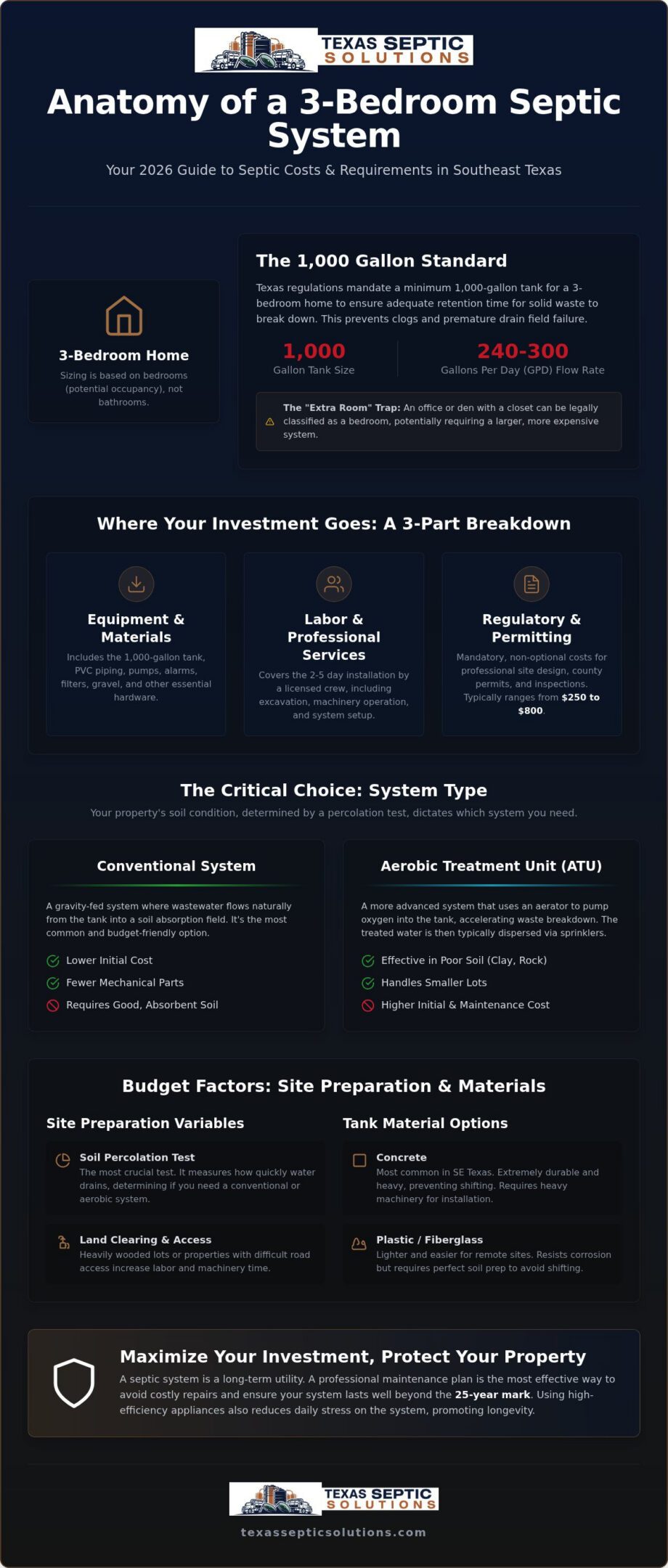
A 1,000-gallon tank is the industry standard for a 3-bedroom home in Texas. This size provides the necessary “retention time” for solids to settle and bacteria to break down waste before the liquid moves to the drain field. To understand the basics of how a septic system works, you have to look at this primary treatment stage. If your tank is too small, wastewater moves through too quickly, which can lead to clogs and expensive field failures. Staying with the 1,000-gallon standard ensures your system can handle the daily peaks of a busy household without backing up.
Homeowners should be aware of the “extra room” trap. If you have a home office, a craft room, or a library that includes a closet and a window, a local inspector might legally classify it as a bedroom. This could accidentally push your requirement from a 3-bedroom system to a 4-bedroom system. This shift increases the cost for septic system for 3 bedroom house because it requires a larger tank and a more extensive drain field to accommodate the higher potential flow.
Capacity Requirements and Flow Rates
Texas regulators use Gallons Per Day (GPD) to measure a system’s capacity. For a typical 3-bedroom residence, the design must handle between 240 and 300 GPD. While high-efficiency toilets and washing machines reduce your actual water usage, they don’t change the legal design requirements. However, using these appliances is a smart move for long-term health. Lower daily loads put less stress on the soil, which helps your system last well beyond the 25-year mark.
Tank Material Options: Concrete vs. Plastic vs. Fiberglass
Choosing your tank material is a decision that affects both your budget and the system’s lifespan. Concrete tanks are the most common choice in Southeast Texas. They are incredibly durable and heavy enough to stay put even when the water table rises. However, they require heavy machinery for installation, which can be tricky on tight lots. Plastic or fiberglass tanks are lighter and easier to transport to remote or difficult-to-access sites in areas like Cleveland or Shepherd. While these materials resist chemical corrosion, they can be more susceptible to shifting if the soil isn’t prepared perfectly. Selecting the right material can change your initial quote by several hundred dollars, so it’s a detail worth discussing with your installer.
The 2026 Cost Breakdown: Where Your Investment Goes
Calculating the total cost for septic system for 3 bedroom house requires looking at more than just a single invoice. Your investment is split into three primary categories: heavy equipment and materials, professional labor, and regulatory compliance. Each of these buckets is influenced by your specific location in the Houston or Cleveland area. For example, a property with easy road access will always be more straightforward to quote than a heavily wooded lot in Shepherd that requires extensive clearing before the first trench is even dug.
The regulatory side is the only fixed variable in the equation. Before any installation begins, you must satisfy Texas permitting requirements. This involves paying for a professional site design and county permit fees. In most Texas counties, these permits and mandatory inspections range from $250 to $800. These aren’t optional costs; they ensure your system is legal and won’t cause environmental issues that could lead to heavy fines down the road.
Equipment and Material Costs
The 1,000-gallon tank is the largest hardware expense, but it’s far from the only one. A complete system includes hundreds of feet of specialized PVC piping, effluent filters to catch solids, and distribution boxes that balance the flow to your drain field. If your soil conditions require a pump-assisted system rather than a standard gravity setup, your hardware list will also include submersible pumps and alarm panels. We also have to account for the “invisible” materials, like the tons of washed gravel or specialized chambers used to create a functional absorption area in the soil.
Labor and Professional Services
Professional labor covers the expertise of a licensed crew and the operation of heavy machinery like backhoes and excavators. A typical 3-bedroom installation takes between 2 and 5 days to complete. This timeframe includes the precision work of leveling the tank and ensuring the drain field pipes have the exact slope required for gravity to do its job. While it might be tempting to look for the lowest possible labor rate, remember that an improperly installed system is the leading cause of premature septic system repair. Investing in a team that provides proper bonding and insurance protects your property value for decades. If you want a clear picture of how these factors apply to your specific lot, the experts at Texas Septic Solutions can help you walk through the details.
Aerobic vs. Conventional: How System Type Changes the Price
Your soil’s texture is the silent partner in your construction project. While the baseline cost for septic system for 3 bedroom house starts with the tank size, the system type is what really moves the needle on your final estimate. In Texas, we generally deal with two extremes: the easy-draining sandy loam of East Texas and the stubborn, heavy clay found throughout much of the Houston metro area. Choosing between a conventional and an aerobic system isn’t always a matter of preference. Often, the results of your soil test and local regulations in places like Huffman or Cypress will make the decision for you.
Conventional systems are the traditional choice, relying on gravity and healthy soil to treat wastewater. They’re simpler to build and operate, but they require specific land conditions to work safely. On the other hand, Aerobic Treatment Units (ATUs) act like a miniature municipal sewage plant on your property. They use oxygen to break down waste faster, which is why they’re the gold standard for lots with poor drainage or high water tables. While an ATU involves more moving parts, it’s often the only legal way to build on challenging Texas terrain.
The Conventional System Advantage
If you’re lucky enough to have deep, sandy soil, a conventional gravity system is usually the most cost-effective path. These systems don’t require electricity or complex controllers to function. Because they have fewer mechanical components, the initial cost for septic system for 3 bedroom house stays lower. You’ll also save money over time because you won’t have a monthly power bill for an air compressor or the need for specialized chemical treatments. It’s a “set it and forget it” solution, provided you follow a basic pumping schedule every few years.
The Aerobic Treatment Reality
For homeowners dealing with heavy clay, an aerobic system is a necessity rather than an upgrade. These systems include extra components like air compressors, timers, and spray heads that distribute treated water over your lawn. Because these parts can wear out, Texas law requires aerobic owners to maintain a service contract with a licensed provider. Properly maintaining your septic system through these contracts ensures your aerator stays running and your spray heads don’t clog. While the upfront investment and recurring maintenance fees are higher than a conventional setup, an aerobic system provides the reliability needed to keep your home functional in tough soil conditions.
Hidden Variables: Site Prep, Soil Tests, and Texas Permitting
Many homeowners focus on the hardware, but the “invisible” work often defines the final cost for septic system for 3 bedroom house. Before a single piece of equipment arrives at your property in Cleveland or Shepherd, we have to prepare the land. This includes clearing brush, removing large roots, or navigating rocky terrain that can slow down excavation. These site-specific challenges are why a one-size-fits-all quote rarely stays accurate once the work begins. Professional site preparation ensures that your tank stays level and your drain field functions as designed for decades.
The engineering phase is just as critical as the digging. You can’t simply pick a spot and start shoveling; you need a professional design that accounts for property lines, well locations, and slope. This design is the roadmap for your entire project and is required by local authorities to ensure environmental safety. Skipping this step or hiring an unlicensed designer can lead to rejected permits and expensive do-overs that double your initial budget.
The Critical Role of the Soil Test
The first $400 to $800 of your budget goes toward a mandatory soil percolation (perc) test. This evaluation measures how quickly your soil absorbs water, which directly determines the size and type of drain field you need. If your soil has a high clay content and fails the perc test, you’ll likely need to transition from a conventional system to a more advanced aerobic model. In Texas, all homeowners must obtain an On-Site Sewage Facility (OSSF) permit from the TCEQ or their local authorized agent before beginning any construction or repair work.
Permitting and Inspection Fees
Navigating the paperwork for Harris, Liberty, or San Jacinto counties requires a professional design signed by a licensed engineer or sanitarian. Permit fees vary by county but generally fall between $250 and $800. Once the permit is in hand, the installation involves a two-stage inspection process. First, an open-hole inspection happens before the pipes are covered to ensure everything matches the approved design. Finally, a final walkthrough confirms the system is fully operational and meets all safety codes.
If you are looking at a septic system replacement cost, be prepared for 2026 environmental codes to play a role. Modern regulations are stricter than they were twenty years ago, which might mean your replacement system needs to be larger or more complex than the original. This is why professional engineering is a non-negotiable step to protect your investment and avoid future fines. If you’re feeling overwhelmed by the local requirements, get a professional consultation from Texas Septic Solutions to clarify your specific needs.
Maximizing Your Investment: Long-Term Savings and Local Expertise
The lowest bid on your project might feel like a win today, but it often hides shortcuts that lead to disaster. When evaluating the cost for septic system for 3 bedroom house, you aren’t just paying for a tank and some pipe. You’re paying for the installer’s understanding of local challenges, like the high water tables in Cypress or the unique drainage issues in Huffman. A neighborly expert knows that saving a few hundred dollars on the front end by skipping a proper site evaluation is never worth the risk of a system failure six months later.
Professional installation also acts as an insurance policy for your home’s resale value. In the Texas real estate market, a documented, high-quality septic system is a major selling point. Prospective buyers want to see that the system was designed specifically for the lot and maintained by professionals. By choosing quality over the absolute lowest price, you ensure your property remains a solid investment rather than a liability. It’s about peace of mind for you now and a smoother closing for you later.
Avoiding Common Installation Pitfalls
One of the most dangerous shortcuts in our industry is “value engineering.” This is often just code for undersized drain fields or improper tank leveling. If a drain field is too small for the daily flow, it will saturate quickly and fail. If the tank isn’t perfectly level, gravity can’t move the wastewater correctly, leading to messy backups. We prioritize site-specific engineering for every client because we know that a system built correctly the first time prevents the most expensive repairs. We don’t cut corners because your home’s functionality depends on precision.
Protecting Your System Post-Installation
Once your system is in the ground, your focus should shift to long-term health. Following a septic system maintenance plan is the most effective way to protect your 3-bedroom investment. For aerobic systems, this includes checking the air compressor and spray heads regularly to ensure they are dispersing treated water correctly. Even for conventional systems, routine septic system maintenance and pumping every 3 to 5 years is non-negotiable. This simple step prevents solids from entering your drain field, which can save you from a catastrophic replacement bill later on.
Ready for a precise quote? Contact Texas Septic Solutions for a professional site evaluation to get your project started on the right foot.
Secure Your Home’s Future with a Precision Septic Plan
Building your home in Southeast Texas is an exciting milestone, and getting the utility infrastructure right from day one is essential. We’ve explored how soil conditions and local OSSF regulations determine the final cost for septic system for 3 bedroom house. From selecting between aerobic and conventional designs to navigating the permitting process in Harris or Liberty County, every detail matters for your property’s long-term health. Remember that your soil’s “perc” rate and the 1,000-gallon tank requirement are the foundations of a successful installation.
Our team of licensed OSSF installers is here to ensure your project meets all environmental standards while providing the 24/7 emergency support you can count on. We take pride in serving Cleveland, Houston, and the surrounding areas with straightforward, professional guidance. Investing in a properly engineered system today prevents the stress of unexpected failures and protects your home’s resale value for decades to come.
Get a Professional Septic Installation Quote for Your 3-Bedroom Home
You don’t have to navigate these complex regulations alone. We’re ready to help you build a system that lasts. Let’s get your project started on the right foot together.
Frequently Asked Questions
How much does a 1,000-gallon septic tank cost for a 3-bedroom house?
A standard 1,000-gallon concrete septic tank typically costs between $600 and $1,000 for the unit itself. While this is a primary component of the cost for septic system for 3 bedroom house, this price doesn’t include delivery, professional excavation, or the necessary internal components like baffles and effluent filters. Keep in mind that specialized plastic or fiberglass tanks can be more expensive than concrete options.
Does a 3-bedroom house always need an aerobic system in Texas?
No, a 3-bedroom home doesn’t always require an aerobic system, as the final decision depends entirely on your property’s soil quality and local regulations. If your land has deep, well-draining sandy loam, you might qualify for a more affordable conventional gravity system. However, if you’re building on heavy clay or have a high water table, Texas law often mandates an aerobic treatment unit to ensure environmental safety.
How long does it take to install a new septic system on a 3-bedroom property?
A professional installation for a 3-bedroom property usually takes between 2 and 5 days to complete once the permit is approved. This timeline covers everything from initial excavation and tank placement to the final plumbing connections and site backfilling. Weather conditions and soil complexity in areas like Cleveland or Huffman can occasionally extend the project by a few days.
Will a 3-bedroom septic system handle a garbage disposal?
A 3-bedroom septic system can handle a garbage disposal, but you’ll need to adjust your maintenance habits to prevent early system failure. Disposals increase the volume of solids in your tank by up to 50 percent, which means you’ll need to pump the tank more frequently than homes without one. It’s often recommended to install a larger tank or a secondary trash tank if you plan on heavy disposal use.
What is the average cost of a perc test for a 3-bedroom home in Texas?
Homeowners in Texas should budget between $300 and $1,200 for a professional soil percolation (perc) test. This evaluation is a non-negotiable part of the cost for septic system for 3 bedroom house because it dictates the entire system design. The price varies based on the number of test holes required and the specific geotechnical requirements of your county.
Does the cost of the septic system include the permit fees?
Most professional installation quotes include the cost of permits and inspection fees, but you should always verify this with your installer before signing a contract. County permits in Texas typically range from $250 to $800 depending on your specific location and the system type. Having your contractor handle the paperwork ensures that all TCEQ and local OSSF standards are met without unnecessary delays.
Can I install my own septic system in Texas to save money?
Texas law generally requires that On-Site Sewage Facilities (OSSF) be installed by a licensed professional to ensure public health and safety. While some counties allow owner-builders to install their own systems under very strict supervision and permitting, it’s rarely recommended. An uncertified installation can lead to legal fines, property liens, and expensive environmental cleanup costs if the system fails due to improper leveling or design.
How much land do I need for a 3-bedroom septic system drain field?
You typically need between 1,000 and 4,500 square feet of dedicated space for a 3-bedroom septic system drain field. The exact footprint depends on how quickly your soil absorbs wastewater; poor-quality clay requires a much larger absorption area than sandy soil. Your site design will also need to maintain specific setback distances from property lines, water wells, and your home’s foundation to meet Texas safety codes.