
Septic system care for Cleveland, TX smart homes
The kitchen sink isn’t a trash can for a septic system. For septic system care for smart homes in Cleveland, TX, keep coffee grounds and food scraps out of the drain: they add solids that build up in the tank. Garbage disposals increase solid waste; schedule more frequent inspections/pumping if used regularly.
Even small amounts of kitchen waste can affect a septic system over time. Keeping solids out is a practical first step, alongside routine inspections and prompt attention to warning signs. Together, these habits help you spot concerns before they cause a bigger disruption.
This guide covers what should and shouldn’t go down the drain, how pumping, inspections, and repairs fit into routine care, and which drain field signs need attention. It also explains what to consider when arranging septic service in Cleveland, so you can choose a practical next step for your home.
Key Takeaways
- See how household size and tank capacity shape a practical pumping schedule for a Cleveland home.
- Learn what inspections and system tests cover, and how Texas OSSF reporting timelines work.
- Recognize drain field odors and standing water as warning signs, with local soil and water conditions in mind.
- Explore what smart septic monitors can help you track and what factors influence their cost.
- Understand when maintenance, pumping, repair, or a new system installation may be the right next step.
Inspection, testing, and reporting
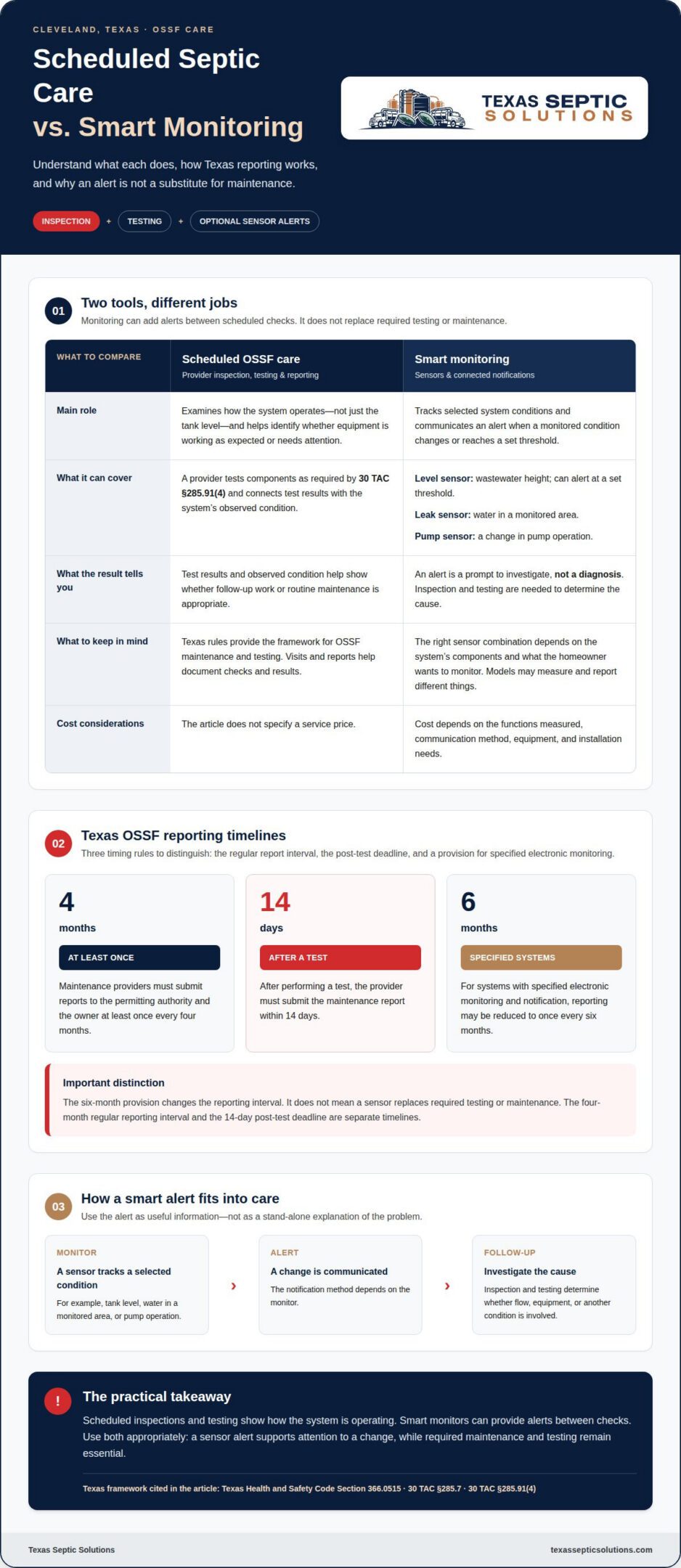
For Cleveland homeowners, inspections, testing, and reporting help show how an onsite sewage facility is operating. Texas rules set reporting intervals, while smart monitors can provide alerts between scheduled checks.
Inspection and Testing Steps
A maintenance visit examines the system’s operation, not just the tank level. The provider tests components as required by 30 TAC §285.91(4), the Texas rule identified for OSSF testing. The inspection can help identify whether equipment is operating as expected and whether a condition needs attention.
Texas OSSF maintenance requirements are governed by Texas Health and Safety Code Section 366.0515 and 30 TAC §285.7. These rules provide the framework for maintenance and testing. A useful visit connects test results with the system’s observed condition, so a homeowner can understand whether follow-up work or routine maintenance is appropriate.
Reporting and Required Timing
Texas OSSF maintenance providers must submit maintenance reports to the permitting authority and the owner at least once every four months. After performing a test, a provider must submit the maintenance report within 14 days. These are separate timelines: one sets the regular reporting interval, while the other applies after a test.
For systems with specified electronic monitoring and notification, maintenance reporting may be reduced to once every six months. This provision changes the reporting interval; it does not mean a sensor replaces required testing or maintenance. Reports give homeowners and the permitting authority a record of system checks and results.
Smart Tank Monitor Operation and Costs
Smart septic tank monitors use sensors to collect information about selected system conditions, then communicate an alert through the monitor’s connected notification method. Their cost depends on the functions measured, communication method, equipment, and installation needs. A useful comparison focuses on which condition the monitor tracks and how it reports a change, rather than assuming every model covers the same tasks.
Sensors for Levels, Leaks, and Pump Failures
Level sensors track wastewater height in a tank and can alert you when it reaches a set threshold. Leak sensors detect water in a monitored area, while pump-monitoring sensors can flag a change in pump operation. The right combination depends on the system’s components and what the homeowner wants to monitor.
A sensor alert is a prompt to investigate, not a diagnosis. A high-level alert, for example, identifies a change in tank level, but inspection and testing are needed to determine whether the cause involves flow, equipment, or another condition. Smart monitoring can support scheduled OSSF maintenance, but it does not replace it.
Cleveland-area septic providers
Choosing septic service in Cleveland, Texas, starts with matching the work to the system’s condition. A home needing a new installation requires a different scope from one facing a sudden backup or routine maintenance. Explaining the problem, property, and work involved helps make the next steps clear.
Start by identifying the need. A recurring maintenance concern may call for an assessment and upkeep, while a tank may need pumping. A damaged component or system failure may require repair. For a property without a suitable system, installation planning must account for the specific needs of the Cleveland site. Describing the issue clearly helps focus the response.
- For maintenance: Share known system details and describe changes in performance.
- For pumping: Explain the household’s use and any recent symptoms, such as slow drains.
- For repair: Note where and when the issue appears, including whether it affects multiple fixtures.
- For installation: Describe the property and how the system will serve the household.
Next, clarify the scope of work. Connect the symptom you notice with the work being considered. For example, explain whether a slow drain affects one sink or several fixtures. That context can help distinguish an isolated plumbing concern from a broader septic-system issue. Installation also requires property-specific planning so the system suits the site and its intended use.
Clear records also help residents and providers stay aligned. Keep available system documents, prior service details, and notes about new symptoms together. If a provider performs a test, Texas reporting rules require a maintenance report within 14 days. Regular reports must also go to the owner and permitting authority at least once every four months. These records help connect current findings with earlier system history.
In Cleveland, the right next step depends on the issue, the system, and the property. Describe the problem plainly, share relevant records, and make sure the proposed work addresses the reported need. For ongoing upkeep, local septic maintenance support can help keep routine care and system concerns on track.
Drain field odors and standing water
Odors or standing water over a drain field deserve attention, especially when they persist or occur alongside slow drains. In Liberty County, clay-heavy soils and relatively high water tables in some lower-lying areas can affect how well a drain field absorbs wastewater.
Homeowners can help prevent backups and drain field damage by keeping excess water and solids out of the system, following routine maintenance, and keeping vehicles and heavy equipment off the drain field. After heavy rain or flooding, watch for pooling, odors, or changes in household drainage rather than treating one symptom as a complete diagnosis.
Texas weather can affect the ground around a septic system. Heavy rainfall or flooding can saturate soil, while clay-heavy soil and high water tables can limit absorption in some locations near Cleveland. If the surrounding soil cannot absorb wastewater effectively, water may collect at the surface and the drain field may show signs of strain.
Look for changes across the property, not just one wet spot. A persistent sewage-like odor, unusually lush growth over part of the field, or standing water without an obvious surface-water cause can indicate a system concern. A wet area after rain may have another cause, but recurring pooling alongside slow drains or odors deserves a closer look.
- Reduce unnecessary water: Spread out laundry and other high-water-use tasks instead of sending several large loads into the system together.
- Protect the field: Keep traffic and heavy loads away from the drain field, and don’t use the area for storage or construction.
- Keep runoff in mind: Notice whether roof or yard drainage flows toward the field and contributes to pooling.
- Track symptoms: Note where odors or water appear and whether indoor drains change at the same time.
Don’t cover a wet area with soil or try to mask an odor before identifying its source. That can hide whether the condition is recurring and make changes harder to describe. Note the location, timing, recent rainfall, and related drain symptoms instead. This information can help an inspection focus on the right area and distinguish a surface-water issue from a septic concern.
If standing water or sewage odors persist, limit activity over the affected area and arrange an inspection. A professional can assess the drain field and septic system together and determine whether repair or another response is needed. Addressing a recurring pattern is more useful than waiting for indoor fixtures to back up.
What septic system maintenance is recommended for homes in Cleveland, Texas?
For smart homes in Cleveland, TX, septic system care starts with a pumping schedule suited to tank capacity and household size. Mindful household habits also help limit excess solids and make it easier to recognize when the system needs assessment.
For a Cleveland household of three to four people, a 1,000-gallon tank is recommended for pumping every 2 to 3 years. With the same household size, a 1,500-gallon tank is recommended for pumping every 3 to 5 years. A 2,000-gallon tank serving five to six people has a recommended interval of 3 to 4 years. These examples show why household size and tank volume should be considered together.
Texas guidance recommends pumping conventional septic tanks every three to five years to help prevent short circuiting of the treatment process. The interval for an individual household also depends on how quickly sludge and scum accumulate. More residents, heavier water use, and food solids entering the tank can change the amount of material that builds up between visits.
- Keep food waste out: Coffee grounds and scraps add solids that accumulate and must be pumped out.
- Consider disposal use: Garbage disposals increase food solids in the tank, so homes using one may need more frequent pump-outs.
- Match care to the home: Use both tank capacity and the number of regular users to guide the maintenance schedule.
A Cleveland pump-out visit includes removing sludge and scum, checking inlet and outlet baffles, and hauling waste to an approved disposal facility. Baffles direct wastewater into and out of the tank. Their condition matters because a pump-out removes accumulated material, while a baffle check can identify a component concern for follow-up.
Between scheduled visits, watch for changes such as slow drains, odors, or wet ground. Regular inspections and maintenance can identify potential issues early, help avoid system failures, and reduce the likelihood of premature replacement. A recurring symptom deserves attention rather than the assumption that the next pump-out will resolve it.
Some Texas aerobic treatment units allow homeowners to perform maintenance starting two years after initial installation, subject to local permitting requirements. This option applies to certain aerobic units, not every septic system. The unit type and local permit conditions determine whether it applies to a particular property.
A practical septic system care plan for smart homes in Cleveland, TX, combines an appropriate pumping interval with mindful household habits and attention to changes in system performance. Keep food waste out, account for regular garbage disposal use, and follow routine maintenance to keep the plan suited to your home.
How smart septic tank monitors work and what they cost
A smart septic monitor measures selected conditions and communicates information through a connected display or alert method. For a Cleveland home, its usefulness depends on whether it tracks a condition you need to watch. A device focused on tank level, for example, answers a different question from one monitoring pump operation.
In general, a sensor detects a change, the monitoring unit processes the reading, and the system presents it to the homeowner. An alert can prompt a closer look, but it does not explain the cause. A high-level warning indicates a change in level, not whether the cause is usage, a blockage, or equipment trouble.
What affects monitor cost?
Monitor costs depend on the conditions measured, the communication method, equipment, and installation needs. A basic level alert has a different scope from a setup combining level, leak, and pump monitoring. Ongoing charges can also depend on the system’s communication or notification arrangement. Compare what each option measures and includes, not just its initial purchase cost.
Installation needs matter too. Tank access, the location of monitoring equipment, and the distance between the sensor and its communication point can affect the work involved. A property with a pump may need a different monitoring setup from one without one. These factors shape the total cost, so a single figure wouldn’t describe every Cleveland home or system.
Choose monitoring around a real need
Start with the concern you want to track. If you want notice of rising wastewater, level monitoring is relevant. If the property has a pump, an alert about pump operation may be more useful. A leak sensor detects water in a monitored area. Choosing by function keeps the device aligned with the system and your concern.
Before relying on an alert, understand what condition triggers it and where the message appears. A phone notification is useful only if you receive it and know what it indicates. Treat alerts as a prompt for follow-up: they flag a change, while inspection determines the cause and appropriate response.
A monitor can support routine awareness, but it does not remove the need for system care. It may help you notice a developing condition between service visits, while maintenance addresses the system itself. If an alert coincides with slow drains, odors, or standing water, consider those signs together rather than assuming the monitor identifies the fault.
For system care that complements monitoring, schedule septic system maintenance to address the equipment and conditions behind recurring alerts.
Texas Septic Solutions
Texas Septic Solutions helps homeowners in Cleveland, Houston, Cypress, Huffman, and Shepherd with septic maintenance, pumping, repairs, and new system installation. If a monitor sends an alert, drains slow, or persistent odors or standing water appear, an inspection can help identify what the system needs. Routine service can also help keep the system functioning and address concerns early.
The right next step depends on what the system is showing. Texas Septic Solutions can help with upkeep, pump-outs, repairs, or installation when a property needs a new system. Contact Texas Septic Solutions to discuss your septic system and the support you need.
Make your next septic decision with confidence
Smart monitoring can bring useful signals into a home, but the next step is understanding what they mean for the system. A recurring alert, a change in household use, or a new concern on the property can help focus a conversation about care. Keep notes on what changed to give that discussion a practical starting point.
For septic system care for smart homes in Cleveland, TX, match the response to your property’s needs. Texas Septic Solutions provides septic system maintenance, pumping, repairs, and new septic system installation for routine care and larger system concerns.
Whether you’re planning ahead or addressing a problem, you can take the next step with a clear account of what you’ve noticed. Contact Texas Septic Solutions to discuss your septic system needs and move forward with confidence.
Frequently Asked Questions
Can coffee grounds and food scraps go into a septic system?
No. Keep coffee grounds and food scraps out of drains because they add solids to the tank. Only human waste should be flushed; never flush wipes (even “flushable” ones), paper towels, toilet paper, feminine hygiene products, grease, garbage-disposal food scraps, or harsh chemicals. Garbage disposals increase solid waste; schedule more frequent inspections/pumping if used regularly. Put food scraps in household waste instead of sending them through the disposal.
Do You Cover Cleveland and the Surrounding Area?
Yes. Texas Septic Solutions proudly serves Cleveland, Houston, Cypress, Huffman, and Shepherd within our designated Greater Houston Metro service footprint. Service includes residential and commercial septic needs. For example, a property owner in Houston or Shepherd can reach out about a septic concern just as a Cleveland homeowner can. Share your location and the issue so the service need is clear.
Should I pump my septic tank?
Yes, pumping removes accumulated solids that otherwise remain in the tank. For residential septic systems, the general schedule is every three to five years; Texas Septic Solutions’ FAQ states approximately every 2-3 years as an average. Household size, tank capacity, and garbage-disposal use affect how quickly solids collect. If you’re noticing changes in drainage or system performance, arrange an assessment instead of relying only on a calendar interval.
What does the licensed maintenance provider do?
A Texas OSSF maintenance provider performs required system tests and submits maintenance reports to the owner and permitting authority. After a test, the report is due within 14 days; regular reporting is required at least once every four months. Texas Septic Solutions holds Maintenance provider license MP000 1859. The provider’s checks and report help document the system’s condition and identify issues that may need follow-up.
How often should septic tanks be inspected and pumped in Texas?
Regular inspections can help identify potential septic system issues. Pumping guidance gives every three to five years as a general interval, while Texas Septic Solutions states approximately every 2-3 years as an average. These schedules differ because tank capacity, household use, and solids entering the system affect how quickly pumping is needed. Regular inspections help assess condition between pump-outs and keep the maintenance plan relevant to the property.
What are signs of septic system failure, and what should homeowners do?
Watch for sewage backups, worsening drainage, persistent odors, or standing water near the drain field. These signs call for prompt attention, especially if several appear together. If septic alarm goes off: immediately minimize water use, check circuit breaker, and contact Texas Septic Solutions right away. Don’t ignore recurring symptoms or assume a monitor identifies the cause; an assessment can help determine what the system needs next.