
Septic System Additives: Do They Work or Are They a Waste of Money?
Americans spend over $400 million every year on septic tank additives, yet the majority of that money is quite literally being flushed down the drain. If you’ve walked down the plumbing aisle at a local hardware store in Cleveland or Cypress, you’ve seen the promises of “instant fixes” and “no-pump” solutions. It’s completely natural to feel tempted by these products, especially when you’re trying to avoid the stress of a system backup or the high cost of emergency repairs.
You want to do what’s best for your home, but the big question remains: septic system additives do they work? In this guide, we’ll share the truth about these biological and chemical treatments and explain why experts, including the EPA, often advise against them. We’ll also show you what actually keeps your Texas septic system healthy so you can enjoy total peace of mind without wasting your hard-earned money on unnecessary vitamins for your tank. By focusing on proven maintenance instead of marketing claims, you can protect your utility and your wallet at the same time.
Key Takeaways
- Understand why scientific research and the EPA confirm that most additives are unnecessary for a properly functioning bacterial ecosystem.
- Discover the definitive answer to “septic system additives do they work” and why these products often fail to reduce actual sludge levels.
- Learn how certain chemical cleaners can damage your system by liquefying grease and pushing harmful solids into your drain field.
- Identify why professional pumping remains the only proven method to remove inorganic solids and prevent system backups.
- Recognize the value of a professional inspection to catch small issues before they turn into expensive emergency repairs.
Understanding Septic System Additives: Why the Hype?
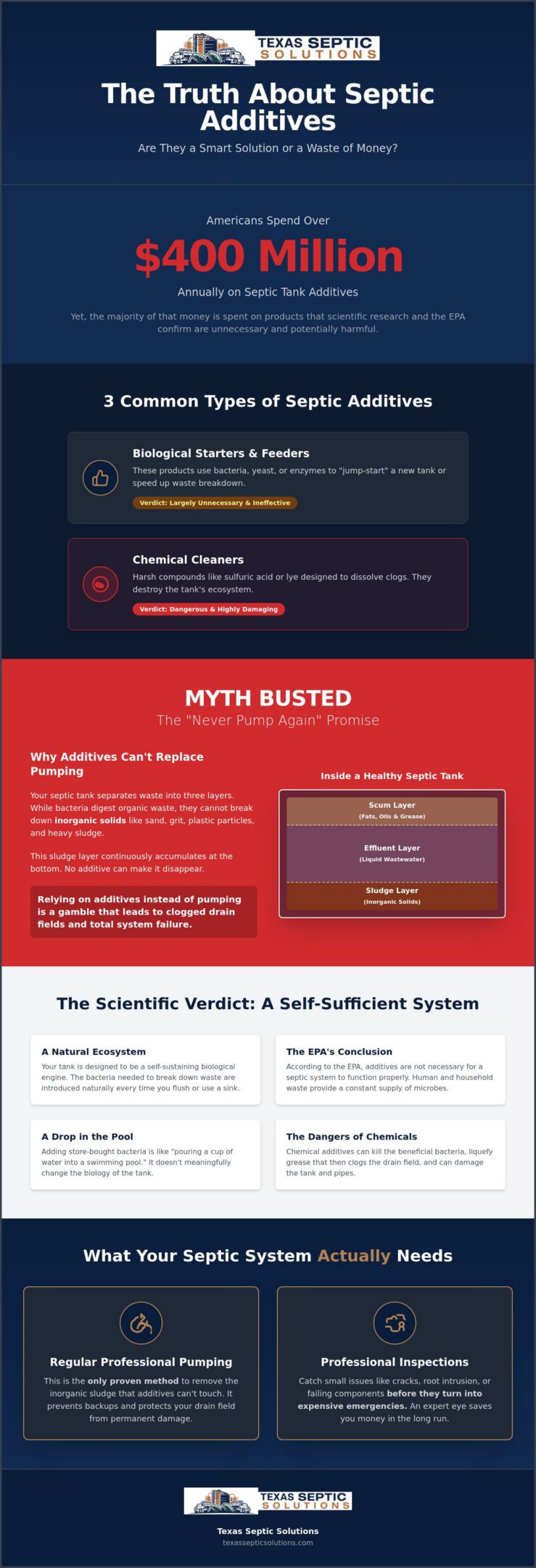
Walk into any hardware store in Cleveland or Cypress and you’ll find shelves lined with “miracle” treatments for your plumbing. Americans spend over $400 million a year on these products, hoping to find a shortcut to home utility management. To understand what are septic system additives, you have to look past the flashy marketing. These are products that claim to enhance the natural digestion of waste or, in some cases, promise to “eliminate” the need for professional pumping entirely.
It is easy to see why these products sell so well. Nobody looks forward to the cost of maintenance, and a $20 box feels like a bargain compared to a major repair. As a neighborly expert, we understand that desire for a quick fix. However, if a product sounds too good to be true, it almost always is. Most additives fall into three specific categories:
- Starters: These use bacteria or yeast cultures to “jump-start” the biological process in a new or recently pumped tank.
- Feeders: These contain enzymes that act as a catalyst to speed up the breakdown of organic matter.
- Chemical Cleaners: These are harsh inorganic compounds designed to dissolve clogs and grease.
Biological vs. Chemical Additives
Biological additives are generally less harmful to your tank’s physical structure because they rely on living organisms like yeast to boost digestion. Chemical additives are a different story. Many of these products contain sulfuric acid or lye. While they might clear a stubborn clog in the moment, they are incredibly destructive to your pipes and the concrete or plastic of your tank. They don’t just kill the “bad” stuff; they wipe out the beneficial bacteria your system needs to function, leaving you with a sterile, non-working tank.
The “Never Pump Again” Marketing Myth
The most dangerous claim in the industry is the idea that you can “never pump again.” When asking septic system additives do they work, this is where the marketing hits a wall. Your septic tank is a settling chamber. While bacteria break down some organic waste, inorganic solids like sand, plastic bits, and heavy sludge will always accumulate at the bottom. No amount of store-bought bacteria can make these solids disappear.
Relying on a box of powder instead of regular septic system maintenance Texas is a gamble that rarely pays off. Pumping is the only verified way to remove that sludge before it flows into your drain field and causes a total system failure. In the next section, we’ll look at the scientific evidence behind these claims.
Do Septic System Additives Actually Work? The Scientific Verdict
When homeowners ask septic system additives do they work, they are usually looking for a way to make their system more efficient. The reality is that your septic tank is already a high-performance biological engine. It doesn’t need “boosters” because it’s designed to be a self-sustaining ecosystem. The bacteria required to break down waste are introduced naturally every time you flush the toilet or run the sink.
Human waste and household greywater provide a constant supply of the exact microbes your system needs. Adding store-bought bacteria is often like pouring a cup of water into a swimming pool; it doesn’t change the chemistry enough to matter. In fact, a healthy tank maintains a delicate balance on its own. Many people believe that “more is better,” assuming that dumping a year’s worth of bacteria into the tank will speed up the breakdown process. This is a common misconception. A septic tank has a limited amount of space and “food” for bacteria. Once the population reaches its natural limit, any extra bacteria you add will simply die off or be flushed out of the system. You can’t force the biology to work faster than the laws of nature allow.
The Natural Bacterial Balance of Your Tank
A functional tank organizes itself into three distinct layers. The top layer is the scum or “crust,” made of fats and oils. The middle is the clear effluent. The bottom is the sludge, where heavy solids settle. Anaerobic digestion is the natural breakdown of organic matter by bacteria in an oxygen-free environment. This process happens 24/7 without any help from a box of powder or liquid chemicals. When the system is left alone, these bacteria work steadily to reduce the volume of organic solids.
What Research from the EPA and Universities Shows
Independent research consistently points to the same conclusion. According to a 2024 EPA fact sheet, additives are not necessary for a septic system to function properly. Even more concerning is that some products can actually interfere with the settling process. Instead of letting solids sink to the bottom, certain additives can suspend them in the effluent. This allows solids to flow into and clog your drain field, which is a recipe for a very expensive repair bill.
Research from Washington State University on septic additives highlights that these products are often a waste of money because they don’t reduce the need for pumping. While bacteria can digest organic solids, they cannot touch inorganic materials like sand, grit, or synthetic fibers. These materials will always build up over time. If you’re worried about your system’s health, trust the science over the marketing labels. Scheduling professional septic system maintenance is a much safer bet for your home and your wallet than relying on retail shortcuts.
The Hidden Dangers: How Additives Can Damage Your System
While the promise of a cheap fix is tempting, the physical damage these products cause often leads to the very disaster you’re trying to avoid. When you ask, septic system additives do they work, you have to consider the mechanical health of your system, not just the biology. One of the biggest risks is the emulsification of fats, oils, and greases (FOG). In a healthy tank, these materials float to the top to form a scum layer. Certain additives break this layer down into tiny droplets that stay suspended in the water. Instead of staying safely in the tank, these oils flow straight into your drain field.
This is where the real trouble starts. Once those suspended solids and greases reach the soil, they plug up the tiny pores that allow water to filter through. In local areas like Cypress and Huffman, where soil conditions can already be challenging, this often leads to soil compaction and total system failure. The financial stakes are high. A simple pump-out is a predictable maintenance expense, but a failed drain field can cost between $5,000 and $20,000 to replace according to industry data. Beyond the cost, there is the serious risk of groundwater contamination, which can affect your family’s health and the local environment.
Risk of Drain Field Clogging and Soil Compaction
Additives often keep solids suspended in the effluent instead of letting them sink to the bottom as sludge. These fine particles travel through the outlet pipe and settle in the leach field soil. Over time, they create a waterproof barrier that prevents the ground from absorbing liquid. If you notice soggy spots in your yard or slow drains, you may already be facing the need for septic system repair in Texas. Once the soil pores are plugged, no amount of chemicals can “unclog” the earth; the only solution is often a complete and costly relocation of the drain field.
Corrosion and Pipe Damage
Harsh chemical additives, especially those containing inorganic acids or alkalis, are incredibly hard on your infrastructure. These substances can eat through concrete tank walls and damage the baffles that keep solids where they belong. The long-term impact on PVC piping and rubber seals is equally concerning, as chemical reactions can make these materials brittle and prone to cracking. It’s also a scientific fact that chemical additives can kill the very bacteria needed for waste digestion, essentially poisoning the system they were meant to help. Choosing a shortcut today can lead to a complete system rebuild much sooner than expected.
Effective Maintenance: What Your Septic System Really Needs
True system health doesn’t come from a box; it comes from a commitment to proper upkeep. When you’re trying to figure out septic system additives do they work, it’s easy to get distracted by the flashy products on the shelf. However, the most reliable way to protect your home is to shift your focus from “adding things” to “removing things.” Your tank is a collection vessel, and once it is full of inorganic solids, no amount of bacteria will create more space. You have to physically remove that waste to keep the system functional.
In areas like Cleveland and Houston, our East Texas clay soil plays a massive role in how we manage these systems. Clay is dense and holds onto water much longer than sandy soil. This means your drain field is already working under high pressure. If you overload the system with too much water or allow solids to escape the tank, the clay soil will quickly become saturated and fail. Effective maintenance is about reducing that stress before it becomes a crisis.
The Role of Regular Septic Pumping
Professional pumping is the only way to remove the inorganic sludge that naturally accumulates at the bottom of your tank. For most households, we recommend a pump-out every 3 to 5 years. This process clears the settling zone so your tank can continue to separate waste effectively. Without this, the sludge layer grows until it eventually overflows into your drain field, causing permanent damage. You can check your septic system maintenance plan to see where your home stands in the typical cycle.
Proactive Tips for a Healthy Microbial Environment
Maintaining the natural bacteria already in your tank is simpler than you might think. You don’t need to add anything special; you just need to stop killing what’s already there. Follow these practical steps to keep your system in top shape:
- Watch your waste: Avoid flushing “flushable” wipes, grease, or heavy chemicals like bleach and drain cleaners. These are the real enemies of your system.
- Manage your water: Spread out laundry loads over the week. Flooding the tank with too much water at once, known as hydraulic overloading, can push solids out before they have a chance to settle.
- Protect the surface: Never park vehicles or build structures over your drain field area. This prevents soil compaction and keeps the pipes from being crushed under the weight.
If it’s been more than three years since your last service, don’t wait for a backup to happen. Schedule your professional septic pumping today to ensure your system remains reliable for years to come.
Professional Care vs. Store-Bought Shortcuts
Choosing between a store-bought box and professional service is the difference between a gamble and a guarantee. While we’ve explored the science behind septic system additives do they work, the most important takeaway for any homeowner is that a product on a shelf cannot diagnose a failing baffle or a cracked tank wall. A professional technician brings expert eyes to your system, identifying small issues before they become catastrophic failures. In the long run, a small investment in routine maintenance prevents the massive, five-figure cost of a total system replacement.
At Texas Septic Solutions, we act as a reliable local authority for the Cleveland, Houston, and Cypress communities. We’ve seen every possible scenario, from simple clogs to complete drain field collapses caused by chemical “quick fixes.” Our goal isn’t just to pump your tank; it’s to ensure your home utility remains functional and safe for your family. We take pride in being a dependable partner for property owners who value straightforward, expert advice over abstract marketing promises.
Why a Maintenance Plan Beats a “Quick Fix”
A professional maintenance visit is comprehensive. When we pump your tank, we perform a detailed inspection of the baffles, which are critical for keeping solids out of your drain field. We also check the effluent levels and the health of your pump system. If you find your septic tank alarm going off, you need a technician who can diagnose the electrical or mechanical cause immediately. A box of bacteria won’t fix a burnt-out pump or a tripped breaker. Early detection of these mechanical issues saves you money and provides the peace of mind that comes from knowing your system is handled by experts.
When to Call Texas Septic Solutions
You should never wait for a backup to occur before seeking help. If you notice slow drains, gurgling pipes, or unusual odors in your yard, it’s a sign that your tank is reaching capacity. These symptoms indicate you need a professional pump-out, not a retail additive. We’re committed to serving our neighbors across East Texas with 24/7 emergency support and routine care that you can trust. We don’t offer shortcuts; we offer solutions that work for the long haul.
Don’t leave your home’s functionality to chance. Schedule your professional septic pumping with Texas Septic Solutions today!
Protect Your Home with Proven Maintenance
The marketing for retail treatments is powerful, but when you ask septic system additives do they work, the scientific answer is clear. These products cannot remove the inorganic solids that naturally build up in your tank. Relying on them only delays essential maintenance and risks a costly drain field failure. True peace of mind comes from removing waste, not adding more chemicals or bacteria to a system that is already designed to be self-sustaining.
At Texas Septic Solutions, we provide expert care tailored to the specific clay soil conditions found in Houston and Cleveland. Every pumping service we perform includes a comprehensive inspection to ensure your baffles and pumps are in top shape. We’re here for you with 24/7 emergency service if things go wrong, but our goal is always to prevent those emergencies through steady, reliable maintenance. Trust the experts who know your local environment and can guarantee a job well done.
Don’t gamble with your drain field; schedule your professional septic pumping with Texas Septic Solutions! We’re ready to help you keep your system running smoothly for years to come.
Frequently Asked Questions
Is it ever necessary to add bacteria to a septic tank?
Adding bacteria is almost never necessary because your household waste naturally introduces the microbes required for digestion. Even after a professional pump-out, the small amount of residue left behind is enough to restart the colony. You don’t need to buy expensive starters to keep the biology moving; your daily usage provides all the bacteria your tank needs to function effectively.
Can septic tank additives cause my drain field to fail?
Yes, additives are a common cause of drain field failure. They can liquefy fats and keep solids suspended in the effluent, allowing them to escape the tank and enter the leach field. Once these materials hit your soil, especially the heavy clay found in East Texas, they create a waterproof barrier. This leads to a total system collapse that is very expensive to fix.
Are there any “septic safe” additives that actually work?
While many products are labeled “septic safe,” this simply means they won’t destroy your existing bacterial colony. It doesn’t mean they actually improve your system’s performance or reduce the need for maintenance. When homeowners ask septic system additives do they work, they should know that no retail product can remove inorganic sludge like a professional pump-out can.
What happens if I use chemical additives in an aerobic septic system?
Using harsh chemicals in an aerobic system is particularly dangerous. These systems rely on a mechanical aerator to support specific bacteria that treat waste more aggressively than standard tanks. Chemicals can corrode the motor components and kill the oxygen-dependent microbes. This results in untreated sewage entering your yard and potentially failing a local health department inspection.
How often should I pump my septic tank instead of using additives?
You should schedule a professional pump-out every 3 to 5 years regardless of any additives you use. This timeline varies based on your household size and total water usage. Regular pumping is the only proven way to ensure that solids don’t reach a level where they begin to exit the tank and clog your secondary treatment system.
Will additives help if my septic tank is already backing up?
Additives will not fix a backup. A backup is a sign of a physical blockage, a mechanical failure, or a tank that is already over its capacity. Pouring chemicals down the drain during a backup is a waste of money and can be dangerous. If you’re experiencing a backup, you need an immediate inspection and a professional pump-out to clear the system safely.
Do yeast or baking soda help septic systems?
There is no scientific evidence that yeast or baking soda provide any significant benefit to a septic system. While they aren’t as harmful as harsh chemical cleaners, they are still unnecessary for a healthy tank. A properly maintained system regulates its own chemistry and bacterial levels without the need for these common household pantry supplies.
Are septic additives regulated by the EPA or Texas state laws?
The EPA does not certify or recommend the use of any septic additives. While Texas state regulations don’t currently ban them, agencies like the TCEQ emphasize that professional maintenance is the only priority for system longevity. Some states have already banned certain additives to prevent groundwater contamination, showing that the environmental risks often outweigh any perceived benefits.