
Septic Solutions for Poor Soil in Huffman: 2026 Guide
Imagine standing in your yard near Lake Houston after a heavy rain, watching the water pool over your drain field while your neighbor tells you their soil percolation test just failed. It’s a common nightmare in East Harris County, where the heavy “black gumbo” clay makes traditional drainage nearly impossible. Finding effective septic system solutions for poor soil Huffman homeowners can trust is the difference between a permit approval and a costly, muddy mistake.
We understand that a failed perc test feels like a dead end for your building plans or a sign of an impending financial disaster for your existing home. You shouldn’t have to fear massive replacement costs or constant yard flooding just because of the ground beneath your feet. This 2026 guide reveals the best engineered septic options designed specifically for Huffman’s challenging terrain and high water tables. We’ll walk you through why aerobic treatment units are the local standard, how to navigate Harris County inspections without the stress, and what it takes to ensure long-term system reliability in even the toughest clay.
Key Takeaways
- Understand why Huffman’s dense clay and high water tables cause traditional gravity systems to fail and lead to rejected soil percolation tests.
- Explore the most effective septic system solutions for poor soil Huffman homeowners can use, including Aerobic Treatment Units that treat wastewater before it ever hits the ground.
- Compare the footprints and maintenance needs of Aerobic and Low-Pressure Pipe (LPP) systems to determine which engineered option fits your specific lot size.
- Learn how to navigate the 2026 Harris County permitting process and why professional engineering is required for non-standard system approvals.
- Discover how a comprehensive design and installation approach can streamline your project and ensure your new system meets all local health department codes.
Why Traditional Septic Systems Fail in Huffman Soil
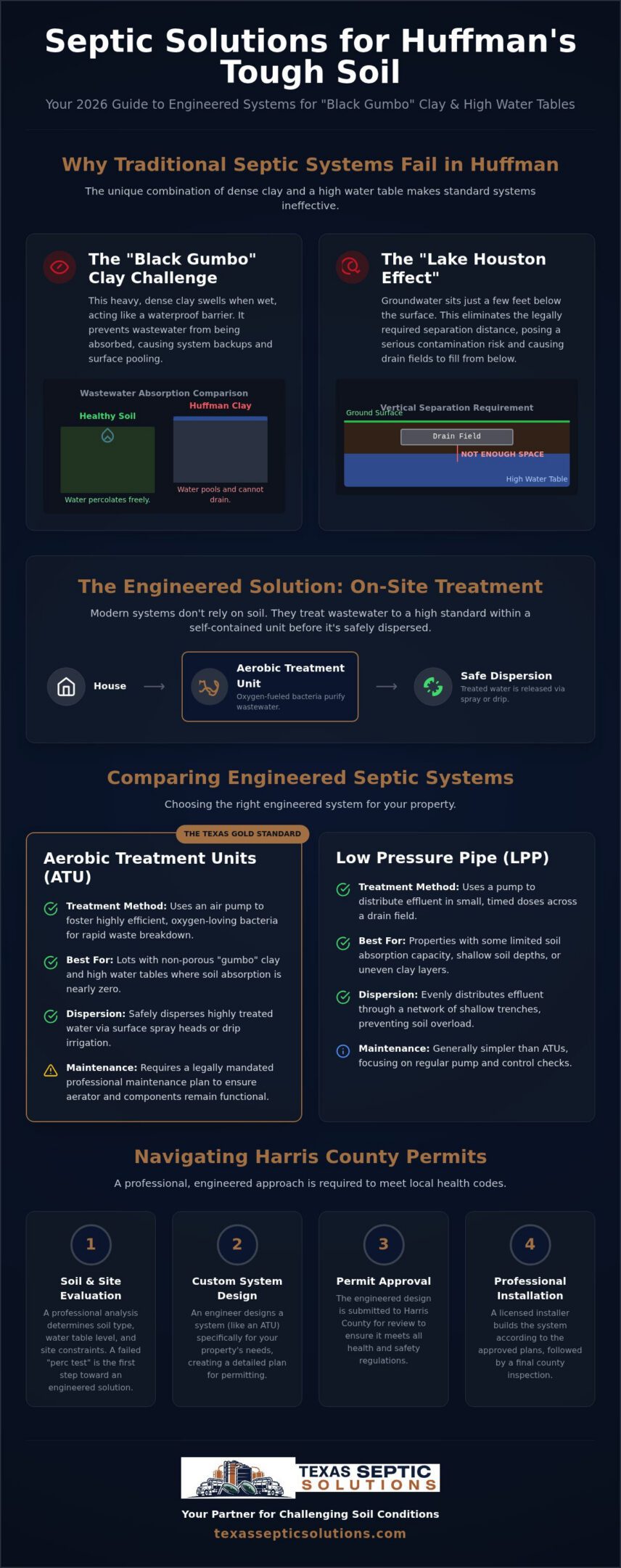
If you’ve ever tried to dig a post hole in Huffman after a rainstorm, you know the struggle. The ground here is dominated by “black gumbo,” a heavy, dense clay that acts more like a waterproof seal than a filter. In our region, “poor soil” isn’t just a minor inconvenience; it’s a combination of this non-porous clay and a high water table that makes standard drainage nearly impossible. Because traditional gravity systems rely entirely on the earth to absorb and treat wastewater, they often aren’t viable. Finding effective septic system solutions for poor soil Huffman residents can rely on starts with understanding why the old ways don’t work here.
A percolation test, or “perc test,” measures the rate at which water drains into the ground to determine if the land can safely handle a standard drain field. In Huffman, the results are often disappointing because the soil simply won’t let the water pass through. When the ground can’t “breathe,” your septic system can’t function.
The Challenge of Huffman’s ‘Black Gumbo’ Clay
Clay is made of microscopic, flat particles that expand significantly when they get wet. In Huffman, these particles swell and knit together, effectively sealing off the drain field. This is a fundamental lesson in how soil permeability affects septic systems; without enough space between soil particles, effluent has nowhere to go. Seasonal Texas rains only make it worse. When the ground is already saturated, the clay becomes compacted, losing what little drainage capacity it had. You might notice your yard staying soggy for weeks or your drains slowing down every time we get a heavy downpour. These are clear signs that the soil has reached its limit and can no longer process waste.
High Water Tables Near Lake Houston
Proximity to Lake Houston brings beauty, but it also brings a high water table. This creates what we call the “Lake Houston effect,” where the groundwater sits just a few feet below the surface. Texas law requires a specific “vertical separation” between the bottom of a septic trench and the groundwater to prevent contamination. In many low-lying Huffman neighborhoods, that gap doesn’t exist. When you try to use a traditional trench system in these areas, the trenches often fill with groundwater from below rather than draining effluent from above. This turns your backyard into a “septic lagoon,” posing a serious risk to local groundwater and creating a mess that traditional repairs just can’t fix. This is why specialized septic system solutions for poor soil Huffman homeowners need usually involve moving away from gravity-fed designs entirely.
Top Septic System Solutions for Poor Soil
In Huffman, “poor soil” isn’t a dealbreaker if you use the right technology. Since traditional gravity systems fail in the local black gumbo clay, engineered systems have become the modern standard. These designs don’t rely on the soil to do the heavy lifting of treatment. Instead, they use mechanical components to clean wastewater before it ever reaches the ground. Finding the right septic system solutions for poor soil Huffman homeowners need often involves choosing between a few specific, high-performance designs tailored for East Harris County.
Aerobic Treatment Units (ATUs): The Texas Gold Standard
Unlike old-school tanks that sit stagnant, ATUs use an air pump to inject oxygen into the wastewater. This process fuels oxygen-loving aerobic bacteria. These microbes are much more aggressive and efficient than the bacteria found in traditional tanks, breaking down waste at an accelerated rate. Because the water is treated to a high standard inside the tank, it can be safely dispersed through spray or drip systems even when the underlying clay has zero absorption capacity. It’s an ideal fix for lots near Lake Houston where drainage is a constant struggle.
Because these systems are more complex, Texas law requires owners to have a septic system maintenance plan in place. This ensures the aerator and disinfection components stay functional. If you’re curious about local regulations or why these systems are mandated for certain lots, the Harris County septic system FAQ provides excellent context on how the county manages wastewater in challenging environments.
Low Pressure Pipe (LPP) Systems
If your property has shallow soil depths or uneven clay layers, an LPP system is a strong contender. These systems use a specialized pump to distribute effluent evenly across a shallow drain field through small-diameter pipes. This “dosing” method is superior to gravity because it prevents any single part of the yard from becoming saturated. This is vital in Huffman, where one corner of a lot might drain slightly better than another. LPP systems are excellent for:
- Properties with shallow restrictive layers of clay.
- Lots with rocky or inconsistent soil profiles.
- Homeowners who want a smaller footprint for their drain field.
While these systems are incredibly reliable, they do rely on mechanical pumps and sensors. Regular inspections are necessary to ensure the pressure remains consistent across the lines. For those dealing with a high water table, a mound system might also be recommended. This involves creating an artificial drainage layer of sand above the natural ground level to provide the necessary vertical separation for safe treatment. If you are struggling with a failed perc test, Texas Septic Solutions can help you determine which of these septic system solutions for poor soil Huffman inspectors prefer for your specific lot.
Comparing Aerobic vs. LPP Systems for Huffman Homes
Choosing between an Aerobic Treatment Unit (ATU) and a Low Pressure Pipe (LPP) system is a common crossroads for local residents. Both are effective septic system solutions for poor soil Huffman properties often require, but your specific lot size and the local humidity play a huge role in the final decision. For smaller lots near Lake Houston, an ATU with a spray dispersal might be the only way to fit a legal system onto the property. LPP systems, while excellent for even distribution, often require a larger subsurface footprint that just isn’t available on tight residential parcels.
Durability is another major factor in our humid East Texas climate. While both systems use mechanical parts, the high moisture levels in Huffman can be tough on electrical components. Ensuring your system is designed with high quality, weather-resistant housing is vital. Because these systems are more complex than a standard tank, you’ll need a partner who understands septic system repair for engineered components when the humid air or heavy rains eventually take their toll.
Installation Cost vs. Long-Term Value
Upfront costs for LPP and mound systems can sometimes be higher than aerobic units because they require a significant amount of specialized sand and gravel to be trucked in. Aerobic systems might have a more attractive initial price tag, but you must factor in the monthly electricity for the aerator and the ongoing cost of chlorine tablets. According to the Texas Commission on Environmental Quality, these alternative systems are necessary when the soil cannot process waste naturally. While the initial investment is higher than a traditional gravity system, it’s the only way to prevent a massive septic system replacement cost just a few years down the road when a cheaper, non-engineered system inevitably fails in the clay.
Maintenance and Reliability
Texas state law mandates ongoing maintenance contracts for all aerobic systems. This isn’t just a suggestion; it’s a legal requirement to ensure the treated water remains safe for your yard. LPP systems generally handle heavy rain better than aerobic spray fields because they keep the effluent underground, preventing the “ponding” effect during a downpour. However, if your septic tank alarm goes off during a Huffman tropical storm, it’s often a sign that the pump tank is taking on too much water. Reliability depends on regular inspections to catch small float or pump issues before they lead to a complete system backup.
Navigating Harris County Septic Permits and Soil Testing
Harris County regulations are notoriously strict when it comes to wastewater. In Huffman, you’re almost guaranteed to need an engineered design because the county classifies our local “black gumbo” as Class IV soil. This soil type is legally unsuitable for standard gravity systems. Securing septic system solutions for poor soil Huffman inspectors will actually approve requires following a specific technical path. You can’t just dig a hole and hope for the best. You need a Professional Engineer (PE) or a Registered Sanitarian (RS) to sign off on a design that proves your lot can handle wastewater safely without contaminating the local water table.
The process starts with a formal application to the Harris County Engineering Department. While state law sometimes allows exemptions for large acreage, Harris County often overrides these rules to protect the environment. In 2026, the permit review time typically takes about 30 days. However, this timeline can stretch if your site plan is missing details or doesn’t account for nearby water wells. Getting it right the first time is the only way to avoid frustrating delays in your construction schedule.
The Site Evaluation Process
A site evaluation is much more rigorous than a basic percolation test. Your evaluator will dig “profile holes” to map out different soil horizons. They are looking for the “restrictive layer,” which is the depth where the clay becomes so dense that water movement stops completely. They also have to identify the peak seasonal groundwater level. This is critical for homes near Lake Houston where the water table can fluctuate wildly. Your system’s size isn’t based on your current family size; it’s dictated by the number of bedrooms in your home. This determines the potential daily flow rate the system must be able to treat.
Securing Your Permit to Construct
Once your PE or RS finishes the engineered drawings, they are submitted for review. After the county issues a “Permit to Construct,” the installation begins, but the oversight doesn’t end there. There are two mandatory inspection phases you must pass. The first is the “open-trench” inspection. An inspector must see the tanks and lines in the ground before any dirt covers them to ensure they match the approved plans. The final phase is a walk-through to verify the electrical components and disinfection systems are active. Common delays in Huffman often stem from improper setbacks or failing to have a mandatory maintenance contract ready at the time of inspection. If you’re feeling overwhelmed by the paperwork, Texas Septic Solutions can manage the entire design, permitting, and installation process as your local one-stop shop.
Custom Septic Design with Texas Septic Solutions
Every lot in Huffman presents a different puzzle. One property near Lake Houston might struggle with a water table just three feet down, while another a mile away is sits on a thick slab of impenetrable black gumbo clay. Because of these variations, a one size fits all approach simply isn’t an option. We specialize in creating custom septic system solutions for poor soil Huffman residents can rely on for decades. We don’t just install tanks; we design integrated waste management systems that respect the unique geography of East Harris County. Our team lives and works in this community, giving us a “neighborly expert” perspective that big box contractors can’t match.
Once your new system is in the ground, protecting that significant investment becomes your next priority. Following a consistent schedule for septic system maintenance Texas homeowners can trust is the best way to avoid future headaches. These engineered systems are mechanical by nature, and they perform best when they receive regular, professional attention to keep their aerators, pumps, and disinfection units in peak condition.
One-Stop Shop for Huffman Homeowners
We believe the permitting and installation process should be as stress-free as possible for you. That’s why we act as a single point of contact for the entire project. We manage the relationship with the Professional Engineers (PEs) who draft your plans, we handle the back and forth with Harris County inspectors, and we coordinate the heavy equipment for excavation. This all-encompassing model ensures nothing gets lost in translation between the designer and the installer. We offer transparent pricing for even the most complex septic system solutions for poor soil Huffman builds require. We can also provide local references from your neighbors in the Lake Houston area who have successfully navigated these same soil challenges with our help.
24/7 Peace of Mind
Septic issues don’t always happen during business hours. Because we are locally based, we can provide 24/7 emergency support when you need it most. Proximity matters when a pump fails or an alarm sounds during a weekend storm. Our commitment to the community means we don’t just walk away after the final inspection. We stay on your team to ensure your system remains compliant with state and county laws while functioning perfectly for your household. You deserve a system that works as hard as you do. Contact us at Texas Septic Solutions to schedule your site evaluation today and let’s find the right engineered path for your property.
Build or Repair with Total Confidence in Huffman
Living near Lake Houston shouldn’t mean living with constant yard flooding or the fear of a failed inspection. Huffman’s dense “black gumbo” clay makes traditional gravity systems a risky bet. Choosing engineered septic system solutions for poor soil Huffman homeowners need ensures your wastewater is treated safely, regardless of how the ground behaves. By navigating the Harris County permitting process with a professional design, you secure both your property value and your peace of mind.
At Texas Septic Solutions, we are your locally owned and operated Harris County compliance experts. We handle every detail, from the initial site evaluation to providing 24/7 emergency response, so you don’t have to manage engineers or inspectors alone. Don’t let poor soil drainage stall your building or repair plans. Request a Site Evaluation for Your Huffman Property today and let’s get your project moving forward. You’ve got a neighborly expert on your side to keep your home functional and your yard dry.
Frequently Asked Questions
Can I install a traditional septic tank if my soil is heavy clay?
No, installing a traditional gravity system in heavy Huffman clay is rarely allowed. Harris County typically classifies this “black gumbo” as Class IV soil, which lacks the permeability needed for standard drain fields. Without proper absorption, wastewater would simply pool on the surface. Instead, you’ll need to look into engineered septic system solutions for poor soil Huffman homeowners use, such as aerobic treatment units that don’t rely on the soil for filtration.
What happens if my land fails a percolation test in Huffman?
Failing a perc test isn’t the end of your building project, but it does change your path. It confirms that your lot cannot handle a conventional septic system. You’ll need to hire a Registered Sanitarian or Professional Engineer to perform a full site evaluation. They’ll design a non-standard system tailored to your land’s specific limitations, ensuring you still meet Harris County health department standards for wastewater disposal.
How much more does an aerobic system cost compared to a traditional one?
Aerobic systems require a larger initial investment than traditional gravity systems because they include complex mechanical parts like aerators and control panels. You also have to factor in the long-term costs of electricity and mandatory maintenance contracts required by Texas law. While the upfront price is higher, these systems are often the only legal way to build on Huffman lots with dense clay or high water tables.
Do aerobic septic systems smell more than traditional ones?
Properly functioning aerobic systems actually produce less odor than traditional ones. Because they use an air pump to circulate oxygen, they foster aerobic bacteria that break down waste much more efficiently. If you notice a strong smell, it’s usually a sign that the aerator has failed or the system needs professional repair. Regular maintenance ensures the treatment process stays balanced and your backyard remains pleasant for your family.
Is it possible to build a house on a lot with a high water table?
Building on a lot with a high water table is common near Lake Houston, but it requires a specialized design. Texas regulations demand a specific amount of dry soil between the septic system and the groundwater. To achieve this, we often install mound systems or aerobic units with surface spray dispersal. These methods ensure wastewater is fully treated before it ever touches the sensitive groundwater levels on your property.
How often does an engineered septic system need maintenance in Texas?
In Texas, aerobic systems must be inspected three times per year under a mandatory maintenance contract. This is a state-level requirement designed to protect the environment and your property. These inspections check the air compressor, water pumps, and disinfection levels. Staying on top of this schedule prevents small mechanical issues from turning into major failures that could lead to a full system replacement.
What are the Harris County requirements for septic systems near Lake Houston?
Harris County has strict setbacks and design requirements for any property within the Lake Houston watershed. You’ll need a professional site evaluation to map out soil horizons and groundwater levels before any permit is issued. Because the county acts as the local authority for the TCEQ, every system must be engineered to prevent runoff into the lake, often mandating advanced treatment technology rather than standard tanks.
Can poor soil septic solutions be repaired, or must they be replaced?
Most engineered systems can be repaired if the issues are caught early. Components like air compressors, water pumps, and electrical floats are all replaceable. We provide 24/7 emergency service to handle these mechanical failures before they cause a backup. However, if a drain field is completely clogged by years of neglect, a more extensive replacement might be necessary, which is why routine maintenance is so vital.