
Septic Pumping for Cleveland, TX Schools: 2026 Guide
Imagine it’s the middle of a busy Tuesday morning while the cafeteria is at full steam and the gym showers are running. Suddenly, a drain backs up in the main hallway. For Cleveland school administrators, this isn’t just a minor plumbing issue. It’s a potential campus-wide shutdown and a major health department violation. We understand that the pressure of keeping hundreds of students safe and comfortable is a heavy responsibility. Managing the high-volume demands of a school campus requires more than just standard maintenance; you need a system that handles heavy usage without ever causing a scene during class hours.
This 2026 guide provides the essential information you need regarding professional septic tank pumping for schools Cleveland TX to keep your facilities hygienic and fully operational. You’ll learn how to navigate strict Texas Commission on Environmental Quality (TCEQ) standards and the benefits of a discreet, zero-disruption pumping schedule. We will also explore proactive maintenance strategies designed for high-capacity commercial systems to ensure your campus stays compliant and your system remains healthy for years to come.
Key Takeaways
- Identify how high-volume surge loads from cafeterias and athletic facilities impact your system’s health and operational readiness.
- Learn to coordinate septic tank pumping for schools Cleveland TX during breaks and weekends to maintain a safe, distraction-free environment.
- Navigate TCEQ and Liberty County compliance requirements with ease by keeping accurate records and required pumping manifests.
- Use a specialized facility manager’s checklist to locate access points and audit for leaks that increase daily wastewater volume.
- Ensure long-term system stability and budget predictability with professional maintenance plans tailored for large-scale campus needs.
Why Schools in Cleveland, TX Require Specialized Septic Pumping
Schools in Cleveland operate on a scale that dwarfs typical residential properties. While a home system manages the needs of a single family, an educational facility must process thousands of gallons of wastewater every day. This volume isn’t spread evenly over 24 hours. Instead, it hits the system in massive waves during specific windows. Understanding how septic systems work at this industrial level is the first step in preventing a campus-wide failure. High-capacity septic tank pumping for schools Cleveland TX requires a level of technical precision that standard residential services simply aren’t equipped to provide.
Managing the “Surge Load” Challenge
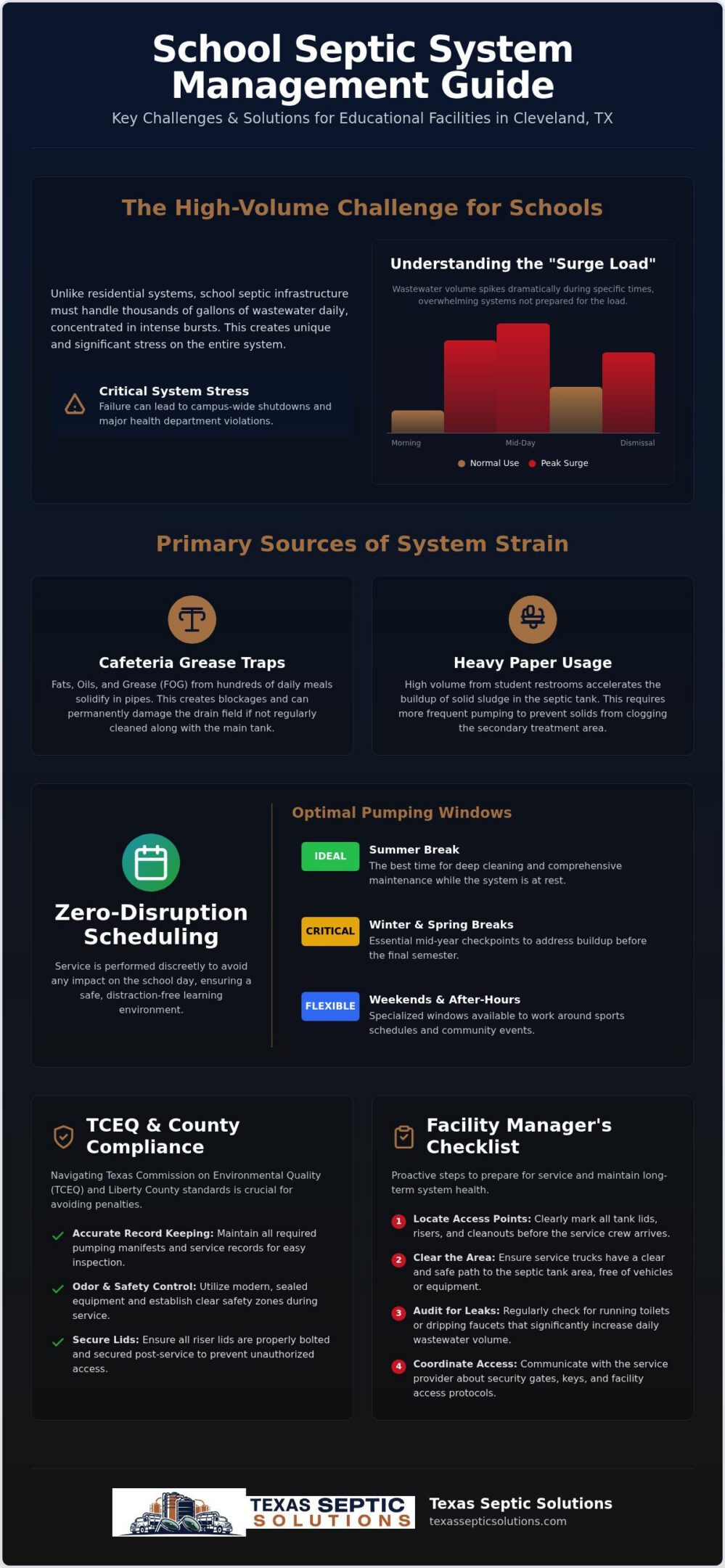
Educational facilities face a unique phenomenon called a surge load. This occurs during passing periods, lunch breaks, and after-school sporting events when hundreds of fixtures are used simultaneously. These peaks put immense pressure on the drain field, which requires time to process liquid effluent. If the system isn’t maintained, the soil becomes saturated quickly. Unlike a home that might need service every few years, septic tank pumping for schools Cleveland TX must be scheduled according to these high-traffic patterns. Many campuses also utilize lift stations to move waste across multi-building layouts. If a lift station pump fails during a peak surge, the resulting backup can create a critical health emergency within minutes.
Cafeteria Grease Traps and School Septic Health
The school cafeteria is another major contributor to system stress. Preparing hundreds of meals daily introduces significant amounts of organic waste into the plumbing. We recommend integrating grease trap cleaning with your main tank pumping to ensure the entire infrastructure remains clear. FOG (Fats, Oils, and Grease) is a combination of food byproducts that solidify inside pipes and tanks, eventually creating a waterproof barrier that can permanently ruin a school’s secondary treatment area or drain field. Heavy paper usage from student restrooms also accelerates sludge buildup. Without regular removal, these solids can bypass the primary tank and clog the soil; this leads to costly repairs and potential school closures due to health department non-compliance.
Zero-Disruption Scheduling: Pumping Without Impacting the School Day
Coordinating a major utility service on a busy campus requires precision. You can’t have heavy vacuum trucks and open tanks while students move between classes. Effective scheduling ensures that maintenance doesn’t interfere with the educational mission. We prioritize after-hours or weekend windows to avoid student exposure to heavy equipment. Our goal is a “ghost-like” presence where the work is finished before the first bell rings or after the last bus departs for the day.
Following Texas septic system standards is about more than just the mechanics of the tank. It’s about the safety of the environment where children learn. This includes managing the logistical dance of school security and facility access protocols. Our team works directly with your facility managers to ensure all gates are open and access lids are cleared before we arrive. This level of coordination is what makes septic tank pumping for schools Cleveland TX successful without causing a single minute of classroom downtime.
The Best Times for Cleveland School District Pumping
Summer break remains the ideal window for high-capacity pumping. The system has a chance to rest, and our crews can perform deep cleaning without any time constraints. However, winter and spring breaks are also critical mid-year checkpoints. These intervals help catch potential issues before the final semester push. For campuses with heavy Saturday sports schedules, we offer specialized Sunday windows. We align our service dates with the Cleveland ISD calendar and local private school schedules to ensure we’re never on-site during testing weeks or major community events.
Discreet Operations and Odor Control
One of the biggest concerns for administrators is the potential for odorous gases to drift into classrooms. We use modern, sealed-connection equipment that traps smells within the vacuum system during the entire process. Safety is our other top priority. We establish clear safety zones to keep any staff or remaining students away from the active pumping area. Once the job is done, we ensure every riser lid is bolted and secured according to state safety protocols. This prevents unauthorized access and keeps the campus safe. If you’re planning your next maintenance window, our team at Texas Septic Solutions can help you build a timeline that fits your specific campus needs.
Compliance and Capacity: Meeting Texas Standards for Schools
Schools in Cleveland must follow strict state and local regulations to remain operational. The Liberty County health department and the Texas Commission on Environmental Quality (TCEQ) classify school facilities as commercial wastewater systems. These systems often handle high Biochemical Oxygen Demand (BOD) loads due to the concentrated nature of cafeteria and gym waste. Staying ahead of these requirements through scheduled septic tank pumping for schools Cleveland TX is the only way to avoid environmental fines or forced campus closures. Routine service ensures that your facility remains a safe place for students to learn without the threat of surfacing sewage or system failure.
By prioritizing regular maintenance, facility managers significantly reduce the likelihood of needing an expensive septic system repair. When solids accumulate, they eventually migrate into the secondary treatment area or the drain field. This leads to total system failure and potential environmental contamination. In Texas, environmental fines for non-compliance are substantial. This makes proactive pumping the most cost-effective strategy for any school district budget.
Record Keeping for School Inspections
Inspectors expect to see a comprehensive paper trail during their visits. It isn’t enough to simply perform the work; you have to prove it happened. Maintaining a detailed log of every pumping event, including the exact volume removed and the date of service, is mandatory for commercial systems. We provide electronic manifests that are essential for state compliance audits. These digital records are easier to track and present to officials than old paper files. You should also ensure your documentation includes baffle inspections and the cleaning of any effluent filters. These details show that the school is meeting its duty of care and following all TCEQ guidelines for large-scale sewage facilities.
High-Capacity Tank Specifications
School septic systems are sized based on peak daily hydraulic flow. If your campus enrollment has increased since the system was originally designed, your current tank might be undersized for your needs. Verifying your capacity is essential for preventing overflows during high-traffic events like football games or graduation ceremonies. Systems processing over 5,000 gallons per day require specialized state-issued permits that involve even more rigorous oversight. The correlation between student headcount and septic tank capacity is direct; every additional student increases the daily hydraulic load, which shortens the required time between necessary pumping cycles. We can help you determine if your system is still adequate for your current student body or if more frequent pumping is needed to compensate for growth.
A Facility Manager’s Checklist for School Septic Pumping
Managing a school’s infrastructure requires a proactive approach that balances student safety with operational efficiency. Before the pumper truck arrives for professional septic tank pumping for schools Cleveland TX, a quick internal audit can save significant time and money. Start by checking for leaking faucets or running toilets in the student restrooms. These minor leaks add thousands of gallons of unnecessary hydraulic load to the system and can lead to premature tank filling. You should also notify campus staff and security of the scheduled maintenance window to ensure no one is surprised by the service vehicles or restricted access areas.
Clear communication prevents confusion and ensures that the service area remains clear of pedestrian traffic. We recommend sending a campus-wide email at least 48 hours in advance. This gives the cafeteria staff and janitorial teams enough time to adjust their schedules if needed. When everyone is on the same page, the pumping process moves faster and with fewer interruptions. Our team works closely with your facility department to verify that every step of the preparation is handled correctly before we begin the extraction process.
Preparing the Campus for the Pumper Truck
A heavy pumper truck needs a stable, clear route to reach the tanks without causing damage to school property. Ensure that access paths are wide enough and don’t require driving over school sidewalks or athletic fields, which aren’t designed for that weight. You must also verify that all manhole covers are accessible and haven’t been paved over or covered by new landscaping. If you have underground utilities near the septic area, mark them clearly to prevent any accidental damage during the service. Having this information ready allows our technicians to position the equipment safely and efficiently, reducing the time we spend on-site.
Post-Pumping Inspection and Maintenance
Once the tank is emptied, the job isn’t quite finished. You must confirm the septic tank alarm is functional and properly reset. High-water alarms are your first line of defense against a backup, so testing them post-service is a critical safety step. Our technicians also clean the effluent filter to ensure liquid continues to flow correctly to the drain field. This is the ideal time to plan your next scheduled septic tank pumping for schools Cleveland TX based on the actual sludge levels we found and your current enrollment data. If you’re ready to schedule your next maintenance window, contact our experts at Texas Septic Solutions for a professional campus assessment.
Reliable School Septic Solutions in Cleveland, TX
Choosing a partner for your campus infrastructure isn’t just about hiring a truck; it’s about finding a guardian for your school’s daily operations. Texas Septic Solutions has built a reputation as the reliable local authority for Cleveland educational facilities. We understand that schools operate on tight budgets and even tighter schedules. Our team brings deep expertise in Liberty County health codes, ensuring your facility remains fully compliant without the stress of navigating complex state regulations alone. We take pride in serving our local community and keeping our schools safe and hygienic for every student and staff member.
Our approach centers on being a long-term maintenance partner rather than just an emergency service provider. By understanding the unique layout of your campus, we can predict potential issues before they disrupt the learning environment. This proactive stance is essential for high-capacity systems that face the extreme demands of modern school life. We are built for the mundane tasks of seasonal upkeep and the high-pressure demands of unexpected failures, providing a sturdy and responsive service model that Cleveland administrators can trust.
Customized Maintenance for School Districts
We offer scalable septic system maintenance plans that adapt to the size of your district. Whether you manage a single private academy or a large public district with multiple campuses, we create a strategy that fits your fiscal year requirements. Our educational clients receive priority scheduling during peak breaks like summer and winter holidays. This ensures your septic tank pumping for schools Cleveland TX is completed when the hallways are empty. We provide transparent reporting and digital manifests to simplify your administrative oversight; this makes board presentations and state audits much easier to manage.
Emergency Readiness for Cleveland Schools
A system backup doesn’t wait for a convenient time. If a failure occurs during school hours, you need a partner who responds immediately. Our 24/7 emergency septic service is designed for these high-pressure scenarios. We have rapid response protocols in place specifically for campus-wide failures. Our technicians use expert troubleshooting to identify the root cause quickly, whether it’s a pump failure or a major blockage. This efficiency helps minimize school closure time and gets your students back in the classroom safely. Relying on our team means ensuring your septic tank pumping for schools Cleveland TX is handled by experts who know your system inside and out. Don’t wait for a crisis to secure your campus infrastructure. Contact us today to establish a reliable pumping schedule and ensure your school remains operational all year long.
Secure Your Campus Infrastructure for 2026 and Beyond
Maintaining a large-scale educational facility requires a proactive approach to wastewater management. We’ve explored how high-volume surge loads and cafeteria grease demand far more than standard residential care. By prioritizing zero-disruption scheduling and strict adherence to Liberty County standards, you protect both your district budget and the health of your students. Professional septic tank pumping for schools Cleveland TX remains the most effective way to prevent campus-wide backups and avoid expensive environmental fines.
As high-capacity commercial pumping specialists, we are dedicated to keeping your system operational through every semester. Our team provides the local expertise needed to navigate Texas environmental codes with total confidence. Whether you require a customized maintenance plan or 24/7 emergency service for school campuses, we have the readiness to support your facility’s unique needs. Schedule a Professional School Septic Consultation with Texas Septic Solutions today to ensure your system stays healthy. We look forward to being your dependable partner in keeping Cleveland’s schools running smoothly and safely for years to come.
Frequently Asked Questions
How often should a school in Cleveland, TX have its septic tank pumped?
Schools typically require more frequent pumping than residential properties due to high-volume daily usage. Most Cleveland educational facilities benefit from an annual pumping schedule or a mid-year checkup during major breaks. The exact frequency depends on your student enrollment numbers and the hydraulic capacity of your system. We recommend a professional assessment to determine a schedule that meets TCEQ requirements and prevents solids from reaching your drain field and causing failures.
Will septic pumping cause a bad smell in classrooms?
Professional pumping shouldn’t impact your indoor air quality when managed correctly. We use modern vacuum equipment and sealed connections to contain odorous gases during the extraction process. By scheduling septic tank pumping for schools Cleveland TX during school breaks or after-hours, we ensure that any temporary outdoor odors dissipate long before students return. Our technicians also verify that all tank lids are securely sealed once the job is finished to prevent lingering smells.
What happens if our school septic system fails during the school day?
A system failure during school hours is a critical health emergency that often requires immediate restroom closures to protect students. If a backup occurs, you should contact our emergency team right away to prevent environmental contamination on campus. We provide rapid response troubleshooting to identify if the issue is a pump failure or a major blockage. Our goal is to resolve the failure quickly so you can avoid a campus-wide shutdown and maintain hygiene.
Are there specific regulations for school septic systems in Liberty County?
Yes, school systems are classified as commercial wastewater facilities and must comply with Texas Commission on Environmental Quality (TCEQ) standards. Liberty County health officials require detailed maintenance logs and proof of regular pumping to ensure the system handles high Biochemical Oxygen Demand (BOD) loads. We help administrators maintain these records and provide the necessary manifests for state audits. Staying compliant is essential for avoiding environmental fines and ensuring your school’s operating permit remains in good standing.
Can you pump school grease traps at the same time as the septic tanks?
Yes, integrating grease trap cleaning with your main septic tank pumping is the most efficient way to manage campus waste. Cafeteria grease can cause severe blockages if it migrates into the secondary treatment area of your septic system. By servicing both at once, we ensure the entire infrastructure remains clear of fats, oils, and grease (FOG). This comprehensive approach saves on mobilization costs and provides a one-stop solution for your facility’s waste management needs.
How much does it cost to pump a high-capacity school septic tank in Cleveland?
The cost for pumping a high-capacity system varies based on the total gallonage and the accessibility of the tanks. School systems are significantly larger than residential units; they often require multiple truckloads to empty completely. Factors like the thickness of the sludge layer and the distance to the disposal site also influence the final price. We provide detailed, customized quotes for Cleveland school districts after a site visit to ensure your budget planning is accurate.
What is the best time of year to schedule school septic maintenance?
Summer break is the gold standard for major septic tank pumping for schools Cleveland TX because it allows for a full system rest. However, winter and spring breaks are also excellent times for mid-year inspections. Scheduling during these windows ensures our heavy equipment doesn’t interfere with bus routes or student passing periods. We prioritize educational clients during these peak holiday windows to ensure your campus is ready for the upcoming semester without any plumbing distractions.
Do you provide emergency 24/7 pumping for schools in Cleveland?
Yes, we provide 24/7 emergency septic service for all educational facilities in the Cleveland area. We understand that a plumbing crisis can happen at any time, and waiting until the next business day isn’t an option for a school campus. Our team is ready to respond to critical failures, high-water alarms, or system backups at any hour. This round-the-clock availability gives facility managers peace of mind that their campus infrastructure is always protected.