
Professional Septic Tank Cleaning in Houston: Bio-Cleaners vs. Expert Service
That $20 bottle of bio-cleaner sitting on your shelf might actually be costing you $15,000 in the long run. It’s easy to see why many homeowners reach for quick DIY fixes when faced with foul odors or slow drains. You want a solution that doesn’t break the bank, but relying solely on additives often masks deeper issues that only professional septic tank cleaning Houston experts can resolve. While these products have their place, they can’t replace the mechanical reset your system needs to handle our local clay soils and heavy rainfall.
We understand the stress of managing a utility you can’t see until something goes wrong. This guide will help you understand why professional pumping is the backbone of a healthy system and how bio-cleaners act more like vitamins than a cure-all. You’ll learn how to set a reliable maintenance schedule, evaluate the real impact of additives, and find a local partner who treats your property with the care it deserves. We’ll show you exactly how to protect your investment and keep your yard functional and fresh year-round.
Key Takeaways
- Understand why professional septic tank cleaning Houston involves deep mechanical removal of sludge rather than just surface-level pumping.
- Learn how Houston’s unique clay soil and high humidity can accelerate system stress, making regular maintenance essential for preventing drain field failure.
- Discover why bio-additives should be viewed as vitamins for your system’s health rather than a substitute for expert pumping services.
- Identify the five critical warning signs that your tank is reaching its limit, including deceptive indicators like unusually lush lawn growth.
- See how proactive maintenance and rapid expert response can prevent the high costs associated with complete system replacements.
What is Professional Septic Tank Cleaning in Houston?
Professional septic tank cleaning Houston is a comprehensive maintenance step that goes far beyond simply removing liquid from your system. Professional septic tank cleaning is the total evacuation and inspection of the tank’s interior. This process is vital because it addresses the three distinct layers inside your tank: the floating scum, the liquid effluent, and the heavy sludge at the bottom. Understanding how a septic system works helps explain why leaving even a small amount of sludge behind can lead to disaster. If the solids aren’t fully removed, they take up valuable space, leading to more frequent service needs and potential drain field clogs that are expensive to fix.
Pumping vs. Cleaning: Understanding the Difference
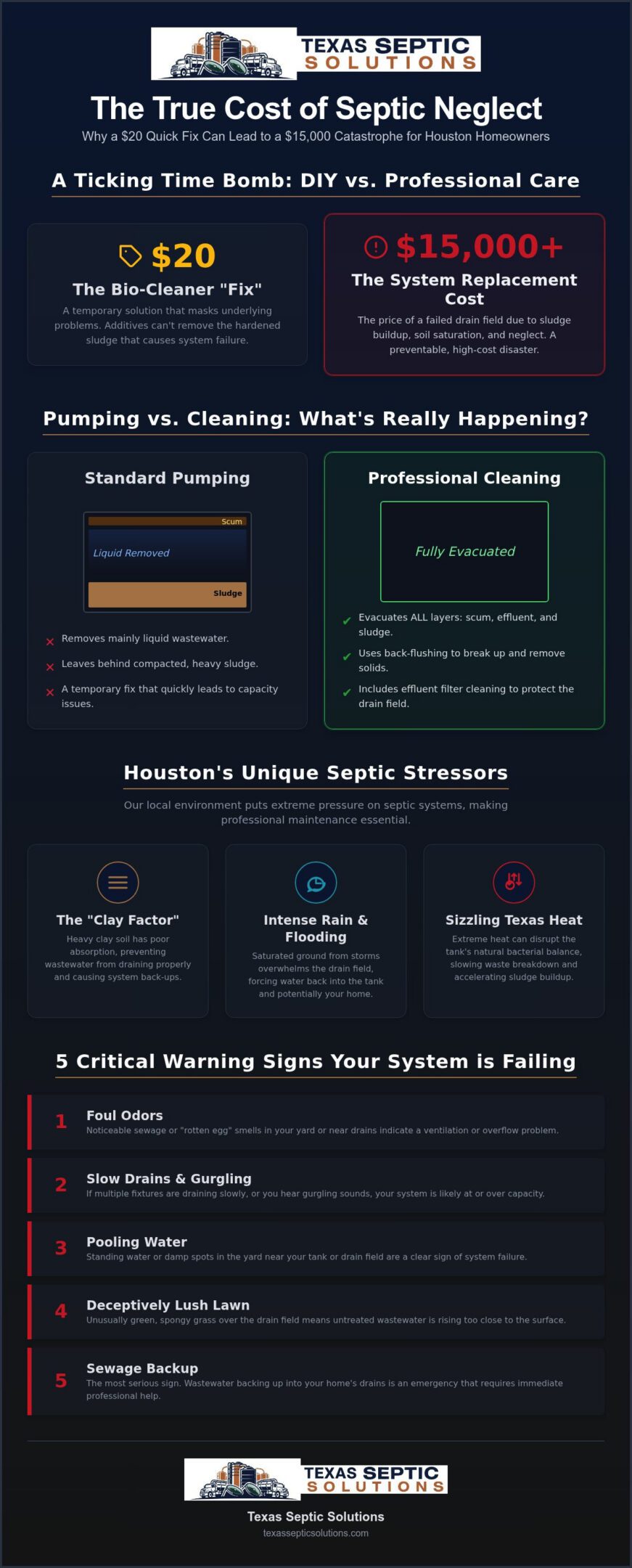
Don’t confuse a quick pump-out with a deep clean. Standard pumping typically removes the wastewater, but professional cleaning targets the sludge that settles and hardens over years. Our team uses back-flushing to agitate these solids. By pumping some liquid back into the tank under pressure, we break up the compacted waste so it can be fully extracted. We also take this opportunity to clean the effluent filter, which acts as a final gatekeeper for your drain field. A clean filter ensures that only clear liquid moves forward, extending the life of your entire system and preventing the high costs associated with a full system failure.
The Role of Texas Regulations in Septic Maintenance
Texas has strict guidelines managed by the Texas Commission on Environmental Quality (TCEQ) to prevent environmental contamination and protect public health. In Harris County and surrounding areas, professional septic tank cleaning Houston services provide the documentation you need for regulatory compliance. This is especially important if you plan to sell your property. Most buyers and lenders won’t close a deal without a certified inspection and a recent pumping record from a licensed provider. Beyond the legalities, regular cleaning prevents untreated sewage from reaching the local water table. It’s a small step that protects both your property value and our local community’s health.
By choosing a full cleaning over a simple pump-out, you ensure your system operates at peak efficiency. This proactive approach is the best way to handle the unique challenges of our local environment while keeping your home’s utility systems running smoothly without unexpected interruptions.
Why Houston’s Climate Demands Professional Septic Maintenance
Houston’s environment presents a unique set of challenges for onsite wastewater systems. Unlike regions with sandy, porous soil, our area is dominated by heavy clay. This “Clay Factor” means the ground acts like a sponge that is already full, leaving very little room for your septic system’s effluent to filter through naturally. When you add the Gulf Coast’s notorious humidity and intense heat, the biological processes inside your tank have to work much harder just to keep up. Without regular attention, these environmental factors can lead to premature system failure.
Heavy Houston rainstorms pose a direct threat to system stability. During a downpour, the ground becomes saturated almost instantly. If your tank is already near capacity due to sludge accumulation, a single storm surge can overwhelm the system, forcing wastewater back into your home or up into your yard. This is why professional septic tank cleaning Houston is a seasonal necessity rather than a luxury. By keeping your tank clear of solids, you create a vital buffer that can handle sudden influxes of water without failing.
Soil Saturation and System Stress
Saturated soil creates intense backpressure. When the drain field cannot absorb more liquid, the effluent has nowhere to go but back toward the tank. In extreme cases, high water tables in Harris County can even cause “floating” tanks if the surrounding ground is liquid-heavy and the tank isn’t properly maintained. Following official septic system maintenance guidelines helps you prepare for these environmental stressors before they turn into emergencies. A clean tank is a heavy, stable tank that is better equipped to withstand the pressure of a Texas flood.
Bacterial Health in Texas Heat
Many homeowners believe that our heat helps bacteria break down waste faster. While true to a point, the extreme Texas summer heat can actually stall the natural digestion process by overheating the tank’s delicate ecosystem. This leads to a faster accumulation of sludge that biological additives simply cannot handle on their own. Mechanical cleaning becomes the only reliable way to reset the system when natural processes fail under the relentless sun. If you’re concerned about how the next big storm might affect your property, it is wise to schedule Septic System Pumping with a local expert who understands Houston’s unique landscape.
Septic Tank Bio Cleaners: Miracle Cure or Maintenance Myth?
Many Houston homeowners see bio-cleaners on hardware store shelves and think they’ve found a loophole to avoid scheduled maintenance. These products usually contain enzymes or bacteria cultures meant to digest organic matter. While they can help maintain a healthy bacterial colony, they aren’t a substitute for professional septic tank cleaning Houston services. There is a persistent ‘Yeast Myth’ suggesting that flushing bread yeast or even raw meat can keep a tank clean forever. In reality, these household hacks often do more harm than good by creating excessive gas or introducing improper bacteria that compete with the natural flora your system needs.
Scientific research on septic tank additives suggests that many of these products don’t provide the miraculous results promised on the label. Some can even be detrimental to the environment. We view these products as supplements rather than solutions. They can’t replace the physical removal of non-biodegradable materials and heavy sludge that naturally accumulates over time.
Bio-Cleaners vs. Professional Pumping
The main difference lies in what happens to the waste. Bio-cleaners attempt to break down solids into liquids. Professional pumping, however, removes those solids from your property entirely. Relying only on additives carries a hidden risk: if the solids are partially broken down but not fully digested, they can stay suspended in the liquid and flow out into your drain field. Once those particles clog your soil, you’re looking at a repair bill in the thousands rather than a simple maintenance cost. A mechanical reset is the only way to ensure your system’s long-term health.
Consider the math. Spending $20 every month on additives adds up to $720 over three years. For that same period, a single professional septic tank cleaning Houston visit is often more affordable and provides a 100% guarantee that the sludge is gone. Pumping is a proactive step that protects your drain field, while additives are often just a reactive gamble.
When to Use Additives (And When to Call a Pro)
Think of bio-cleaners as vitamins. They’re great for supporting a system that’s already in good shape, especially right after a fresh pump-out. They help jump-start the natural digestion process after the tank has been emptied. However, once your tank reaches its capacity, no amount of bacteria can ‘eat’ its way through years of accumulated sludge. This is the ‘Point of No Return’ where additives become a waste of money and effort.
If your drains are slow or you smell odors in the yard, it’s time to stop the DIY experiments and call a professional. For a deeper look at what your system needs to stay healthy, check out our Septic System Maintenance Texas guide. We help you stay ahead of repairs with a clear, local-focused strategy that keeps your home running smoothly.
5 Signs Your Houston Property Needs Professional Cleaning
Your septic system usually gives you a heads-up before a total failure occurs. In Houston, where heavy rain can quickly turn a small issue into a yard-wide flood, paying attention to these signals is critical for your home’s functionality. Many property owners mistake early warning signs for simple plumbing clogs, but the reality is often more complex. Recognizing these five indicators can be the difference between a routine maintenance visit and an expensive emergency repair.
- Slow Drains and Gurgling: If your sinks take longer to empty or you hear a distinct “glug” sound after flushing, your tank is likely reaching capacity. This isn’t just a nuisance; it’s a warning that air is being trapped by rising sludge levels.
- Lush Green Grass: A patch of vibrant, green grass over your drain field might look nice, but it’s often a sign of trouble. It usually means wastewater is leaking into the upper soil layers, providing extra “fertilizer” to the roots because the tank can no longer contain it.
- Foul Odors: You shouldn’t smell your septic system. Persistent rotten-egg odors near the tank or inside your home indicate that gases are escaping through full pipes or backed-up vents.
- Standing Water: Finding puddles in your yard when it hasn’t rained is the ultimate red flag. This ponding means your drain field is saturated and can’t process any more liquid.
- Backups: The most obvious sign is wastewater backing up into lower-level drains, such as basement showers or floor drains.
Identifying Indoor Warning Signals
Toilets are often the “canary in the coal mine” for septic issues. If a plunger doesn’t fix a slow flush, the problem is likely deeper than a simple clog in the trap. When the tank is full, the water has nowhere to go, causing it to sluggishly exit the bowl. Is your septic tank alarm going off? If so, you need to act immediately to prevent a backup into your tubs and showers. A professional septic tank cleaning Houston expert can determine if the issue is a simple blockage or a system that has reached its mechanical limit.
Outdoor Red Flags in Your Yard
Walk your property and check for “spongy” soil. If the ground feels soft or bouncy underfoot near the tank or drain field, it’s a sign of subsurface flooding. This saturation is common in Harris County due to our clay-heavy soil. Surfacing sewage is a significant health hazard for your family and pets. If these odors or wet spots persist after a rainstorm, it’s time to stop guessing. You need an immediate professional pump-out to clear the accumulation and protect your property from long-term damage. Don’t wait for the problem to get worse; schedule your Septic System Pumping today to reset your system and gain peace of mind.
Professional Cleaning: The Texas Septic Solutions Advantage
When you face a backup or a failing drain field, you don’t just need a service provider; you need a partner who understands the local landscape. We provide 24/7 emergency response for Houston, Cypress, and the surrounding communities because we know that septic issues don’t wait for business hours. Our team is built for the high-pressure demands of unexpected failures and the methodical care required for long-term maintenance. We take pride in being the “neighborly expert” you can trust to handle the messy work correctly every time.
Our approach to professional septic tank cleaning Houston focuses on the total health of your property. We don’t just empty the tank and leave. We look at the entire system to ensure your drain field is protected from environmental contamination. Regular maintenance is the most effective way to avoid the $15,000+ cost of a full septic system replacement. By removing solids before they reach your soil, we extend the lifespan of your infrastructure for decades.
What to Expect During Your Service Visit
Every service call begins with locating and uncovering your tank lids. If you haven’t installed risers yet, we can help you understand how they make future access much easier and prevent yard damage. Once the tank is open, we use our specialized back-flushing technique. This involves agitating the sludge layer to ensure no hardened solids are left behind at the bottom of the tank. We then perform a final inspection of the baffles and check the overall tank integrity to catch small cracks or leaks before they become catastrophic issues.
Long-Term Protection for Your Investment
We believe in proactive care over reactive repairs. Our experts help you build a custom maintenance plan based on your household size and water usage habits. This ensures you aren’t pumping too often or, more importantly, waiting too long. This methodical approach gives you the peace of mind that your home remains functional and your yard stays fresh. We value long-term relationships and take accountability for the health of every system we service.
Don’t wait for a foul odor or a slow drain to tell you there is a problem. Taking action now saves you from the stress of emergency failures and the high costs of system neglect. Schedule your professional septic tank cleaning today! Our team is ready to provide the comprehensive care your Houston property deserves.
Secure Your Home’s Long-Term Functionality Today
Maintaining a healthy septic system in the Gulf Coast region requires more than just a quick DIY fix. We’ve explored how Houston’s unique clay soil and heavy rainfall put extra stress on your infrastructure, making professional septic tank cleaning Houston a necessary part of homeownership. While bio-cleaners can support a healthy tank, they simply can’t remove the heavy sludge that eventually clogs drain fields and leads to costly replacements.
As your licensed and insured local experts, we’re ready to help you stay ahead of utility issues. Whether you’re in Houston, Cypress, or Cleveland, our team provides the reliable, comprehensive care your property needs to function correctly year-round. We offer 24/7 emergency service to ensure you’re never left dealing with a backup alone. Protect your investment today.
Book Your Professional Septic Cleaning with Texas Septic Solutions and gain the peace of mind that comes with a properly maintained system. Your home is a major investment, and we’re here to help you protect it for years to come.
Frequently Asked Questions
How often should I have my septic tank professionally cleaned in Houston?
You should schedule professional septic tank cleaning Houston every three to five years according to EPA recommendations. In Harris County, our heavy clay soil and high rainfall can put extra stress on your system, so larger families often need a more frequent schedule. Keeping a consistent cycle prevents solids from reaching your drain field and ensures your system can handle the next big Texas rainstorm without backing up into your home.
Can a septic tank bio cleaner replace professional pumping?
No, bio-cleaners cannot replace mechanical pumping. While these additives help break down organic waste, they can’t remove non-biodegradable items or the heavy sludge that settles at the bottom of the tank. Professional pumping is the only way to physically remove these solids and reset your system’s capacity. Think of additives as vitamins that support a healthy system, not a substitute for the mechanical cleaning it eventually needs.
What happens if I never clean my septic tank?
Neglecting your tank leads to a total system failure. As sludge builds up, it eventually overflows into your drain field, clogging the soil and preventing absorption. This often results in sewage backing up into your home or surfacing in your yard. In many cases, this damage is irreversible and can lead to a full system replacement costing $15,000 or more, which is why regular cleaning is a vital investment.
Why does my septic tank smell worse after it rains in Houston?
Heavy rain saturates Houston’s clay soil, preventing septic gases from escaping through the ground naturally. This atmospheric pressure can force foul odors back through your plumbing vents or drains. Additionally, a high water table in our region can cause a full tank to backup slightly, making existing odors much more noticeable around your property. If the smell persists after the ground dries, it’s a sign your tank likely needs professional attention.
Are septic tank additives safe for all types of systems, including aerobic?
Many biological additives are safe, but you must be careful with aerobic systems. Texas law requires aerobic owners to maintain a service contract with a licensed provider who inspects the system at least three times per year. Always consult your maintenance partner before adding anything to an aerobic system. Improper chemicals can kill the beneficial bacteria your system relies on to treat wastewater effectively and protect the local environment from contamination.
How long does a professional septic tank cleaning take?
A typical professional septic tank cleaning Houston visit takes between one and two hours for a standard 1,000-gallon residential tank. This timeframe includes the time needed to locate the lids, evacuate the waste, and perform a back-flush to break up settled sludge. If your tank has easy access through risers, the process is even faster and minimizes the time our team needs to spend on your property to complete the job.
Will the septic pumper truck damage my Houston lawn?
Our team takes every precaution to protect your landscaping during a service visit. Our trucks carry long lengths of hose so we can usually remain on your driveway or the street while servicing the tank. If we must pull onto the lawn due to the tank’s location, we look for the firmest path possible to avoid leaving ruts in our soft, often saturated Houston soil. We prioritize keeping your property in great shape.
What is the difference between a septic tank bio cleaner and a chemical cleaner?
Biological cleaners use natural bacteria and enzymes to digest organic waste, while chemical cleaners use harsh acids or solvents to dissolve clogs. We strongly advise against using chemical cleaners. They can kill the healthy bacteria your tank needs to function and may even corrode your pipes or damage the drain field soil. Biological options are a safer supplement for system health, but neither option replaces the need for mechanical pumping.