
Preventing Septic System Damage During Construction in Houston: A Homeowner’s Guide
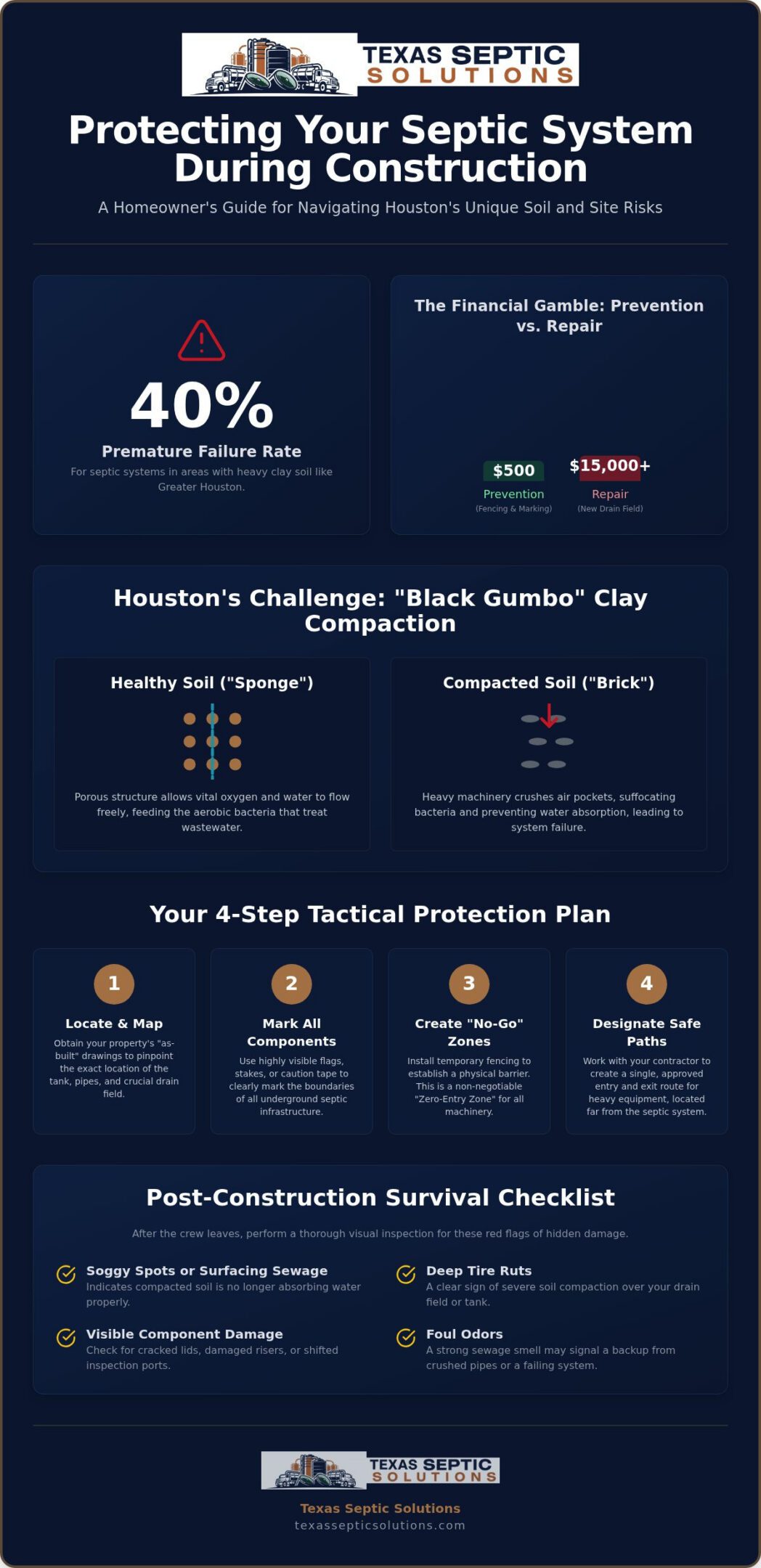
Did you know that in parts of Greater Houston with heavy clay soil, the premature failure rate for septic systems can reach nearly 40 percent? It’s a high stakes gamble to let heavy machinery onto your property without a clear strategy. That’s why preventing septic system damage during construction Houston projects is so critical for your budget and your peace of mind. One wrong turn by a bulldozer can crush a tank or compact your drain field, leading to a massive repair bill you didn’t plan for.
We know that coordinating contractors is stressful, especially when they don’t know your yard’s layout as well as you do. You deserve to enjoy your home upgrades without the lingering fear of a sewage backup. This guide will teach you how to physically protect your infrastructure from heavy loads and soil compaction. We’ll cover everything from pre-construction marking to setting “no-go” zones for your crew. You’re going to learn the exact rules to give your builder so you can focus on your new project with total confidence that your septic system remains safe.
Key Takeaways
- Learn why preventing septic system damage during construction Houston projects starts with understanding the difference between static soil weight and the crushing force of heavy machinery.
- Discover how Houston’s heavy clay soil makes your drain field vulnerable to compaction, which can permanently choke off the oxygen needed for your system to function.
- Find out how to obtain your “as-built” drawings to pinpoint exactly where your tank, distribution box, and drain field are buried before the first truck arrives.
- Get a tactical guide for setting up physical “Zero-Entry Zones” and designated construction paths to keep contractors away from your expensive infrastructure.
- Learn the essential visual signs to look for after the crew leaves to ensure no hidden structural damage or soil ruts occurred during the build.
Why Construction is the #1 Threat to Your Houston Septic System
Home construction projects are exciting, but they often put your underground utilities at risk. When we talk about construction-related damage, we’re usually looking at two distinct problems: structural crushing of the tank and the clogging of soil pores. While you might understand how septic systems work on a basic level, it’s easy to forget that they’re engineered for “static loads.” This means they’re designed to hold the weight of the soil above them, not the “dynamic loads” of a 20-ton concrete truck or a heavy skid-steer rolling across the yard.
The financial stakes are incredibly high. You might spend $500 on temporary fencing and professional marking, but a destroyed drain field can easily cost $15,000 or more to replace. The most frustrating part of this damage is the “Invisible Failure” concept. Your system might seem perfectly fine when the contractors pack up their tools and leave. However, the damage often shows up months later when the internal pipes finally collapse or the compacted soil stops absorbing effluent. By the time you notice the backup, the contractor is long gone, and you’re left with the bill.
The Hidden Vulnerability of Your Drain Field
Your drain field is the most fragile part of the entire infrastructure. It relies on a network of delicate lateral lines surrounded by gravel or synthetic media. These components are buried relatively shallow to allow for proper evaporation and soil treatment. Even a single pass by a small piece of equipment can crush a pipe or shift the media, permanently ruining the flow. Many homeowners fall for the myth that if the ground is dry, it’s safe to drive on. In reality, dry soil still transmits massive amounts of pressure downward, and that pressure is exactly what kills your system’s functionality.
Houston-Specific Risks: Climate and Soil
Houston homeowners face unique challenges due to our local environment. Our “Black Gumbo” clay is notoriously unforgiving. Once this clay is compacted by heavy tires, it loses its ability to absorb water, essentially turning into a waterproof brick. According to industry data, septic systems in heavy clay soil like ours can have a chronic malfunction rate as high as 54 percent. Our heavy rainfall and high water tables only make things worse. Wet soil compacts much deeper and faster than dry soil. High water levels can even cause components to shift or “float” if the surrounding earth is disturbed by heavy machinery. Prioritizing the work of preventing septic system damage during construction Houston is the only way to avoid these local pitfalls.
Understanding Soil Compaction and the Houston Clay Factor
Houston is famous for its “Black Gumbo” clay. Scientifically known as Vertisols, this soil is a major hurdle when you’re preventing septic system damage during construction Houston homeowners often overlook. Unlike sandy soils that allow water to flow freely, our local clay expands and contracts with moisture. When this soil is healthy, it acts like a sponge. It’s full of microscopic air pockets and pathways that allow water to move and oxygen to reach the “aerobic” bacteria living underground. These bacteria are the workforce of your system, and they need that oxygen to survive and process waste.
Compaction is the process of literally squeezing those air and water pathways out of existence. When heavy machinery rolls over your yard, it crushes the soil structure, turning your “sponge” into a “brick.” Once clay is compacted, it rarely returns to its original state on its own. This structural change is why expert guides warn that you must avoid construction over the system at all costs. If the air is gone, the bacteria die, the water stops moving, and your expensive infrastructure fails.
The Science of Wastewater Filtration
A drain field doesn’t just “hide” water; it cleans it. As effluent leaves the tank, it trickles through the soil where microbes neutralize pathogens. If the soil is compacted, the water cannot sink in. Instead, it follows the path of least resistance, which usually leads straight to the surface. This creates “surfacing sewage,” those dreaded soggy, foul-smelling spots in the yard. Maintaining soil porosity is the single most important factor in ensuring your system lasts its full 20 to 30 year lifespan. If you’re worried about existing soil issues, a professional septic system maintenance check can help identify early warning signs of compaction.
Equipment Weight vs. Soil Strength
Many homeowners assume that a small tractor or a landscaping crew won’t cause much trouble. However, the math of “pounds per square inch” (PSI) tells a different story. A standard pickup truck might weigh around 5,000 pounds, but a loaded concrete mixer or a dump truck full of gravel can exceed 60,000 pounds. These massive dynamic loads concentrate all that weight into the small contact patches of the tires. Even in areas like Cypress or Huffman, where the soil might feel solid, “light” equipment can still be a threat. A small skid-steer with narrow tires can actually exert more ground pressure than a larger machine with wide tracks, leading to deep, permanent ruts in your drain field.
Locating and Marking Your Septic Components Before Construction
You can’t protect what you can’t see. Many homeowners assume they know where their tank is because of a single green lid, but your system is much larger than that one point. Precision is the most important part of preventing septic system damage during construction Houston residents often overlook. A “close enough” guess could lead to a heavy truck parking directly over your distribution box, causing a localized collapse that’s expensive to fix. Follow these four steps to ensure your entire infrastructure is visible to every worker on site.
- Step 1: Obtain your “as-built” drawing. This is the official blueprint of your system’s installation.
- Step 2: Identify the tank, the distribution box, and the full perimeter of the drain field.
- Step 3: Use a soil probe or hire a professional septic system repair expert to verify the exact depth and location of underground lines.
- Step 4: Mark every component with high-visibility flags or bright spray paint designed for turf.
Finding Your “As-Built” Plans in Harris County
If you don’t have your original installation papers, don’t panic. In unincorporated Harris County, you can contact the Harris County Engineer’s Office at (713) 274-3900 to request records of your permit and site map. These documents show the intended layout for your suburban lot. If your home is older and no records exist, you’ll need a professional locating service. They use electronic transmitters or cameras to map the lines exactly. Protecting your septic drain field requires knowing its boundaries down to the inch, as even a small encroachment can lead to long-term soil compaction issues.
Visual Cues for the Untrained Eye
While you wait for your records, look for physical clues in your yard. You might see white PVC cleanout pipes sticking up near the house or green plastic lids flush with the grass. Sometimes, the grass over a drain field grows faster or stays greener during a dry Houston summer because of the moisture below. You should also look at the slope of your yard; drain fields are typically installed on a slight downward grade from the tank. Never guess where the lines end. If you mark an area too small, a contractor might think the “safe” zone starts sooner than it actually does. Accuracy is your best defense against unexpected repair bills.
5 Tactical Steps to Protect Your System from Contractors
Verbal warnings often disappear the moment a job site gets busy. When a subcontractor is focused on a deadline, your underground lines are the last thing on their mind. To ensure your project doesn’t end with a sewage backup, you need a physical strategy for preventing septic system damage during construction Houston crews will actually respect. It’s about making the “no-go” zones impossible to ignore.
- Establish a permanent “Zero-Entry Zone” using sturdy physical barriers.
- Create a clearly marked “Construction Path” for all vehicle traffic.
- Add specific septic protection clauses to every contractor agreement.
- Post “No Heavy Equipment” signs directly on your perimeter fencing.
- Personally brief every new subcontractor who arrives on your property.
Setting Up Physical Barriers
Don’t rely on small flags or thin string. Bright orange “safety fence” or snow fencing is the standard for a reason. It’s highly visible and difficult to move accidentally. When you install your fence, don’t just put it on top of the lines. You need a “Buffer Zone” that extends at least 10 to 15 feet beyond the edge of the drain field. This prevents the weight of a nearby truck from causing a lateral soil collapse. Check your fence every morning to make sure it hasn’t been pushed aside for “just a minute” to make a turn.
Managing the “Concrete Truck” Risk
Concrete trucks are the single biggest threat to your underground infrastructure. A fully loaded truck can weigh over 60,000 pounds, which is far beyond what any septic tank or drain field pipe is designed to handle. To avoid this risk, plan for your contractor to use a long-reach pump. This allows the heavy truck to stay on the driveway or street while the concrete is piped to the backyard. Also, designate a concrete washout area far away from your septic field. The high pH of concrete runoff can kill the beneficial bacteria your system needs to function.
Contractor Accountability
Trust is good, but documentation is better. Before any equipment arrives, take high-resolution photos of your yard, cleanout pipes, and tank lids. Include a line in your work orders stating that the contractor is liable for any repairs needed due to unauthorized traffic over the septic area. A simple daily check-in with the job foreman goes a long way. Remind them that the orange fence is a hard boundary. If you suspect a vehicle has already encroached on your system, contact us for an immediate septic system repair evaluation before the damage becomes a total system failure.
Post-Construction Survival Checklist: Ensuring Your System is Safe
You’ve finally crossed the finish line of your home improvement project. Before you celebrate, it’s time to verify that your efforts in preventing septic system damage during construction Houston were successful. Even with fences in place, accidents can happen. A quick walk-through can reveal if a delivery driver took a shortcut or if heavy rains caused soil to shift around your tank lids. Catching these issues now prevents a small problem from turning into a total system failure later.
- Perform a visual inspection: Walk the entire drain field area to look for new depressions, deep ruts, or areas where the grass has died off.
- Check lids and risers: Ensure all tank covers are still level and don’t have new cracks or shifts in position that could allow rainwater to enter.
- Monitor indoor plumbing: Pay close attention to your toilets and drains for any new gurgling sounds or sluggishness that wasn’t there before the project started.
- Schedule a professional check: A specialized septic system maintenance Texas inspection can verify the internal health of your lines using camera tools.
Testing the System After the Crew Leaves
One of the most effective ways to check your system’s health is a “Stress Test.” You can do this by running water in several sinks or tubs for about 30 to 60 minutes. This simulates a high-usage day and ensures your lateral lines are still flowing freely. While the water is running, walk out to the drain field. You shouldn’t see any water surfacing or smell any foul odors. If your system has a distribution box, check it for any sudden accumulation of sediment or debris that might have been shaken loose by nearby vibration or soil movement.
When to Call for Professional Help
Some damage isn’t visible on the surface. If you notice “red flags” like sewage odors in the yard or water backing up into the lowest drains in your home, you need an immediate camera inspection. Don’t ignore small ruts in the drain field. These ruts act like channels, directing heavy Houston rainwater straight into your septic trenches, which can drown the beneficial bacteria. Once you’re certain the construction phase hasn’t caused harm, it’s the perfect time to transition into a long-term septic system maintenance plan. This proactive approach ensures your infrastructure remains sturdy and functional for decades to come, regardless of what’s happening on the surface.
Build Your Future Without Burying Your Budget
You’ve worked hard to improve your property, and your septic system shouldn’t pay the price for that progress. By using physical barriers like orange safety fencing and strictly managing where heavy equipment travels, you can avoid the permanent soil compaction that ruins drain fields. Remember that Houston’s heavy clay doesn’t forgive a 60,000 pound concrete truck. Precision in preventing septic system damage during construction Houston projects is the difference between a successful build and a multi-thousand dollar repair bill.
We’ve served the Houston, Cypress, and Cleveland communities for over a decade, and we’ve seen how easily construction can disrupt even the sturdiest systems. If you’re planning a project, let us help you set up for success. We offer expert camera inspections to verify your pipe integrity and 24/7 emergency support if something goes wrong. Protect your investment; schedule a pre-construction septic marking and inspection with Texas Septic Solutions today. You’ve got enough to manage with your renovation; let us handle the underground details so you can build with total peace of mind.
Frequently Asked Questions
Can I drive a small tractor over my septic tank if it is buried deep?
No, you shouldn’t drive any machinery over your tank regardless of its burial depth. Septic tanks are engineered to support the static weight of the soil above them, not the dynamic pressure of moving vehicles. In Houston’s heavy clay, this extra weight can cause the tank to shift or the inlet pipes to shear off. Even a small tractor can exert enough localized pressure to crack a concrete lid or damage a riser.
How far away should construction equipment stay from the drain field?
Construction equipment should maintain a buffer of at least 10 to 15 feet from the edge of your drain field. This distance helps prevent the lateral pressure of heavy tires from collapsing the soil walls of your trenches. Maintaining this distance is a vital part of preventing septic system damage during construction Houston homeowners must enforce. Physical barriers like orange safety fencing are the best way to ensure contractors respect this boundary.
What happens if a contractor accidentally drives over my septic lid?
You need to schedule an immediate inspection if a vehicle strikes your septic lid. Even if the lid doesn’t look broken, the weight can cause it to shift or create hairline fractures. These cracks allow rainwater and dirt to enter your tank, which can overwhelm the system and lead to a backup. Our 24/7 emergency septic service can assess the structural integrity of your lids and risers to prevent a total failure.
Is it safe to store construction materials like lumber or bricks on top of the septic field?
It is never safe to store heavy materials like lumber, bricks, or pallets on your septic field. These items create a constant static load that compresses the soil and chokes off the oxygen your aerobic bacteria need to process waste. Over time, this weight turns your absorbent soil into a hard, waterproof layer. Always keep your drain field clear of any storage to ensure you are preventing septic system damage during construction Houston projects.
Can I pave a temporary driveway over my septic lines if I use gravel?
You cannot pave a temporary driveway over septic lines, even with a layer of gravel. Gravel doesn’t distribute weight effectively enough to protect shallow pipes from being crushed. The constant vibration and pressure from vehicles will compact the “Black Gumbo” clay beneath the gravel. This leads to permanent drainage issues that often require a full system replacement. Always route temporary paths away from all underground septic components to avoid costly repairs.
Do Houston regulations require me to fence off my septic system during a pool build?
While specific fencing requirements vary by permit, protecting your system is essential during high-risk projects like pool builds. The Harris County Engineer’s Office often reviews site plans to ensure new structures don’t encroach on existing septic fields. Even if a fence isn’t strictly mandated by your specific permit, we highly recommend it. Pool construction involves some of the heaviest machinery, making it a leading cause of accidental system damage in Cypress and Huffman.
How do I know if my soil is already too compacted from previous construction?
You can check for compaction by looking for standing water or soil that feels as hard as a brick. In Houston, healthy soil should have a sponge-like quality that allows for drainage. If your yard has deep ruts from previous projects or if water pools for days after a light rain, your soil pores are likely clogged. A professional maintenance inspection can determine if your soil still has the porosity needed to treat wastewater effectively.
Will a septic inspection show if my pipes were crushed by a truck?
Yes, a professional inspection using specialized camera tools will reveal if your pipes are crushed or misaligned. We can thread a high-resolution camera through your lateral lines to see exactly where a collapse has occurred. This is a critical step in preventing septic system damage during construction Houston residents often overlook. Identifying a crushed pipe early allows for a targeted repair instead of waiting for a messy and expensive sewage backup to occur.