
Liberty County Septic Tank Permits: 2026 Guide
Could a single signature really be the difference between a smooth home build and a $550 surprise penalty? In Liberty County, starting your installation before securing the proper paperwork doesn’t just stall your project; it triggers an automatic double-fee fine that nobody wants to pay. We understand that securing Liberty County septic tank permits can feel like a maze of soil morphology reports and conflicting office addresses between Liberty and Cleveland. You’re likely feeling the pressure to get your system in the ground, but you want to make sure every requirement is met so your final inspection isn’t a nightmare.
We’ve built this 2026 guide to take the guesswork out of the process and keep your hard-earned money in your pocket. You’ll master the permitting sequence to ensure your system is legal, safe, and built to last for decades. This article provides a clear checklist of required documents, explains the specific soil evaluation requirements, and walks you through the typical 2-to-6-week timeline. By following these steps, you can plan your project with confidence and ensure your property remains compliant with all local regulations.
Key Takeaways
- Learn how to handle the application process for Liberty County septic tank permits while ensuring you stay compliant with current 2026 regulations.
- Understand why a professional soil morphology evaluation is mandatory and how it differs from a standard perc test in our local clay soils.
- Discover the specific acreage and setback requirements that dictate exactly where your system can be legally placed on your lot.
- Identify the five essential documents you’ll need for a complete permit packet to ensure a smooth submission at the county offices.
- Prepare for the two-phase inspection process, including the “open-hole” check, to secure your final Notice of Approval without a hitch.
Understanding Liberty County Septic Permit Requirements & Penalties
In Liberty County, any private wastewater system is officially classified as an On-Site Sewage Facility, or OSSF. Before you dig a single hole or lay a pipe, the law requires you to obtain a permit. This isn’t just a hurdle of red tape; it’s a vital safety measure. Because our region deals with high water tables and frequent flooding near the Trinity River, these regulations protect our local groundwater from contamination. Understanding septic system basics helps you see why the county is so strict. A poorly designed or unpermitted system can leak pathogens into the soil your family lives on, leading to environmental and health hazards.
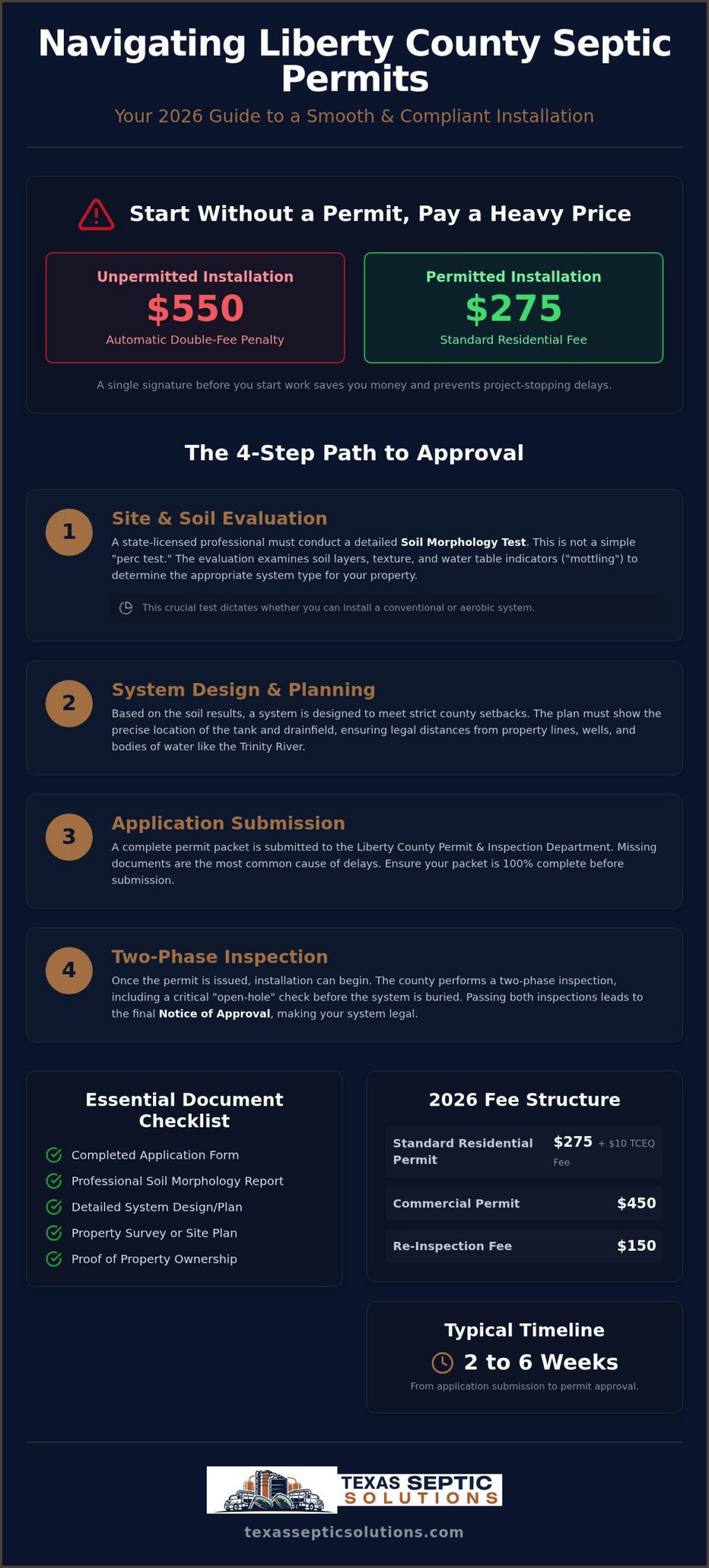
The entire permitting process is overseen by a Designated Representative, or DR. This official is tasked with reviewing your plans and ensuring they meet both state and local safety codes. If you decide to bypass this step and start installation without approval, the financial consequences are immediate. The county enforces a “double fee” penalty for unpermitted work. This means a standard residential permit fee jumps to a $550 penalty, which is a significant and avoidable hit to your construction budget. Working with the DR from the start ensures your project stays on track and remains fully legal.
When is a Liberty County Septic Permit Required?
You’ll need to secure Liberty County septic tank permits for any new construction, system relocation, or major structural repair. If you’re adding a second dwelling to your property or replacing an aging tank, the county requires a new application to ensure the land can still handle the waste load. There’s one small exception for emergency repairs. If your system fails and requires immediate attention to protect public health, you can start the work right away. However, you must report that repair to the permit office within 72 hours to avoid being cited for unauthorized work.
The 2026 Fee Structure: Residential vs. Commercial Costs
Budgeting for your project requires knowing the exact costs set by the county. For 2026, a standard residential permit is $275, plus a $10 state TCEQ fee. If you’re developing a business property, commercial Liberty County septic tank permits cost $450. Other common fees include $125 for relocating an existing system and $150 for any re-inspections if the initial work fails to meet county standards. The Liberty County Permit & Inspection Department processes these applications Monday through Friday, between 08:00 AM and 04:00 PM. Paying the correct fee upfront is the best way to keep your project moving toward a successful final inspection.
Step 1: Conducting the Site Evaluation and Soil Morphology Test
Before you can apply for Liberty County septic tank permits, you need to know exactly what is happening beneath the surface of your property. Liberty County isn’t uniform; you might have sandy loam that drains beautifully or heavy, “gumbo” clay that holds water like a bathtub. These soil types are the single biggest factor in deciding which system you can install. If you have Type IV clay, a traditional gravity-fed system won’t work because the wastewater simply won’t soak into the ground. This leads to surface pooling and system failure, which is why the county requires professional testing before any design is approved.
Many homeowners confuse a simple “perc test” with a professional soil morphology evaluation. A perc test just measures how fast water disappears in a hole. A morphology test, required by the TCEQ On-Site Sewage Facility Program, is much more detailed. A licensed evaluator examines soil color, texture, and structure. They look for “mottling,” which are orange or grey spots that signal where the water table sits during the rainy season. If your soil shows signs of a high water table or poor drainage, the county will likely mandate an aerobic system to prevent groundwater contamination.
Finding a Licensed Texas Site Evaluator
You can’t perform this evaluation yourself. Liberty County requires a professional licensed by the state to conduct the field visit. During the visit, the evaluator digs at least two profile holes, usually five feet deep, in the area where you plan to put your drainfield. They’ll map out the property, noting the distance to your well, property lines, and any nearby bodies of water like the Trinity River. This data forms the legal backbone of your permit application and ensures your system won’t interfere with your neighbors’ utilities.
How Soil Results Impact Your Installation Costs
The results of your soil test directly dictate your construction budget. If your land has deep, sandy soil, you might qualify for a conventional system, which is generally less expensive to install. However, if the evaluator finds heavy clay, you’ll need an aerobic treatment unit. While these systems are highly effective for difficult terrain, they require more complex components and a mandatory two-year initial maintenance contract. Getting an accurate professional site evaluation early prevents you from buying the wrong equipment or facing a permit rejection later. Knowing your soil type before you design the system is the best way to avoid expensive mid-project changes when applying for Liberty County septic tank permits.
Step 2: Designing Your System Based on County Setbacks
Once your soil morphology report is complete, the next phase is translating those results into a professional site plan. In Liberty County, you cannot simply sketch a layout on a napkin and hope for the best. The county requires a formal design drafted by an “Authorized Agent,” which typically means a licensed Professional Engineer or a Registered Sanitarian. This expert uses your soil data to determine the size and type of the system required to safely process your home’s wastewater. A precise design is your best defense against application rejection, which can stall your construction for weeks.
Lot size plays a massive role in this stage. If your property is smaller than the county’s minimum acreage requirements for certain system types, your design options will be limited. High-density areas require more advanced treatment to prevent neighboring systems from interfering with each other. Your designer will look at the total “daily flow” of your household, which is based on the number of bedrooms and total square footage. This calculation ensures the tank and drainfield are large enough to handle your family’s needs without backing up or saturating the ground.
Mandatory Setback Distances for Liberty County
Mapping your property involves more than just finding a clear spot for a tank. You must adhere to strict setback distances to protect your infrastructure and the local environment. When applying for Liberty County septic tank permits, your site plan must clearly show these gaps. Standard setbacks include:
- Public or Private Wells: Usually requires a 50 to 100 foot clearance depending on the well’s construction.
- Property Lines: A minimum 5 to 10 foot buffer is standard to ensure maintenance access.
- Waterways: Systems must be kept away from creeks, ponds, and the Trinity River floodplain.
- Swimming Pools and Foundations: You must maintain a safe distance to prevent moisture from undermining your home’s structure or leaking into pool water.
Conventional vs. Aerobic: Which Design Fits Your Land?
Your design will ultimately fall into one of two categories. A conventional system uses gravity to move effluent into a series of underground trenches. These are simpler and often preferred for larger lots with excellent sandy soil. However, if your land has heavy clay or limited space, an aerobic design is usually the only path forward. These systems act like a miniature municipal treatment plant, using oxygen to break down waste more efficiently. While aerobic designs are more complex, they allow for flexible placement on smaller lots where traditional drainfields won’t fit. Getting this choice right during the design phase is essential for securing Liberty County septic tank permits on the first attempt.
Step 3: Submitting Your Application to the Permits Office
After your design is finalized, the next step is the physical submission of your application packet. This is the moment where many projects stall because of incomplete paperwork. You’ll take your documents to the Liberty County Permit & Inspection Department, which operates Monday through Friday from 08:00 AM to 04:00 PM. You can visit the main office in Liberty or the branch in Cleveland. When you submit your packet along with the $275 residential fee, you’re waiting for a specific document called the “Authorization to Construct.” Do not let a contractor convince you to start digging before this paper is in your hands. Starting early triggers that $550 double-fee penalty, and the county won’t hesitate to shut your site down.
Incomplete applications are the leading cause of delays. The permit office won’t “hold” a spot for you if you’re missing a signature or a deed. They’ll simply hand the packet back, and you’ll have to start over. This is why we recommend double-checking every page before you make the drive to Liberty or Cleveland. Ensure your 911 address is correctly listed and matches your warranty deed exactly. Any discrepancy here can lead to an immediate rejection at the front desk.
Document Checklist for Homeowners
A successful application for Liberty County septic tank permits requires five essential pieces of documentation. Keep these organized in a single folder to ensure a smooth hand-off at the office:
- Recorded Affidavit to the Public: This must be filed with the County Clerk’s office first if you’re installing an aerobic system.
- Two-Year Maintenance Contract: A signed agreement with a licensed provider is mandatory for all new aerobic installations.
- Warranty Deed: This serves as your legal proof of ownership for the property.
- Site Evaluation and Soil Analysis: The professional report from Step 1 that dictates your system type.
- Technical Design Drawings: The scaled maps showing your tank, lines, and all required setbacks.
Timing Your Submission with Your Construction Schedule
The review timeline for Liberty County septic tank permits typically ranges from 2 to 6 weeks. This depends on the current volume of applications and the complexity of your site design. We suggest submitting your packet as soon as your design is ready, rather than waiting for your house foundation to be poured. If you want to bypass the stress of the permit desk entirely, we can handle the entire process for you. We specialize in new septic system installation and permitting, ensuring your project stays on schedule and avoids any costly administrative errors.
The Inspection Process: Securing Your Notice of Approval
Once you hold your Authorization to Construct, the installation can finally begin. However, the permitting process isn’t complete until the county gives its final stamp of approval through a series of field inspections. These visits ensure the system in the ground matches the design on paper. Skipping these steps or covering your work too early can lead to costly delays and a $150 re-inspection fee. We recommend coordinating closely with your installer to ensure the county inspector arrives at the exact right moments during the build.
The first major hurdle is the “open-hole” inspection. This happens after the tanks and lines are placed but before any soil is backfilled. The inspector needs to see the actual components, check the slope of the pipes, and verify that the media in the drainfield meets state standards. If everything looks correct, they’ll give you the green light to cover the system. This stage is critical for Liberty County septic tank permits because it’s the only time the county can verify the structural integrity of the underground work.
After the system is covered, a final site visit occurs. During this phase, the inspector checks the electrical components, especially for aerobic systems that require aerators and alarms. They’ll also look at the final grading of the soil to ensure rainwater won’t pool over the tanks. Once you pass this final check, the county issues your official “Notice of Approval.” This document is your legal right to use the system and is often required by mortgage companies and title offices during future property sales.
Preparing Your Site for the Field Inspector
Inspectors have a busy schedule, typically visiting sites between 08:00 AM and 04:00 PM. To avoid a failed visit, make sure the site is easily accessible. Gates should be unlocked, and pets should be secured away from the installation area. If the inspector can’t reach the system or if the holes have already been filled, you’ll be charged that $150 re-inspection fee. Clear communication between you, your contractor, and the Liberty County Environmental Health office is the best way to keep the project moving without extra costs.
Ongoing Compliance: Maintenance Contracts for Aerobic Systems
Passing the final inspection is a huge win, but for aerobic systems, the responsibility continues. Liberty County requires all aerobic systems to be inspected three times per year by a licensed provider. When you applied for your Liberty County septic tank permits, you already signed a mandatory two-year initial maintenance contract. Keeping this contract active is a legal requirement. These regular check-ups prevent small mechanical issues from turning into expensive failures, ensuring your system remains safe for your family and the surrounding community.
Get Your Liberty County Project Started Right
Securing Liberty County septic tank permits is the most important step in protecting your property value and the local environment. From the initial soil morphology test to the final Notice of Approval, every phase of the process ensures your system operates safely for years to come. By following the correct submission steps and respecting mandatory setbacks, you’ll avoid the $550 double-fee penalty and keep your construction timeline on track. Navigating these requirements in Cleveland and Shepherd can be complex; however, you don’t have to do it alone.
Our team provides the reliable, local authority you need to move forward with confidence. Let Texas Septic Solutions handle your Liberty County permit paperwork today. With our Licensed Texas Site Evaluators and deep knowledge of local codes, we manage the technical details so you can focus on your new home. We even offer 24/7 emergency support to keep your utilities running smoothly long after the final inspection is over. We’re ready to help you build a system that’s legal, efficient, and built to last.
Frequently Asked Questions
How much does a septic permit cost in Liberty County in 2026?
A standard residential septic permit costs $275 in 2026, which includes a mandatory $10 state TCEQ fee. Commercial permits are currently priced at $450. If you need to relocate an existing system on your property, the fee is $125. These costs cover the administrative review and the necessary field inspections. You can pay these fees at the Liberty or Cleveland office locations during their standard business hours of 08:00 AM to 04:00 PM.
Can I install my own septic tank in Liberty County if I have the permit?
Texas law allows homeowners to install their own septic system if it’s for their primary single-family residence. However, you must still follow the full permitting process, including the soil morphology test and professional design. For aerobic systems, most homeowners find the technical requirements and mandatory maintenance contracts difficult to manage alone. We recommend hiring a licensed professional to ensure the installation passes the county’s strict open-hole and final electrical inspections without any issues.
How long does it take to get a septic permit approved in Liberty County?
The approval process for Liberty County septic tank permits typically takes between 2 and 6 weeks. This timeline begins once you submit a complete application packet, including your warranty deed and soil analysis, to the permit office. Factors like seasonal demand or high volumes of construction in areas like Cleveland can affect this duration. Submitting an accurate, professional design from the start is the most effective way to avoid delays caused by application rejections.
What is the penalty for installing a septic system without a permit in Texas?
Installing a septic system without a permit in Liberty County results in an automatic double-fee penalty. For a standard residential project, this means your initial $275 cost jumps to a $550 fine. Beyond the financial hit, the county can issue a stop-work order, forcing you to halt construction until the paperwork is resolved. In some cases, you may even be required to dig up uninspected work, which adds significant labor costs and project delays.
Do I need a new permit to repair an existing septic system in Liberty County?
You generally need a permit for any major structural repair or relocation of an existing system. Replacing a tank or moving a drainfield requires new documentation to ensure the system remains compliant with current groundwater protection standards. Minor maintenance often doesn’t require a permit, but emergency repairs must be reported to the Liberty County Permit & Inspection Department within 72 hours. If you’re unsure if your repair requires a permit, it’s safer to check first.
What is the minimum lot size for a septic system in Liberty County?
Minimum lot sizes depend on your water source and the type of system you plan to install. Generally, properties with a private well require at least one acre, while those on public water may qualify with a half-acre lot. These requirements prevent over-saturation of the soil and protect local wells from contamination. Your licensed site evaluator will confirm if your specific acreage meets the current 2026 standards during your initial field visit and soil morphology test.
Who are the current septic inspectors for Liberty County?
Septic inspections are conducted by the Liberty County Environmental Health and Engineering Departments. While staffing can change, these offices manage all field visits for open-hole and final approvals. You can schedule your inspection by calling (936) 334-3219. It’s helpful to verify the current director’s name when you submit your application, as administrative leadership can shift. Always ensure your site is accessible for the inspector between 08:00 AM and 04:00 PM to avoid re-inspection fees.
What happens if my soil test fails for a conventional septic system?
If your soil morphology test reveals heavy clay or a high water table, you won’t be approved for a conventional gravity system. Instead, the county will require an aerobic treatment unit (ATU). These systems use oxygen to treat wastewater more effectively, making them safe for failed soils. While aerobic systems have different maintenance requirements, they are often the only legal solution for property owners in the clay-heavy regions of Liberty County, Cleveland, and Shepherd.