
Is My Property Suitable for a Septic System? Houston Homeowner Guide 2026
What if the dream lot you just purchased is legally unbuildable because of the dirt beneath your feet? It’s a question that keeps many local buyers up at night, especially when they start asking, “is my property suitable for a septic system Houston?” In our region, the answer isn’t always a simple yes or no. Instead, it’s a puzzle involving high water tables, heavy clay, and strict Harris County regulations that can catch even seasoned property owners off guard.
We understand the anxiety of staring at a piece of land and wondering if you’ll be forced into a complex aerobic system or if a conventional setup is even an option. You want clarity before you commit your hard-earned money to a project. This guide will help you discover exactly how Houston soil, lot size, and 2026 local regulations determine your property’s potential. We’ll break down the site evaluation process, explain why our local “gumbo” clay changes the game, and help you identify the right system for your specific lot so you can move forward with confidence.
Article Highlights
- Learn how Houston’s heavy clay and high water tables impact your drainage options and system longevity.
- Check your acreage and setback distances against 2026 standards to see is my property suitable for a septic system Houston.
- Compare conventional and aerobic systems to find the most reliable and compliant fit for your specific property.
- Follow the professional path from initial soil testing to final permitting to ensure your system meets all Harris County requirements.
- Discover how expert site design prevents common failures and keeps your property functional for years to come.
Understanding Houston Soil and High Water Tables
In Southeast Texas, the ground under your feet dictates your lifestyle more than you might think. When you ask, “is my property suitable for a septic system Houston,” you’re looking for a green light from the local environment. In technical terms, these residential setups are called On-Site Sewage Facilities (OSSF). Unlike city sewer lines that carry waste away to a central plant, an OSSF treats everything right on your lot. It’s a complex balance of biology and geology that requires the soil to do the heavy lifting.
To get started, you must understand what a septic system is and how it interacts with the local landscape. In Houston, we don’t have the luxury of deep, sandy loam that naturally filters water. Instead, we deal with a flat coastal prairie dominated by “gumbo” clay and a water table that sits remarkably close to the surface. A professional site evaluation is the mandatory legal prerequisite for any septic project in Harris County or the surrounding areas.
The Challenge of Clay Soil (Class IV Soils)
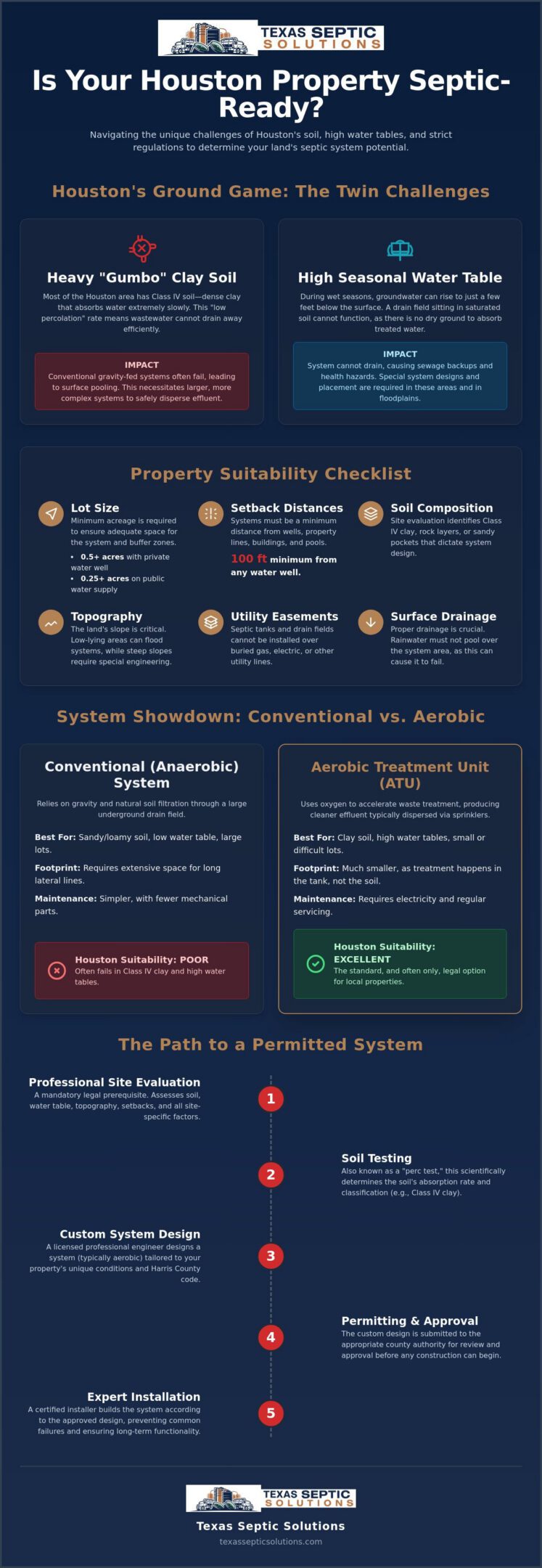
The Texas Commission on Environmental Quality (TCEQ) classifies soil based on its texture and ability to absorb water. Most of the Houston area consists of Class IV soils. This is heavy, dense clay that holds onto moisture like a sponge but refuses to let it pass through. Because liquid cannot “percolate” through these tight clay particles at a safe rate, traditional gravity-fed systems often fail here. If the soil can’t absorb the effluent, the waste has nowhere to go but up to the surface. This soil texture directly affects the size of your drain field; the heavier the clay, the more square footage you need to spread out the water. On smaller lots, the required size for a conventional drain field can quickly exceed the available space.
Water Table and Floodplain Considerations
In communities like Cypress and Huffman, the high water table presents a different set of hurdles. During the wet seasons, the groundwater can rise to within a few feet of the surface. If you try to install a conventional system where the trenches sit in saturated soil, the system cannot function. It becomes a health hazard and a plumbing nightmare. Additionally, many Houston properties sit within designated floodplains. Local regulations require specific safeguards for these areas, such as anchoring septic tanks to prevent them from “popping” out of the ground during a flood event. Proper surface drainage is just as critical as underground absorption. If rainwater pools over your system, it effectively shuts down the treatment process, regardless of how well your tank is functioning.
The Houston Property Septic Suitability Checklist
Before you break ground on a new home or purchase a rural lot, you need a clear picture of your land’s limitations. Determining is my property suitable for a septic system Houston requires looking at more than just the dirt. It involves checking legal boundaries, local health department codes, and the physical layout of your lot to ensure you have enough “usable” space. Even a large lot can become “unbuildable” if the placement of a well or a utility easement leaves no room for a drain field.
We recommend starting with this foundational checklist to see if your property meets the basic criteria for an On-Site Sewage Facility (OSSF):
- Lot Size: Harris County typically requires at least 0.5 acres if you have a private water well, or 0.25 acres if you’re on a public water supply.
- Setbacks: You must maintain specific distances from property lines, swimming pools, and habitable structures.
- Soil Composition: While we covered clay earlier, we also look for “rock” layers or rare sandy pockets that change your design options.
- Topography: Low-lying “bowls” that collect rainwater can drown a system, while steep slopes might require specialized engineering to prevent runoff.
- Utility Easements: You cannot install tanks or lines over gas pipes, buried electrical lines, or telephone easements.
Minimum Acreage and Setback Rules
In Harris and Liberty counties, the rules for 2026 remain strict regarding water protection. The most critical setback is the 100-foot distance required between a septic drain field and any water well. If your lot is narrow, this single rule can dictate exactly where your house must sit. On smaller lots, the lack of space for a traditional lateral line often makes an aerobic treatment unit (ATU) the only legal option. These systems treat waste more thoroughly in a smaller footprint, allowing for tighter installations that still meet health codes.
Topography and Landscape Drainage
Houston is famously flat, but even a few inches of elevation change matter. We evaluate the natural “fall” of the land to see if a gravity-fed system is possible. For properties in areas like Cleveland or Liberty with more rolling terrain, we must account for slope stability. You never want to install a drain field in a low spot where water stands after a storm. If you aren’t sure where your system should go, the team at Texas Septic Solutions can help you evaluate your lot’s layout before you commit to a design.
Remember that your landscaping plans also play a role. You can’t plant large trees with aggressive roots over your lines, and you certainly can’t drive heavy vehicles over the area. Thinking through these details now prevents expensive repairs or system relocations down the road.
Aerobic vs. Conventional: Which System Fits Your Land?
Once your site evaluation is complete, the data from your soil analysis will point toward one of two main technologies. When deciding is my property suitable for a septic system Houston, the final verdict usually comes down to how well your land can process water. While many homeowners hope for a simple, old-school setup, the physical reality of Southeast Texas geology often dictates a more modern approach. Both systems are highly reliable when designed correctly, but they solve very different environmental problems.
Conventional systems are the traditional choice for properties with high-quality, absorbent soil. These systems use a septic tank to settle solids and a network of perforated pipes, known as a drain field, to distribute liquid into the ground. They are prized for their simplicity because they typically don’t require electricity or mechanical aerators. However, they have a large footprint and require specific soil conditions that are increasingly hard to find in developing areas.
When a Conventional System Works
A conventional system is only viable if you have “perfect” soil, typically a sandy loam that allows water to percolate at a steady rate. You might find these conditions in specific pockets of Shepherd or Huffman where the ground isn’t dominated by heavy clay. Because these systems rely entirely on gravity and natural soil bacteria, they have fewer moving parts to maintain. Despite these benefits, they are becoming rarer in new Houston developments. Strict 2026 setback rules and the prevalence of Class IV clay mean most modern lots simply can’t support the massive drain field a conventional system requires.
Why Aerobic Systems are the Houston Standard
Aerobic Treatment Units (ATUs) are often described as miniature city sewer plants. They use an electric pump to inject oxygen into the treatment tank, which allows aerobic bacteria to break down waste much faster and more thoroughly than traditional methods. This high level of treatment is the primary reason they are the standard for clay-heavy Houston lots. Since the water leaving the tank is significantly cleaner, it can be distributed through surface sprayers or drip emitters rather than buried deep in a trench.
This “surface application” is a game changer for properties with high water tables or dense “gumbo” soil. Aerobic systems also save a significant amount of space, making them the go-to choice for smaller acreage. Because these systems involve mechanical components like timers, compressors, and pumps, they do require more consistent oversight. Staying ahead of potential issues is simple with a dedicated septic system maintenance plan. These plans ensure your system remains compliant with Harris County regulations while protecting your long-term investment. Whether your land calls for a conventional or aerobic setup, the goal is the same: a dependable system that protects your home and the local environment.
The Professional Path: Soil Testing and Permitting
Getting a definitive answer to “is my property suitable for a septic system Houston” requires more than a visual check. You need a licensed professional to perform a technical deep dive into your land’s capabilities. This process is the bridge between owning a piece of dirt and owning a functional home site. In Texas, this path is strictly regulated to protect groundwater and public health, meaning you can’t simply dig a hole and hope for the best. Instead, you’ll follow a structured series of steps to secure your “License to Operate.”
The journey typically follows this professional sequence:
- Step 1: The Site Evaluation. You hire a Registered Sanitarian (RS) or a Professional Engineer (PE) to physically inspect the lot.
- Step 2: Soil Analysis. The evaluator digs test pits or uses a soil auger to identify soil textures and restrictive horizons.
- Step 3: Technical Design. A designer uses the soil data and your home’s bedroom count to create a custom blueprint.
- Step 4: Permitting. The design is submitted to the Harris County Engineering Department or the relevant local authority for review.
- Step 5: Final Inspection. Once installed, the county inspector visits the site to issue the “green tag” before the system is covered with dirt.
The Site Evaluation Process
During the evaluation, the professional looks for signs of seasonal high water tables and identifies the soil’s Long-Term Acceptance Rate (LTAR). This rate determines how many gallons of water your soil can safely process per square foot each day. In Houston, we often find Class IV clays that have a very low LTAR, which is why a standard “perc test” isn’t enough. Comprehensive soil testing for septic systems prevents future failures by ensuring the system is sized correctly for the specific drainage speed of your land.
Navigating Local Permits
In unincorporated Harris County, the permitting process has moved to an online ePermits system to streamline applications. However, the technical requirements remain rigorous. While a typical Texas septic permit takes 4 to 8 weeks to process, missing a single document can reset your timeline. If your property is within Houston city limits, you may face different restrictions compared to rural Liberty County. We always recommend that your installer manages the paperwork. They understand the local “Local Order” nuances that can vary from state minimums. If you need help starting this process, contact Texas Septic Solutions to schedule a professional site evaluation and get your project moving in the right direction.
Custom Septic Design with Texas Septic Solutions
Determining is my property suitable for a septic system Houston doesn’t have to be a solo mission. Our “neighborly expert” approach is designed to take the guesswork out of the process, from the first soil probe to the final county inspection. We’ve spent years working with the Harris County Watershed Protection group and surrounding local authorities, so we know exactly what they look for in a permit application. By handling the complex technical details and the online ePermits system, we allow you to focus on the rest of your build while we ensure your utilities are handled correctly.
The most valuable asset we offer is our deep familiarity with Houston’s unique geology. We don’t just see “dirt”; we see the Class IV clay and high water tables that have caused so many other systems to fail. A generic design might pass a minimum inspection today, but an expert design is what prevents a costly septic system repair five or ten years down the road. We build systems to last, standing behind our work with 24/7 support and a commitment to the long-term health of your property.
Professional Design and Installation
Our design process is rooted in precision. We match your tank size to your household’s specific needs, following the Texas standard of 120 gallons per day per bedroom. This ensures your system isn’t overstressed during high-usage days. Once the blueprint is approved, our team handles the heavy lifting of excavation and site preparation. We use professional-grade equipment to install your tanks and distribution lines, ensuring everything meets or exceeds TCEQ standards. We manage the entire site until the final “green tag” is issued, giving you total peace of mind.
Long-Term Reliability and Support
A successful installation is just the beginning of our partnership. To ensure your system runs smoothly, we integrate modern alarms and monitors that alert you to issues before they become emergencies. This proactive technology helps you avoid stressful septic tank alarm going off scenarios that can disrupt your home life. We also offer a comprehensive septic system maintenance Texas plan to keep your aerobic or conventional system in peak condition for decades.
Ready to see if your land is ready for your new home? Schedule a site evaluation with Texas Septic Solutions today. We’ll provide the professional clarity you need to move forward with your Houston property project.
Secure Your Property’s Future with Expert Guidance
Building a home in Southeast Texas starts with understanding the ground beneath your feet. We’ve explored how Houston’s unique clay soil and seasonal high water tables dictate system choice; local setback rules can also influence your entire site plan. The final answer to is my property suitable for a septic system Houston depends on a precise professional evaluation that balances these geographic challenges with the latest technology. Whether your land requires a specialized aerobic unit or a traditional setup, success lies in a design that meets strict Harris and Montgomery County regulations.
Don’t leave your investment to chance or guess at soil drainage speeds. Our team of Licensed OSSF Installers is here to provide the local expertise and 24/7 support you need for a functional, compliant property. From navigating the online permitting process to long-term maintenance, we’re your partner in protecting your home’s essential services. We’ve seen every soil scenario and remain ready to solve yours.
Get a Professional Site Evaluation for Your Houston Property and take the first step toward a reliable on-site sewage facility. We’re ready to help you build with confidence.
Frequently Asked Questions
Can I install a septic system in Houston if I have heavy clay soil?
Yes, you can certainly install a system in heavy clay, but it almost always requires an aerobic treatment unit (ATU). Because Houston’s “gumbo” clay is classified as a Class IV soil, it holds water rather than filtering it like sand would. An aerobic system bypasses this drainage hurdle by treating the waste inside the tank and using surface sprayers for distribution.
What is the minimum lot size for a septic system in Harris County?
Harris County regulations generally require a minimum of 0.5 acres if your property uses a private water well. If you have access to a public water supply, that requirement usually drops to 0.25 acres. These rules exist to ensure there’s enough space to maintain safe distances between your waste treatment area and your drinking water source.
How much does a soil perc test cost for a new septic system in Houston?
While we don’t provide flat pricing without a site visit, professional site evaluations and soil analysis in Southeast Texas are standard requirements for all new builds. This assessment is the only way to officially determine is my property suitable for a septic system Houston. The data gathered during this test allows a designer to create a system that matches your specific soil drainage speed.
Do I need an aerobic or conventional septic system for my property?
Your soil type and lot size are the primary deciding factors for your system type. If you have deep, sandy soil and significant acreage, a conventional system might be a viable option. However, most modern Houston properties require aerobic systems because they handle clay soil and high water tables more effectively while requiring a much smaller footprint.
Can I build a pool if I already have a septic system on my lot?
You can build a pool, but you must respect strict setback requirements to protect your treatment lines and the pool’s structure. In most local jurisdictions, you’ll need to maintain at least a 5 to 10-foot buffer between the pool edge and any part of the septic system. It’s vital to map your existing lines before any excavation begins to avoid a utility failure.
What happens if my property fails the initial soil suitability test?
Failing a traditional soil “perc” test doesn’t mean your land is unbuildable. It simply means the soil cannot absorb water fast enough for a conventional gravity-fed system. In these scenarios, we move to an engineered aerobic design. These systems use mechanical aeration to treat waste thoroughly, making the soil’s natural absorption rate a secondary concern for the system’s success.
How far does a septic tank need to be from my house in Texas?
In Texas, a septic tank must be located at least 5 feet away from the foundation of your home. While the tank itself is relatively close, the drain field or spray irrigation area requires much larger setbacks from the house and property lines. These distances ensure that effluent doesn’t impact your foundation or cross over onto a neighbor’s lot.
Is it possible to install a septic system in a designated floodplain?
It is possible to install a system in a floodplain, but it requires specialized engineering and anchoring. You must secure the tanks to prevent them from “popping” out of the ground during a flood and use watertight seals on all components. These extra precautions keep your system functional and protect local groundwater during the heavy rain events common in Houston.