
Huffman RV Park Septic Pumping: 2026 Manager’s Guide
Imagine it’s a sweltering holiday weekend and your Huffman RV park is at maximum capacity. Just as the grills start heating up, a guest reports a foul odor near the main lift station, signaling a system on the brink of failure. For park managers, this isn’t just an inconvenience; it’s a threat to your reputation and your bottom line. Managing the constant flow from dozens of rigs requires more than just reactive fixes. It demands a proactive strategy for septic tank pumping for RV parks Huffman to ensure your facilities stay functional and your guests stay happy.
We understand that the pressure of maintaining high-volume wastewater systems while navigating complex Harris County health codes can be overwhelming. This guide provides the clarity you need to handle 2026 regulatory demands and prevent catastrophic backups before they start. You’ll discover how to manage high-volume wastewater demands, maintain strict environmental compliance, and implement a scheduling model that eliminates guest disruptions. We will also walk through the specific TCEQ standards for aerobic systems and the logistical requirements for keeping your commercial property running smoothly year-round.
Key Takeaways
- Understand the critical differences between residential systems and the high-volume wastewater demands unique to commercial RV parks.
- Discover why heavy-duty pumping equipment is essential for managing the rapid sludge and scum accumulation in large-scale tank systems.
- Learn how scheduled septic tank pumping for RV parks Huffman keeps your facility compliant with 2026 TCEQ and Harris County health regulations.
- Identify the benefits of a 24/7 emergency service partner in preventing catastrophic system failures during peak holiday occupancy.
- Master the documentation and maintenance standards required to pass local health inspections and protect your park’s professional reputation.
Scaling Septic Solutions for High-Occupancy RV Parks in Huffman
Huffman RV parks aren’t just larger versions of backyard systems. They are complex, high-demand utilities that face unique environmental pressures. Unlike a standard home where usage is predictable, an RV park deals with “transient” waste. This means dozens of different holding tanks are discharging concentrated waste into your system daily. Understanding how septic systems work at this scale is the first step in preventing a park-wide disaster.
When you manage a hospitality site, septic health is a business continuity issue. A single backup doesn’t just cost money for repairs; it results in lost bookings and negative reviews that can haunt your business for years. Professional septic tank pumping for RV parks Huffman is about more than just clearing a tank. It’s about protecting your investment against the specific stresses of the East Texas camping season.
The Impact of Seasonal Guest Spikes on Waste Volume
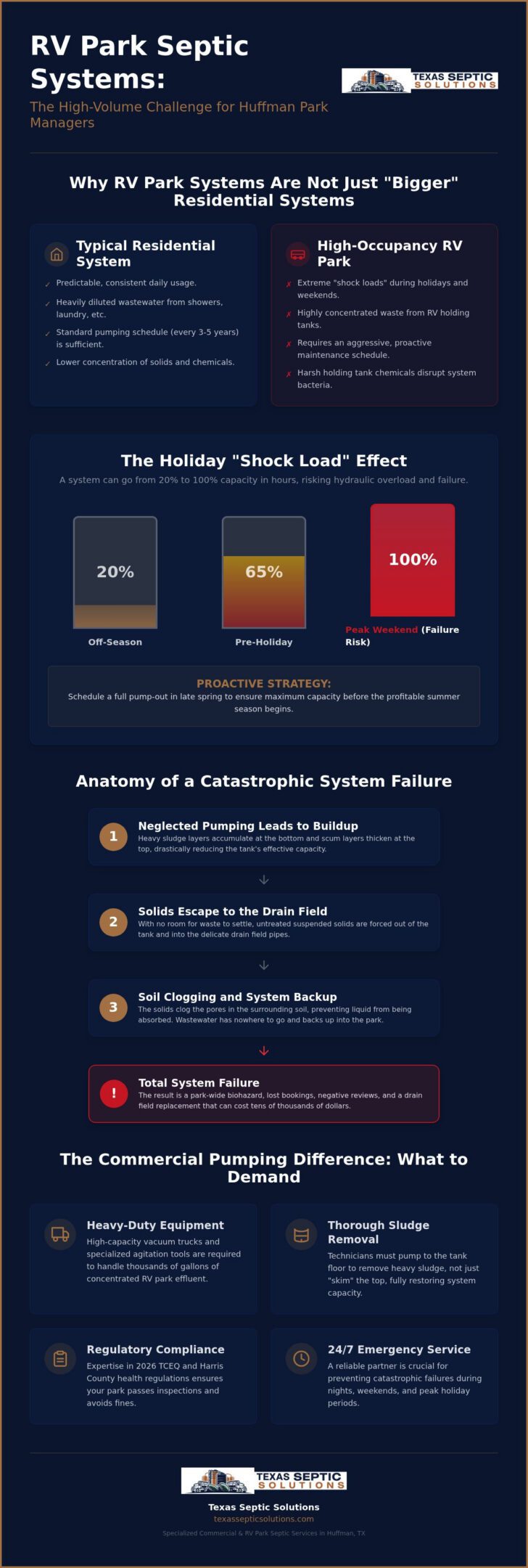
Holiday weekends like the Fourth of July create massive “shock loads.” Your system might go from 20% capacity to 100% in a matter of hours as guests arrive and hook up. Monitoring your tank levels before these peak seasons is critical. You don’t want to start a busy weekend with a tank that is already two-thirds full of solids. Early inspections allow you to clear space before the rush begins.
Hydraulic overload occurs when the volume of liquid entering the septic system exceeds its design capacity, forcing untreated wastewater out of the tank or into the drainfield. To avoid this, many Huffman managers schedule a full pump-out in late spring. This ensures the system has maximum headroom to handle the influx of guests without failing during the most profitable times of the year. It’s a simple step that prevents expensive emergency calls during a holiday.
Why Residential Pumping Standards Do Not Apply
A standard residential pumper is used to dealing with family waste, which is heavily diluted by laundry, dishwashers, and long showers. RV waste is different. It is much more concentrated and often contains specialized holding tank chemicals designed to break down solids and mask odors. These chemicals can be harsh on the natural bacteria in your main system, requiring a more aggressive maintenance approach.
Standard residential pumping schedules simply can’t keep up with the waste-to-water ratio of an RV park. If you hire a pumper who only understands residential loads, they might underestimate how quickly your sludge layers accumulate. Specialized septic tank pumping for RV parks Huffman requires technicians who understand high-occupancy demands and have the heavy-duty equipment to handle thousands of gallons of concentrated effluent efficiently.
The Mechanics of Commercial Pumping for Large-Scale RV Systems
Large-scale RV systems in Huffman operate under a constant state of stress. Unlike residential setups, these commercial systems often utilize a series of interconnected tanks to process heavy waste loads. This design allows for better settling of solids, but it also means maintenance requires a more technical approach. We use heavy-duty vacuum trucks and specialized agitation tools to ensure that every tank in the sequence is completely cleared, not just the one closest to the inlet.
Managing Sludge and Scum in Multi-Tank Systems
In a multi-tank configuration, the first tank acts as the primary settling chamber. However, the high-velocity flow from dozens of RVs can easily stir up solids, carrying them into subsequent tanks. If your pumper only “skims” the floating scum layer, the heavy sludge at the bottom continues to build, eventually reducing your total capacity. We prioritize a thorough pump-out that reaches the floor of every tank to reset your system’s volume and functionality.
RV park grease traps require separate, frequent monitoring because cooking oils from guest trailers can quickly solidify and bypass the main septic baffles.
Protecting the Drain Field from Failure
The drain field is the heart of your wastewater infrastructure and the most expensive component to replace. When tanks aren’t pumped regularly, suspended solids escape into the leach field, clogging the soil pores. This leads to a total system shutdown. Investing in routine septic tank pumping for RV parks Huffman is far more cost-effective than a full septic system repair, which can cost tens of thousands of dollars for commercial properties.
Following Texas septic regulations isn’t just about avoiding fines; it’s about extending the life of your leach field through proper management. You can identify early signs of drain field struggle by looking for spongy grass near the lines, slow-draining utility pedestals, or persistent odors during humid Huffman afternoons. These are warnings that your system is fatigued by the hydraulic load and needs immediate attention.
Watch for these red flags and don’t wait for a total backup to occur. If you notice any signs of system fatigue, reaching out to Texas Septic Solutions for a professional assessment can save your park from a mid-season catastrophe.
Choosing a Septic Pumping Partner: Huffman’s Commercial Criteria
Finding a reliable partner for septic tank pumping for RV parks Huffman involves more than just checking a price list. You need a team that treats your wastewater system as a critical business asset. Commercial properties face much higher stakes than residential ones. If a system fails, you aren’t just dealing with a messy yard; you’re facing potential health code violations and a loss of guest revenue. Your provider must have the infrastructure and local accountability to match those stakes.
24/7 Response Readiness vs. Scheduled Maintenance
A septic failure on a Friday evening is an immediate hospitality crisis. Guests expect working utilities, and a delay in response can lead to refund demands and damaged online ratings. Reliability means having a partner who provides emergency septic service whenever a crisis strikes. We act as the neighborly expert who’s always on standby, ensuring that your park remains a clean and welcoming environment for every traveler. Having a pro on call gives you the peace of mind to focus on park management rather than utility stress.
Equipment Requirements for Heavy-Duty Pumping
Residential trucks often lack the capacity for commercial jobs. If a pumper has to make three trips to clear your system, it increases costs and creates unnecessary traffic in your park. You should look for partners with high-capacity vacuum trucks that can handle 5,000+ gallons in a single visit. Logistics also matter in crowded Huffman campgrounds. Long-reach hoses are essential for accessing tanks without driving heavy equipment over delicate leach fields or too close to guest RVs. A professional partner should bring:
- High-CFM vacuum pumps to pull heavy sludge from deep, large-scale tanks.
- Specialized agitation tools to break up solid “scum” layers before extraction.
- Verification of legal disposal at TCEQ-approved Texas facilities.
Technical expertise is non-negotiable. Your partner should be intimately familiar with the differences between traditional anaerobic tanks and the aerobic systems frequently used in East Texas clay. Aerobic units require more frequent mechanical checks and specific air compressor maintenance. Before signing a contract, ask for proof of commercial liability insurance and current Texas licensing. This verification protects your business from liability and guarantees that all waste handling meets Harris County and TCEQ standards.
Regulatory Compliance and Maintenance Standards for Huffman Parks
Staying compliant with Huffman health codes isn’t just a legal chore; it’s a vital part of your park’s operational health. In Harris County, the environmental health department acts as the authorized agent for the Texas Commission on Environmental Quality (TCEQ). This means your RV park is subject to Title 30, Chapter 285 of the Texas Administrative Code. Failure to meet these standards can lead to significant fines and even temporary closures during peak season. Professional septic tank pumping for RV parks Huffman ensures you have the documentation needed to prove your system is managed responsibly.
Texas Environmental Standards for Waste Management
Harris County inspectors look for evidence that your system isn’t overflowing or leaking into local East Texas waterways. Protecting the San Jacinto River watershed is a major priority for local authorities. Illegal dumping or using unlicensed pumpers can result in massive fines that far outweigh the cost of professional service. You must keep a detailed log of every maintenance event to stay in the clear during unannounced inspections. Use the following list to ensure your records meet 2026 standards:
- Date of the pumping service.
- Total volume of waste removed in gallons.
- Full name and TCEQ license number of the service provider.
- The destination of the waste (the authorized disposal site used).
- A signed manifest or receipt from the technician.
Designing a Proactive Maintenance Schedule
Calculating your pumping frequency depends on your total RV slot count and your average occupancy rate. A park with 50 slots at 90% capacity will accumulate solids much faster than a standard commercial property. You shouldn’t wait for the tanks to reach capacity before calling for service. Instead, integrate septic system maintenance Texas into your quarterly business plan. This proactive approach prevents the high-pressure hydraulic loading that leads to system fatigue.
Establishing a formal septic system maintenance plan allows you to budget for expenses and avoid the “emergency premium” fees often associated with last-minute holiday calls. In Huffman, the clay-heavy soil makes drainage difficult, meaning a reliable septic tank pumping for RV parks Huffman is the only way to prevent surface ponding and odors. By scheduling your pump-outs during lower-occupancy mid-week windows, you ensure zero guest disruptions while maintaining a high standard of environmental safety.
Don’t let a paperwork error or a missed pumping date put your business at risk. Reach out to Texas Septic Solutions today to set up a compliant, professional maintenance schedule tailored to your park’s specific needs.
Texas Septic Solutions: Specialized RV Park Services in Huffman
Texas Septic Solutions stands as the reliable local authority for wastewater management in our community. We don’t just pump tanks; we act as guardians of your property’s functionality. Our team understands that RV parks are dynamic businesses with fluctuating needs. We bring a “can-do” attitude to every job, whether it’s a routine check-up or a high-pressure failure during a holiday rush. By choosing a partner for septic tank pumping for RV parks Huffman who is rooted in the area, you’re investing in a relationship built on accountability and local pride.
Custom Maintenance Plans for Huffman Campgrounds
We recognize that your pumping needs in January look very different from those in July. Our team works with you to design service intervals that match your specific occupancy cycles. During high-traffic seasons, we increase our visits to keep your system ahead of the hydraulic load. In the off-season, we scale back to save you operational costs. This tailored approach ensures you aren’t paying for unnecessary trips while guaranteeing you’re never caught off guard by a full tank.
For multi-site managers, we provide consolidated billing and detailed reporting. This makes it easy to track maintenance across several properties without drowning in paperwork. Our grounded and professional tone isn’t just for our writing; it’s the way our technicians conduct themselves on your site. We respect your guests and your property, ensuring that our presence is as discreet as possible while we work to keep your utilities running smoothly.
Rapid Emergency Response for Urgent Failures
When a lift station fails or a main line clogs, time is your biggest enemy. A delay of even a few hours can lead to guest relocations and lost revenue. We provide 24/7 service to Huffman and the surrounding East Texas regions to ensure a crisis never lasts longer than it has to. Our technicians arrive ready to solve the problem, minimizing downtime and keeping your park operational. We prioritize rapid response because we know your reputation is on the line.
Beyond just pumping, we perform comprehensive system inspections during every visit. This allows us to identify worn baffles or struggling pumps before they become emergency repairs. We don’t just treat the symptoms; we focus on long-term system health. Contact Texas Septic Solutions today for a commercial consultation to secure a partner who values your business as much as you do. We are ready to provide the professional septic tank pumping for RV parks Huffman owners need to stay compliant and worry-free.
Secure Your Park’s Future with Proactive Maintenance
Managing a successful RV park means balancing guest satisfaction with complex utility demands. You’ve seen how seasonal spikes can strain your system and why specialized equipment is necessary for commercial-grade waste. By prioritizing a scheduled approach to septic tank pumping for RV parks Huffman, you protect your property from the high-pressure failures that lead to negative reviews and costly downtime. Staying ahead of TCEQ regulations and maintaining clear pumping records ensures your business remains a reliable destination for travelers year-round.
You don’t have to navigate these technical challenges alone. As local Huffman experts and licensed commercial waste haulers, we are here to support your operations with 24/7 emergency availability and customized care plans. Our team is ready to help you maintain a clean, compliant, and stress-free environment for every guest who pulls into your park. Schedule a Commercial Pumping Consultation with Texas Septic Solutions today to ensure your infrastructure is ready for the busy season ahead. Let’s work together to keep your park running at peak performance.
Frequently Asked Questions
How often should an RV park septic tank be pumped in Huffman?
Pumping frequency varies based on your total slot count and how many rigs are currently hooked up. A high-occupancy park in Huffman might need service every three to six months to prevent sludge overflow. We recommend monitoring your levels before major holidays to avoid mid-season crises. It’s better to pump a few weeks early than to deal with a backup when your park is at 100% capacity.
What are the signs that an RV park septic system is failing?
Watch for pooling water or unusually green grass near your drain field. Slow-draining pedestals and gurgling sounds in your park’s main lines are also major red flags. If guests complain about persistent sewage smells near the lift stations, your system is likely struggling. These signs indicate that your system is reaching its hydraulic limit and needs a professional assessment to avoid a total failure.
Are there specific chemicals RV guests use that harm septic systems?
Many RV holding tank treatments contain formaldehyde or bronopol, which are toxic to the natural bacteria in your septic system. These chemicals stop the breakdown of solids, leading to faster sludge accumulation. We suggest providing guests with a list of septic-safe enzymes or providing approved treatments at your park store. Educating your visitors helps protect your infrastructure and reduces the frequency of septic tank pumping for RV parks Huffman.
Does Harris County require specific permits for RV park septic pumping?
Harris County enforces strict TCEQ regulations for all commercial on-site sewage facilities. You must ensure your service provider is a licensed waste hauler who can provide a manifest for every load removed. These records are vital for your annual health department inspections. Failing to produce these documents can lead to hefty fines, so always verify that your pumper is fully authorized to operate in Huffman and surrounding areas.
Can I use a residential septic company for my Huffman RV park?
You should only hire a company with commercial-grade vacuum trucks and experience in high-volume wastewater management. Residential pumpers often use smaller trucks that can’t handle the 5,000-plus gallon capacity of many RV park systems in one trip. This leads to higher costs and more traffic in your park. Texas Septic Solutions specializes in both residential and commercial scales, ensuring we have the right tools for your specific infrastructure.
What should I do if my RV park septic alarm goes off on a weekend?
Don’t ignore a septic alarm, even if it happens on a Saturday night. This signal usually means your pump has failed or your tank levels are dangerously high. We offer 24/7 emergency septic service to handle these urgent situations before they turn into a park-wide disaster. Silence the alarm if your control box allows it, but call for a technician immediately to prevent wastewater from backing up into guest sites.
How much does commercial septic pumping cost for an RV park?
Commercial costs depend on several factors like the total volume of waste removed and the thickness of the sludge layer. Access to your tanks also plays a role; if our trucks need extra hose length to reach a buried lid, that adds to the labor. Emergency timing and disposal fees at authorized Texas facilities also influence the final investment. We provide transparent consultations to help you budget for these essential maintenance needs.
How do I prevent septic odors from upsetting my RV park guests?
Routine septic tank pumping for RV parks Huffman is the most effective way to eliminate odors before they start. You should also check your vent pipes for blockages and ensure your baffles are working correctly to keep solids where they belong. High-occupancy periods naturally produce more gases, so a proactive maintenance plan is your best defense. Keeping your system healthy ensures guests remember the scenery, not the smell of the utilities.