
How to Reduce Water Usage for Septic Health: 2026 Guide
Did you know that toilets account for nearly 30% of an average home’s indoor water consumption? For Texas homeowners, this isn’t just a utility bill concern; it’s a direct threat to the delicate balance of your septic system. We understand the stress that comes with watching a slow drain or spotting a soggy patch in the yard, wondering if a massive repair bill is just around the corner. It’s frustrating to feel like you’re walking on eggshells every time you run the dishwasher or take a long shower.
The good news is that you don’t have to guess about your system’s limits. This guide will show you exactly how to reduce water usage for septic health by managing the “surge” that often leads to hydraulic overload. We’ll walk through practical, step-by-step strategies to lower your household consumption and protect your drainfield. You’ll learn about the latest 2026 WaterSense standards, smart plumbing integrations that catch leaks before they cause damage, and a daily habit checklist that ensures your system stays healthy for years to come.
Key Takeaways
- Understand the “one gallon in, one gallon out” rule to prevent hydraulic overload and protect your system from sudden backups.
- Discover exactly how to reduce water usage for septic health by upgrading to 2026-standard high-efficiency fixtures and smart monitoring tools.
- Avoid the “laundry day flood” by spreading out high-volume water tasks to give your tank’s bacteria time to process wastewater properly.
- Protect your drainfield from saturation by managing outdoor irrigation and rainwater runoff to ensure the soil remains ready for treatment.
- Learn how strategic water conservation works alongside professional maintenance to extend the lifespan of your septic investment.
Understanding Hydraulic Overload and Your Septic System
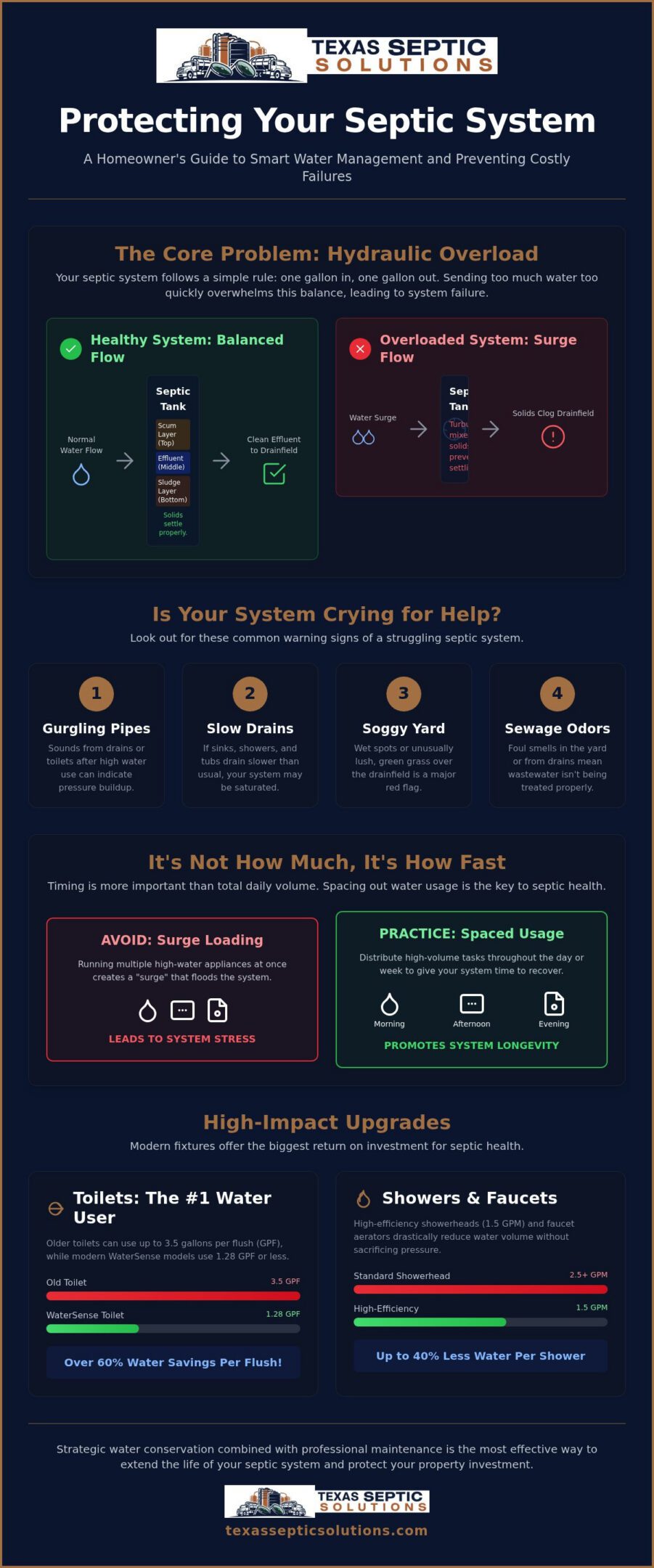
Hydraulic overload is a technical term for a very simple, messy problem. It happens when wastewater flows into your tank faster than the system can process or disperse it. To manage your system effectively, you have to understand How Septic Systems Work. Most tanks operate on a strict “one gallon in, one gallon out” rule. Every time you flush a toilet or run a faucet, an equal amount of liquid must leave the tank and enter your drainfield. This balance is exactly why learning how to reduce water usage for septic health is so vital for long-term home maintenance.
The real danger isn’t just the water itself; it’s what the water carries. In a healthy tank, solids settle at the bottom while grease floats to the top, leaving a relatively clear layer of effluent in the middle. When water rushes through too quickly, it creates turbulence that stirs up those solids. Instead of staying in the tank to be broken down by bacteria, the sludge gets pushed out into the drainfield. This is the top cause of system death. Once those perforated pipes and the surrounding soil clog with solids, the system can’t “breathe,” leading to total failure.
If you aren’t sure if your system is struggling, keep an eye out for these common warning signs:
- Gurgling sounds in your pipes during or after high water use.
- Sinks, tubs, or toilets that drain much slower than they used to.
- Bright green, lush patches of grass or soggy spots appearing over the drainfield area.
- Sewage odors wafting through the yard or up from the drains.
The Impact of Texas Clay Soil on Drainage
In the Greater Houston and Cleveland areas, we deal with heavy clay soil that presents unique challenges. Unlike sandy soil that absorbs liquid like a sponge, clay is dense and holds onto moisture. This means our local drainfields have lower absorption rates and need more time to “rest” between doses of wastewater. Our high humidity also slows down the natural evaporation process. When heavy Texas rains saturate the ground, your soil is already at its limit. Adding high indoor water usage on top of a rainstorm is a recipe for a backup.
Surge Loading vs. Total Daily Volume
Timing is often more important than the total amount of water you use. You might only use 200 gallons of water a day, but how you use it matters. Spreading that 200 gallons over 24 hours gives the tank plenty of time to settle. Using that same 200 gallons in a single two-hour window, like running the dishwasher while everyone takes back-to-back showers, creates a “surge.” We define surge loading as the primary threat to bacterial settling because it keeps the tank in a constant state of turbulence. Managing these peaks is the secret to a long-lasting system.
Step-by-Step Guide to High-Efficiency Plumbing Upgrades
Upgrading your plumbing fixtures is one of the most effective ways to protect your system. By 2026, low-flow technology has advanced significantly, providing excellent water pressure while using a fraction of the volume. To start, you should identify the biggest water “thieves” in your home. These are typically older toilets and showerheads that pre-date modern efficiency standards. Prioritizing these replacements offers the best return on investment for both your wallet and your drainfield. If you are also considering advanced treatment options, Tradewinds Water Filtration offers a comprehensive 2026 price guide and ROI analysis for whole-house systems. Before you begin, gather a few basic tools to make these DIY updates easier.
Toilets: The Largest Water Consumer
Toilets are the heavy hitters of indoor water use. According to EPA guidelines on septic care, older models can use up to 3.5 gallons per flush (GPF). Replacing these with 1.28 GPF WaterSense models can reduce toilet water usage by over 60%. If you aren’t ready for a full replacement, you can perform a simple dye test. Drop a few drops of food coloring into the toilet tank and wait 15 minutes. If color appears in the bowl without flushing, you have a silent leak that is constantly saturating your septic system. If you find a leak you can’t fix yourself, it’s often a sign that you need professional septic support to ensure your system hasn’t been compromised.
Showerheads and Faucet Aerators
Installing a 1.5 GPM (gallons per minute) showerhead is a quick win for any homeowner. Modern designs use air-induction technology to maintain a strong spray while using less water. This reduces the total volume sent to the tank and lowers the demand on your water heater. Don’t overlook your faucets, either. Aerators are small, inexpensive mesh screens that screw onto the tip of your faucet. They are the easiest answer for how to reduce water usage for septic health at the sink. To maintain them, simply unscrew the aerator and soak it in white vinegar for an hour to remove mineral buildup before reattaching. If the mesh is torn or heavily corroded, a new one costs only a few dollars and can be installed in seconds.
Optimizing Laundry and Kitchen Habits for Septic Longevity
Daily habits determine the lifespan of your septic system. Even with high-efficiency hardware, how you manage your chores can either support or sabotage your tank’s microbial environment. Understanding how to reduce water usage for septic health in the kitchen and laundry room is about preventing sudden surges that disrupt the settling process. We often see systems fail not because of a mechanical break, but because of a series of small, avoidable habits that add up over time.
The traditional “Laundry Day” is one of the most common causes of hydraulic overload. When you run five or six loads of laundry in a single afternoon, you send hundreds of gallons of water through the tank in a few hours. This “flood effect” doesn’t just stir up solids; it can actually flush out the beneficial bacteria your system needs to treat waste. Additionally, the type of detergent you choose matters. Liquid detergents are generally better than powders, which can contain inorganic fillers that contribute to sludge buildup. Avoid using excessive bleach or harsh chemicals, as these can kill the “good” bacteria that keep your system functioning properly.
The “One Load Per Day” Rule
Spreading your laundry throughout the week is a simple but powerful strategy. By sticking to one load per day, you give your tank 24 hours to settle and process the greywater. This habit is especially important for households using High-Efficiency (HE) washers. While HE machines use significantly less water than older top-loaders, they still contribute to the total daily volume. Following university water conservation tips can help you establish a routine that protects your drainfield from saturation. For larger families with multiple bathrooms, this staggered approach is non-negotiable. It ensures that the system has time to recover between high-use periods like morning showers and evening chores.
Kitchen Efficiency and Waste Management
Your kitchen is the second largest source of wastewater and solids. One of the best things you can do for your system is to stop using the garbage disposal entirely. These devices send finely ground food particles into the tank; these don’t break down easily and lead to more frequent pumping needs. Instead, focus on “dry” cleaning your plates. Scraping food into the trash or compost instead of rinsing it down the sink can save 5 to 10 gallons of water per meal. Modern dishwashers are also a major asset. Most 2026 models use as little as 3 gallons per cycle, which is far more efficient than hand-washing. Hand-washing can easily consume 20 gallons or more if the tap is left running. To maximize every drop, only run the dishwasher when it is completely full and use the “eco” setting to minimize water throughput.
Outdoor Water Management and Drainfield Protection
Your drainfield is the engine of your septic system. It’s the final stage where wastewater is purified by the soil before returning to the groundwater. For this biological process to work, the soil must be able to “breathe.” When we discuss how to reduce water usage for septic health, we aren’t just talking about what goes down your drains. We’re also talking about managing the thousands of gallons of rainwater and irrigation that hit your yard. If the soil is already saturated by outside sources, it cannot absorb the effluent coming from your house.
In areas like Houston and Cleveland, our heavy clay soil creates a “bowl effect.” During the intense Texas storm season, water pools quickly and stays put. If your drainfield is sitting in a puddle, the system will eventually back up into your home, regardless of how little water you use indoors. Protecting this area from external flooding is just as important as fixing a leaky toilet.
Diverting Runoff and Rainwater
Start with your roof. A single inch of rain on a 2,000-square-foot roof produces about 1,250 gallons of water. If your downspouts point toward your septic tank, you’re essentially drowning your system. Inspect your gutters regularly to ensure they are clear and functioning. You should also take these proactive steps to manage runoff:
- Ensure all downspout extensions direct water at least 10 feet away from any septic components.
- Install swales or French drains to redirect surface water around the absorption area rather than through it.
- Maintain a 10-foot “clear zone” around the tank and drainfield, keeping it free of heavy structures, parked vehicles, or dense trees.
Smart Irrigation Habits
Irrigation is a frequent but hidden threat to septic longevity. You should never install sprinkler heads directly over a drainfield. This adds unnecessary moisture to soil that is already working hard to process wastewater. During the wetter Texas months, adjust your irrigation timers or install rain sensors to skip cycles when the ground is already damp. When landscaping, choose native Texas grasses like Buffalograss. These varieties are adapted to our local climate, require significantly less supplemental water, and have shallow root systems that won’t invade or clog your pipes.
If you notice water pooling over your system after a heavy rain, don’t wait for the drains to slow down. Reach out to schedule septic tank pumping to clear the system and give your drainfield a chance to dry out before a major failure occurs.
Integrating Water Conservation with Professional Texas Septic Care
Mastering how to reduce water usage for septic health is a major victory for any property owner, but it is only one half of the equation. Think of conservation as the daily exercise that keeps your system fit, while professional care serves as the necessary check-up. These two elements work together to prevent the hydraulic overload discussed earlier. Even the most water-efficient household will eventually accumulate solids that bacteria cannot break down. By reducing the volume of water flowing through the tank, you allow for better separation of these solids, which can actually extend the time between your scheduled septic tank pumping services. However, conservation is never a replacement for the physical removal of sludge.
A comprehensive septic system maintenance plan acts as your early warning system. It bridges the gap between your efficient habits and the mechanical needs of the tank. In Texas, where soil conditions can shift and weather can be unpredictable, having a professional eye on your system ensures that small issues don’t turn into catastrophic failures. We’re on your team to ensure your investment lasts as long as possible.
The Role of Professional Inspections
Sometimes, being extremely careful with water can unintentionally hide developing problems. For example, a slow leak in the tank wall or a partially blocked pipe might not show symptoms if your daily water volume is very low. During a professional inspection, technicians perform “load tests” to simulate higher usage and ensure the drainfield can still handle a surge. This proactive approach identifies the need for septic system repair long before you see sewage backing up into your home. We use your maintenance records to track how your system responds to different seasons, allowing us to diagnose issues with precision.
Emergency Readiness in East Texas
There are moments when water conservation simply isn’t enough to fix a malfunctioning system. If you hear a septic tank alarm, it is a signal that the water level in the tank has reached a critical point. At this stage, you must stop all indoor water usage immediately. This includes pausing laundry, skipping showers, and avoiding toilet flushes until help arrives. Ignoring an alarm can lead to permanent soil damage in your drainfield that water-saving habits alone cannot reverse.
When these high-pressure situations occur, our team provides 24/7 emergency septic service to restore your home’s functionality. As we move through the 2026 season, remember that your system is a living biological filter. By combining smart water habits with professional oversight, you’re doing more than just saving money; you’re protecting your property’s long-term health and value.
Secure the Future of Your Septic System
Protecting your investment starts with understanding that your septic system has a limit. By upgrading to 2026 WaterSense fixtures and spreading out high-volume tasks like laundry, you prevent the hydraulic overload that leads to system failure. You’ve learned that managing outdoor runoff and selecting native Texas landscaping are just as vital as fixing a leaky faucet. Mastering how to reduce water usage for septic health isn’t about restriction; it’s about giving your system the time it needs to process waste effectively.
While daily habits make a huge difference, professional oversight is the final piece of the puzzle. As a local, family-owned business, we take pride in serving our neighbors in Cleveland, Houston, and Cypress. Whether you’re dealing with a sudden backup or just want a proactive check-up, we’re here with 24/7 emergency support and comprehensive maintenance plans. Don’t wait for a slow drain to become a major repair. Schedule a Septic Inspection with Texas Septic Solutions Today to keep your system running smoothly for years to come. Your home deserves the peace of mind that comes with expert care.
Frequently Asked Questions
Does a low-flow toilet really make a difference for my septic system?
A low-flow toilet makes a massive difference because toilets are the single largest source of indoor water use, accounting for nearly 30% of consumption. By switching from an older 3.5 GPF model to a 1.28 GPF WaterSense toilet, you reduce the volume sent to your tank by over 60%. This reduction is a primary strategy for how to reduce water usage for septic health, as it directly prevents the turbulence that stirs up solids.
How much water does the average person use daily on a septic system?
The average person typically uses between 60 and 70 gallons of water every day. In a household with four people, that adds up to nearly 300 gallons hitting your septic tank daily. By adopting high-efficiency habits and hardware, you can lower this to around 40 or 50 gallons per person. Keeping track of these numbers helps you avoid the “surge loading” that puts your drainfield at risk of failure during heavy use.
Can I use a water softener if I have a septic tank?
You can use a water softener, but it must be a modern, demand-initiated regeneration model. Older timer-based units often discharge excessive salt brine and water, which can disrupt the bacterial balance and soil structure in your drainfield. In 2026, high-efficiency softeners are designed to minimize this impact. Always ensure your softener is professionally tuned to your specific water hardness to avoid unnecessary cycles that could lead to hydraulic overload.
What should I do if my drainfield is flooded after a heavy Texas rain?
If a heavy Texas rain saturates your yard, stop all non-essential water use immediately. When the ground is already soaked, your drainfield cannot absorb more liquid from the house. Divert any gutter runoff away from the area and avoid driving heavy equipment over the wet soil. Do not have your tank pumped while the ground is flooded; the pressure from the surrounding water can actually cause an empty tank to “float” or shift.
Does using less water mean I can pump my septic tank less often?
Reducing water usage can extend the time between pumping services, but it doesn’t replace the need for regular maintenance. While less water allows for better solid settling, the sludge layer at the bottom of the tank will still grow over time. Even with perfect conservation habits, non-biodegradable solids accumulate. We recommend sticking to your professional inspection schedule to ensure that your low-flow habits aren’t masking a deeper mechanical issue in the tank.
Is it okay to take long showers if I only do it once a day?
Long showers are manageable if you use a high-efficiency 1.5 GPM showerhead. Without one, a 20-minute shower can dump 50 gallons into your system at once, creating a mini-surge. If multiple family members take long showers back-to-back, you risk stirring up the tank’s solids. To stay safe, try to space out showers by at least an hour. This gives the tank time to settle and prevents a sudden volume of hot water from disrupting the system.
How do I know if my septic system is currently experiencing hydraulic overload?
You can identify hydraulic overload by watching for slow-draining sinks or gurgling sounds in your pipes after a shower. If your septic tank alarm goes off or you see water pooling over the drainfield during dry weather, your system is likely overwhelmed. These signs indicate that the tank is receiving more water than the soil can process. Recognizing these symptoms early is key to understanding how to reduce water usage for septic health before a backup occurs.
What are the best water-saving appliances for septic health in 2026?
What are the best water-saving appliances for septic health in 2026?
The best appliances for septic health in 2026 include WaterSense-labeled toilets (1.28 GPF) and 1.5 GPM showerheads. High-Efficiency (HE) washing machines are also essential, as they use significantly less water than traditional top-loaders. Additionally, smart water monitors like Flo by Moen are now common tools for detecting silent leaks. These devices track usage in real-time and can automatically shut off your water if they detect a pipe burst or a running toilet. To see how these tools fit into a broader smart infrastructure, you can explore Project-based engineering and installation fees for integrated automation systems to help optimize your home’s overall resource efficiency.