
How to Manage a Septic System with a Home Business in Cypress: 2026 Guide
Imagine it’s a busy Saturday morning in Cypress. You’ve got clients lined up for your home hair salon or a massive order ready for your cottage bakery, when suddenly, the drains gurgle and a foul smell takes over your workspace. For many local entrepreneurs, this isn’t just a plumbing annoyance; it’s a total shutdown of their livelihood. Learning how to manage a septic system with a home business Cypress is the difference between a thriving enterprise and a costly emergency repair. Most residential systems in Harris County are built for standard household use, not the high-volume water or chemicals your business might generate.
You’ve worked hard to build your business, and the last thing you need is a utility failure threatening your reputation. We know that the fear of business downtime and the complexity of Harris County septic regulations can feel overwhelming. This guide will show you exactly how to protect your investment while keeping your operations running smoothly. You’ll learn which chemicals are “system killers,” how to set a maintenance schedule that fits your specific business type, and how to ensure you stay compliant with the latest 2026 standards. We’ll give you the confidence to focus on your customers while we help you handle the infrastructure.
Key Takeaways
- Identify if your operation is “high-risk” by evaluating its specific waste footprint, focusing on the impact of chemicals, solids, and fats on your tank’s health.
- Learn exactly how to manage a septic system with a home business Cypress by staggering water-heavy tasks to protect your drainfield from hydraulic failure.
- Navigate 2026 Harris County and TCEQ requirements with ease to ensure your home-based business remains legally compliant and fully permitted.
- Upgrade your maintenance strategy from a passive schedule to a proactive “business insurance” plan that catches small issues before they halt your production.
- Discover how high-efficiency fixtures and smart water management can offset the extra load of employees or customers without risking system backups.
Understanding the Impact of a Home Business on Your Cypress Septic System
Cypress is seeing a massive rise in home-based ventures across the 281 and 832 area codes. Whether you’re running a boutique hair salon, a specialized pet grooming service, or a cottage bakery, your home’s infrastructure is now doing double duty. Most property owners don’t realize that a standard residential system is designed strictly for domestic waste produced by a single family. When you add employees or a steady stream of customers, you’re shifting into a “light commercial” usage category. Learning how to manage a septic system with a home business Cypress starts with recognizing that your tank has specific mechanical and biological limits.
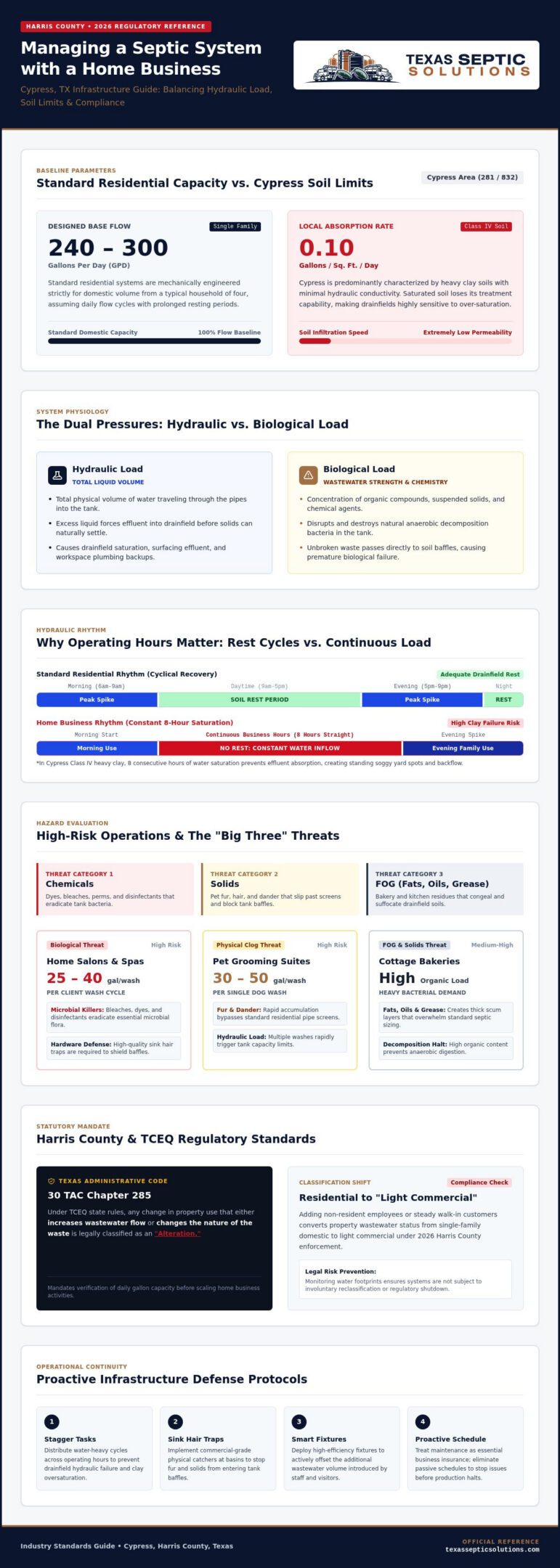
Two main factors determine your system’s health: hydraulic load and biological load. Hydraulic load is the total volume of water moving through your pipes. A typical Cypress home is designed for a base flow of 240 to 300 gallons per day. Biological load refers to the “strength” of the wastewater. Business activities often introduce higher levels of organic matter or chemicals than a family of four, which can easily disrupt the anaerobic decomposition in septic tanks. When the bacteria can’t keep up with the waste, the system begins to fail.
The 24/7 Strain: Why Business Hours Matter
In a normal household, water usage usually happens in spikes during the morning and evening. This cycle gives the drainfield time to “rest” and process effluent. When you run a business, that water usage often becomes constant throughout the day. In Cypress, where Class IV heavy clay soils are common, this lack of downtime is a major risk. These soils have low hydraulic conductivity, often absorbing only 0.10 gallons per square foot per day. If your business keeps the system saturated for eight hours straight, the soil loses its ability to treat the waste. This leads to soggy spots in your yard or, worse, backups in your workspace.
Residential vs. Light Commercial Classification
Your business might technically change your system’s legal status under Texas Commission on Environmental Quality (TCEQ) rules. Any change in property use that increases flow or changes the nature of the waste is considered an “alteration” under 30 TAC Chapter 285. It’s vital to know your tank’s daily gallon capacity before you scale your operations. Many homeowners find that a septic system repair is often avoidable if they simply monitor their daily water footprint. Knowing your limits prevents the system from being legally reclassified or failing due to simple overwork.
Identifying High-Risk Home Businesses for Septic Systems
Not all businesses are created equal when it comes to wastewater. Understanding your specific “waste footprint” is the first step in learning how to manage a septic system with a home business Cypress. While an accountant working from a home office has zero impact, other ventures introduce the “Big Three” risks: Chemicals, Solids, and Fats, Oils, and Grease (FOG). Properly identifying these risks is the only way to know how to manage a septic system with a home business Cypress without facing a total shutdown. Cypress entrepreneurs running pet grooming suites face a hidden danger: hair accumulation. A single dog wash can use 30 to 50 gallons of water and release a massive amount of fur and dander that bypasses standard screens, leading to physical clogs.
Home Salons and Spas: The Chemical Challenge
Home-based hair salons in Cypress are at the highest risk for biological failure. Every client wash cycle adds 25 to 40 gallons of water, but the real threat lies in the products. Hair dyes, perms, bleaches, and disinfectants are designed to kill organisms; unfortunately, they don’t distinguish between scalp microbes and the beneficial bacteria in your tank. These chemicals can wipe out the microbial flora essential for waste breakdown. Following EPA guidelines on septic care and maintenance is vital to prevent these chemicals from reaching your drainfield. A high-quality hair trap installed at the sink is the first line of defense for a Cypress salon to keep solids out of the tank baffles. If you’re noticing slow drains or odors in your workspace, it’s time to talk to Texas Septic Solutions about a professional inspection.
Cottage Food Industries: The Grease Problem
If you run a catering business or a cottage bakery, your primary enemy is grease. Standard residential systems aren’t equipped with commercial-grade grease interceptors. TCEQ standards establish that wastewater from food preparation can have a Biochemical Oxygen Demand (BOD) of 1,200 mg/L even after a grease trap, which is nearly ten times higher than domestic waste. High-temperature dishwashing might seem clean, but it actually emulsifies grease, allowing it to bypass the tank and clog the soil in your drainfield. Additionally, excess flour and yeast can lead to “sludge bulking,” where solids fail to settle and instead float into the secondary treatment zones. Managing these organic loads requires a much more aggressive pumping schedule than a typical home.
Practical Strategies for Managing Increased Hydraulic Load
Managing water flow is just as important as managing your cash flow when you work from home. Most residential systems in Cypress are designed for a specific daily volume, usually between 240 and 300 gallons. When your business adds customers or heavy cleaning cycles, you risk saturating the soil. Because Cypress is known for Class IV heavy clay, water doesn’t disappear quickly. To avoid a swampy yard or a backup, you must learn how to manage a septic system with a home business Cypress by controlling your “hydraulic spikes.” This means spreading out water usage so the system never reaches its breaking point at a single moment.
Compliance is also a factor. The TCEQ On-Site Sewage Facility regulations mandate that systems must be sized for their actual usage. If your business pushes you over the 5,000 gallons per day limit, you’re no longer in standard residential territory. Even for smaller operations, staying within your permitted flow is essential for system longevity and legal safety. Staying proactive helps you avoid the stress of unexpected utility failures.
The Scheduling Hack for Home Businesses
Creating a water budget is the most effective way to protect your drainfield without spending a dime. If you run an in-home daycare, TCEQ commercial charts suggest an additional 8 to 15 gallons per day for every child and employee. A 10-child daycare can easily add 150 gallons to your daily load. If you save all your laundry for “laundry day,” you’ll likely flood the system. Instead, spread these tasks across the entire week. Time-block your water usage by running dishwashers or washing machines late at night, well after business hours, to give the field a chance to drain during the day.
Essential Hardware Upgrades
Business owners should consider a few key hardware upgrades to act as a safety net. An effluent filter is non-negotiable; it prevents hair, lint, and food particles from escaping the tank and ruining your soil. You should also ensure your tank has risers that extend at least 2 inches above the ground. This makes it easy for you to perform quick visual checks without digging up the yard. Remember, a septic tank alarm going off is a critical business warning that requires immediate attention. It’s much better to catch a high-water event early than to deal with a full-blown emergency in front of a client. Installing high-efficiency toilets and low-flow faucets can also help offset the extra water your business requires.
Regulatory Compliance and Safety in Cypress, TX
Cypress sits in unincorporated Harris County, meaning all on-site sewage facilities (OSSF) fall under the jurisdiction of the Harris County Engineering Department. These local rules are strictly backed by the Texas Commission on Environmental Quality (TCEQ) under 30 TAC Chapter 285. If you change your property use from a standard family home to a customer-facing operation, you’ve triggered what the state calls an “alteration.” Knowing how to manage a septic system with a home business Cypress requires staying on the right side of these digital compliance trackers. Lapsing on your aerobic maintenance contract can lead to Class C misdemeanor charges in the Harris County Justice of the Peace Courts.
Many older Cypress properties have “grandfathered” systems permitted decades ago. These setups were designed for a much lower flow and might not meet the current 2026 standards for commercial pre-treatment. If your business introduces hair dyes or kitchen grease, your existing system might be legally insufficient. Professional guidance ensures you don’t accidentally run an unpermitted commercial activity that could lead to heavy fines or a forced shutdown of your livelihood. Staying proactive with your legal requirements is just as important as the physical maintenance of the tank itself.
Permitting and Capacity Checks
You must notify the county if your business results in an increase in permitted daily flow. For instance, Harris County mandates that any OSSF serving a food-preparation business must have plans signed and sealed by a Texas-licensed Professional Engineer. Understanding your “Daily Design Flow” is critical; you must stay under the 5,000 gallons per day threshold to avoid complex industrial wastewater permitting. A professional inspection protects your business license by proving your infrastructure can safely handle your specific volume. This validation is often required by insurance companies before they cover home-based commercial activities.
Record Keeping as a Business Asset
Maintaining a septic system maintenance plan doubles as a vital business record. Harris County requires aerobic treatment units to undergo quarterly inspections, and these reports must be filed through the proper digital portals within 14 days of service. Keeping copies of these filings, along with pumping receipts, provides proof of due diligence for your insurance provider or during tax season. A clean service record increases property value for future buyers. If you need help staying compliant with local regulations, contact Texas Septic Solutions for expert maintenance and support.
Professional Maintenance: Protecting Your Business Continuity
Maintaining your infrastructure is a form of business insurance. While a typical family might pump their tank every three to five years, your business requirements are much more demanding. Pumping for a standard 1,000-gallon tank usually costs between $275 and $475 in our area, but a backup during business hours costs much more in lost revenue and client trust. Learning how to manage a septic system with a home business Cypress means shifting your mindset from reactive repairs to proactive care. We see many local entrepreneurs treat their septic system as an afterthought until it stops production entirely. This is a mistake that can lead to weeks of downtime while the soil in your drainfield recovers.
Proactive inspections allow us to catch small leaks, failing aerators, or component wear before they become emergencies. For a customer-facing business, 24/7 emergency support isn’t just a luxury; it’s a necessity. If your system fails on a Friday evening before a busy weekend of appointments, you need a partner who can respond immediately. Texas Septic Solutions serves as the neighborly expert for Cypress business owners, offering the technical skill of a large firm with the accountability of a family-owned local business. We take pride in keeping your home and your business functional through every season.
Custom Pumping Schedules
Your specific business type dictates how often you need service. High-risk operations like pet grooming or catering may need to pump their tanks every 12 to 18 months rather than the standard multi-year interval. This prevents the accumulation of hair, fats, or solids that can clog your effluent filter or enter the secondary treatment chamber. Aerobic systems require even more attention because they rely on mechanical parts and consistent oxygen levels to treat waste. Harris County mandates quarterly inspections for these units to ensure they meet environmental standards. You can find more details on general upkeep rules in our guide to septic system maintenance Texas. Adjusting your schedule based on biological load prevents scum blankets from reaching your drainfield and causing permanent damage.
Partnering with Texas Septic Solutions
We provide a Rapid Response Promise to all our Cypress business partners. We understand that your home is your office, your storefront, and your livelihood. If your venture grows beyond the capacity of your current tank, we offer professional design services to help with a septic system replacement that scales with your success. Our team has over 20 years of hands-on experience helping property owners navigate the unique soil and regulatory challenges of our community. We’re built for both the mundane tasks of upkeep and the high-pressure demands of unexpected failures. Schedule a capacity check for your home business today! and protect your continuity with a partner who cares about your success.
Securing Your Livelihood and Your Home in Cypress
Your home business is a vital part of the Cypress community. Transitioning your mindset from standard residential care to a light commercial approach is the best way to ensure your doors stay open. By managing your daily hydraulic load and staying ahead of strict Harris County regulations, you prevent the backups that threaten your daily operations. Learning how to manage a septic system with a home business Cypress allows you to grow your venture without the constant worry of utility failure or unexpected business downtime.
Don’t wait for a gurgling drain to take a proactive step. We’ve been a family-owned partner for local entrepreneurs since 2010, bringing over 20 years of local expertise to every job. Whether you need a routine capacity check or 24/7 Emergency Service for Cypress, we’re ready to support your success. Protect your home business with a professional septic inspection from Texas Septic Solutions. You’ve built something great; let’s make sure your home’s infrastructure is strong enough to handle your growth and keep your business running smoothly.
Frequently Asked Questions
Do I need a bigger septic tank if I run a business from my Cypress home?
Not necessarily, but your system capacity must match your “Daily Design Flow.” If your business adds employees or involves high-volume water tasks, your current tank might be undersized. Harris County requires systems to handle actual usage. If you’re exceeding the standard residential design of 240 to 300 gallons per day, a larger tank or a secondary treatment unit might be required to avoid saturating the heavy Cypress clay soil.
Can I use salon disinfectants like Barbicide with a septic system?
You should avoid flushing concentrated disinfectants directly into your tank. These chemicals are designed to kill bacteria, which includes the beneficial microbes responsible for breaking down waste. If you’re learning how to manage a septic system with a home business Cypress, consider a separate holding tank for chemical waste. Wiping out your tank’s biological flora leads to foul odors and eventual system failure, requiring a professional pump-out to reset the balance.
How often should a home business pump their septic tank?
Most home businesses should pump every 12 to 18 months. While a standard family might wait three to five years, the higher organic and hydraulic load of a business fills the tank with solids much faster. Regular pumping acts as business insurance against unexpected downtime. Your specific schedule depends on your waste footprint, such as the amount of hair from a salon or fats from a home bakery.
What happens if my septic system fails while I have customers at my house?
An immediate backup or foul odor can damage your business reputation and force a temporary shutdown. This is why we offer 24/7 Emergency Septic Service to our Cypress clients. If you notice gurgling drains or slow toilets while customers are on-site, stop all water usage immediately. Having a reliable local expert on call ensures you can address the issue rapidly and resume your business operations with minimal disruption to your schedule.
Are there specific Harris County rules for home business septic systems?
Yes, the Harris County Engineering Department enforces strict digital tracking of maintenance contracts. If you change your home’s usage to include a business, it’s legally considered an “alteration.” Aerobic systems in unincorporated areas like Cypress require quarterly inspections. Lapsing on these requirements or failing to file reports within 14 days can result in legal penalties. Keeping an accurate service log is essential for staying compliant with local 2026 standards and protecting your property value.
Can I install a grease trap on a residential septic system for my home bakery?
You can and should install a point-of-use grease trap for a cottage food operation. Standard residential tanks aren’t built to handle the high levels of fats, oils, and grease (FOG) produced by commercial baking. Without a trap, grease enters the drainfield and seals the soil, leading to permanent failure. Harris County mandates that food-prep businesses have specialized pre-treatment designs signed by a Professional Engineer to protect the local groundwater and system integrity.
Will pet grooming hair clog my aerobic septic system?
Hair is a major physical threat to aerobic systems because it doesn’t break down easily. It can wrap around aerator shafts, clog spray heads, and block effluent filters. To prevent this, you must install high-grade hair interceptors at every grooming station. Even with filters, pet groomers in Cypress often need more frequent inspections to ensure the mechanical components of their aerobic unit remain clear of dander, fur, and heavy antimicrobial shampoos.
How do I know if my home business is exceeding the hydraulic load of my system?
Look for warning signs like persistent soggy spots in the yard, slow-draining sinks, or a septic alarm activation. You can calculate your load by monitoring your water meter or tracking business-specific tasks. For example, if you’re running multiple wash cycles for a salon, you’re likely pushing the limits of the soil’s absorption rate. Learning how to manage a septic system with a home business Cypress involves balancing this daily water budget to prevent field failure.