
How to Keep Your Septic System Healthy with a Large Family: A 2026 Guide
Imagine it’s 7:00 AM on a Monday morning and you have four children lined up for the shower when the downstairs toilet starts to gurgle. For many homeowners, this is the start of a nightmare scenario that ends with an expensive emergency call. If you’re managing a busy household, you’ve likely felt that nagging worry about whether your tank can handle the constant pressure. Learning how to keep septic system healthy with a large family is about more than just being careful; it’s about active load management to prevent hydraulic overload.
We understand that a large family puts unique demands on your home’s infrastructure. You shouldn’t have to live in fear of a backup every time someone starts a load of laundry or takes a long bath. This 2026 guide provides the specific strategies you need to prevent overflows and extend the life of your system. We’ll walk you through setting a customized pumping schedule based on your actual usage, establishing simple house rules for guests and kids, and finding the peace of mind that comes with a system built for your real life.
Key Takeaways
- Avoid hydraulic overload by staggering high-water activities like laundry and showers to give your tank time to process waste effectively.
- Protect your drain field by enforcing strict “Three Ps” house rules and eliminating “flushable” wipes that cause major blockages in high-use systems.
- Learn how to keep septic system healthy with a large family by moving beyond generic advice to a custom pumping schedule based on your actual occupancy.
- Identify the early warning signs of system strain so you can address minor issues before they turn into costly emergency repairs.
- Partner with a reliable local authority to ensure your home’s infrastructure is professionally maintained and ready for heavy daily demands.
The High-Occupancy Challenge: Why Large Families Strain Septic Systems
Managing a household with five, six, or more people is a full-time job. Between the endless cycles of laundry and back-to-back showers, your plumbing never seems to catch a break. Understanding how to keep septic system healthy with a large family starts with recognizing that your system isn’t just a tank in the ground; it’s a living biological filter that requires time to process waste. When you have a high-occupancy home, you’re constantly pushing the limits of what that filter can handle safely. Without a strategy, the system can quickly become overwhelmed by the sheer volume of daily activity.
What is Hydraulic Overload?
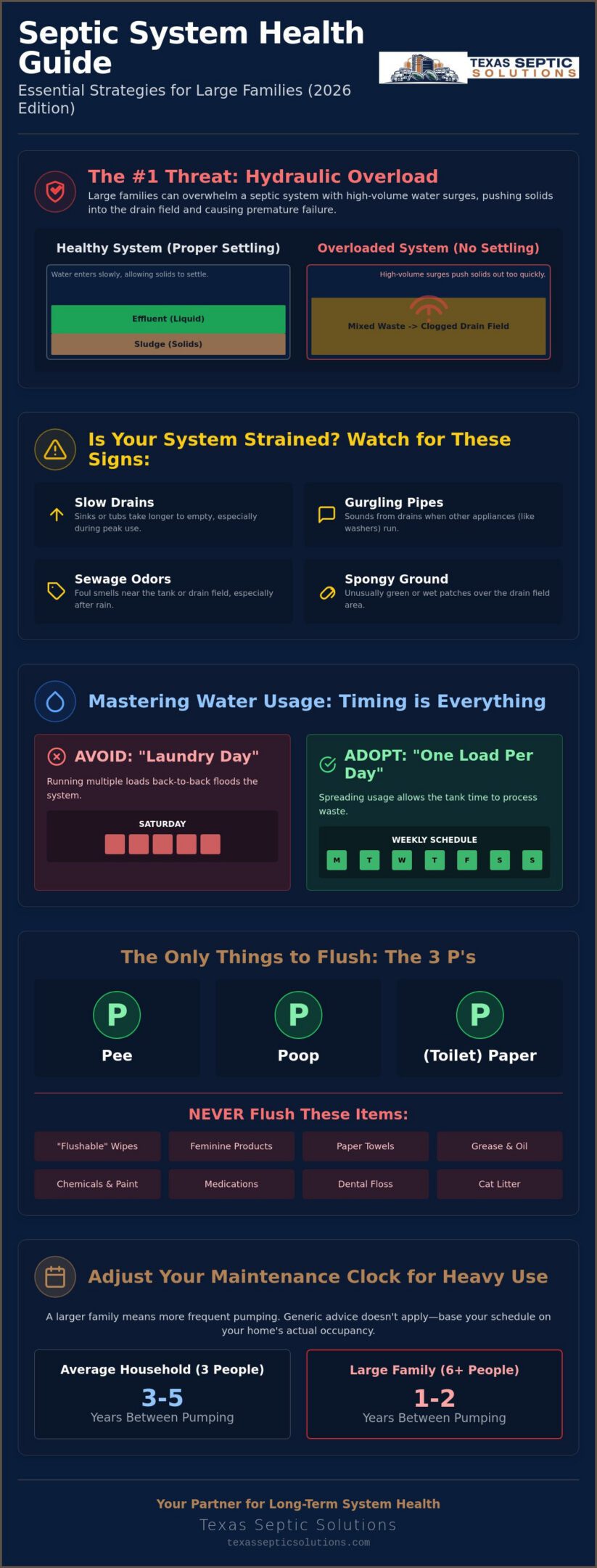
A healthy system relies on a delicate balance of time and gravity. To understand how septic systems work, you have to look at the 24-hour settling cycle. In a perfect scenario, wastewater enters the tank and stays there long enough for heavy solids to sink to the bottom and oils to float to the top. This leaves a clear layer of liquid in the middle, known as effluent, to flow out into the drain field for final treatment.
When too many people use water at the same time, you create “slugs” of water. These high-volume surges rush through the tank so fast that they don’t give solids enough time to settle. Instead, those solids are pushed directly into your drain field pipes, where they cause permanent clogs. Hydraulic overload is the leading cause of premature drain field failure in large homes.
The Impact of Constant Usage
Large families often reach the “sludge limit” much faster than the average three-person household. There is a critical difference between organic load, which is the actual waste and paper, and hydraulic load, which is the sheer volume of water. While your tank might be big enough to hold the waste, the constant flow of water from a busy house prevents the “rest periods” the bacteria need to break down those solids. This lack of downtime means the tank stays in a state of constant turbulence.
In our service areas around Houston and Cleveland, we face an additional challenge: the East Texas clay factor. Unlike sandy soil that drains quickly, our local clay holds onto moisture like a sponge. When a large family produces hundreds of gallons of water daily, the ground can become saturated and lose its ability to absorb more liquid. Learning how to keep septic system healthy with a large family in this environment requires being mindful of how much water you send down the drain at once.
Watch for these indicators that your system is struggling with its current load:
- Slow-draining sinks or tubs, especially during the morning rush.
- Gurgling sounds coming from the pipes when the washing machine drains.
- Spongy, bright green grass over the drain field even during dry Texas summers.
- Occasional sewage odors near the tank or after a heavy rainstorm.
If you notice these signs, it’s a signal that your system is working overtime. Addressing these symptoms early can prevent a total system backup and help you avoid the stress of an unexpected failure.
Mastering Water Conservation: Staggering Usage to Prevent Flooding
When you’re looking for practical ways on how to keep septic system healthy with a large family, timing is everything. It isn’t just about the total number of gallons you use each day; it’s about how quickly those gallons enter the tank. A sudden surge of 100 gallons can cause more damage than 300 gallons spread over 24 hours. By managing your household’s water rhythm, you prevent the “flood” that pushes solids into your drain field. Following EPA guidelines on septic care is especially important for high-occupancy homes where the margin for error is slim.
Creating a Septic-Safe Laundry Schedule
For a big family, “Laundry Day” is a recipe for system failure. Running five or six loads of laundry back-to-back sends a massive volume of water into the tank, leaving no time for settling. This is a primary cause of hydraulic overload. Instead, adopt the “One Load Per Day” rule. Spreading seven loads across seven days allows your system to process the water steadily.
Always choose liquid detergents over powders. Powdered soaps often contain fillers that don’t fully dissolve, creating a clay-like “scum” that adds to the sludge layer in your tank. High-efficiency washing machines are also a wise investment for large households, as they can reduce water usage per load by up to 50 percent. If your current machine is older, consider a Septic System Maintenance check to ensure your drainage setup is handling the discharge correctly.
Optimizing Bathroom Habits
The morning rush is the most stressful time for your septic system. If four people shower in a row while the dishwasher is running, your tank is essentially under attack. You can mitigate this by staggering usage. Encourage some family members to shower in the evening and others in the morning. Implementing a “15-minute rule” between consecutive showers gives the tank a brief window to stabilize.
Simple fixture upgrades make a huge difference in a busy house. Low-flow showerheads and faucet aerators are inexpensive and can save thousands of gallons of water annually. These small changes reduce the daily hydraulic load without requiring anyone to change their lifestyle.
Finally, stay alert for hidden water waste. A single running toilet can leak 200 gallons of water a day directly into your septic tank. This constant “trickle” prevents the tank from ever resting and can saturate your drain field in a matter of weeks. Test your toilets by putting a few drops of food coloring in the tank; if color appears in the bowl without flushing, you have a leak that needs immediate repair. Proactive load management is a core pillar of how to keep septic system healthy with a large family.
Establishing ‘House Rules’ for Waste: What Large Families Must Avoid
When you have a full house, the bathroom becomes the busiest room in the home. With so many people using the facilities, the margin for error disappears. A single guest or child flushing the wrong item can trigger a backup that affects everyone. Implementing a strict “Three Ps” policy—Pee, Poop, and Paper only—is the most effective way to manage waste. If you want to know how to keep septic system healthy with a large family, start by making sure every resident understands that the toilet is not a trash can.
Education is your best tool for long-term system health. Post a small, friendly sign in guest bathrooms and talk to your children about what happens after they flush. Many homeowners are surprised to learn that “flushable” wipes are one of the leading causes of system failure. These wipes do not break down like toilet paper; instead, they knit together in the tank or pipes, creating massive blockages that require professional Septic System Repair. According to the EPA guide to septic system care, only human waste and toilet paper should ever enter your system.
The ‘Never Flush’ Checklist
Large households often use more cleaning products, but you must be selective. Anti-bacterial soaps and harsh chemical cleaners are designed to kill bacteria, which is exactly what your septic tank needs to function. A high-occupancy tank relies on a thriving colony of “good” bacteria to break down solids. When you flood the system with bleach or anti-bacterial agents, you kill that colony and stop the digestion process. Stick to septic-safe, biodegradable cleaners and liquid soaps.
You should also be mindful of your toilet paper choices. Not all brands dissolve at the same rate. You can perform a simple “jar test” with your kids: put a few squares of TP in a jar of water and shake it. If it doesn’t begin to dissolve within 30 seconds, it’s too thick for a high-use system. Avoid flushing the following items at all costs:
- Feminine hygiene products and cotton swabs.
- Paper towels and facial tissues.
- Cigarette butts or dental floss.
- Cat litter, even if labeled as “flushable.”
Kitchen Management for Big Meals
The kitchen is another high-risk area. If you’re cooking for a large crowd, your sink sees a lot of action. Garbage disposals are generally forbidden for septic owners because they send finely ground food particles into the tank. These particles don’t break down easily and contribute to a rapidly growing sludge layer. Scraping every plate into the trash or a compost bin before rinsing is a mandatory habit for big families.
Fats, oils, and grease (FOG) are particularly dangerous. When grease cools, it hardens inside your pipes and forms a waterproof “cap” over the liquid in your tank. This prevents oxygen from reaching the bacteria and leads to odors and clogs. If you encounter a slow drain, skip the caustic chemical cleaners. Instead, use a mixture of baking soda and vinegar followed by boiling water. This natural approach is a key part of how to keep septic system healthy with a large family without harming the delicate biological balance of your tank.
Adjusting Your Maintenance Clock: Pumping and Inspection for Heavy Use
The most common piece of advice you’ll hear is to pump your tank every three to five years. For a household of two or three people, that works well. However, if you have a large family, following that generic timeline is a guaranteed way to experience a system failure. Knowing how to keep septic system healthy with a large family means acknowledging that your maintenance schedule must be as unique as your household. High occupancy means more solids and more water, which fills your tank’s capacity much faster than the average home.
Waiting for a backup to occur before calling for help is a costly mistake. Instead, you should consider a proactive septic system maintenance plan to automate your care. This ensures that a professional is looking at your system before the sludge layer reaches the critical point where it begins to exit into your drain field.
Determining Your Pumping Frequency
Calculating your pumping needs is a matter of simple math. If you have a standard 1,000-gallon tank and a family of six, you’ll likely need to schedule a pump every 1.5 to 2 years. This frequency accounts for the increased volume of waste and toilet paper a busy house produces. If you frequently host extended family or guests, you might even need to move that clock up to every 12 months.
Keep a detailed log of every service call, including the date and the thickness of the sludge layer reported by the technician. If your tank is consistently near capacity during a two-year check, you’ve found your ideal rhythm. Ignoring these signs leads to “load stress,” where the system never quite catches up with the incoming waste. If you haven’t had your tank cleared recently, it’s time to schedule Septic System Pumping to reset your baseline.
Visual Inspections You Can Do
You don’t always need a technician to spot trouble. Once a month, walk your drain field. Look for areas where the grass is unusually lush or “spongy” underfoot. This often indicates that the soil is saturated and can’t handle the hydraulic load your family is producing. You should also keep a close eye on your control panel. If you hear the septic tank alarm going off, stop all water usage immediately and call for service. For large families, an alarm is often the final warning before a total indoor backup.
Finally, protect the area around your tank and drain field. With more people in the house, there are often more cars in the driveway. Never allow anyone to park or drive over the septic components. The weight of a vehicle can crush pipes or compact the soil, destroying the drainage capacity you rely on every day. Maintaining clear boundaries is a simple but vital part of how to keep septic system healthy with a large family.
Partnering with Texas Septic Solutions for Long-Term System Health
Managing a high-occupancy household is a constant balancing act. You’ve implemented the water schedules and established the house rules, but you still need a professional team to handle the technical side of your system. We specialize in helping families move from a cycle of stressful emergency repairs to a steady, proactive management strategy. When you understand how to keep septic system healthy with a large family, you realize that having a dependable partner is the final piece of the puzzle. We don’t just pump tanks; we help you manage your home’s infrastructure so you can focus on your life.
We believe every large family deserves a maintenance plan that reflects their actual usage rather than a generic industry average. Our experts analyze your tank size, soil type, and daily water volume to create a schedule that prevents solids from ever reaching your drain field. This customized approach is how we’ve helped thousands of families in the Greater Houston area avoid the high costs of total system replacement. By transitioning to a managed care model, you eliminate the guesswork and the fear of a sudden failure.
Local Expertise for East Texas Soils
Homeowners in Huffman and Cypress face unique challenges because of the heavy clay content in our local soil. These soils don’t drain as quickly as sandy alternatives, making hydraulic overload a constant threat for big households. We tailor every septic system repair to account for these environmental factors. Our team understands that a repair for a family of six looks different than a fix for a single resident. We use our local knowledge to ensure your system is robust enough to handle high-occupancy demands year after year. This commitment to the community means we’re always ready to provide straightforward, neighborly advice.
Ready for Any Emergency
When you have a house full of people, a septic failure isn’t just an inconvenience; it’s a household crisis. You can’t afford to wait 48 hours for a technician to show up when the toilets won’t flush and the laundry is piling up. That is why we provide 24/7 service and rapid response for backups or alarm failures. We’re built for high-pressure situations and remain unfazed by the most complex mechanical challenges. Our goal is to provide the stability your home needs to function without interruption. If you’re ready to secure your system’s future, schedule your high-occupancy inspection today and let us build a plan that fits your family’s specific water footprint.
Secure Your Home’s Infrastructure for the Future
Managing a busy household is enough of a challenge without worrying about what is happening underground. By mastering water load management and enforcing clear house rules, you’ve already taken the most important steps toward protecting your property. Remember that standard industry advice often fails high-occupancy homes. The real secret of how to keep septic system healthy with a large family is staying ahead of the sludge limit with a maintenance schedule tailored to your specific needs.
As a local, family-owned authority, we specialize in specialized high-occupancy maintenance plans that provide the reliability you need. Whether you are in Houston, Cleveland, or the surrounding areas, we are ready to help with 24/7 emergency service and professional expertise. Don’t wait for a gurgling drain to remind you that your tank is full. Take control of your home’s functionality and enjoy the peace of mind that comes with a professionally managed system.
Keep your family’s system healthy—schedule a professional pumping today!
You have the tools and the knowledge to prevent backups and extend the life of your system. With a little consistency and the right local partner, your septic system will continue to support your family’s needs for years to come.
Frequently Asked Questions
How often should a family of 5 or 6 pump their septic tank?
A family of 5 or 6 should typically schedule a pump every 1.5 to 2 years. This is much more frequent than the standard three to five-year recommendation for smaller households. Because your tank fills with solids and waste much faster, this proactive schedule is essential for how to keep septic system healthy with a large family and prevents solids from escaping into the drain field.
Can a septic system handle two showers running at the same time?
While your plumbing can physically handle two showers at once, it’s best to avoid this to prevent hydraulic overload. Sending a large volume of water into the tank simultaneously can create turbulence that pushes unsettled solids into your pipes. If you must run multiple showers, ensure no other water-heavy appliances, like the dishwasher or washing machine, are running at the same time.
Is it okay to use a garbage disposal with a large family on septic?
You should avoid using a garbage disposal if you have a large family on a septic system. Disposals send finely ground food particles into the tank that don’t break down easily, which rapidly increases the sludge layer. In a high-occupancy home, this extra organic load can lead to more frequent pumping needs and a higher risk of system clogs.
What are the first signs of septic failure in a high-use home?
The earliest signs of trouble include slow-draining sinks, gurgling sounds in your pipes, and foul odors near the tank. You might also notice patches of bright green, spongy grass over the drain field even during dry weather. In a busy house, these symptoms can escalate quickly, so it’s important to address them as soon as they appear.
Are there specific detergents better for large families on septic?
Large families should prioritize liquid, phosphate-free, and biodegradable detergents. Liquid soaps are better than powders because they don’t contain fillers that can clog your system. Avoid using excessive amounts of bleach or anti-bacterial cleaners, as these chemicals kill the beneficial bacteria needed to break down waste in a high-use tank.
How do I explain septic rules to house guests without being awkward?
The best way to inform guests is by placing a small, polite sign in the bathroom reminding them to only flush the “Three Ps” (Pee, Poop, and Paper). You can also give a quick, casual mention that your home runs on a sensitive septic system. Most guests appreciate the heads-up and are happy to help you avoid a messy and inconvenient backup.
What should I do if my septic alarm goes off during a family gathering?
If your septic alarm sounds, you must stop all water usage immediately and call for emergency service. The alarm indicates that the water level in the tank or pump chamber has reached a critical point. Continuing to use water during a gathering will likely result in a sewage backup into your home, so it’s vital to act fast.
Does a larger family need a larger septic tank?
Yes, septic tanks are sized based on the number of bedrooms and potential occupancy of a home. If you’ve added family members or expanded your household, your current tank may be undersized for the daily load. A larger tank provides more surface area and time for solids to settle, which is a key factor in how to keep septic system healthy with a large family.