
How to Improve Septic System Efficiency in Houston Through Care
Steady care does more for septic efficiency than waiting for a problem to appear. To improve septic system efficiency in Houston, pump the tank every three to five years and keep up with inspections and maintenance. Protect the drain field, use water thoughtfully, and keep grease and harmful waste out of the system.
It makes sense to focus on the tank, but everyday habits and drain field conditions matter, too. A septic system works as a whole, so a blockage or excess water can affect performance even when the tank is maintained.
This guide covers practical maintenance, drain field protection, and waste disposal habits that support reliable septic system efficiency in Houston. You’ll also learn how system type affects care, which warning signs need attention, and when professional maintenance or repair can help.
Key Takeaways
- Plan regular septic maintenance and pumping; the right schedule helps limit solids buildup and support reliable drainage.
- Protect the drain field by keeping vehicles, trees, and rainwater drainage away from it.
- Keep fats, oils, and grease out of household drains, and let them solidify before disposing of them in the trash.
- Use antibacterial cleaning products thoughtfully, since they can harm beneficial microbes in the system.
- Understand how aerobic and anaerobic systems differ so you can make sense of their distinct treatment processes and care needs.
Septic pumping and drain field care
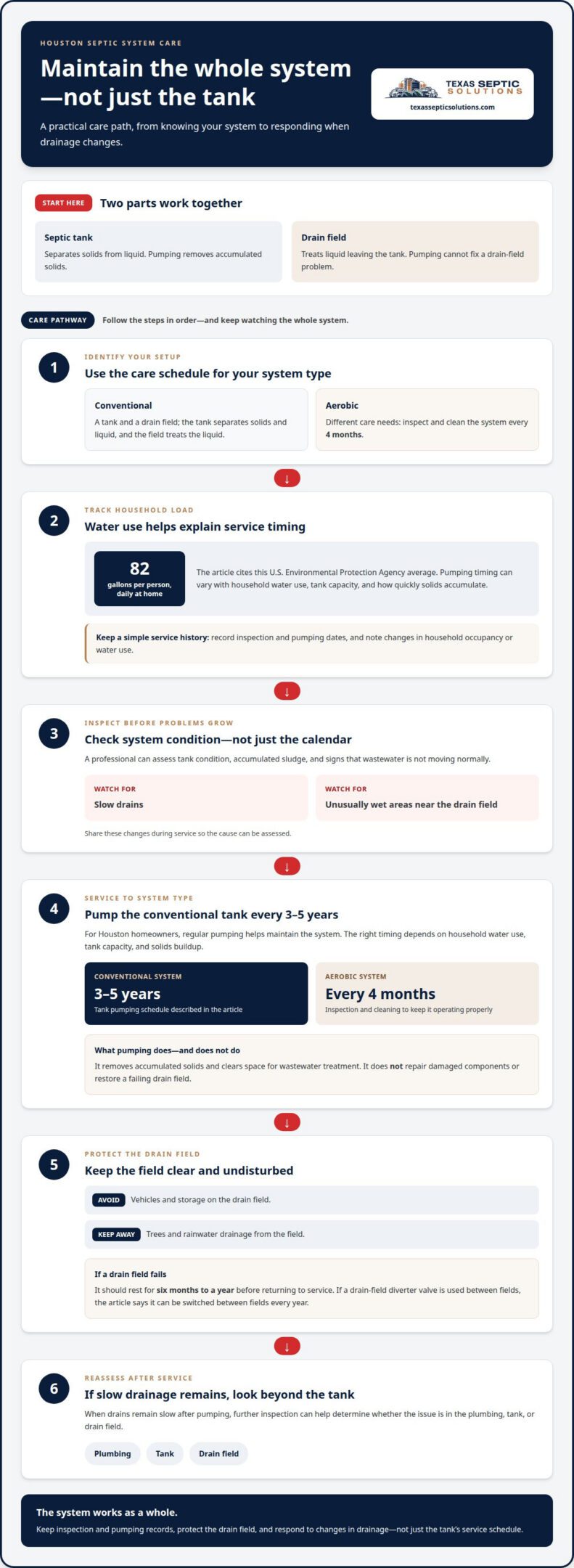
Regular inspections and pumping help a septic system handle wastewater without unnecessary strain. A conventional system typically has a septic tank and a drain field. The tank separates solids from liquid, while the drain field treats liquid leaving the tank. Both need attention: pumping the tank cannot resolve a drain field problem.
For Houston homeowners, pumping every three to five years helps maintain the system. The right timing can depend on household water use, tank capacity, and how quickly solids accumulate. Solids build up over time, and excess buildup can contribute to slow drainage. Each American uses an average of 82 gallons of water daily at home, according to the U.S. Environmental Protection Agency. Tracking household water use can help explain why one home’s tank may need attention sooner than another’s.
Inspect before problems grow
An inspection involves more than checking the pumping schedule. A professional can assess the tank’s condition, accumulated sludge, and signs that wastewater is not moving normally. Slow drains or unusually wet areas near the drain field can signal a developing problem. Share changes in household occupancy or water use, and keep records of past pumping and inspection dates so the system’s service history is clear.
Aerobic systems have different care needs from conventional systems. They should be inspected and cleaned every 4 months to keep them operating properly. Regular service can identify issues before they disrupt treatment. Follow the system’s maintenance requirements rather than applying a conventional tank schedule to every setup.
What pumping does, and what it cannot do
During septic tank pumping, a service professional removes accumulated solids. This clears space for wastewater treatment to continue, but it does not repair damaged components or restore a failing drain field. If drains remain slow after pumping, further inspection can help determine whether the problem is in the plumbing, tank, or drain field.
- Note changes in household use that may affect wastewater volume.
- Keep inspection and pumping records together for easier scheduling.
- Describe slow drainage or wet ground during the service visit.
Drain field care matters after tank service, too. The field removes contaminants from liquid leaving the tank, so avoid treating it as a traffic or storage area. If a drain field fails, it should rest for six months to a year before returning to service. Pumping on schedule, arranging inspections, and responding to drainage changes support the whole system rather than the tank alone.
Some guidance recommends pumping when the distance between the top of the sludge and the bottom of the outlet tee is four inches. A septic drain-field diverter valve can be switched between fields every year. After drain-field failure, it should rest for 6-months to a year before being switched back into service.
Solids accumulate in septic tanks over time and can cause slow drainage. One answer states that a tank may be pumped too often if it is pumped more frequently than every two or three years.
Bacterial additions and bioaugmentation
Septic treatment depends on microbes that break down organic material inside the system. Antibacterial and antimicrobial household cleaning products can kill beneficial bacteria and microbes. For example, frequent use of antibacterial cleaners may affect the biological activity needed to process wastewater. Use cleaning products thoughtfully, and avoid treating strong chemicals as a shortcut to better septic performance.
Bioaugmentation means adding microbes to increase existing biomass, stabilize the biological process, and improve the system’s ability to produce acceptable effluent. It aims to support the microbial population already working in the tank. The idea is different from repairing a cracked component or clearing a blockage: added microbes address biological activity, not physical damage.
Understand what an additive can and cannot address
For an anaerobic septic system, it takes about two years for anaerobic biomass to build up in a septic tank. That gradual development helps explain why a quick dose cannot replace consistent system care. A product added to the tank does not remove accumulated solids, correct a damaged pipe, or restore a drain field that is no longer functioning properly.
Before adding a bacterial product, identify the problem you’re trying to solve. A slow drain, for example, can result from a plumbing restriction or a tank issue rather than a shortage of microbes. If wastewater backs up or the system shows signs of physical failure, additives are not a substitute for diagnosing the cause and arranging repair.
Keep the system’s design in mind. Microbial activity depends on conditions inside the tank and the waste entering it. Repeatedly adding products without understanding the system can distract from practical steps, such as limiting harmful cleaning chemicals and following an established maintenance routine.
- Use antibacterial and antimicrobial cleaners carefully, rather than assuming more cleaning improves septic treatment.
- Keep a note of product use and changes in drainage, so a service professional has useful context.
- Consider bioaugmentation as biological support, not a fix for physical damage or accumulated solids.
Be cautious with household remedies presented as universal solutions. Adding yeast, for instance, does not establish that every septic system needs it or that it will resolve a specific problem. Systems differ, and an additive should not replace an inspection when symptoms persist.
In practical terms, supporting biological performance starts with protecting the microbes already present. Limit exposure to antibacterial products, track symptoms, and distinguish biological concerns from mechanical ones. If a system continues to drain poorly or shows signs of failure, a diagnosis can determine whether it needs maintenance or repair rather than another additive.
Drain field protection
Houston clay soils can drain slowly, while heavy rainfall and flooding can saturate the ground. When soil around a drain field is saturated, it has less capacity to absorb wastewater, which can lead to pooling and strain system performance.
Protect the field by keeping vehicles, trees, and rainwater drainage systems away from it. These safeguards reduce soil compaction, root interference, and excess water flowing across the treatment area. A clear field gives wastewater room to move through the soil rather than collecting at the surface.
Keep traffic and heavy loads off the field
Vehicle tires and heavy equipment press down on soil. Compacted ground has less space for water and air to move, so wastewater may drain poorly. Keep cars, trucks, trailers, and construction equipment off the drain field. Use another route for regular yard access, and do not place sheds or other heavy structures over the treatment area.
Even routine landscaping can add weight. A parked lawn tractor or stacked building materials can put concentrated pressure on the same patch of soil. Mark the drain field on a property plan and share its location with anyone doing yard work. This helps prevent accidental traffic during mowing, deliveries, or home projects.
Manage plants and surface water
Keep trees away from the drain field because roots can grow toward pipes and moisture. Choose shallow-rooted plants for nearby landscaping, and avoid planting deep-rooted trees where roots could reach system components. If a tree already stands close to the field, watch for unusually wet ground or slow drainage.
Direct roof runoff, driveway drainage, and other surface water away from the drain field. A downspout that empties beside the treatment area, for example, can add water where the soil needs to absorb wastewater. Keep drainage routes clear, and avoid grading that directs runoff toward the field. After heavy Houston rain, note whether water repeatedly pools in the same spot.
- Keep vehicles, equipment, and stored materials off the drain field.
- Route downspouts and other drainage away from the treatment area.
- Keep trees and deep-rooted plants away from system components.
- Record recurring pooling or soggy ground for an inspection.
After flooding, avoid driving across saturated ground near the drain field. Tire ruts can compact wet soil and change how surface water flows. Watch for persistent pooling, sewage odors, or wastewater surfacing, and arrange an inspection if these signs appear. Keeping traffic and runoff away helps preserve the soil’s role in treatment, especially during Houston’s heavy rains.
Fats, oils, and grease disposal
Kitchen habits affect what enters a septic system. Keep fats, oils, and grease out of drains, and let them solidify before putting them in the trash.
Household Practices to Prevent Overload and Clogs
Prevent clogs by catching cooking residue before it reaches the sink. After frying, let grease cool and solidify, then scrape it into the trash. Collect liquid cooking oil in a container instead of pouring it down the drain. Wipe greasy pans with a paper towel before washing them to reduce residue entering the plumbing.
Keep food scraps out of the sink, too. Scrape plates into the trash before rinsing, and use a sink strainer to catch scraps that remain. These steps reduce material entering household pipes and the septic tank. During a new kitchen installation, plan for a convenient place to collect cooking grease near the cleanup area.
Products and Chemicals to Avoid
Avoid sending antibacterial and antimicrobial household cleaning products into the system unnecessarily. These products can harm beneficial bacteria and microbes that help process wastewater. Texas on-site sewage facilities are designed to handle human waste, not industrial or hazardous waste or chemicals. Never pour those materials into a household drain.
Check product labels before disposing of cleaning liquids or chemical residues. A sink or toilet is not a safe disposal route for leftover solvents, paint products, or industrial cleaners. Keep them out of septic plumbing, and follow appropriate disposal directions for the product. Household drain use should stay limited to wastewater and ordinary human waste.
Grease causes a different problem from chemicals. As fats, oils, and grease cool, residue can cling to plumbing and collect with other material. Repeating the habit adds residue over time, even if a small amount from one meal seems harmless. Put cooking waste in the trash rather than relying on hot water to carry it away. Hot water may move grease through the drain temporarily, but it does not remove it from the system.
- Collect cooking grease in a container, then dispose of it with household trash.
- Scrape plates and wipe greasy cookware before washing.
- Keep hazardous and industrial chemicals out of septic drains.
- Use antibacterial cleaners carefully to limit harm to beneficial microbes.
If a kitchen drain slows after grease or chemical disposal, stop adding residue and watch for changes in drainage. A persistent clog can affect plumbing and septic operation, and repeated flushing will not remove a blockage. These kitchen routines help prevent avoidable material from entering the system and support steadier wastewater flow.
Septic system types and efficiency
In Houston, septic system owners must have a maintenance contract, and almost all on-site sewage facilities require permits before construction, installation, repair, extension, or other alteration. Texas OSSF work must be performed by a licensed installer or directly by the homeowner when the system serves their single-family residence; anyone paid for any part of the process must be licensed by the state.
System type affects how wastewater is treated, how much space is needed, and which care steps matter. Consider the treatment process alongside the property’s conditions and the system’s actual performance.
How aerobic and anaerobic systems differ
An aerobic septic system uses oxygen to break down waste and includes multiple treatment stages. Aerobic systems are described as more efficient than anaerobic systems and can work well on smaller properties. Their treatment process depends on equipment and components operating as designed, so system-specific maintenance matters.
Anaerobic systems treat waste without the same oxygen-based process. They are less efficient than aerobic systems and require a larger leach field. That space requirement can influence which design fits a property. The available area, soil, wastewater flow, and treatment needs all shape the system choice.
Maintenance, permits, and system changes
Texas OSSF maintenance provider requirements are referenced in 30 TAC §285.91(4). Houston owners need a maintenance contract, and failing to have one is considered a misdemeanor violation. For an aerobic system, inspections and cleaning every 4 months help keep it operating properly. Match maintenance to the system type rather than assuming every design follows the same routine.
For permitted work, almost all Texas OSSFs require a permit before construction, installation, repair, extension, or another alteration. A paid worker must be a licensed state installer. A homeowner may perform the work directly when the system serves their single-family residence. These requirements matter when planning a repair or changing an existing setup.
Repair is appropriate when a diagnosed component problem or damage is affecting performance. Consider an upgrade or replacement when the current system cannot handle the property’s wastewater needs or continues to fail despite appropriate maintenance. Persistent slow drainage, sewage surfacing, or recurring system trouble are reasons to arrange an assessment and determine whether repair or a larger change is needed.
- Confirm the system type before setting its maintenance routine.
- Consider treatment stages, available leach-field space, and wastewater needs when evaluating system fit.
- Plan permits and qualified installation work before altering an OSSF.
If system performance has declined, schedule a septic system assessment to identify whether repair or a system change is the next practical step.
Texas Septic Solutions: New Septic System Installation
Texas Septic Solutions provides new septic system installation for properties that need a system designed for their wastewater needs. If an existing setup has recurring performance problems, septic system repair can address a diagnosed issue, while regular maintenance and pumping support ongoing care.
The right next step depends on how the system is performing. Slow drainage or other changes may call for an assessment before deciding whether maintenance, pumping, or repair is appropriate. For a property that needs a new system, installation is the service to discuss.
Contact Texas Septic Solutions to discuss your septic system’s condition and the service that fits your needs.
Make your next septic decision with confidence
Connect what you’ve noticed at home with the system’s service history. Keep a record of recurring symptoms and changes in household use, then use that context to discuss what the system needs. This can help distinguish routine care from a problem that calls for more attention.
If you’re deciding how to improve septic system efficiency in Houston, Texas Septic Solutions provides installation, septic system repair, inspections, maintenance, and pumping. Serving the Greater Houston area, including Houston, Cleveland, Cypress, Huffman, and Shepherd, the company helps homeowners and businesses address system needs with appropriate service.
Contact Texas Septic Solutions to discuss your septic system and the next practical step. With a clear understanding of its condition, you can move forward with greater confidence.
Frequently Asked Questions
How does a septic system work, and what affects its efficiency?
A septic system separates and treats household wastewater through a tank and a soil-based treatment area. Its efficiency depends on the system design, wastewater volume, and whether components work properly. For homeowners asking how to improve septic system efficiency in Houston, start by matching household water use to the system’s design. For example, running several water-heavy appliances together can send a large flow through the system at once.
How often should septic tanks be inspected and pumped in Houston, Texas?
Residential systems should be inspected annually, and pumping frequency is every three to five years; approximately every 2-3 years is also stated as the average. The right interval depends on tank capacity, household use, and how quickly solids build up. Aerobic systems have a different care schedule, with inspections and cleaning every 4 months. Keeping service records helps track the system’s history and plan future maintenance.
How can homeowners protect septic drain fields from damage and improve drainage?
Keep traffic and excess surface water away from the drain field, and avoid disrupting the soil. Heavy rain can saturate soil around the drain field; avoid parking heavy vehicles over the drain field during wet conditions. Only human waste should be flushed; never flush wipes (even “flushable” ones), paper towels, toilet paper, feminine hygiene products, grease, garbage-disposal food scraps, or harsh chemicals. Garbage disposals increase solid waste; schedule more frequent inspections/pumping if used regularly.
What are the signs of a failing or inefficient septic system?
Warning signs include repeated slow drains, sewage odors, wastewater surfacing, or unusually wet ground near the system. A septic alarm also needs attention. If septic alarm goes off: immediately minimize water use, check circuit breaker, and contact Texas Septic Solutions right away. To improve septic system efficiency in Houston, note where and when symptoms occur, such as a drain slowing after laundry, and share that pattern during service.