
How Often to Pump a Septic Tank with a Garbage Disposal: A 2026 Homeowner Guide
Did you know that flipping your garbage disposal switch can actually double the organic load on your septic system? Most homeowners love the convenience of a disposal, but you’re likely feeling that familiar anxiety whenever you hear those blades grinding. You’ve probably heard conflicting advice from plumbers who say it’s fine and septic pros who warn of total system failure. This leaves you wondering exactly how often to pump a septic tank with a garbage disposal to avoid a massive repair bill or a messy backup in your yard.
It’s a valid concern because that extra food waste can quickly overwhelm your tank’s capacity, especially in the heavy clay soils common across East Texas. In this 2026 guide, we’ll show you exactly how a disposal changes your maintenance schedule and how to prevent expensive drainfield clogs. We’ll cover the latest TCEQ regulations, provide a clear pumping timeline based on your household size, and give you the professional tips needed to use your disposal without risking your home’s functionality. You’ll walk away with a reliable plan to keep your system healthy and your long term costs down.
Key Takeaways
- Understand the “50% Rule” and how un-digested food solids can quickly overwhelm your septic system’s delicate ecosystem.
- Discover how often to pump septic tank with garbage disposal by learning how to adjust the standard Texas maintenance window for your specific household.
- Protect your drainfield from the unique challenges of East Texas clay soil, which can easily become clogged by fine food particles.
- Adopt simple “scrape, don’t grind” habits to minimize solid accumulation and prevent unexpected emergency backups.
- Learn how proactive maintenance serves as an insurance policy for your home’s value and prevents the high cost of premature system failure.
The Impact of Garbage Disposals on Septic Tank Pumping Frequency
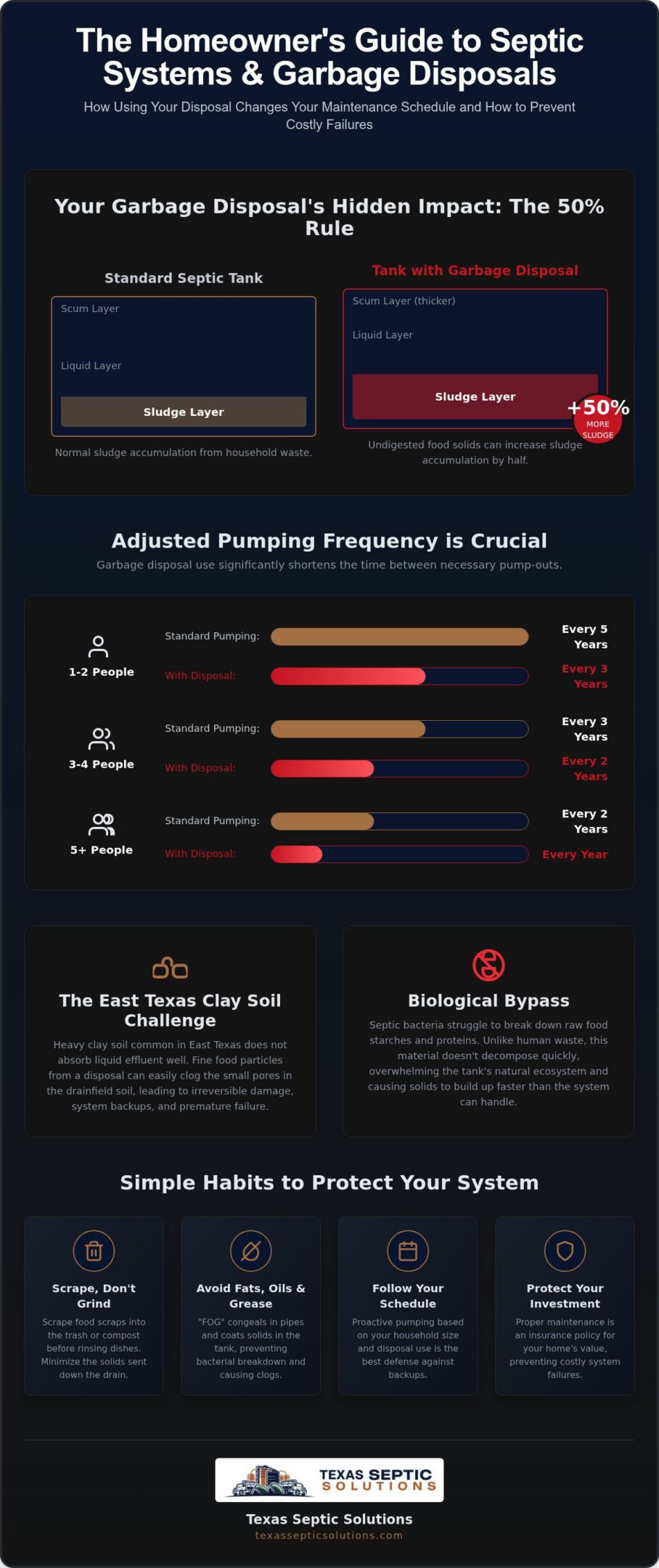
A garbage disposal is a modern convenience, but it changes the fundamental math of your plumbing. When you grind up dinner scraps, you aren’t just sending water down the drain; you’re injecting “un-digested” raw organic matter into a system designed primarily for liquid and pre-processed waste. This creates a significant burden. Most industry experts follow the “50% Rule,” which states that adding a disposal typically increases the rate of sludge accumulation by half. This is the primary reason why homeowners need to reconsider how often to pump a septic tank with a garbage disposal.
Food particles behave differently than human waste. While human waste has already been partially broken down by the body’s digestive enzymes, raw food starches and proteins arrive at the tank “whole.” They don’t decompose as quickly in the anaerobic environment of a standard tank. Additionally, kitchen sinks are a major source of fats, oils, and grease (FOG). These substances can coat food particles, making them even harder for bacteria to reach and break down. Over time, this thickens the layers inside your tank faster than a standard maintenance schedule can handle.
The Science of Sludge vs. Scum Layers
Understanding how a septic system works is key to seeing the danger. In a healthy tank, waste separates into three layers: a top scum layer, a middle liquid layer, and a bottom sludge layer. Ground food particles are problematic because they often stay suspended in the liquid layer longer than heavier solids. This increases the risk of those particles escaping into your drainfield and causing a permanent clog.
Sludge is the heavy layer of solids and food waste that disposals rapidly accumulate at the bottom of your septic tank.
High levels of nitrogen and phosphorus from food can also disrupt the bacterial balance. These nutrients can trigger “blooms” of certain microbes that don’t actually help with waste breakdown, effectively slowing down the natural decomposition process and forcing the tank to fill up sooner than expected.
Biological Bypass: Why Bacteria Can’t Keep Up
Your septic tank is a living ecosystem powered by bacteria. These microbes are efficient at processing waste that has already passed through a human digestive tract, but they struggle with raw food starches, cellulose, and complex proteins. This creates a “biological bypass” where waste sits in the tank without breaking down. The bacteria are essentially overwhelmed by the sheer volume of “new” material they have to process.
You might be tempted to use septic additives or enzymes to speed things up, but these products rarely fix the core issue of excessive solid loading. Bacteria simply can’t keep pace with a high-volume disposal used multiple times a day. If you use your disposal daily, knowing how often to pump a septic tank with a garbage disposal is your best defense against an unexpected and expensive system backup.
Calculating Your New Pumping Schedule: Tank Size vs. Usage
For most Texas homes, the standard baseline for maintenance is a pump-out every three to five years. However, adding a disposal to the mix changes those numbers instantly. When you’re trying to figure out how often to pump septic tank with garbage disposal, you have to account for the fact that you’re essentially asking a system designed for liquids to handle a heavy volume of solids. As a general rule of thumb, you should plan to reduce your pumping interval by one to two years to compensate for the extra sludge.
Household size compounds this impact significantly. A single person using a disposal occasionally won’t see the same sludge buildup as a family of five. In larger households, the disposal is often running after every meal, sending a constant stream of starches and proteins into the tank. If you have a tank smaller than 1,000 gallons, which is common in older Houston or Cleveland area properties, the combination of a high occupant count and a garbage disposal is a high-risk scenario that often leads to premature system failure.
Pumping Frequency Comparison Table
To help you visualize the difference, consider these typical maintenance windows based on average usage. Following these guidelines for septic system maintenance ensures your tank never reaches the “critical mass” point where solids begin to spill into the drainfield.
- 1-2 People: Standard (5 years) vs. With Disposal (3 years)
- 3-4 People: Standard (3 years) vs. With Disposal (1.5 to 2 years)
- 5+ People: Standard (2 years) vs. With Disposal (Annual pumping recommended)
If you fall into the high-occupancy category, don’t wait for a backup to occur. Scheduling regular septic system maintenance is the most cost-effective way to protect your property and avoid the stress of a sudden utility failure.
Signs Your Disposal is Filling Your Tank Early
Your plumbing often provides early warning signs before a total backup occurs. Pay close attention to gurgling sounds coming from the kitchen sink or laundry line, especially right after you run the disposal. This sound usually indicates that air is being trapped by rising sludge levels in the tank. You might also notice slow drainage specifically after running the dishwasher, as these appliances often discharge into the same line as the disposal. Finally, look at your yard. If the grass over the tank or drainfield is suddenly much lusher and greener than the rest of the lawn, it’s a sign that the tank is full and “leaking” nutrient-rich effluent too close to the surface.
Why Garbage Disposals Are “Septic Killers” in East Texas Soil
While national guides provide general advice on how often to pump septic tank with garbage disposal, they often overlook the unique geology of the Houston and Cleveland areas. Our local soil is dominated by dense, heavy clay. Unlike sandy soil that allows water to percolate easily, clay acts like a sponge that holds onto moisture. When you introduce a garbage disposal into this environment, you’re essentially setting a trap for your drainfield. The extra solids don’t just fill the tank; they migrate into the soil and cause permanent damage.
Many homeowners rely on generic charts for calculating pumping frequency, but these don’t always account for the high-solid effluent coming from a kitchen sink. In East Texas, the “fine” food particles produced by a disposal don’t settle at the bottom of the tank as reliably as other waste. Instead, they stay suspended in the liquid and flow out into the drainfield. The intense Texas heat also plays a role by accelerating the fermentation of raw food waste inside your tank. This process creates gases that stir up the settling layers, pushing even more solids toward the exit baffle.
Clay Soil and Particle Clogging
Clay soil lacks the natural porosity needed to filter out high-solid waste. When those tiny food bits enter the perforated pipes of your drainfield, they physically plug the tiny gaps in the soil. Even worse, kitchen waste is often laden with starches and microscopic grease. This grease acts as a “waterproofing” agent, coating the soil particles and preventing them from absorbing water. Over time, this leads to a “biomat” buildup, which is a thick layer of bacteria and slime that eventually seals off the drainfield entirely. Once this happens, a standard septic system repair is often the only way to restore functionality.
The Cost of Ignoring the Texas Soil Factor
Ignoring these local conditions can lead to total system failure, which is a nightmare for homeowners in Cypress and Huffman. While a national average might suggest a long maintenance window, Texas clay requires 20% more drainage area than sandy soil just to handle standard waste. Adding a garbage disposal to a system that’s already working hard against the soil is a recipe for disaster. Local inspections are far more critical than national averages because they account for how your specific soil is responding to the disposal’s load. Staying ahead of the sludge is the only way to protect your property value and avoid the massive cost of a full system replacement.
Maintenance Strategies for Disposal-Heavy Households
Living with a septic system doesn’t have to mean living without modern conveniences. While many online forums suggest you should never use a disposal, we know that isn’t always practical for a busy Huffman or Cypress kitchen. The key is shifting your mindset from using the disposal as a trash can to using it as a last resort. We call this the “Scrape, Don’t Grind” rule. By scraping plates into the trash or compost first, you drastically reduce the volume of solids entering your tank. This simple habit directly influences how often to pump a septic tank with a garbage disposal, potentially saving you from the cost and hassle of annual service.
You also need to watch your water usage during grinding. Many homeowners believe running a heavy stream of water helps the disposal work better. In reality, that extra water can create hydraulic overload. It pushes the recently ground food particles out of the tank before they have a chance to settle, sending them straight to your drainfield. Instead of a high-pressure blast, use a steady but moderate flow of cold water to help the waste settle as sludge rather than staying suspended in the liquid layer.
5 Steps to Safer Disposal Usage
Implementing a few small changes in your daily routine can prevent a major utility failure. Follow these steps to keep your system running smoothly:
- 1. Use cold water only: This keeps fats and grease in a solid state so they can settle into the sludge layer rather than coating your pipes.
- 2. Limit usage: Only use the disposal for small, soft organic scraps that accidentally miss the trash can.
- 3. Avoid fibrous foods: Never put celery, corn husks, or potato peels down the drain; these fibers won’t break down in an anaerobic tank.
- 4. Upgrade your model: Consider installing a septic-assist disposal model that injects helpful enzymes during the grinding process.
- 5. Get expert help: Schedule a septic system maintenance plan to ensure a professional is regularly monitoring your sludge levels.
The Role of the Effluent Filter
If you use a disposal, an effluent filter is your system’s best friend. Think of it as a final security guard. It sits on the outlet pipe of your tank and catches those fine food particles before they can reach the soil. While a high-quality filter might cost around $100, it can prevent a $15,000 drainfield replacement. Because food waste is stickier and more fibrous, you’ll need to clean this filter more frequently. We recommend that our neighbors in Huffman check their filters every six months to ensure proper flow and prevent backups.
If you’re worried about your disposal’s impact on your system, schedule a professional septic inspection today to check your sludge levels and ensure your filter is clear.
Professional Pumping: Protecting Your Texas Property Value
Maintaining a septic system isn’t just about avoiding a backup; it’s a strategic investment in your property’s equity. In real estate markets like Cleveland and Houston, savvy buyers and inspectors look closely at maintenance logs. A home with a documented history of regular care sells faster and for a better price than one with a questionable utility status. When you consider how often to pump septic tank with garbage disposal, remember that this schedule is your best defense against a $20,000 system replacement. Spending a few hundred dollars on a routine pump-out is an incredible ROI compared to the catastrophic cost of a new drainfield.
During a professional visit from Texas Septic Solutions, we do more than just empty the tank. We perform a comprehensive check of the baffles, evaluate the sludge levels, and ensure the effluent filter is clean. This proactive approach identifies small issues before they become expensive failures. While we offer 24/7 emergency service as a safety net, we always tell our customers that consistent maintenance is their true shield against the stress of a failing system. Understanding how often to pump septic tank with garbage disposal helps you stay ahead of these risks before they turn into property-damaging events.
Avoiding the Emergency Call-Out
Holiday gatherings are the most common time for a emergency septic service call. With more people in the house and the garbage disposal running constantly, your system faces peak demand. This is often when “fatbergs,” which are clumps of grease and ground food waste, form in your residential lines and cause immediate backups. A scheduled maintenance history gives you peace of mind that your tank has the capacity to handle these high-load events without failing when you have guests over.
Your Local Septic Experts in Southeast Texas
Our team covers a wide range of Southeast Texas, from the busy neighborhoods in Houston to the rural woods of Shepherd. We understand that local soil conditions and TCEQ regulations vary significantly by county. Staying compliant with your permit requires an expert who knows the specific rules for your area. We take pride in being your neighborly experts, ensuring your home remains a safe and functional sanctuary for years to come.
Schedule your next septic tank pumping with Texas Septic Solutions today!
Secure Your Home’s Future with Proactive Septic Care
Using a garbage disposal doesn’t have to lead to a plumbing disaster, but it does require a smarter approach to maintenance. By understanding how food solids increase sludge and why East Texas clay soil demands faster drainage, you can stay ahead of potential failures. We’ve shown that reducing your pumping interval by just one or two years can save you thousands in long term repair costs. Knowing exactly how often to pump septic tank with garbage disposal is the first step in protecting your property value and your family’s comfort.
At Texas Septic Solutions, we specialize in managing high-load systems in the unique soil conditions of Houston and Cleveland. Whether you need a specialized maintenance plan for your disposal-heavy household or our 24/7 emergency service for a sudden backup, we’re here to help. Our local experts understand the specific challenges of East Texas geology and TCEQ regulations. Don’t wait for your system alarm to go off before taking action. Book Your Septic Pumping Service in Houston & Cleveland today and let our team provide the reliable, professional care your home deserves.
Frequently Asked Questions
Is it ever okay to have a garbage disposal with a septic system?
Yes, it is perfectly fine to have a garbage disposal with a septic system as long as you are proactive with your maintenance. You just need to accept that your tank will accumulate solids much faster than a home without one. Using the disposal sparingly for small, soft scraps and scheduling more frequent pump-outs will keep your system running smoothly without risking a backup.
What are the worst foods to put down a disposal if I have a septic tank?
The worst offenders are fats, oils, grease, and fibrous vegetables like celery, onion skins, or corn husks. You should also avoid starchy foods like pasta, rice, and potato peels because they expand and create a thick sludge that bacteria struggle to break down. These items contribute heavily to the solid waste layer, which directly impacts how often to pump septic tank with garbage disposal to avoid clogs.
Can I use septic-safe additives to avoid pumping more often?
No, septic additives are not a substitute for physical pumping. While some products claim to dissolve solids, they often just break waste into smaller particles that then travel into your drainfield and cause permanent damage. The only way to remove the “un-digestible” food scraps that a disposal introduces is to have a professional pump the tank out on a shortened schedule.
How do I know if my septic tank is full because of the disposal?
You’ll likely notice slow drains in the kitchen, gurgling sounds in your pipes, or foul odors near the tank area. Another telltale sign is a patch of lush, bright green grass over your drainfield, which suggests the tank is overflowing with nutrient-rich food waste. If you’re questioning how often to pump septic tank with garbage disposal, these physical symptoms are your final warning to schedule service.
Does a garbage disposal affect an aerobic septic system differently?
Yes, a garbage disposal can be even more taxing on an aerobic system because it increases the organic load the aerator must process. Excessive food waste can deplete the oxygen levels needed by the “good” bacteria, leading to system failure or clogged spray heads. If you have an aerobic unit, you must be extremely careful with what goes down the drain to keep the mechanical parts functioning.
What is the average cost to pump a septic tank in Cleveland, TX?
The cost to pump a septic tank in Cleveland depends on several factors, including the tank’s total capacity and how deep the access lids are buried. Prices also vary based on the current disposal fees at local treatment facilities. While we can’t provide a flat rate here, a routine pump-out is always a small fraction of the price you’d pay to replace a failed drainfield.
Can a garbage disposal cause my septic alarm to go off?
Yes, a garbage disposal can trigger your septic alarm if the high volume of solids causes a blockage or interferes with the float switches. When sludge levels get too high from food waste, the floats can get stuck or the water can’t move through the tank fast enough, triggering the high-water alarm. If your alarm sounds after a big meal, it’s time to call for a pump-out.
How often should I clean my septic filter if I use a disposal?
You should clean your effluent filter at least every six months if you use a disposal. Food particles are often finer and stickier than other household waste, meaning they clog the small mesh of the filter much more quickly. Regular cleaning prevents these solids from reaching your drainfield soil, which is vital for homeowners dealing with the heavy clay found throughout Southeast Texas.