
How Gray Water Affects Septic Systems in Huffman: A Homeowner’s Management Guide
Imagine walking out to your Huffman backyard after a busy Saturday of laundry and showers, only to find a suspicious, soggy patch of grass right over your drain field. It’s a common sight for many neighbors, but it often leads to the same frantic question: is my household’s “gentle” water actually destroying my expensive septic system? Understanding how gray water affects septic systems Huffman homeowners rely on is the first step toward avoiding a five-figure replacement bill. It’s completely natural to feel overwhelmed by the technical side of wastewater, especially when the health of your property is on the line.
We believe you shouldn’t have to fear your washing machine or shower. This guide will show you how to balance your household’s gray water output to prevent septic failure and protect your property’s value. You’ll gain a clear understanding of what gray water really is, learn actionable steps to reduce daily system stress, and discover exactly when it’s time to call in a professional for maintenance. We’ll provide the local expertise you need to ensure your home remains functional and your lawn stays dry, regardless of how many loads of laundry you have to finish.
Key Takeaways
- Identify which household appliances generate gray water and why high volumes can lead to hydraulic stress on your property.
- Understand how gray water affects septic systems Huffman homeowners use by diluting the beneficial bacteria needed to break down waste.
- Learn how to implement a staggered water usage schedule and high-efficiency upgrades to protect your drain field from saturation.
- Compare the pros and cons of integrated septic systems versus gray water diversion methods to find the best fit for your home.
- Determine when professional pumping and maintenance are required to restore balance and prevent expensive system repairs.
Understanding Gray Water and Your Huffman Septic System
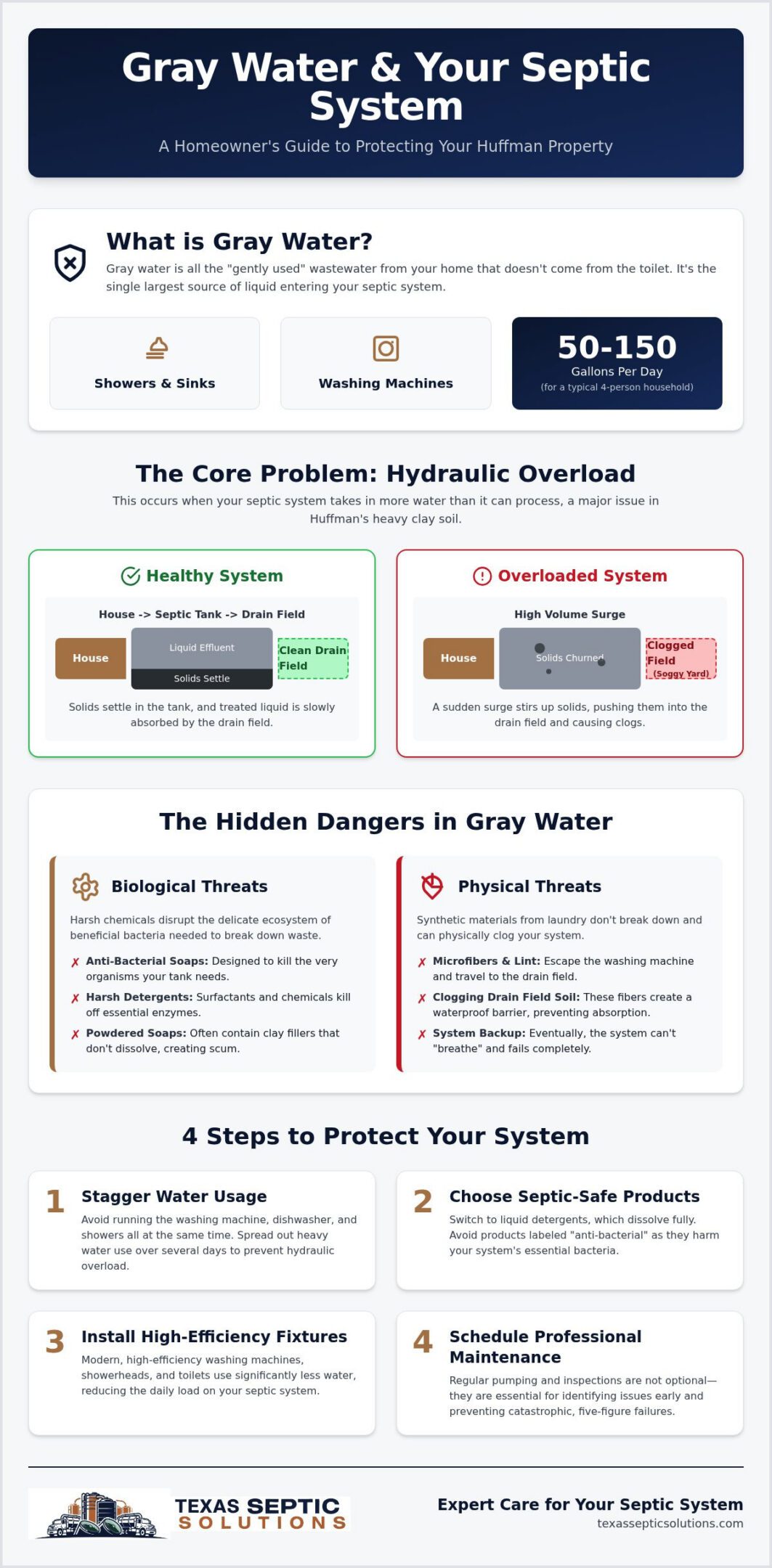
Understanding Gray Water is the first step in protecting your home’s infrastructure. Gray water is the “gently used” wastewater from your showers, bathroom sinks, and washing machines. While it doesn’t contain the high levels of bacteria found in toilet waste, it accounts for the vast majority of the liquid entering your tank. In a standard Huffman home, gray water and black water mix together, requiring the system to process a massive amount of fluid every day. For a typical four-person household, this can mean managing 50 to 150 gallons of gray water daily, according to industry research.
The geography of our area makes this volume especially critical. Because of our proximity to Lake Houston and the heavy clay soil common in East Texas, the ground often struggles to absorb liquid quickly. This local environment directly influences how gray water affects septic systems Huffman families use. When the soil is already damp from high humidity or a Gulf Coast rainstorm, it cannot take on the hundreds of gallons of shower and laundry water your family produces without reaching a breaking point.
Why Gray Water Volume Matters in East Texas
In Huffman, the biggest threat to your septic health is hydraulic overloading. This happens when the sheer volume of water entering the tank exceeds its capacity to filter it. High humidity and heavy rainfall mean our soil often stays saturated. If you run multiple loads of laundry while the ground is already wet, the water has nowhere to go. This surge of liquid stirs up the tank, preventing solids from settling at the bottom. Instead of staying in the tank, those solids get pushed out into your drain field, leading to clogs and soggy patches in your yard.
Common Myths About Gray Water Disposal
Many homeowners believe that gray water is harmless because it’s “just soap.” That’s a dangerous myth. Modern detergents often contain surfactants and chemicals that can interfere with the natural enzymes and bacteria your system needs to break down waste. Another common misconception is that you can pipe laundry water directly into your yard without a permit. While Texas law provides some leeway for small residential systems, Harris County serves as a strict authorized agent for the TCEQ. You generally cannot bypass your system or install diversion lines without following local regulations. Gray water still contains pathogens and organic matter that require proper treatment to keep your property safe and legal.
The Biological and Physical Impact of Gray Water on Septic Health
Your septic tank is more than just a holding vessel; it’s a living biological reactor. For it to function, a specific balance of anaerobic bacteria must thrive to break down solids. When we look at how gray water affects septic systems Huffman homeowners depend on, we have to consider the “Bacterial Flush.” This happens when massive amounts of hot, soapy water enter the tank at once, diluting the natural enzymes and killing off the colonies that digest waste. While there are documented Benefits of Gray Water Reuse for irrigation, allowing too much untreated gray water to surge into your tank disrupts this delicate ecosystem.
Physical debris also plays a major role in system decline. Every time you run the washing machine, thousands of tiny microfibers and bits of lint escape into the system. These synthetic fibers don’t break down. Instead, they float in the gray water and eventually make their way to your effluent filter or, worse, out into the soil of your drain field. Over time, this physical stress creates a waterproof barrier in the soil. This prevents your system from “breathing” and processing liquid correctly, eventually leading to a total backup.
How Soaps and Detergents Kill Your Tank’s ‘Good’ Bacteria
Not all soaps are created equal. Many products labeled “biodegradable” are still harmful to your septic system because they contain surfactants that stay suspended in water too long. Anti-bacterial soaps are particularly destructive. They are designed to kill the very organisms your tank needs to survive. We recommend that Huffman residents switch to liquid detergents. Powdered soaps often contain fillers like clay that don’t fully dissolve, leading to a thick “scum” layer that can clog your intake pipes. If you suspect your tank’s biology is struggling, a professional septic system maintenance check can help identify if your chemical usage is the culprit.
Hydraulic Overload: The Silent System Killer
Hydraulic overload occurs when the volume of water entering your tank is faster than the rate at which it can exit to the drain field. This creates a “stirring” effect. Instead of the heavy solids staying at the bottom and the grease staying at the top, the rushing gray water mixes everything together. This turbulent water carries suspended solids directly into your leach field, where they plug up the pores in the soil. Hydraulic overload is the leading cause of premature drain field failure in Texas. Once the soil is clogged with these displaced solids, the only solution is often an expensive repair or a full system replacement.
Evaluating Gray Water Diversion vs. Septic Integration
Deciding whether to keep your system integrated or install a diversion setup is a major choice for Huffman residents. Most homes in our community use an integrated system where every drop of wastewater flows into a single tank. While this is the standard design, it’s important to understand how gray water affects septic systems Huffman families rely on every day. Adding hundreds of gallons of water from showers and washing machines increases the risk of soil saturation, but separating those flows comes with its own set of technical and regulatory challenges.
For many, the choice comes down to a balance between installation costs and long-term property protection. An integrated system is easier to manage from a plumbing perspective, but a diversion system can act as a safety valve for your drain field. We’ll help you weigh these options so you can make the best decision for your property’s specific needs and soil conditions.
Pros and Cons of Integrated Septic Systems
Integrated systems are popular because they are straightforward. You have one set of pipes, one tank, and a single maintenance schedule to follow. The initial installation cost is lower, and the plumbing is significantly less complex than split systems. However, these setups are highly sensitive to “surge” days. If you do five loads of laundry on a rainy Sunday, you risk flooding your drain field. To keep these systems healthy, following a guide for septic system maintenance Texas homeowners can trust is vital. Regular professional care ensures that the combined load of gray and black water doesn’t lead to a messy, expensive backup.
Is Gray Water Diversion Legal in Huffman, TX?
Diversion systems, like “laundry-to-landscape” setups, can significantly reduce the hydraulic load on your main tank. According to the Oklahoma State University Extension on Gray Water, reusing this water can conserve resources and protect your primary septic components from excessive wear. But legality is a local matter. In Huffman, Harris County acts as the authorized agent for the Texas Commission on Environmental Quality (TCEQ). While state law allows some residential reuse under 400 gallons per day without TCEQ authorization, you must still follow Harris County’s specific permitting and design requirements. DIY diversion is risky; it often leads to environmental contamination and can result in heavy fines from the county.
Upgrading to a professional gray water diversion system can cost between $1,000 and $8,000 depending on the complexity and pumping requirements. For many Huffman property owners, the most cost-effective strategy is sticking with an integrated system but investing in high-efficiency fixtures and consistent pumping. Maintaining one robust system is usually simpler and more affordable than managing two separate infrastructures. If your current system is struggling with water volume, a professional evaluation can determine if a repair or a specialized diversion is the right path forward for your home.
Managing Gray Water: A Guide for Huffman Residents
Managing wastewater in Huffman requires a more strategic approach than in drier parts of Texas. Because our local soil is often saturated or composed of heavy clay, the “dump and forget” method simply doesn’t work. Understanding how gray water affects septic systems Huffman homes rely on means realizing that your system has a daily “speed limit.” If you exceed that limit, the water won’t drain, and your yard will pay the price. Proactive management isn’t just about saving your tank; it’s about protecting your property’s long-term value.
Effective management starts with visibility. You should regularly walk your drain field to look for “ponding” or unusually lush patches of grass. These are early warning signs that your soil is struggling to keep up with the gray water volume. Installing a septic filter is another professional-grade move. This small device sits in the outlet pipe and catches laundry lint, hair, and debris before they can reach the soil. It’s a simple barrier that prevents the physical clogs we discussed earlier.
Optimizing Your Laundry and Shower Schedule
Surges are the primary enemy of a healthy septic system. We recommend the “one load per day” rule for laundry. Spacing out your chores gives the drain field time to rest and process the liquid. If you have guests visiting, remind them to keep showers short. High-efficiency, low-flow showerheads are an inexpensive upgrade that can save dozens of gallons per day. These small changes prevent the hydraulic overload that forces solids out of the tank and into your yard.
Choosing the Right Products for a Healthy Tank
The chemicals you pour down the drain determine the biological health of your system. Huffman households should look for “septic-safe” labels, but don’t stop there. Choose liquid detergents over powders, and avoid products containing high levels of phosphorus or harsh surfactants. Fabric softeners and bleach should be used sparingly, as they can coat the tank’s interior and kill beneficial bacteria. To keep your system running at peak performance, we suggest a professional septic filter cleaning service as part of your routine upkeep. This ensures that the gray water debris you’ve successfully trapped doesn’t eventually lead to a backup.
If your system is showing signs of stress after a heavy rain or a busy weekend, don’t wait for a total failure. Reach out for a professional septic system maintenance check to ensure your home’s infrastructure is ready for whatever the Texas weather throws at it.
Professional System Optimization: Protecting Your Huffman Property
While daily management habits are your first line of defense, professional pumping remains the only effective way to “reset” a system that has been under consistent hydraulic stress. When you understand how gray water affects septic systems Huffman residents own, you realize that even “gentle” water can churn up the tank’s contents. Over time, this turbulence carries fine particles toward the outlet. Professional pumping removes the sludge and scum layers before they can be pushed into the drain field, giving your system the clean slate it needs to process wastewater efficiently again.
Specialized repairs are often necessary when gray water debris has already caused physical damage to your home’s infrastructure. If your effluent filter is constantly clogging or your drain field has become compacted from years of laundry lint, simple habit changes aren’t enough to fix the problem. We focus on identifying the root cause of system failure, whether it’s a broken baffle or a saturated leach field. By addressing these issues early, we help you avoid the five-figure costs associated with a total system replacement.
When to Call for Professional Septic Repair
Identifying “gray water red flags” early can save your yard and your wallet. Watch for gurgling sounds in your pipes, slow drains in the laundry room, or persistent dampness over the tank area. These aren’t just minor plumbing quirks; they’re signs that your system is struggling to keep up with the incoming volume. If your septic tank alarm is going off, it’s a critical situation that requires immediate professional attention. Ignoring these early warnings of drain field saturation allows solids to migrate deeper into the soil, eventually leading to a total backup.
The Texas Septic Solutions Advantage in Huffman
We understand that septic issues don’t follow a 9-to-5 schedule, especially after the heavy rainstorms common in East Texas. Our team provides 24/7 emergency response for critical backups in the Huffman area, ensuring you’re never left stranded with a non-functional system. Our comprehensive inspections look specifically at hydraulic load issues, analyzing how your household’s water usage patterns interact with the local soil. We don’t just pump and leave; we provide a roadmap for long-term property protection. Contact Texas Septic Solutions today for a professional system evaluation and let us help you optimize your home’s most vital utility.
Take Control of Your Home’s Septic Health Today
Protecting your property starts with a clear understanding of how gray water affects septic systems Huffman residents rely on daily. We have explored how volume surges and chemical choices can either preserve or punish your drain field. By staggering your laundry, choosing the right soaps, and monitoring for early warning signs like soggy grass or slow drains, you can prevent the most common causes of system failure. These simple shifts in your household routine provide a strong foundation for a long-lasting, functional utility system.
However, even the best household habits sometimes need a professional boost. Texas Septic Solutions is here to help with expert local knowledge of Huffman’s specific soil and climate challenges. Whether you need a routine pumping to reset your tank or a comprehensive maintenance plan to prevent future issues, we are your neighborly experts. We even offer 24/7 emergency service for those unexpected backups that often follow heavy East Texas rains. Schedule your Huffman septic inspection with Texas Septic Solutions today! Taking these proactive steps now ensures your system stays functional and your property value remains protected for years to come.
Frequently Asked Questions
Can gray water from my washing machine go directly into my yard in Huffman?
You cannot legally discharge washing machine water directly onto the ground in Huffman without a professional design and a permit from Harris County. While Texas law allows some gray water reuse for residential irrigation, it must meet strict standards to prevent health hazards. Discharging untreated laundry water can lead to soil contamination and environmental fines. It’s always best to consult with a local expert before attempting to bypass your integrated septic system.
How often should I pump my septic tank if I have a large family?
Large families should typically schedule professional pumping every two to three years to prevent solids from reaching the drain field. Because more people generate a higher volume of wastewater, the tank fills with sludge and scum much faster than a small household. Regular maintenance is the most effective way to manage how gray water affects septic systems Huffman properties rely on, ensuring the tank doesn’t overflow during high-usage periods like holidays.
Do septic-safe detergents really make a difference for my drain field?
Septic-safe detergents are vital because they lack the harsh surfactants and high phosphorus levels that disrupt the tank’s biology. Standard detergents can stay suspended in water longer, carrying grease and chemicals directly into your drain field soil. Over time, these chemicals create a waterproof layer that prevents the ground from absorbing liquid. Switching to liquid, septic-safe options protects the longevity of your soil’s absorption capacity and prevents premature system failure.
What are the signs that gray water is overloading my septic system?
The most common signs of hydraulic overload include slow-draining sinks, soggy patches of grass over the drain field, and sewage odors near the tank. You might also notice that your drains gurgle when the washing machine discharges. These symptoms indicate that the volume of gray water is entering the system faster than the soil can process it. If you see these red flags, it’s time to schedule a professional inspection to prevent a total backup.
Is it worth installing a separate gray water tank in Texas?
Installing a dedicated gray water tank can be a significant investment, often ranging from $2,000 to $8,000 for complex systems. For many Huffman homeowners, it’s more cost-effective to invest in high-efficiency appliances and regular pumping of their existing integrated system. However, if your property has very poor soil drainage or a high water table, a separate diversion system might be the only way to protect your primary drain field from constant saturation.
Can I use bleach in my laundry if I have a septic system?
You can use bleach in small, infrequent amounts, but excessive use will kill the beneficial bacteria in your septic tank. A single large load with heavy bleach can wipe out the microbial colonies responsible for breaking down solids. If you must use bleach, try to space out those laundry loads over several days. This allows the tank’s ecosystem time to recover and prevents untreated waste from exiting the system and clogging your leach field pipes.
What happens if I ignore a gurgling drain or slow-flushing toilet?
Ignoring these early warning signs usually leads to a complete system failure and much higher repair costs. A gurgling drain is often the first signal that your tank is full or your drain field is saturated with gray water. If left unaddressed, the wastewater will eventually back up into your home’s lowest drains, such as showers or tubs. We provide 24/7 emergency service to handle these critical situations, but early maintenance is always the more affordable path.
How does heavy Huffman rain affect my gray water disposal?
Heavy rain saturates the Huffman soil, leaving no room for your septic system to discharge household gray water. When the ground is already soaked, any additional water from showers or laundry has nowhere to go. This illustrates how gray water affects septic systems Huffman residents manage during the wet season. During periods of heavy rainfall, it’s critical to minimize indoor water usage to reduce the hydraulic load and give your drain field time to recover.