
Houston Landlord Guide: Explaining Septic Care to Tenants
It’s 2 AM on a humid Houston Tuesday when your phone buzzes with the call every landlord dreads. The guest bathroom is overflowing, your tenant is panicking, and you’re already mentally calculating the cost of an emergency repair. Most tenants moving into the Houston area are used to city sewers where everything disappears forever with a single flush. They don’t realize that our local “black gumbo” clay makes septic health a delicate balance. It’s stressful to trust a five-figure investment to someone who might not know the difference between a “flushable” wipe and actual toilet paper.
We understand that frustration, but the right approach can turn a confused renter into a proactive partner. This guide covers exactly how to explain septic system care to tenants Houston landlords can trust to protect their infrastructure. You’ll learn the communication strategies, essential lease addendums, and educational tools needed to keep your system running smoothly. We’ll walk through a clear plan to ensure your tenants respect the tank as much as you do, reducing the risk of backups and keeping your maintenance costs predictable.
Key Takeaways
- Shift your tenant’s mindset from a city sewer perspective to a “living ecosystem” model to prevent accidental system damage.
- Master the specific “Welcome Home” talk track for how to explain septic system care to tenants Houston landlords use to ensure long-term compliance.
- Implement “micro-education” tools like sink-side signage and clear lease addendums to protect your liability and reduce maintenance confusion.
- Prepare your renters for Houston’s “black gumbo” soil challenges by providing clear protocols for water usage during heavy rain and tropical storms.
- Leverage professional maintenance plans to offload the burden of monitoring and catch small issues before they become five-figure replacement bills.
The “City Sewer” Mindset vs. Houston Septic Reality
Most tenants arriving in suburbs like Cypress or Huffman are used to municipal systems. In the city, you flush and forget. The wastewater travels miles away to a treatment plant managed by the city. On a septic property, that treatment plant is buried in the backyard. When deciding how to explain septic system care to tenants Houston landlords often find that education is the best defense against a midnight emergency. You aren’t just giving them a list of chores; you’re helping them understand a living, biological ecosystem.
Understanding how a septic system works is the first step for any renter. Unlike a city sewer pipe, a septic tank is an “invisible asset.” It is often the most expensive utility on the property. If it fails, the home becomes uninhabitable quickly. Reframing this as a shared responsibility helps the tenant feel like a partner in home maintenance rather than a child being told what to do. Clear communication ensures their daily comfort remains uninterrupted.
Why “Flush and Forget” Doesn’t Work in East Texas
A healthy septic system relies on billions of microscopic bacteria to break down solids. These tiny workers are the engine of the tank. In a city apartment, a tenant might use heavy bleach or industrial drain cleaners without a second thought. In a Houston septic system, those harsh chemicals kill the “good” bacteria instantly. When the bacteria die, solids don’t break down, the tank fills too fast, and the drainfield clogs.
Help your tenants connect their habits to their own comfort. A dead system doesn’t just cost money; it creates foul odors and slow-draining tubs. Nobody wants to deal with a backup during a summer heatwave. By choosing septic-safe cleaners, tenants ensure their own home stays fresh and functional.
The Financial Stakes for Houston Property Owners
The drainfield is the most sensitive part of the infrastructure. In the heavy clay soils found around Cleveland and Shepherd, drainage is already a challenge. One weekend of negligence, such as hosting a large party with excessive flushing or pouring grease down the sink, can saturate the soil. This leads to weeks of repair downtime and significant stress for everyone involved.
We recommend positioning a septic system maintenance plan as a major benefit for the tenant. It means a professional is regularly checking the system so the tenant doesn’t have to worry about it. When you show them that you are investing in the system’s health, they are more likely to respect the rules you’ve set in place. It turns a potential conflict into a collaborative effort to keep the property in top shape.
The “Welcome Home” Talk Track: Explaining the Why
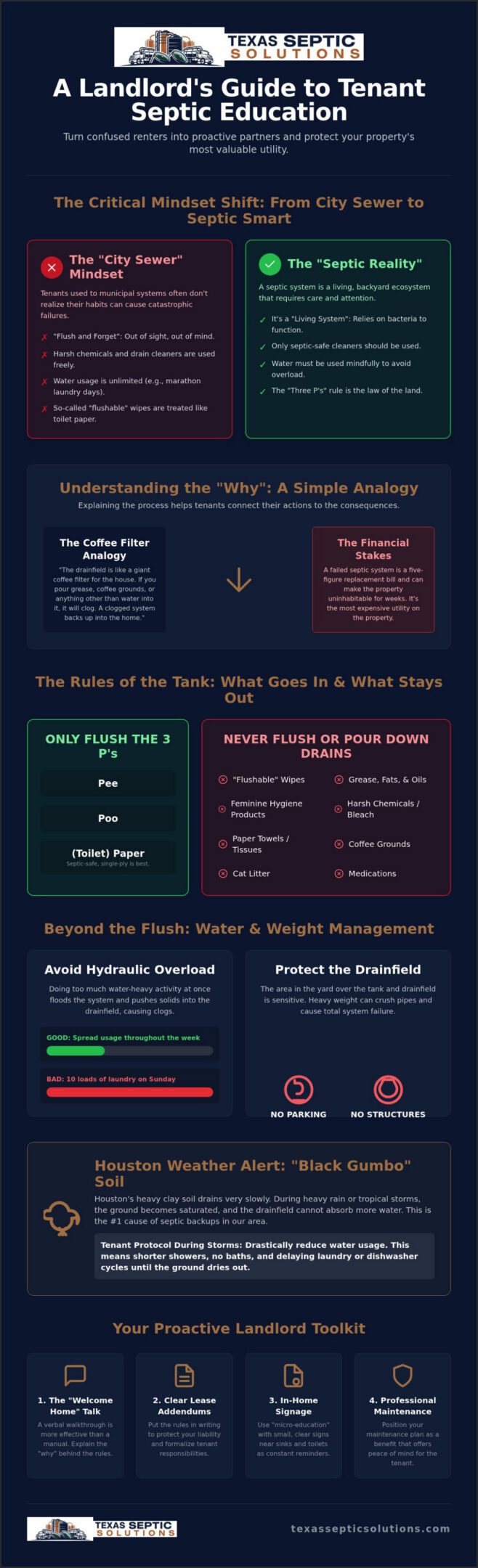
Handing a tenant a thick manual at move-in is a passive approach that rarely works. Most people won’t read it. Instead, you need a verbal walkthrough that focuses on the “why” behind the rules. When you are deciding how to explain septic system care to tenants Houston landlords should treat the orientation like a guided tour of the property’s most vital organ. Start with the “Three P’s” rule: only Pee, Poo, and (toilet) Paper go down the drain. It is a simple, memorable, and non-negotiable standard for every person in the house.
To help them visualize the mechanics, use the “Coffee Filter” analogy. Tell your tenants that the drainfield is like a giant coffee filter buried in the yard. If they pour mud or coffee grounds into a filter, the water can’t pass through. If the filter clogs, the wastewater overflows. This simple visual helps them understand the importance of septic system maintenance as a way to keep that filter clean and functional.
Water volume is the next critical topic. Explain the concept of “Hydraulic Overload.” Doing ten loads of laundry on a single Sunday floods the tank with more water than the soil can absorb at once. This pressure can push solid waste out into the drainfield. Encourage them to spread laundry and heavy water use throughout the week. Finally, walk them outside and point out the tank lids. Explain that parking a vehicle or placing a heavy “above-ground” pool over the tank can crush the pipes and lead to a total system failure.
Explaining Aerobic Systems and Alarms
In many Houston suburbs like Cypress, rental properties use aerobic systems. These systems are more complex and include a control box with an alarm. You must teach your tenant how to respond if the septic tank alarm goes off. Usually, this is a high-water warning. Tell them they can hit the “Mute” button to stop the buzzing, but they must notify you immediately. It is never a “fix it later” situation; it is an early warning that prevents a full-blown backup.
The Kitchen Education: Grease and Garbage Disposals
Garbage disposals are often the primary cause of tank failure in rental units. Provide a simple rule: “If you can’t eat it, don’t drain it.” Explain that Fats, Oils, and Grease (FOG) create a concrete-like layer in the tank that reduces capacity. If you’re ever unsure about your system’s current capacity, reaching out for a professional septic pumping service can prevent these issues from escalating. This proactive approach keeps the kitchen running and your investment protected.
Essential Tools for Tenant Education: Signage and Leases
While a verbal walkthrough establishes a solid foundation, physical tools and clear documentation provide the daily reminders a tenant needs. When figuring out how to explain septic system care to tenants Houston property owners should focus on “micro-education.” These are small, non-intrusive cues placed at the point of action. For example, providing a “Tenant Septic Kit” as a move-in gift is a neighborly gesture that serves a functional purpose. Include a pack of high-quality, septic-safe toilet paper and a list of approved household cleaners. This removes the guesswork for the renter and ensures only safe products enter your tank from day one.
Documentation is equally vital for protecting your investment. During the initial move-in inspection, take clear photos of the drainfield and tank area. Show these to the tenant and explain that this specific zone must remain clear of heavy vehicles, trailers, or temporary structures like portable pools. By documenting the yard’s condition and explicitly pointing out the “no-go” zones, you create a visual boundary that is much harder to ignore than a simple verbal request.
Visual Aids and Bathroom Signage
Simple signage is one of the most effective ways to educate your rental guests and long-term tenants alike. A small, professionally printed sign in the guest bathroom can save you thousands in repair costs. A sample sentence might read: “This home runs on a septic system; please only flush toilet paper.” We also recommend taping a comprehensive “Do Not Flush” list inside the cabinet door of every bathroom and the kitchen sink. This list should include common offenders like wipes, feminine products, and cigarette butts. Finally, walk the tenant to the “clean-out” pipe outside. When they know where the system connects to the house, it becomes a tangible part of the property they need to respect.
The Septic Addendum: Defining Responsibilities
A well-drafted lease addendum is your primary tool for liability protection. It shouldn’t be scary, but it must be specific. Clearly define the difference between routine maintenance, which you might cover, and “negligence-based” pumping or repairs caused by the tenant. For instance, if a technician finds a toy or a bundle of wipes in the baffle, the cost should fall on the tenant. Your addendum should also require tenants to report any leaks, slow drains, or system alarms within two hours. Encourage them to consult a septic system repair guide to recognize early warning signs. This prompt reporting allows you to dispatch a professional before a small clog turns into a major property failure.
Houston Weather Challenges: Heavy Rain and Drainage
Houston is famous for its “black gumbo” soil. This heavy clay is a nightmare for drainage because it acts more like a brick than a sponge. When it rains, the clay expands and stops absorbing water. For a tenant used to city living, a heavy downpour is just a reason to stay inside and perhaps do some laundry. For a septic owner, it’s a period of high risk. Part of knowing how to explain septic system care to tenants Houston landlords must master involves preparing them for our specific local climate. If the ground is saturated, the wastewater from the house has nowhere to go, which can lead to immediate backups.
One of the most dangerous mistakes a tenant can make during a flood is requesting a tank pump-out while the yard is still underwater. You must explicitly forbid this in your communication. When the ground is heavy with water, an empty septic tank becomes a giant buoy. The hydrostatic pressure can actually push the tank out of the ground, severing pipes and causing thousands of dollars in structural damage. Tell your tenants that if the yard is flooded, they must wait for the water to recede before any pumping occurs.
Managing Surface Water in Cleveland and Huffman
In areas like Cleveland and Huffman, large lots often have varying elevations that can direct rainwater toward the drainfield. Educate your tenants on the importance of keeping gutters and downspouts pointed away from the septic area. If they notice new “soggy spots” or standing water over the tank after a typical Houston rain, they need to report it immediately. This could indicate a grading issue or a saturated field. Additionally, remind them that while the yard is wet, they must never drive ATVs, lawnmowers, or heavy equipment over the drainfield. The weight of these vehicles can compact the wet clay, permanently destroying the soil’s ability to treat wastewater.
The “Flood Protocol” for Rental Tenants
When a tropical storm or a major Houston downpour hits, your tenants should follow a specific “Flood Protocol.” The goal is to reduce the load on the system until the soil can breathe again.
- Reduce indoor water usage by at least 50% during the storm.
- Avoid using the dishwasher or washing machine until the yard is no longer squishy.
- Limit showers to five minutes and skip any unnecessary flushes.
If the system alarm sounds during a storm, it often means the tank is taking on groundwater. In these cases, it is vital to know when to call for emergency septic service versus waiting for the rain to stop. If you are facing a weather-related backup right now, contact Texas Septic Solutions for immediate professional guidance.
Professional Support: Partnering with Texas Septic Solutions
Even the most thorough education plan needs a professional safety net. Landlords have enough on their plates without having to inspect tank baffles or monitor sludge levels themselves. Partnering with a local expert allows you to step back from the role of “septic police” while still protecting your investment. We take the lead on technical maintenance so you can focus on the business of property management. When considering how to explain septic system care to tenants Houston property owners should view a professional service plan as the final piece of the puzzle. It shifts the burden of technical oversight to a team that understands the specific soil conditions of Cypress, Shepherd, and the surrounding Texas Gulf Coast.
Turning tenant education into a long-term property protection strategy requires more than just a move-in talk. It requires a consistent presence that reinforces the rules you’ve set. By having a professional team handle the dirty work, you demonstrate to your tenants that the septic system is a high-priority asset. This professional oversight encourages them to stay diligent with their own habits, knowing that the system is being monitored by experts who will notice if things aren’t right.
Routine Pumping and Inspection Schedules
Regular inspections are the only way to catch tenant abuse before it leads to a total system failure. During a routine visit, our technicians can spot signs of excessive grease or non-flushable materials that a tenant might not even realize they are using. This proactive approach identifies small issues while they are still manageable repairs rather than catastrophic replacements. Beyond immediate protection, keeping detailed maintenance records is essential for insurance claims and maximizing property resale value. We recommend scheduling your 2026 inspection early in the year. This ensures your system is optimized before the peak Houston summer heat puts extra strain on the biological processes in the tank.
24/7 Emergency Peace of Mind
Even with the best training, accidents happen. A guest might flush something they shouldn’t, or a heavy rain might trigger a high-water alarm. Providing our 24/7 contact information on a fridge magnet gives your tenants a direct line to help, preventing them from making “DIY” mistakes that could worsen the problem. Our rapid response teams serve rental properties across Houston, Cleveland, and Huffman, ensuring that a midnight backup doesn’t turn into a week-long disaster. By combining tenant education with professional oversight, you create a comprehensive defense for your property’s most expensive utility. Protect your rental property today with a professional maintenance plan from Texas Septic Solutions.
Protecting Your Rental Investment for the Long Term
Managing a rental property with a septic system doesn’t have to be a source of constant anxiety. By shifting your tenant’s perspective from a “flush and forget” city mindset to one of biological stewardship, you prevent the most common causes of system failure. Using physical tools like bathroom signage and detailed lease addendums provides the daily reminders needed to keep your infrastructure healthy through every season. Mastering how to explain septic system care to tenants Houston landlords can trust is the first step toward a worry-free property.
The most effective strategy is pairing tenant education with professional oversight. Texas Septic Solutions offers 24/7 emergency service for Houston landlords and has deep expertise in managing the “black gumbo” clay soils unique to our region. We provide comprehensive maintenance records that protect your liability and property value. Get a Professional Maintenance Plan for Your Houston Rental Property and gain the peace of mind you deserve. Your property is a major investment; let’s keep it running smoothly together.
Frequently Asked Questions
Can I charge my tenant if they flush “flushable” wipes and break the septic system?
Yes, you can typically charge a tenant for repairs caused by negligence if your lease includes a specific septic addendum. When a technician finds “flushable” wipes or feminine products clogging the baffle, it is clear evidence of misuse. These items do not break down like toilet paper and can cause immediate backups. Keep the technician’s report and photos as documentation for your security deposit claims to ensure the tenant remains accountable for their habits.
How often should a rental property septic tank be pumped in Houston?
Most Houston area rental septic tanks require pumping every 3 to 5 years, though high-occupancy homes may need it more often. For aerobic systems common in Cypress and Huffman, Texas law requires inspections three times per year. Regular pumping prevents solids from escaping into the drainfield, which is vital in our local clay soil. Staying on a strict schedule is the best way to avoid a five-figure replacement bill caused by simple maintenance neglect.
Should I allow my tenants to use a garbage disposal with a septic system?
We strongly recommend disabling or removing garbage disposals in septic-reliant rentals. Disposals send finely ground food waste into the tank, which does not break down as easily as human waste. This leads to rapid sludge buildup and can overwhelm the bacteria in your system. Instead, encourage tenants to use sink strainers and compost their food scraps. It’s a simple change that significantly extends the life of your expensive septic infrastructure.
What is the most important thing to tell a tenant moving from the city to a septic home?
The most critical lesson is that a septic system is a living biological treatment plant, not a bottomless city sewer pipe. When deciding how to explain septic system care to tenants Houston landlords should emphasize that everything flushed stays on the property. Teach them the “Three P’s” rule: only pee, poo, and paper. This simple mindset shift helps city-dwellers understand why they cannot use the toilet as a trash can for wipes or chemicals.
How do I know if my tenant is abusing the septic system before it fails?
Routine professional inspections are your best early warning system. During a maintenance visit in Cleveland or Shepherd, a technician can measure sludge levels and check the health of the bacteria. If the tank is filling too quickly, it often suggests the tenant is using too much water or flushing prohibited items. Look for “lush” green grass over the drainfield or slow-draining sinks, as these are common signs that the system is struggling under current usage.
What should my Houston tenant do if the septic yard area is flooded after a storm?
Your tenant must immediately reduce water usage by 50% until the ground dries out completely. Saturated “black gumbo” clay cannot absorb wastewater, so every gallon sent down the drain during a flood risks a backup. Instruct them to skip laundry and limit showers to five minutes. Most importantly, warn them never to request a pump-out while the yard is underwater. An empty tank can float and pop out of the ground, causing massive structural damage.
Are there specific cleaners I should tell my tenants to avoid?
Instruct your tenants to avoid industrial-strength drain cleaners, high concentrations of bleach, and excessive antibacterial soaps. These chemicals are designed to kill germs, but they also destroy the beneficial bacteria that break down waste in your tank. Advise them to use “septic-safe” labeled products or natural alternatives like vinegar and baking soda. Keeping the bacterial colony healthy ensures the system functions efficiently and prevents foul odors from developing around the rental property.
What does it mean if the septic alarm goes off in my rental house?
A septic alarm usually signals a high water level in the tank or a pump failure. Tell your tenant to press the “Mute” button to stop the noise, but emphasize that the situation is an immediate priority. They should stop all non-essential water use and notify you right away. Because these issues can lead to a home backup within hours, we provide 24/7 emergency septic service to handle these critical failures for landlords across the Houston area.