
Houston Gov Septic Pumping: 2026 Compliance Guide
What happens to public trust when a high-capacity septic system fails during a major Houston event? For facility managers, the answer is a logistical and public relations nightmare that no one wants to face. Managing septic tank pumping for government facilities Houston requires more than just a scheduled truck; it demands a strategic partner who understands the high stakes of public infrastructure. You already know that keeping these systems running is about more than just waste management. It’s about protecting the health of the community and the integrity of the facility itself.
We understand that navigating the updated 2026 TCEQ reporting requirements while trying to avoid service disruptions is a constant balancing act. It’s stressful to coordinate maintenance around public hours, especially when the risk of a backup is always looming. This guide provides a comprehensive reference for maintaining your high-capacity systems while meeting every strict Texas safety standard. We’ll walk you through the updated compliance landscape, show you how to achieve zero-downtime waste management, and explain why a 24/7 emergency response plan is your most important safety net for public safety.
Key Takeaways
- Understand the critical differences between high-traffic municipal loads and standard residential systems to ensure your infrastructure remains healthy.
- Streamline your audit process by mastering the specific TCEQ Chapter 285 documentation required for septic tank pumping for government facilities Houston.
- Implement strategic scheduling for off-peak hours to maintain public facility operations without the risk of service disruptions or backups.
- Evaluate commercial vendors based on the strict bonding and insurance standards necessary for working on restricted or secure government property.
- Build a long-term maintenance partnership with a local authority that provides 24/7 emergency support as a safety net for your community.
The Critical Role of Septic Tank Pumping for Government Facilities
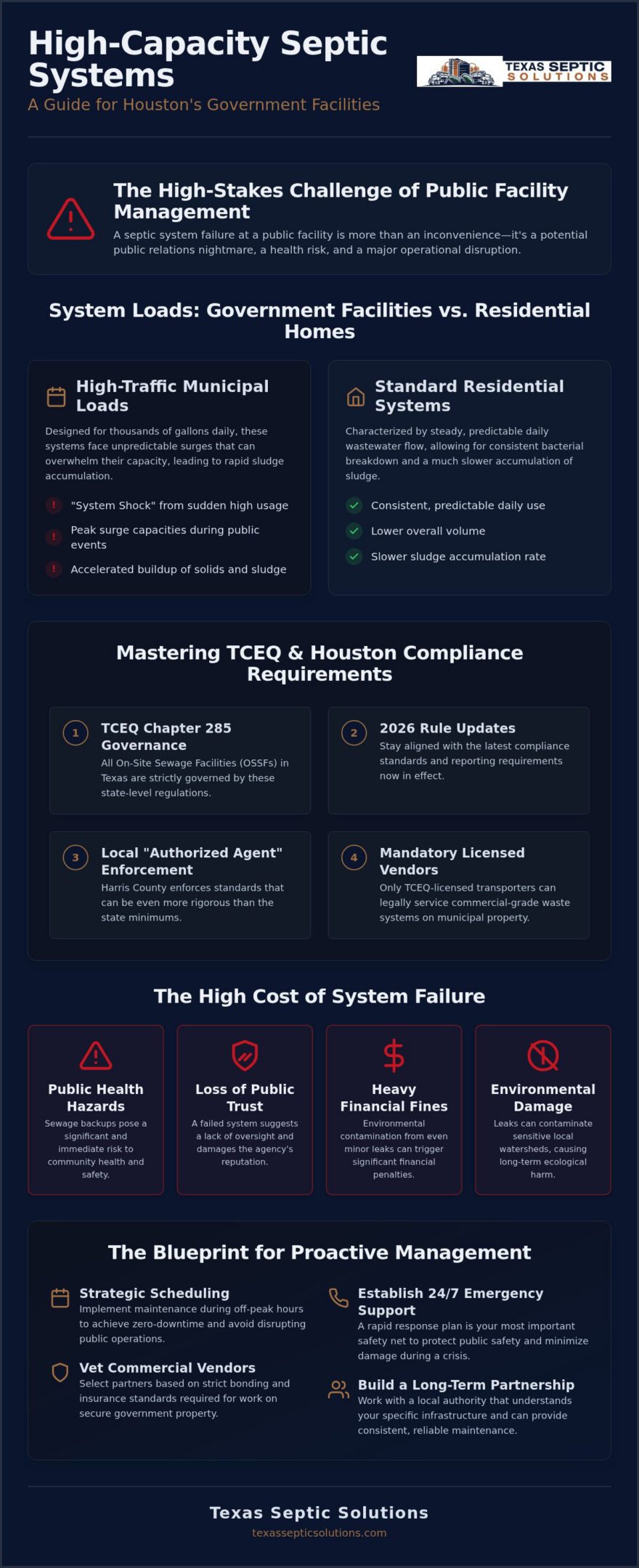
Managing waste at a municipal level isn’t like keeping up with a three-bedroom ranch. Government-scale septic management deals with high-traffic infrastructure designed to handle thousands of gallons of effluent daily. Whether it’s a county administrative building in Cypress or a regional park in Huffman, these systems face pressures that residential units never encounter. Understanding how septic systems work at this scale is the first step in preventing a public works disaster. Routine septic tank pumping for government facilities Houston ensures that high-volume usage doesn’t lead to premature system failure or environmental hazards.
In areas like Cleveland and Shepherd, government sites often rely on high-capacity systems that accumulate sludge at an accelerated rate. When thousands of people use a facility over a weekend, the biological processes inside the tank can’t always keep pace. Professional pumping becomes a non-negotiable public health requirement. It’s the only way to guarantee that the system remains functional and safe for the community it serves.
High-Traffic vs. Residential Load Factors
Public facilities don’t have steady, predictable waste streams. A municipal building might be relatively quiet on a Tuesday but packed during an election or a public hearing. This creates what we call “system shock.” It’s a scenario where a sudden influx of wastewater disrupts the natural bacterial breakdown process. Pumping frequency must be calculated based on these peak surge capacities rather than average daily use.
If sludge levels get too high, a surge of water will push solids directly into the drain field. In the heavy clay soils common around the Greater Houston area, this leads to immediate and expensive soil clogging. Calculating the right service interval requires looking at several factors:
- Surge Capacity: The maximum volume the system can handle during peak events without overflowing.
- Visitor Fluctuations: Seasonal peaks in park attendance or administrative deadlines.
- Sludge Accumulation: The rapid buildup of non-biodegradable materials common in public restrooms.
Public Health and Liability Management
A sewage backup in a public-facing facility isn’t just a maintenance headache; it’s a significant liability. In Houston’s sensitive watersheds, even a minor leak can lead to environmental contamination that triggers heavy fines. Beyond the financial cost, there’s the issue of public perception. Government accountability is under the microscope, and a failed septic system suggests a lack of oversight.
Consistent septic tank pumping for government facilities Houston reduces the risk of these failures. It protects the local environment and ensures that public buildings remain open and operational. By staying ahead of the maintenance curve, facility managers protect both the taxpayers’ investment and the health of the community. It’s a proactive approach that turns a potential crisis into a routine, manageable task.
Navigating Houston and TCEQ Compliance Standards
Compliance isn’t just about following rules; it’s about protecting your agency from legal and environmental fallout. In Texas, On-Site Sewage Facilities (OSSFs) are strictly governed by the Texas Commission on Environmental Quality (TCEQ) under Title 30 of the Texas Administrative Code, Chapter 285. For facility managers, staying aligned with TCEQ compliance standards is a constant responsibility, especially with the 2026 rule updates now in effect. Harris County acts as an “Authorized Agent,” meaning local enforcement can be even more rigorous than state minimums. When you coordinate septic tank pumping for government facilities Houston, you’re entering a highly regulated process that requires meticulous attention to detail.
Every vendor you hire must be licensed by the TCEQ for commercial-grade waste handling. This isn’t a suggestion; it’s a requirement for working on any municipal site in Harris County. Licensed transporters are trained to handle the specific volumes and environmental risks associated with public infrastructure. They understand that a single mistake in documentation or disposal can lead to significant fines for the government entity.
TCEQ Reporting and Record Keeping
Every time a service truck leaves your facility, a paper trail must begin. A pumping manifest isn’t just a receipt; it’s a legal document that proves where the waste was taken. These manifests must include the date of service, the exact volume pumped, and the certified disposal site used. We recommend that government agencies retain these records for at least five years to satisfy potential state audits. If you encounter an emergency repair, remember that state law requires you to report the incident to the TCEQ or your local agent within 72 hours. Keeping an organized log of these events ensures you’re always ready for a surprise inspection.
Environmental Protection and Disposal Standards
Proper disposal is the cornerstone of environmental safety in East Texas. It’s not enough to remove the waste; you need “proof of proper disposal” to shield your agency from liability. Large-capacity septic systems (LCSS), common in municipal buildings, fall under heavy scrutiny from the EPA. These systems process wastewater for 20 or more people daily, making them vital for groundwater protection. Ensuring your waste ends up at a permitted facility keeps your agency on the right side of the law. If you’re concerned about your current documentation, our team can help you organize your septic system maintenance records to ensure everything is audit-ready.
Strategic Logistics for Government Septic Pumping in Houston
Government logistics require a level of precision that standard residential services don’t touch. When managing septic tank pumping for government facilities Houston, the focus shifts entirely to operational continuity. You can’t have a vacuum truck blocking the entrance to a county courthouse or a busy municipal annex at 10:00 AM on a Monday. Coordinating these services involves understanding the specific layout of the site and the security protocols in place. Efficient septic tank pumping for government facilities Houston relies on a team that can navigate restricted access areas while keeping the public safe and the facility running. Whether it’s a secure municipal site or a sprawling regional park with multiple Types of septic systems, every move must be calculated.
Effective management starts with a robust septic system maintenance plan. This isn’t just a calendar of dates; it’s a strategic document that accounts for the unique footprint of each facility. By mapping out tank locations and access points ahead of time, we ensure that our crews can get in and out without compromising the facility’s security or function. This proactive planning prevents the “out of sight, out of mind” mentality that often leads to infrastructure failure.
Off-Peak Service Coordination
Public thoroughfares and busy administrative offices don’t stop for maintenance. We prioritize night and weekend pumping to ensure that your daily operations remain untouched. This requires a team that can perform a rapid setup and teardown, especially in high-traffic areas. We use safety cordoning to keep pedestrians away from work zones and employ noise mitigation techniques to minimize the impact on surrounding neighborhoods. Our goal is to leave the site exactly as we found it, but with a fully cleared system ready for the next cycle of high-traffic use. We understand that in public service, being invisible is often the highest form of efficiency.
Emergency Readiness for Public Infrastructure
In Houston, the weather is as much a factor as the usage rates. Hurricane season and heavy flood events put immense pressure on public waste systems, often leading to saturated drain fields and backflow issues. This is why every government facility needs a reliable 24/7 emergency septic service partner. If a system fails during a storm or a major public event, the health risks to the community escalate instantly. We maintain strict response time benchmarks to ensure that critical failures are addressed before they become headline-grabbing problems. Having a partner who understands the local geography and the specific challenges of Houston’s soil during a flood event is the ultimate safety net for your infrastructure.
Selecting a Qualified Vendor for Government Contracts
Choosing the right partner for septic tank pumping for government facilities Houston is a high-stakes decision for any procurement officer. It’s not just about checking a box on a service list; it’s about finding a vendor who functions as a reliable local authority. Government property requires vendors who carry the necessary insurance and bonding to operate on secure municipal sites. Beyond the paperwork, you need a team that understands the physical challenges of the region. Houston’s heavy clay soil and high water table can make pumping a delicate operation, especially for deep-set or high-volume tanks found at large administrative centers.
Evaluating equipment capabilities is a critical step in the vetting process. A standard residential pump truck might struggle with the sheer volume or the depth of a municipal system. You should look for a vendor with a well-maintained fleet designed for high-capacity loads. This ensures that the job is finished quickly and correctly, without the risk of equipment failure while on-site. Local expertise matters here. A neighborly expert knows the shortcuts and the site-specific challenges that out-of-town contractors often miss.
Vendor Vetting and Safety Protocols
Safety is a priority. It’s non-negotiable. Every technician arriving on your site should have up-to-date OSHA compliance training and specific safety certifications for waste handling. We recommend that procurement officers ask to see a vendor’s fleet maintenance records. Reliable performance on-site starts with the health of the trucks and tools being used. Before you accept a bid, use this checklist to gauge a vendor’s readiness:
- Certifications: Are all technicians TCEQ-licensed and safety-certified?
- Insurance: Does the vendor meet the specific liability and bonding limits for Harris County?
- Capacity: Can their equipment handle the total volume of your multi-tank system in a single visit?
Cost-Efficiency vs. Long-Term Reliability
The lowest bid is often the most expensive choice in the long run. If a vendor cuts corners on pumping depth or fails to inspect the baffles during service, you’ll face much higher septic system replacement costs down the road. Evaluating the total cost of ownership (TCO) for your septic infrastructure means looking at the value of preventative care. Multi-year service contracts are often the best route for municipal budgeting. They lock in reliable service and ensure that your compliance documentation is always current. If you’re ready to secure a partner that values accountability as much as you do, reach out to our team for a commercial septic service consultation today.
Texas Septic Solutions: Houston’s Partner in Public Waste Management
Managing public infrastructure is a heavy responsibility that requires more than just a standard service provider. You need a partner who understands the unique pressures of municipal waste management and the high stakes of public health. Texas Septic Solutions provides a specialized approach to septic tank pumping for government facilities Houston, focusing on long-term system health and total regulatory compliance. Our team operates across the entire Greater Houston region, bringing professional care to sites in Cleveland, Cypress, Huffman, and Shepherd. We’ve built our reputation on being the reliable local authority that facility managers trust when the stakes are high.
Our 24/7 emergency response acts as a critical safety net for Houston’s public facilities. Whether it’s a sudden backup at a county annex or a system failure during a major storm, we’re ready to move. We don’t just show up; we arrive with the specific expertise needed to stabilize the situation and protect the community. This commitment to readiness ensures that your facility remains operational and safe, even under the most challenging environmental conditions.
Tailored Solutions for Municipal Needs
We understand that every government site has a different usage profile. For instance, regional parks in the Houston area often experience massive surges in traffic during holiday weekends or large community festivals. A generic pumping schedule won’t work for these high-traffic scenarios. We provide tailored strategies that include pre-event inspections and post-event pumping to handle these volume spikes without risking system shock. Our process includes providing transparent, audit-ready documentation for every job, ensuring you have the exact records required for TCEQ compliance and internal government reporting.
We invite procurement officers and facility managers to contact our team for a professional facility assessment. We’ll walk your site, evaluate your multi-tank systems, and provide a comprehensive bid that accounts for both routine maintenance and emergency contingencies. Taking this proactive step eliminates the guesswork and keeps your department ahead of the compliance curve while protecting taxpayer-funded assets.
The Texas Septic Solutions Difference
What sets us apart is our combination of high-capacity equipment and deep local knowledge. We utilize heavy-duty vacuum trucks specifically designed for large-scale government tasks, allowing us to handle even the deepest municipal tanks with efficiency. Our technicians are experts in East Texas drainage and soil conditions, which is vital for maintaining systems in Houston’s varied landscape. We live and work in these communities, and that local pride shows in the quality and reliability of our service. We provide the peace of mind that comes from knowing your waste management is in the hands of a sturdy, responsive, and accountable local partner.
Secure Your Infrastructure for 2026 and Beyond
Managing public infrastructure requires a proactive stance on maintenance and a deep understanding of evolving state regulations. By prioritizing routine septic tank pumping for government facilities Houston, you protect public health and extend the lifespan of high-capacity systems. You’ve seen how strategic logistics and strict documentation keep your agency audit-ready while preventing costly service disruptions. Whether you’re overseeing parks in Cypress or administrative offices in Cleveland, the right partnership ensures your waste management remains invisible and efficient.
Our team at Texas Septic Solutions stands ready as your TCEQ compliance experts. We provide 24/7 emergency service availability to ensure your facility is never left vulnerable to unexpected failures. Serving the Greater Houston area with local pride, we understand the specific drainage and soil challenges that impact our municipal sites. Request a Professional Pumping Assessment for Your Houston Facility today to secure a maintenance plan built for long-term reliability. Let’s work together to keep Houston’s public infrastructure running smoothly and safely for the entire community.
Frequently Asked Questions
How often should government facilities in Houston pump their septic tanks?
Government facilities should typically schedule pumping every 1 to 3 years depending on the volume of public traffic. While the TCEQ suggests a general 3 to 5 year window for standard tanks, high-traffic municipal sites in Houston experience much faster sludge accumulation. Regular monitoring ensures you don’t reach a critical level that causes a backup during a public event. We help facility managers establish a custom schedule based on their specific occupancy and usage rates.
What documentation does a government agency need after a septic pumping service?
You need a complete paper trail for every service visit to remain audit-ready. This includes a signed pumping manifest that details the date, the volume removed, and the specific licensed disposal site used. You should also keep a copy of the technician’s inspection report and any disposal receipts. These records prove compliance with local Harris County ordinances and TCEQ Chapter 285 rules. We recommend keeping these documents in your facility log for at least five years.
Can Texas Septic Solutions handle pumping for secure or restricted government sites?
Yes, we are equipped to manage septic tank pumping for government facilities Houston that require restricted access. Our team understands the security protocols and coordination needed for municipal annexes, secure administrative buildings, and restricted public works sites. We work closely with your security personnel to ensure our technicians and high-capacity vacuum trucks follow all onsite safety and clearance procedures. This ensures your infrastructure is maintained without compromising the security of the facility or its staff.
What are the TCEQ requirements for high-capacity septic systems in Houston?
High-capacity systems must adhere to Title 30 of the Texas Administrative Code, Chapter 285. This includes maintaining a valid permit and, for aerobic systems, a continuous maintenance contract with a licensed provider. You must report any emergency repairs to the TCEQ or the local authorized agent within 72 hours. Regular inspections and documented pumping are mandatory to prevent environmental contamination in Houston watersheds. Staying current on these rules protects your agency from significant fines and legal liability.
How do you manage septic pumping for public facilities during flood seasons?
During Houston’s flood season, we focus on preventing system saturation and backflow. Heavy rains and high water tables can cause drain fields to fail, leading to sewage backups in public buildings. We monitor weather patterns and offer priority service to clear tanks before major storms hit. If flooding occurs, our emergency crews respond quickly to pump out excess wastewater and assess any damage to the system’s structural integrity or electrical components.
Does your company offer emergency 24/7 pumping for municipal buildings?
We provide full 24/7 emergency septic service for all municipal and government buildings in the Greater Houston area. Public safety doesn’t follow a 9-to-5 schedule, so we remain on call to handle urgent failures, overflows, or unexpected backups. Our rapid response team is stationed to reach sites in Cypress, Huffman, and Cleveland quickly. We arrive with the specialized equipment needed to stabilize high-capacity systems and restore functionality to your facility immediately.
Are there specific Houston ordinances for commercial wastewater disposal?
Houston and Harris County follow strict rules regarding the transport and disposal of commercial wastewater. All septage must be taken to a TCEQ-permitted disposal facility, and the transporter must be properly licensed and bonded. Local ordinances require detailed reporting to ensure that waste doesn’t end up in storm drains or sensitive local bayous. We handle all the necessary paperwork and disposal manifests to ensure your agency meets every municipal and state-level environmental standard.
What happens if a government facility misses a scheduled septic inspection?
Missing a scheduled inspection can lead to permit revocation and heavy financial penalties from the TCEQ. Beyond the legal risks, it leaves your facility vulnerable to hidden system failures that could cause a major public health hazard. Routine inspections are the only way to catch small leaks or component wear before they turn into a total system collapse. If you’ve missed a deadline, contact us immediately to perform a professional assessment and bring your documentation back into compliance.