
Harris County Septic Inspection Requirements: The 2026 Homeowner’s Compliance Guide
Did you know that missing a single paperwork deadline for your aerobic system can lead to a misdemeanor charge in Harris County? It’s a stressful reality for many local homeowners, especially when you’re just trying to keep your property functional and safe. Between the complex ePermits portal and the strict Watershed Protection Group rules, staying on top of Harris County septic inspection requirements often feels like a full-time job. You shouldn’t have to worry about a $128 re-inspection fee or legal letters from the OCE just because the local regulations have tightened.
We understand the pressure of maintaining compliance while managing a busy life. This guide simplifies the 2026 compliance landscape, helping you navigate the quarterly inspection cycle and mandatory maintenance contracts with confidence. We’ll walk through the exact timeline for scheduling, the specific steps to avoid penalties, and how to ensure your system passes every check on the very first attempt. By the end of this guide, you’ll have a clear roadmap to keep your system legal and your peace of mind intact.
Key Takeaways
- Understand the local hierarchy of rules to ensure your system meets the specific standards set by the Harris County Office of the County Engineer.
- Learn how to navigate the strict 24-hour scheduling rule and why professional coordination is essential to meeting Harris County septic inspection requirements.
- Discover why a valid maintenance contract is a legal necessity for aerobic systems and how providers report directly to the county on your behalf.
- Use a targeted checklist to verify tank lids and control panels before the official inspector arrives to avoid failed inspections.
- See how 24/7 professional support can resolve system alarms or failures before they impact your compliance status.
Understanding Harris County OSSF & Septic Regulations
Living in unincorporated Harris County means you aren’t tied to city sewer lines, but it also means you’re responsible for your own wastewater treatment. The state of Texas provides a baseline for safety through the TCEQ 30 TAC 285 regulations. However, Harris County operates under a specific Local Order that often exceeds these state minimums. This local oversight ensures that as our community grows, our groundwater remains protected from contamination. Understanding the basics of how septic systems function is the first step in realizing why these rules are so rigid. Because of the high water table and soil density in areas like Cypress and Huffman, Harris County septic inspection requirements are designed to catch issues before they become environmental hazards.
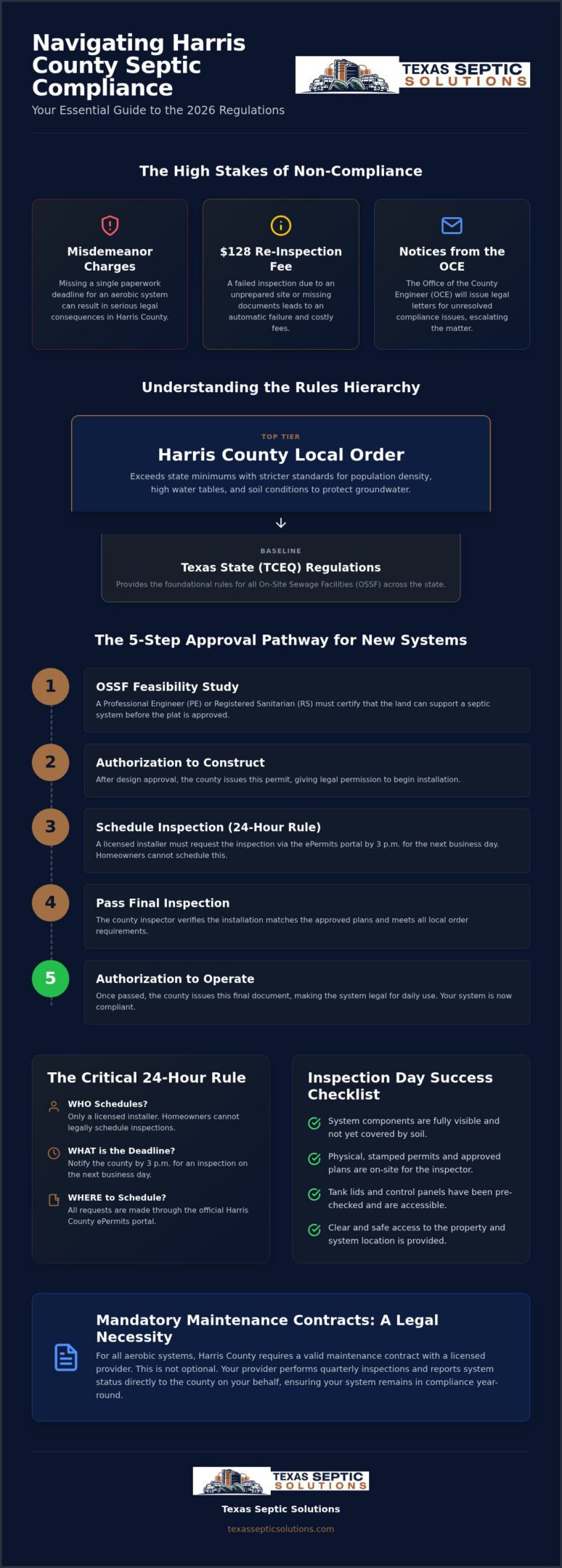
These regulations apply to all On-Site Sewage Facilities (OSSF), which is the technical term for your septic system. The county’s standards are stricter than surrounding rural areas because of our high population density. When homes are closer together, a single failing system can impact the health of an entire neighborhood. This is why the county requires a multi step approval process. It begins with professional design and ends with a final inspection. Only after passing this final check will the county issue an Authorization to Operate, which is the document that makes your system legal for daily use.
The Role of the Office of the County Engineer (OCE)
The OCE Watershed Protection division is the primary gatekeeper for your system’s legality. They don’t just check if your tank works; they monitor the entire lifecycle of your OSSF. Recently, the county transitioned fully to an ePermits system. Paper applications are now a thing of the past. If you’re a homeowner with questions about your specific site, you’ll need to coordinate through the Water Quality Permitting Group. This shift to digital filing helps the county track maintenance history more accurately, but it can be confusing for those not used to the portal. We often step in to help our customers manage this digital paperwork so nothing gets lost in the system.
OSSF Feasibility Studies for New Plats
If you’re planning to build on a new piece of land, Harris County requires an OSSF feasibility study before the plat can be approved. This study must carry the seal of a Professional Engineer (PE) or a Registered Sanitarian (RS). It proves the land can actually support a septic system without failing or leaking into neighboring properties. These studies are critical because they prevent homeowners from investing thousands into a lot that can’t legally house a functional system. Once your design is approved, you’ll receive an Authorization to Construct. This is your legal permission to start the installation. Without it, any work performed is considered a violation of the local order and could lead to significant fines.
The 24-Hour Rule & Scheduling Your Inspection
Scheduling an inspection in Harris County isn’t as simple as picking up the phone and requesting a visit. The Office of the County Engineer (OCE) follows a strict protocol known as the 24-hour rule. Specifically, a licensed installer must notify the Watershed Protection Group by 3 p.m. to secure an inspection for the following business day. Homeowners cannot legally schedule these inspections themselves. This rule ensures that only professionals who understand the technical setup are coordinating with the county’s inspectors. If you’re currently in the middle of a build or repair, our team can help you manage these Harris County septic services to ensure your timeline stays on track.
When the inspector arrives, your site must be ready for a full review. This means all components must be visible and the system shouldn’t be covered with soil yet. You are also required to have the physical, stamped permits and approved plans on-site. If these documents are missing or if the inspector can’t access the property, they’ll leave immediately. This results in an automatic failure and a “Deficiency List” that outlines exactly what went wrong. You can find more details on these specific onsite requirements in the Harris County Wastewater FAQ.
Step-by-Step Scheduling via E-Permits
The transition to the ePermits portal has streamlined the process, but it requires precise data entry. Your installer will access the Inspection Request Form using your specific permit number and the site address. They must also verify their license information is current within the system. Before the request is even submitted, we double-check that all “Permit Office Stamps” are visible on the digital and physical plans. Any discrepancy between the filed plans and the actual installation will trigger an immediate stop-work order.
Re-inspection Fees and Delays
Failing an inspection is more than just a headache; it’s an expensive setback. If your system doesn’t pass the first time, Harris County requires a re-inspection fee of $128. This fee must be paid in full through the portal before a second visit can even be scheduled. Common reasons for these delays include the system not being fully ready or the installer not being present. Ignoring the Deficiency List or attempting to operate the system without a final “Authorization to Operate” can lead to misdemeanor charges. We prioritize getting it right the first time to save you from these legal penalties and unnecessary costs. If your system is throwing an alarm right before a scheduled check, don’t panic. Our 24/7 team is ready to handle emergency septic repairs to keep your inspection on schedule.
Maintenance Contracts: The Mandatory Harris County Requirement
If you own an aerobic system in Harris County, you’re legally required to keep a valid maintenance contract on file with the Office of the County Engineer (OCE). This isn’t just a recommendation for system longevity; it’s a strict regulatory mandate. Harris County has adopted more stringent Harris County septic inspection requirements than the state of Texas. While the state minimum often allows for inspections every four months, Harris County requires professional inspections every three months, or quarterly. This increased frequency ensures that aerobic systems, which rely on mechanical parts and disinfection, are always operating safely in our high-density environment.
Your maintenance provider acts as the official link between your property and the OCE. Every time a technician visits your site, they are required to file a report with the local permitting authority within 14 days. Because this reporting is done directly through the county’s digital system, the OCE knows immediately if a visit is missed or if a contract has expired. If you let your contract lapse, you won’t just get a friendly reminder. The county frequently files misdemeanor violations in the Justice of the Peace Courts for non-compliance. We work closely with our customers to ensure these deadlines are met so you never have to face a judge over a paperwork oversight.
What Your Maintenance Provider Must Check
During these quarterly visits, your technician performs a series of specific checks to verify the health of your system. They test the chlorine residual to ensure the effluent is properly disinfected and evaluate the air compressor for consistent oxygen flow. The alarm system is also tested to ensure it will alert you the moment a pump or compressor fails. Finally, they assess the effluent quality to make sure the treated water is clear and odorless. All these findings are documented on the “OSSF Acknowledgment of Testing Requirements” form, which is then submitted to the county to maintain your “Authorization to Operate” status.
Transitioning Maintenance Providers
You have the right to change your service company at any time, but you must handle the transition carefully. Harris County does not allow for a “gap” in coverage. When you switch providers, the new company must file the new contract with the OCE immediately to prevent a red flag in the system. An unplanned gap often triggers a county audit, which can lead to unexpected site visits and fees. To help you stay ahead of these rules, we’ve developed a septic system maintenance plan that handles all the county reporting and scheduling for you. This proactive approach keeps your system functional and ensures you remain in full compliance with local laws year-round.
Preparing for Success: A Septic Inspection Checklist
Passing a Harris County septic inspection isn’t about luck; it’s about meticulous preparation. By the time the OCE inspector arrives, your system should be a perfect physical reflection of the engineered plans submitted during the permitting phase. Any deviation, no matter how small, can lead to a failed grade and that $128 re-inspection fee we mentioned earlier. To ensure your property meets all Harris County septic inspection requirements, we recommend a final walkthrough using this specific checklist:
- Verify Tank Lids: All lids must be secure and set to the correct grade. They shouldn’t be buried under feet of soil, nor should they be sticking up so high they become a trip hazard.
- Test the Control Panel: Ensure the panel is easily accessible and not hidden behind landscaping or locked structures. Flip the test switch to confirm the audible and visual alarms are fully functional.
- Check Spray Head Positioning: For aerobic systems, spray heads must be positioned exactly as shown on the design. They shouldn’t be spraying on driveways, property lines, or over pools.
- Confirm Design Accuracy: The inspector will compare the onsite installation to the approved engineering design. If a tank was moved five feet to avoid a tree without an official permit modification, the system won’t pass.
Common Red Flags for Harris County Inspectors
Inspectors often look for specific “red flags” that indicate a rushed or improper installation. One of the most common issues is the use of unapproved fill material over the drain field. Using heavy clay or rocky soil can compact the area and prevent proper evaporation. If your tank is buried deep, missing risers are another immediate fail. Risers bring the access point to the surface, allowing for future maintenance without digging. We also see many failures due to incomplete electrical wiring. All wires for the pump and aerator must be housed in proper conduit and connected according to the local electrical code. If you aren’t sure if your wiring is up to par, our team can provide expert septic system repair to fix these issues before your inspection date.
Preparing the Site for the Inspector
Logistics matter just as much as the mechanical components. You should clear all construction debris from the area and ensure there’s a clear, safe path to every part of the system. If you have a locked gate, make sure someone is there to provide entry or leave it unlocked for the scheduled window. You must also have your physical “Authorization to Construct” document clearly visible, often taped to a front window or attached to a temporary post near the system. An inspector cannot approve a system they cannot safely access. If you’re feeling overwhelmed by these technical details, let us help you manage your septic system maintenance and inspection prep to ensure a smooth approval process.
Professional Support: Navigating Harris County Compliance
Dealing with the Harris County Office of the County Engineer doesn’t have to be a solo mission. We’ve spent years acting as the bridge between local homeowners and the Watershed Protection Group. Our team understands that meeting Harris County septic inspection requirements is about more than just digging a hole; it’s about precise engineering and digital compliance. Whether you’re dealing with the heavy clay of Cypress or the high-water-table areas of Huffman and Houston, we know exactly how local soil conditions impact your system’s performance. We don’t just install systems; we live in these communities and understand the unique environmental challenges our neighbors face every day.
One of the biggest stressors for homeowners is a system alarm going off the night before a scheduled inspection. That’s why we offer 24/7 service. If your aerator fails or a pump stops working at 2 a.m., you don’t have to face an automatic failure and a re-inspection fee. We’re built for both the routine maintenance and those high-pressure moments where immediate resolution is the only option. Our custom maintenance plans are specifically designed to satisfy the Harris County Local Order, ensuring your quarterly reports are filed on time, every time. This proactive care provides the peace of mind that your home remains functional and legal without you having to track the calendar yourself.
Why Local Expertise Matters in Harris County
The ePermits portal has its own set of quirks that can trap the unwary. We’ve navigated this system thousands of times and understand the specific documentation inspectors expect to see on-site. Over the years, we’ve built professional relationships with local inspectors, which helps us anticipate their concerns and address them before they ever reach the deficiency list. If you’ve already received a notice of violation or a failed report, our septic system repair services are designed to fix those issues immediately and get you back into the county’s good graces. We handle the technical fixes so you can avoid the legal headaches and potential misdemeanor charges mentioned earlier in this guide.
From Design to Final Approval
If you’re starting a new residential build, we provide comprehensive design services that take you from the initial feasibility study all the way to final approval. We handle the complex ‘Authorization to Operate’ paperwork so you can focus on moving into your new home. Our goal is to make the entire process seamless, transparent, and stress-free. We take full accountability for meeting Harris County septic inspection requirements, acting as the seasoned expert who remains unfazed by even the most complex challenges. Get your Harris County septic system inspected and permitted today and let us handle the technical details for you.
Securing Your System’s Legal Standing
Staying on top of Harris County septic inspection requirements doesn’t have to be a source of constant anxiety. You now understand how the strict 24-hour scheduling rule works and why quarterly maintenance is a non-negotiable legal hurdle for aerobic system owners. By keeping your site ready for inspectors and ensuring your paperwork is filed correctly through the ePermits portal, you protect both your property investment and your peace of mind. These small, proactive steps prevent the heavy fines and legal headaches that come with non-compliance.
We’re here to take the technical weight off your shoulders. As a licensed OSSF maintenance provider and expert in OCE e-permitting, our team handles the complex reporting that keeps you out of the Justice of the Peace courts. Whether you need a routine contract renewal or 24/7 emergency service for a sudden system failure, we have the local expertise to resolve it fast. Schedule your Harris County compliance inspection with Texas Septic Solutions today to ensure your system remains in perfect standing. You’ve built a great home; let’s work together to keep it that way.
Frequently Asked Questions
Do I need a permit for septic repairs in Harris County?
Yes, you generally need a permit for significant septic repairs. While minor component swaps might not require a filing, replacing a tank or modifying the system layout involves specific applications and fees. For instance, a permit to replace a septic tank only costs $200. It’s best to consult with a professional to ensure your repair stays within the local order’s legal boundaries and avoids potential fines.
How often does Harris County require septic inspections for aerobic systems?
Harris County requires aerobic septic system inspections every three months. This quarterly schedule is more stringent than the Texas state minimum of every four months. These regular checks ensure your system’s disinfection and mechanical components are working correctly. Your maintenance provider must file these reports within 14 days of the site visit to keep your property compliant with Harris County septic inspection requirements.
What happens if I forget to renew my septic maintenance contract?
Forgetting to renew your contract triggers an automatic red flag in the Harris County OCE system. Since providers report directly to the county through a digital portal, any gap in coverage is immediately visible to regulators. This oversight often leads to a summons to a Justice of the Peace Court and potential misdemeanor charges. We recommend setting up an auto-renewing plan to avoid these legal complications and the stress of a county audit.
Can I schedule my own septic inspection with the Harris County OCE?
No, homeowners aren’t permitted to schedule their own inspections with the Office of the County Engineer. A licensed installer must submit the request through the ePermits portal by 3 p.m. for a next-day visit. This ensures the professional responsible for the work is present to address technical questions from the inspector. Attempting to bypass this rule will only lead to delays and confusion in your project timeline.
How much is the re-inspection fee if my septic system fails?
The re-inspection fee for a failed system in Harris County is $128.00. You must pay this fee through the ePermits portal before you can schedule a follow-up visit. To avoid this extra cost, ensure all components like tank lids and control panels are accessible and match the approved engineering design exactly before the inspector arrives. Getting it right the first time saves you both money and time.
What is the difference between a ‘Permit to Construct’ and an ‘Authorization to Operate’?
An Authorization to Construct is your legal permission to begin the physical installation based on approved engineering plans. In contrast, an Authorization to Operate is the final document issued only after your system passes its official inspection. You can’t legally use your septic system until the second document is issued. Operating without it can result in significant legal penalties from the Watershed Protection Group.
Does Harris County require soil testing before a new septic installation?
Yes, Harris County requires a feasibility study, which includes soil analysis, for all new septic installations on new plats. This study must be performed and sealed by a Professional Engineer or a Registered Sanitarian. It proves the ground can safely absorb wastewater without failing. This step is vital for preventing environmental contamination and ensuring your specific site meets all Harris County septic inspection requirements.
Who do I contact if my septic alarm is going off in Harris County?
You should contact your licensed maintenance provider immediately if your septic alarm sounds. An alarm usually indicates a pump failure, a high water level, or an aerator issue that needs professional attention. We provide 24/7 emergency service to handle these failures before they cause a backup or lead to a failed county inspection. Don’t ignore the buzzer; it’s your system’s way of asking for help.