
Finding My Septic Tank Lid: Safe Ways to Locate It
If finding my septic tank lid is what brought you here, you may be dealing with missing records, a cover hidden under grass, or uncertainty about where it’s safe to dig. Start by leaving the shovel in the shed. Guessing can disturb the system or put you in harm’s way.
Begin with property information and surface clues, not excavation. Permits, service records, and the likely route of the sewer line can help narrow the search, but they may not pinpoint a buried lid. This guide explains how to search methodically, why underground utilities must be marked before digging, and when to stop and arrange professional help.
You’ll learn how to use what you know about the property, what to avoid around an exposed tank, and how a septic inspection can help when the location remains unclear. A careful search is safer than digging at random, and you don’t have to identify every part of the system yourself.
Key Takeaways
- Finding my septic tank lid starts with property and service records, not guesswork with a shovel.
- Use yard clues to narrow the search, but don’t treat one sign as proof of the tank’s location.
- Tank covers and their visibility vary, so approach a suspected buried lid cautiously.
- Stop digging if you encounter an unidentified pipe or utility, or if the location is uncertain.
- When records and surface clues aren’t enough, professional inspection and diagnostics can help clarify the next step.
What Is a Septic Tank Lid, and Why Might You Need to Find It?
A septic tank lid covers an access opening in the tank. A qualified septic professional uses the opening to access the system for work such as an inspection, pumping, or repair. The lid’s position depends on the tank layout, so there is no single distance or direction from the house that applies to every property. For a general overview of septic tank operation, see What is a Septic Tank?
If you’re finding my septic tank lid because the system needs service, separate what you know from what you’re assuming. A hard-to-find cover does not, by itself, mean the tank has a problem or needs pumping. It means the access point hasn’t been identified. Start with records and observation rather than broad or deep digging.
What does the septic tank lid provide access to?
The lid provides access to the tank through a designated opening. It is not an invitation to climb in, lean over an open tank, or handle parts you can’t identify. Septic tanks can contain hazardous gases. Keep the cover closed unless access is needed for appropriate service, and never enter the tank.
Don’t assume every nearby feature is the lid. Pipes carry wastewater or connect system components, while a vent or another yard feature may be part of the broader system. Cover types and layouts vary, so appearance alone may not tell you what a feature is or where the tank begins.
When might a homeowner need to locate the lid?
You may need to identify the access point before a scheduled inspection or septic tank pumping. A repair or diagnostic visit may also require access to part of the system. Locating the lid helps establish where work can begin, but it doesn’t determine which service the system needs.
Use clues to narrow the search, not to confirm a location. A visible cover, a change in the ground, or a remembered service location may help, but none proves that the tank or lid is directly beneath that spot. Grass or soil can conceal features, and a pipe route doesn’t necessarily lead straight to the access cover.
Make a simple record of what you can verify: where the sewer line appears to leave the house, what property documents show, and where you notice possible system features. Don’t move heavy objects or dig around anything that could be a pipe or utility. Leave uncertain features undisturbed.
This measured approach helps protect the yard and prevents a guess from becoming unnecessary damage. Next, review property records and service paperwork, then use them to guide a careful search.
How to Find a Septic Tank Lid: Start With Records, Then Search Carefully
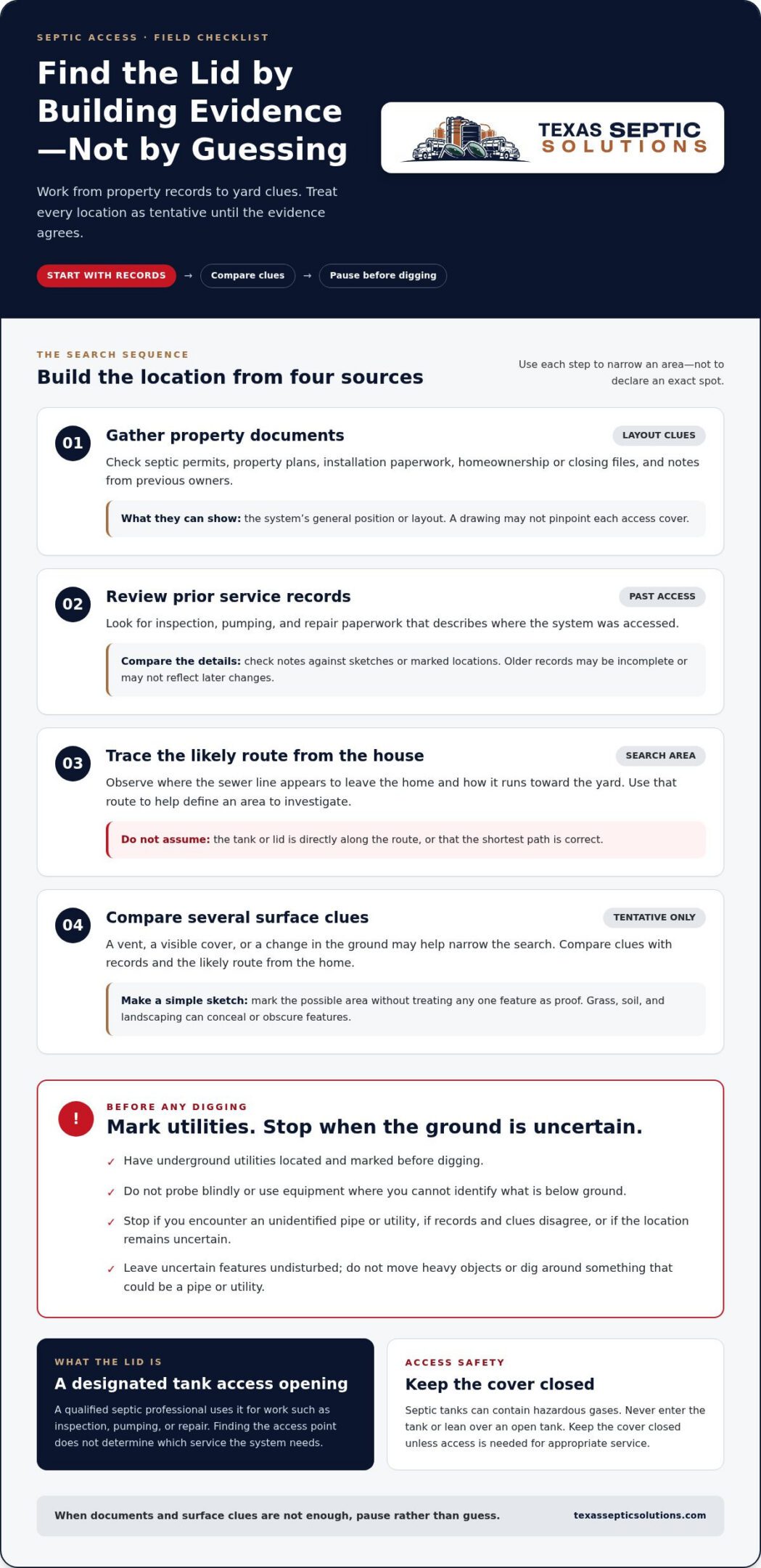
Build the search from the strongest information available. Records are generally more useful than a single patch of grass or suspected vent, while a visual clue can help narrow the area shown on a plan. The U.S. Environmental Protection Agency’s guide to Understanding Your Septic System explains how system components work together, which can help you interpret features around the yard.
- Gather property documents. Look for septic permits, property plans, installation paperwork, or other documents that show the system layout. Check homeownership files, closing documents, and notes from previous owners. A drawing may show the tank’s general position without pinpointing each access cover.
- Review prior service paperwork. Inspection, pumping, and repair records may describe where the system was accessed. Compare notes with any sketch or marked location. Older records are useful evidence, but they may be incomplete or may not reflect later changes.
- Trace the likely route from the home. If the paperwork doesn’t settle the question, observe where the sewer line appears to leave the house and how it runs toward the yard. This may help define an area to investigate, but it doesn’t prove that the tank or lid sits directly along the route. Don’t assume the shortest path is correct.
- Compare several surface clues. A vent, visible cover, or change in the ground may support a suspected location. Check whether the clues align with the records and likely route from the house. Note the possible area on a sketch rather than digging based on one feature.
Which records can help locate a septic tank?
Look for property plans, septic-system documents, and prior inspection or service records. A diagram can show the tank’s general layout, while service notes may point to an access area used before. Compare the documents rather than relying on one page. Records may be missing, unclear, or outdated, so use them to guide observation, not as an exact underground map.
How should you interpret clues in the yard?
A vent or suspected pipe route is one clue to compare with documents and other visible features, not a guarantee of the lid’s location. Grass, soil, and landscaping patterns can change for many reasons and don’t confirm that a lid is underneath. Mark a possible search area tentatively. Stop if locating the cover would require uncertain digging, equipment, or disturbing a pipe or utility.
Before digging, have underground utilities located and marked. Don’t probe blindly or use equipment where you can’t identify what’s below ground. If the records and clues don’t agree, pause. Texas Septic Solutions provides septic inspections and diagnostics to help assess the system and clarify the next step.
Septic Tank Lid Types and Yard Clues: What Can, and Cannot, Tell You
A lid may be obvious, partly hidden, or covered by soil and landscaping. Its material, shape, and visibility depend on the system, so don’t expect every septic tank to have the same cover. Use clues to narrow the search, then compare them with records or other evidence. A clue may suggest where to look, but rarely confirms the tank’s exact position on its own.
| What you find | What it may suggest | What it cannot confirm |
|---|---|---|
| A cover shown on a plan or service record | The documented access location or general tank layout | That the cover is still in precisely that spot, or that the records reflect later changes |
| A visible cover at the surface | A possible access point worth comparing with system records | That it is the tank lid, or that the tank sits directly below it |
| A suspected cover beneath grass, soil, or landscaping | A possible area to investigate if other clues support it | That a change in the yard marks a lid or identifies its exact depth and position |
What might a visible or buried cover look like?
An access cover may have a noticeable outline or sit within a riser, but appearances vary. Soil, grass, or landscaping can make a cover less visible over time. Don’t assume a flat or unusually green patch marks a lid. A metal detector may locate some metal components, but it won’t identify every lid or tank.
Can a vent or pipe route identify the lid?
A vent or suspected pipe route can help define an area to check, especially if it agrees with a plan or service note. The route toward the tank doesn’t necessarily pinpoint the access cover. Treat each feature as one piece of evidence, then cross-check it against records or professional diagnostics before deciding where to dig.
When finding my septic tank lid, distinguish between a documented location, a visible feature, and a guess. A document gives you a reference to compare; a visible feature gives you something to investigate; a guess needs more evidence. If two clues point to different places, don’t choose one simply because it looks more convincing.
A suspected cover isn’t a safe step or a signal to open the tank. Don’t stand on it, test it with your weight, or lift it to see what’s underneath. A cover could be unstable, and opening the tank can expose you to serious hazards. Leave it closed until access is needed for appropriate septic work.
Keep a simple yard sketch showing where each clue appears and whether it matches the records. This helps you explain what you observed without treating a vent, pipe route, or landscaping pattern as proof. If the location remains unclear, stop rather than digging around an unverified feature. An inspection can help establish the access point.
How to Expose a Suspected Septic Lid Without Taking Unnecessary Risks
Finding a likely access point and uncovering it are separate tasks. Even when records and surface clues point to a small area, a suspected lid may be deeper than expected, and the ground may contain pipes or utility lines you can’t see. Before any digging, have underground utilities located and marked. Don’t use a shovel or equipment to explore an uncertain area.
If you choose to clear loose surface material from a confidently identified spot, keep the work limited and stop if the cover doesn’t appear where expected. Avoid deep, forceful, or blind digging, and don’t probe around unfamiliar lines or fittings. The goal is to identify the cover, not expose the tank completely or prepare it for entry.
When should a homeowner stop digging?
Stop if you’re unsure the location is correct, the search would need to spread, or an unknown pipe or utility appears. Stop if the soil shifts or the cover looks damaged, unstable, or stuck. Don’t force it. Pausing is a prudent safety decision, not evidence that the septic system has failed.
Use these clear stop points:
- The location is still a guess. Return to records or get professional help instead of widening the hole.
- The ground or cover seems unsafe. Keep people and pets away, and don’t stand on or try to move an unstable cover.
- You encounter something unidentified. Don’t dig around a pipe, cable, or other feature you can’t confidently identify.
Why locating a lid is different from opening it
Finding the cover doesn’t mean it needs to be opened. Access may be needed for an inspection, pumping, or repair, but the appropriate service depends on the situation. A septic tank can contain hazardous gases. Never enter one, lean into an opening, or test the air yourself. Keep the cover closed and leave tank access and inspection work to qualified septic professionals.
This distinction matters even if the lid looks sturdy or the opening appears small. A homeowner’s search should end at identifying a possible access point, not lifting a cover to look inside. If a lid is damaged or stuck, forcing it could create a new hazard or damage the access point. Keep others away and arrange appropriate septic service.
If you’ve reached a stop point, you haven’t failed to find the lid. You’ve avoided turning uncertainty into a risky excavation. Texas Septic Solutions provides professional septic inspections and diagnostics to help clarify access and determine an appropriate next step.
When Professional Septic Inspection Can Help Find the Lid
If records are missing, surface clues conflict, or finding the likely location would require uncertain digging, a professional inspection and diagnostics can be a practical next step. A septic professional can assess the available information and help identify system access without treating one yard clue as proof. For homeowners finding my septic tank lid, this support can replace guesswork with a clearer plan.
Texas Septic Solutions serves residential and commercial customers across the Greater Houston Metro area within a 100-mile radius around Cleveland, TX. The team serves customers in Cleveland, Houston, Cypress, Huffman, and Shepherd. Local experience can help make sense of property layouts, landscaping, and past service records. The goal is to understand the system and its access points, then determine whether further service is appropriate.
What can professional inspection and diagnostics address?
Texas Septic Solutions provides Detailed Inspections and Diagnostics to help identify system concerns and clarify what may need attention. Locating an access point can support an inspection and, when appropriate, help prepare for septic tank pumping or repair. Finding a lid does not, by itself, mean the tank needs pumping or a repair. The appropriate next step depends on the system’s condition and the reason for the visit.
Some locations require more investigation, especially when records are incomplete or visible clues don’t line up. Share what you’ve found and where you’ve already looked so that information can guide the assessment. If you encounter a damaged or unstable cover, leave it undisturbed and mention it when describing the situation.
What should a homeowner share when requesting help?
A few details can make it easier to understand the search so far. Gather what you have, even if it’s incomplete, and describe the location plainly. Helpful information includes:
- Property plans, septic documents, and prior inspection or service records
- Areas you’ve checked and any possible covers, vents, or suspected pipe routes you noticed
- Whether records and yard clues point to the same place or conflict
- The property location
- The reason you need access, such as a planned inspection, pumping, or repair concern
You don’t need to dig further to make the information useful. A sketch or clear description of the suspected area can explain what you observed while leaving uncertain ground undisturbed. If you’ve noticed another system concern, describe what you observed without trying to diagnose it yourself.
When you’re ready to discuss an uncertain tank location, contact Texas Septic Solutions about septic inspection and diagnostics. Sharing your records, observations, and property location can help start a focused conversation about identifying system access and choosing an appropriate next step.
Take the Next Step Toward a Clear Answer
If finding my septic tank lid has reached the point where the next move would be guesswork, pause the search. A clear plan for identifying the access point can help protect your yard and prepare for the right septic service. You don’t need to uncover more ground before getting expert guidance.
Texas Septic Solutions is family-owned and operated, with more than 20 years of hands-on septic expertise. The company has served customers since 2010 and is licensed and insured, with Installer II license OS0029925 and Maintenance provider license MP000 1859. That experience supports a careful, practical approach to septic inspection and diagnostics.
Share what you know about the property and the search so far. Contact Texas Septic Solutions about septic inspection and diagnostics for help taking the next step without turning an uncertain location into an unnecessary risk.
Frequently Asked Questions
Can I find my septic tank lid without the original plans?
Yes. Start with past pumping or inspection paperwork, then compare it with visible features such as a vent or likely sewer-line route. Those clues can narrow the area, but they won’t confirm the access point. If searching would mean widening a hole based on a guess, stop. Professional inspection and diagnostics can help when records and observation don’t identify the lid.
Can a metal detector find a septic tank lid?
A metal detector may locate some metal objects near a septic system, but it can’t reliably find every tank or lid. Covers and surrounding materials vary, and a signal could come from something unrelated, such as buried metal debris. Treat a reading as a clue, not proof of septic access. Compare it with records and other observations, and stop before disturbing an unknown line or structure.
Is a septic tank lid always visible above the ground?
No. Depending on the property, soil, grass, or landscaping may conceal the lid, while another system’s cover may be easy to see. A hidden cover alone doesn’t show that the system has a problem. Check available plans or service notes and observe the yard before considering any digging. If you still can’t identify the access point, arrange a professional inspection instead of widening the search.
Can I open a septic tank lid after I find it?
No. Finding a cover doesn’t mean you should open it. A cover may be heavy, damaged, or difficult to identify with confidence, and an open septic tank can expose people to serious hazards. Never enter a tank or lean over an opening. Leave access and inspection work to septic professionals, even if the lid seems straightforward to lift. If it looks unstable or damaged, keep clear and describe what you noticed when arranging service.
Should I dig around a septic tank lid if I cannot see it?
Don’t dig blindly or keep expanding an excavation when the lid’s location is uncertain. First review property or service records, then use visible yard features only to narrow a possible area. Stop if you find an unidentified line, shifting soil, or a damaged cover. If careful checks still leave you guessing, professional diagnostics are a safer next step than digging farther.
Do I need to be home when a septic professional visits?
No. You don’t need to be home during Texas Septic Solutions service because the work is performed outside the home. You can make the visit more informed by sharing available septic records or noting where you suspect the lid may be. If your property is in Cleveland, Houston, Cypress, Huffman, or Shepherd, include its location when arranging service.