
Finding a Licensed Septic Inspector in Cypress, TX: A Homeowner’s Guide
Would you bet the value of your Cypress home on a quick “pass/fail” checklist that ignores the heavy clay soil of Harris County? Many homeowners treat a septic check as a mere formality, but missing a single structural flaw can lead to massive repair bills down the road. Finding a licensed septic inspector Cypress TX families can trust is about more than just a signature; it’s about securing a technical audit of your property’s underground infrastructure. It’s completely normal to feel overwhelmed by complex TCEQ rules or the fear of hiring an inspector who misses critical issues.
We believe you deserve total confidence in your home’s utility systems. This guide will show you how to select a professional who understands Harris County regulations, helping you protect your investment and avoid the nightmare of unexpected failures. You’ll learn exactly what a certified inspection report should cover to satisfy lenders and regulators. We’ll also preview the essential maintenance steps, including the three annual inspections required for aerobic systems, to ensure your property remains safe and compliant for years to come.
- Understand how Harris County’s heavy clay soil and TCEQ standards dictate the specific type of inspection your property requires.
- Identify the essential credentials a licensed septic inspector Cypress TX needs to provide a report that satisfies lenders and title companies.
- Learn the step-by-step process of a professional evaluation, from checking structural integrity to testing the functionality of baffles and pumps.
- Discover why a routine maintenance check is not a substitute for a comprehensive real estate inspection during a home sale.
- Gain a clear path to long-term system health and learn how to avoid the high costs of unexpected septic failures.
Why You Need a Licensed Septic Inspector in Cypress, TX
Skipping a professional audit when buying a home in Cypress is a gamble you don’t want to take. Your septic system is likely the most expensive utility on your property, and unlike a leaky faucet, its failures are often hidden underground until they become a full blown emergency. Hiring a licensed septic inspector Cypress TX ensures that you aren’t just getting a visual check, but a technical evaluation of how the system performs under local conditions. Beyond the financial risk, an unmaintained system can leak untreated waste into our local groundwater, creating a health hazard for your family and neighbors.
Harris County Septic Regulations and Compliance
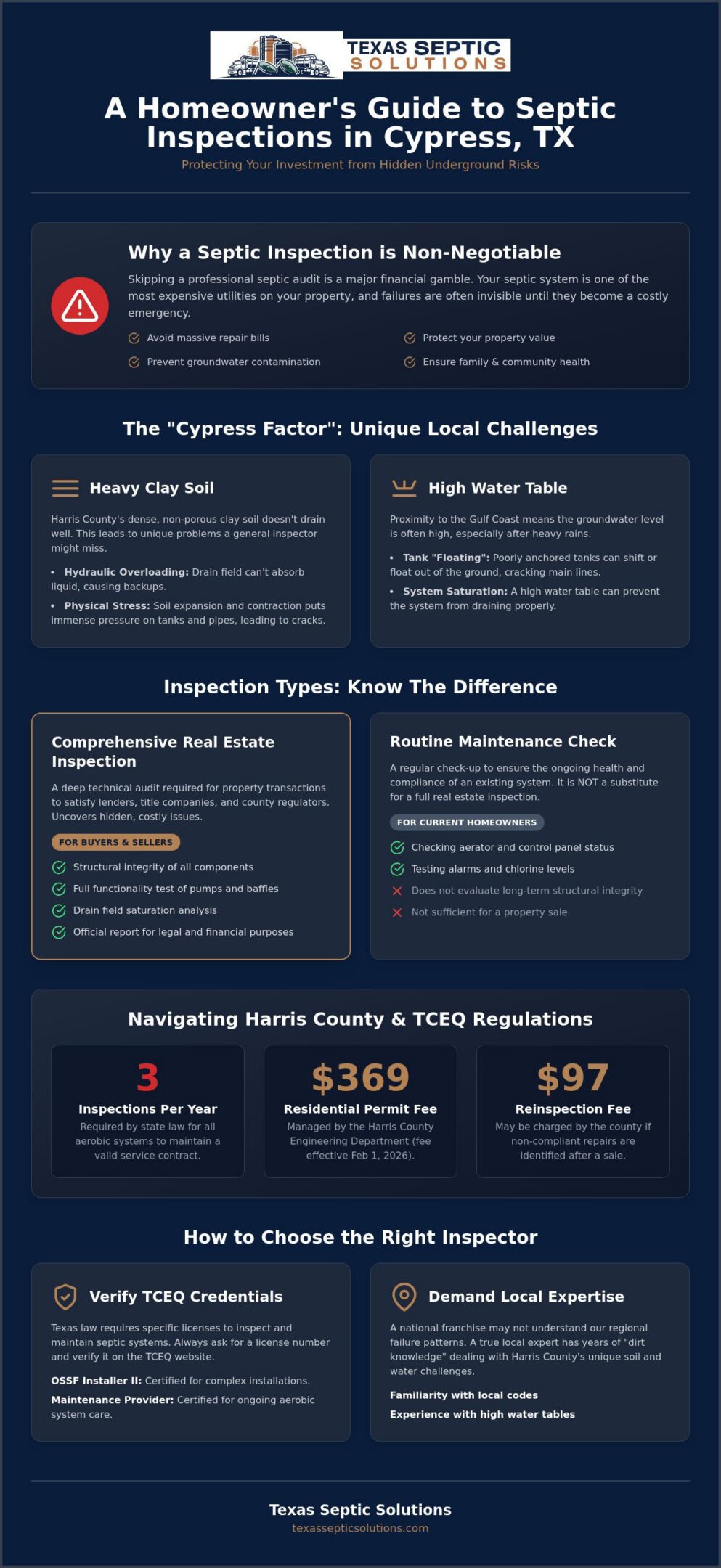
The regulatory landscape in our area is strict for a reason. While the Texas Commission on Environmental Quality (TCEQ) set the baseline standards, the Harris County Engineering Department manages the specific permitting and enforcement for Cypress residents. As of the updated fee schedule effective February 1, 2026, residential permit fees are set at $369, and failing to have a valid, licensed inspection can delay property transfers or lead to hefty late fees. A licensed professional knows exactly what documentation lenders and title companies require to close a deal. They understand that for aerobic systems, state law requires a service contract and at least three inspections per year. Without a certified report from a licensed expert, you might find yourself facing a $97 reinspection fee if the county identifies non-compliant repairs after you’ve already moved in.
The “Cypress Factor”: Soil and Water Table Challenges
Cypress has a unique geological profile that challenges even the best-designed systems. To truly understand what a septic system is and how it functions here, you have to account for our heavy clay soils. Unlike sandy soils that drain quickly, the clay in Harris County is dense and non-porous. It holds moisture for long periods, which can lead to hydraulic overloading where the drain field simply cannot absorb more liquid. This soil also expands and contracts significantly with Texas weather cycles, putting immense physical stress on concrete tanks and PVC piping.
A general home inspector or a plumber from outside the area might miss the subtle signs of “clay-clogging” or the risks posed by our high Gulf Coast water table. During heavy rains, a high water table can actually cause a poorly anchored or empty tank to “float” or shift, cracking the main lines. A licensed septic inspector Cypress TX specifically looks for these regional failure patterns. They evaluate the structural integrity of the baffles and the pump’s ability to handle the resistance of heavy soil, giving you a clear picture of the system’s longevity before you commit to a purchase or a major repair.
Choosing the Right Inspector: Credentials and Local Expertise
Finding a qualified licensed septic inspector Cypress TX residents can rely on starts with looking past the price tag. While a general home inspector might offer a “septic add-on” for a small fee, these surface-level checks often miss the structural nuances that lead to system failure. You need a professional who carries specific credentials from the Texas Commission on Environmental Quality (TCEQ) and understands how our local climate affects equipment over time. A true expert arrives with more than a flashlight; they bring specialized tools to perform a comprehensive septic inspection that protects your family’s health and your wallet.
Verifying TCEQ Licenses and Certifications
Texas law is clear about who can legally inspect and maintain these systems. When you’re vetting a licensed septic inspector Cypress TX, ask for their TCEQ license number. You can verify this in seconds on the TCEQ website. It’s vital to distinguish between different roles: an OSSF Installer II can handle complex installations, while a Maintenance Provider is certified to manage the ongoing health of aerobic systems. Because many modern Cypress homes use aerobic treatment units, your inspector must have specific training in these mechanical systems. They should be able to explain the status of your aerator, control panel, and chlorine levels without hesitation.
The Value of Local Reviews and Community Reputation
National franchises often lack the specific “dirt knowledge” required in Southeast Texas. A local expert who has spent years working in Cypress, Houston, and Huffman will be intimately familiar with how our high water table impacts tank buoyancy. They won’t just give you a generic report; they’ll provide context based on regional failure patterns they’ve seen in your specific neighborhood. Check local reviews for a “neighborly expert” vibe. You’re looking for someone who takes the time to explain their findings rather than rushing to the next job. If you’re unsure about the current state of your system, it’s often best to consult with a local professional who values long-term community relationships over a quick inspection fee.
Before you sign a contract, ensure the inspector is fully insured and bonded. This protects you in the rare event that property damage occurs during the evaluation. You should also ask a few targeted questions to gauge their expertise:
- Do you specialize in aerobic or anaerobic systems?
- Will you be checking the structural integrity of the tank baffles?
- Do you provide a written report that meets Harris County and lender requirements?
- What tools will you bring to evaluate the drain field’s absorption rate?
A professional should arrive with a probe to locate the tank, mirrors or cameras to view the interior, and testing equipment for the electrical components. If they show up with only a shovel, they aren’t providing the level of detail you need for a secure investment.
What a Comprehensive Septic Inspection Includes
Don’t be fooled by a service provider who simply walks the property and peers into the tank with a flashlight. A true technical audit is far more intensive than a basic visual check. While some competitors might only verify that the tank isn’t overflowing, a professional licensed septic inspector Cypress TX homeowners trust will perform a multi-point evaluation of the entire infrastructure. This process identifies small issues before they turn into the kind of system wide failures that can cost thousands of dollars to rectify. Following Texas Commission on Environmental Quality regulations, our inspection covers every layer of the system, from the plumbing exiting your home to the furthest spray head or drain line.
Tank and Component Analysis
The first step involves a deep dive into the tank’s current health. Your inspector will measure the sludge and scum layers to determine if the system is overdue for pumping. They also scrutinize the inlet and outlet baffles. These are critical components that prevent solids from escaping the tank and clogging your drain field. If these baffles are corroded or blocked, the entire system’s balance is at risk. A septic tank riser is essential because it provides permanent, easy access for inspections and maintenance without the need for repeated, labor-intensive digging. Without these access points, inspectors often can’t see the true condition of the tank’s interior components.
Mechanical parts act as the “brain” and “heart” of your system. We test the electrical components, including the effluent pump, the float switches, and the high water alarms. If a float fails, your pump won’t trigger, leading to a backup. If the alarm is dead, you won’t know there’s a problem until waste is in your yard. We ensure these safety nets are fully functional and properly wired to meet local safety codes.
Testing the Distribution and Drain Field
Once the tank and mechanicals are cleared, the focus shifts to how the system handles water volume. A hydraulic load test involves introducing a controlled amount of water into the system to see how quickly the drain field absorbs it. This is where Cypress clay soil often shows its true colors. Your licensed septic inspector Cypress TX will probe the soil in the drain field to check for biomat buildup or soil compaction that might be hindering drainage. Biomat is a slimy layer of bacteria that, while necessary, can grow too thick and “waterproof” your soil if the system isn’t breathing correctly.
For homes with aerobic systems, we also evaluate the disinfection process. This includes checking the chlorine residual levels to ensure the water being sprayed is safe and bacteria-free. We also check the spray patterns of the sprinkler heads. If a head is buried or pointing at your foundation, it can cause localized flooding and structural issues over time. This level of detail is exactly what separates a professional audit from a generic home inspection.
Real Estate Inspections vs. Routine Maintenance Checks
Many homeowners assume that a recent pumping receipt is enough to clear a home for sale. This is a common misconception that can stall a closing at the last minute. While a maintenance visit keeps the system running, a real estate audit is a forensic investigation required by lenders and title companies. A licensed septic inspector Cypress TX provides the formal documentation needed to prove the system is not just functional, but structurally sound and compliant with current standards. Without this specific report, you risk the buyer’s financing falling through or being held liable for repairs after the keys change hands.
The Rigor of a Real Estate Septic Audit
A real estate inspection is significantly more invasive than a standard checkup. To truly evaluate the system, the tank must often be pumped during the inspection itself. This allows the inspector to see the bottom of the tank and check for structural cracks, root intrusion, or thinning walls that are hidden when the tank is full. We also map the entire system, including the exact location of the tank and the dimensions of the drain field. This “map” is invaluable for the new owner who needs to know where they can and cannot build or landscape. We also identify “grandfathered” systems. These are older setups that were legal when installed but might require mandatory upgrades to meet 2026 Harris County codes before a title can legally transfer.
Routine Health Checks: Preventing Emergency Failures
Outside of a home sale, routine inspections are your best defense against a sudden disaster. A proactive audit can identify a septic tank alarm going off before waste actually backs up into your home. These checks are a core part of a professional septic system maintenance plan, allowing you to catch small mechanical issues like a sticking float or a failing aerator. The math is simple: a small inspection fee today is a fraction of the total septic system replacement cost you would face if a neglected system fails completely. If you’re preparing to list your property, book a professional real estate inspection to ensure a smooth, surprise-free transaction.
Using these reports as a negotiation tool is a smart move for both parties. For sellers, a clean report justifies your asking price and proves the home has been well-maintained. For buyers, an inspection report that identifies aging components allows you to negotiate a repair credit or price reduction before you’re locked into the purchase. It turns an underground mystery into a transparent part of the deal.
Booking Your Cypress Septic Inspection with Texas Septic Solutions
When the clock is ticking on a real estate contract, you don’t have time for delays or vague answers. You need a licensed septic inspector Cypress TX who respects your timeline and provides a report that stands up to lender scrutiny. We understand that an inspection is only the first step in a larger process. Our team is built for 24/7 readiness, ensuring that tight closing deadlines don’t slip through your fingers because of a slow utility check. We provide clear, actionable reports that translate technical data into plain English so you can make informed decisions about your property.
Choosing a full-service provider gives you a distinct advantage. If our audit reveals a fault, you aren’t left searching for another contractor to interpret the findings. We can move directly from identifying an issue to performing a septic system repair. This seamless transition ensures that the repair work aligns perfectly with the diagnostic report, saving you from the stress of coordinating between multiple companies during a home sale or an emergency.
The Texas Septic Solutions Difference
Our “neighborly expert” approach means we treat your property like it’s our own. We’ve spent decades navigating the specific Harris County environmental regulations that govern Cypress homes. We know the local inspectors, the permitting office, and the 2026 fee schedules by heart. This local history allows us to anticipate potential regulatory hurdles before they become problems. You’ll receive transparent communication from the moment you call us until the final report is filed. We don’t just find problems; we provide the roadmap to solve them.
Ready to Schedule? Here is the Process
Once you receive your inspection report, our job isn’t finished. We sit down with you to review every finding. If the system is in great shape, we’ll help you establish a maintenance schedule to keep it that way. If repairs are necessary, we’ll prioritize them based on what’s required for immediate safety versus long-term health. To prepare for our arrival, please ensure that access to your tank lids or risers is clear of heavy debris or overgrown landscaping. Having your previous maintenance records or a system map handy can also help us provide a more thorough evaluation of the system’s history.
Don’t leave your property’s health to chance or hire a “cowboy” inspector who might miss a five-figure structural flaw. Secure your investment with a team that knows Cypress soil and Harris County law inside and out. Schedule your professional septic inspection in Cypress today and get the peace of mind that comes with a truly licensed septic inspector Cypress TX.
Secure Your Property’s Future Today
Protecting your Cypress home starts with looking beneath the surface. You’ve learned how Harris County’s dense clay soils and strict TCEQ regulations make a professional audit a necessity rather than an option. Whether you’re navigating a high-stakes real estate transaction or simply staying ahead of routine maintenance, the right expert ensures your system remains a functional asset instead of a hidden liability. A licensed septic inspector Cypress TX provides the technical clarity you need to avoid expensive repairs and comply with local environmental standards.
At Texas Septic Solutions, our TCEQ licensed technicians have been serving Cypress and Harris County since 2026. We’re built for both the steady work of upkeep and the pressure of urgent deadlines, offering 24/7 emergency support when you need it most. We’re ready to partner with you to keep your property safe and your utility systems reliable. Book Your Licensed Septic Inspection with Texas Septic Solutions to get started. We look forward to helping you protect your home and your peace of mind.
Frequently Asked Questions
How much does a septic inspection cost in Cypress, TX?
The cost of an inspection depends on the type of system and the purpose of the evaluation. A standard health check for a conventional system is generally less expensive than a comprehensive real estate audit. Real estate inspections require more labor and documentation to satisfy lenders and title companies. You should also consider potential fees like the Harris County reinspection fee of $97 if the system fails its initial check.
Does a septic inspection include pumping the tank?
Pumping is not always included in a standard maintenance inspection unless sludge levels indicate it’s necessary. However, for a real estate transaction, we often recommend pumping the tank during the visit. This allows a licensed septic inspector Cypress TX to view the floor and walls of the tank to check for structural cracks or root intrusion that would be hidden when full.
How long does a professional septic inspection take?
A thorough evaluation typically takes between one and three hours to complete. Simple conventional systems are on the shorter end of that scale, while complex aerobic systems take longer due to mechanical testing. If your tank lids are buried or landscaping has overgrown the access points, it can add extra time to the process. We always aim for efficiency without rushing the technical details.
What happens if my septic system fails the inspection?
If your system fails, you will receive a detailed report explaining the specific issues and the required repairs. You’ll need to address these faults to bring the system back into compliance with Harris County standards. Once the repairs are finished, the county requires a $97 reinspection fee to verify the work. We provide clear guidance on the most cost-effective path to getting your system passed and protected.
Do I need to be home during the septic inspection?
You don’t need to be present as long as we have clear access to the tank lids and a working water supply. However, we encourage homeowners to be there if possible. It gives us a chance to show you the system components and explain our findings in real time. This is especially valuable for new buyers who aren’t familiar with how to maintain an on-site sewage facility.
How often should I have my septic system inspected in Texas?
The frequency depends entirely on the type of system you own. Texas state law requires aerobic septic systems to be inspected at least three times per year under a formal maintenance contract. For conventional gravity-flow systems, a professional inspection every three to five years is the standard recommendation. Regular checks help you identify small issues before they turn into a full system failure.
Can a general home inspector perform a septic inspection?
Most general home inspectors lack the specific TCEQ credentials required for a legal septic audit. You must hire a licensed septic inspector Cypress TX to ensure the report is valid for real estate transactions and county permitting. A specialist has the tools and “dirt knowledge” to evaluate the tank’s structural integrity and the drain field’s absorption rate, which a generalist might miss.
What is the difference between an aerobic and anaerobic inspection?
An anaerobic inspection focuses on the tank’s structural health and the gravity-fed drain field’s ability to process effluent. Aerobic inspections are more technical because these systems function like a miniature sewage treatment plant. We must test mechanical aerators, electrical control panels, and disinfection systems like chlorine levels. Both types involve checking sludge levels and ensuring the baffles are free of blockages or corrosion.