
Expert Septic Tank Control Panel Troubleshooting: A Homeowner’s Guide
It’s 2:00 AM on a Saturday, and a piercing, high-pitched shriek is echoing through your backyard, signaling a potential disaster with your septic system. You’re likely staring at a box full of confusing wires and switches, feeling a mix of panic and frustration as you wonder if a sewage backup is about to ruin your home. We understand that silence is your first priority, but effective septic tank control panel troubleshooting requires a calm, methodical approach to ensure your property stays functional and safe.
You don’t have to be an electrician to understand the basics of your system’s nerve center. This guide will teach you how to safely silence the alarm, identify whether a float or a pump has failed, and recognize when the issue is a simple tripped breaker. By the end, you’ll know exactly how to handle these common hiccups and when it’s time to call Texas Septic Solutions for an expert repair. We’ll walk you through the diagnostic process step by step, from checking power levels to understanding the advanced technology that keeps East Texas aerobic systems in compliance.
Key Takeaways
- Learn the immediate steps to silence a loud septic alarm while safely inspecting your yard for signs of a system failure.
- Master the basics of septic tank control panel troubleshooting to distinguish between a simple tripped breaker and a major mechanical fault.
- Understand how float switches and timers work together as the “brain” of your system to manage wastewater flow effectively.
- Identify the critical warning signs that indicate you need professional diagnostic tools and expert repair to prevent a total system backup.
Understanding Your Septic Tank Control Panel: Components and Indicators
The control panel serves as the central brain of your entire wastewater system. While most homeowners focus on the tank itself, the panel manages the timing and volume of effluent distribution. In our local climate, these systems are typically housed in a NEMA 4X weather-proof enclosure. This specific rating is vital for Texas homeowners because it protects sensitive electronics from intense UV rays, heavy rain, and the corrosive humidity common in areas like Houston and Cypress. Without this protection, the internal components would fail much faster. Understanding Your Septic Tank involves knowing how these mechanical parts interact to keep your yard dry and your home safe.
Most residential setups use a Simplex configuration, meaning there is one pump doing all the work. Larger properties or commercial sites might use a Duplex panel, which alternates between two pumps to prevent overworking a single unit. Effective septic tank control panel troubleshooting begins with identifying which system you have and ensuring the green power light is glowing steadily. If that green light is dark, you likely have a power supply issue before you even get to the pump mechanics.
The Visual Interface: What the Lights Are Telling You
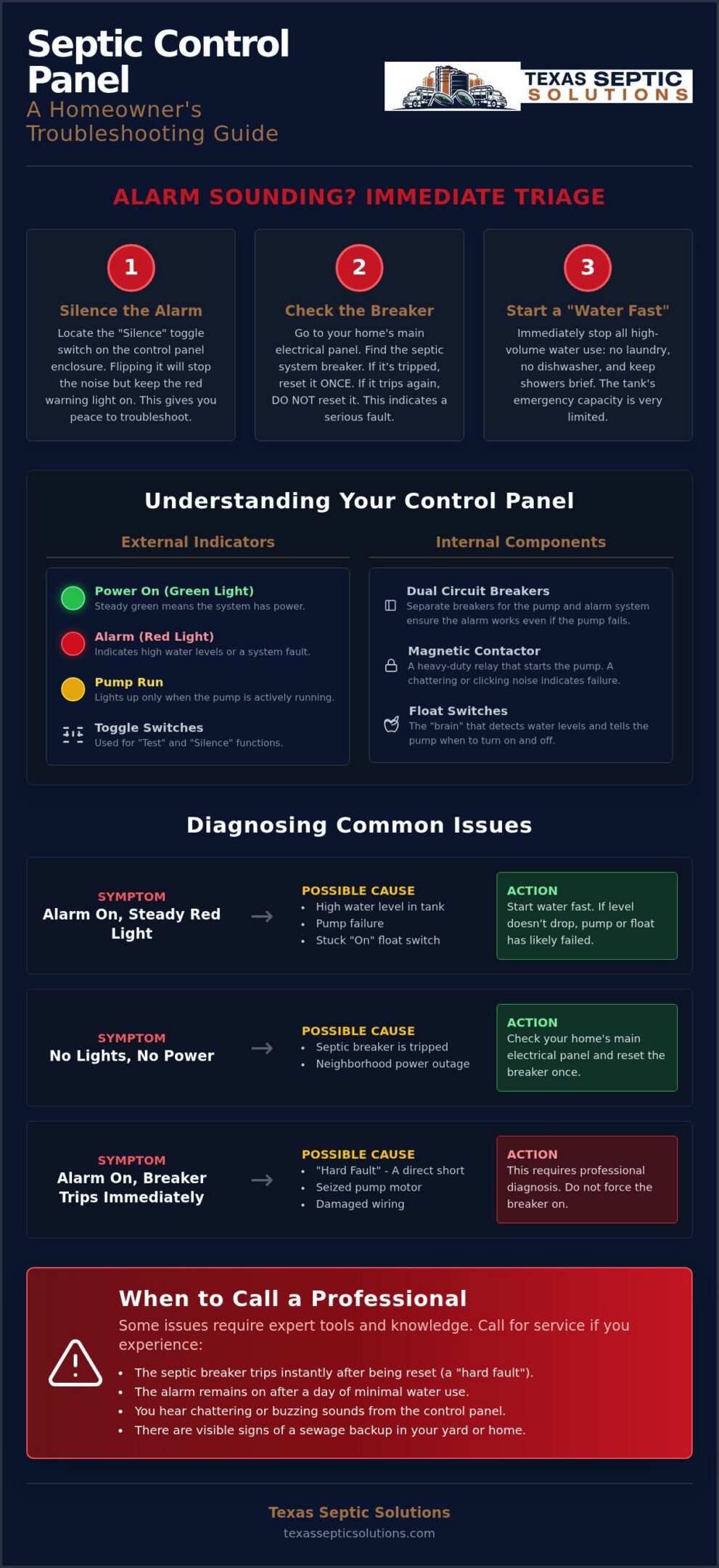
Your panel uses a simple light system to communicate its status. A steady green light means the system has power and is ready to operate. If you see a red light, the system is in alarm mode, usually indicating high water levels. A flashing red light often points to a specific mechanical failure, while a steady red light suggests the tank is full and needs immediate attention. Don’t ignore these signals, as they are your first line of defense against a backup.
You’ll also notice a “Pump Run” indicator. This light should only be on when the pump is active. If it stays on for hours, your pump might be struggling or a float switch could be stuck. Most panels include toggle switches for “Test” and “Silence.” Using the silence switch stops the audible shriek but doesn’t fix the problem; it simply buys you some peace while you wait for a technician to arrive.
Internal Anatomy: Breakers, Contactors, and Relays
Inside the box, you’ll find two distinct circuit breakers. One controls the pump, while the other powers the alarm system. This separation ensures that even if a pump failure trips a breaker, the alarm still has power to notify you. Another critical component is the magnetic contactor. This is a heavy-duty relay that physically closes the circuit to start the pump motor. If you hear a chattering or clicking sound, the contactor is likely failing. Finally, the terminal block acts as the hub where all the wires from your float switches connect. Understanding these parts is the first step in septic tank control panel troubleshooting before you decide to call for professional backup.
Immediate Triage: What to Do When the Septic Alarm Sounds
Hearing that high-decibel shriek for the first time is jarring. It’s designed to be impossible to ignore. Your first move is to locate the “Silence” toggle on the side or bottom of the enclosure. Flipping this switch won’t fix the underlying issue, but it will stop the noise and allow you to think clearly. Once the noise is gone, you can begin the process of septic tank control panel troubleshooting without the pressure of a screaming siren. Keep in mind that the red light will remain illuminated until the high-water condition or mechanical fault is resolved.
After silencing the alarm, head to your home’s main electrical service panel. Sometimes a power surge or a nearby lightning strike can trip the dedicated septic breaker. If you find it in the “off” position, flip it back once. If it trips again immediately, don’t force it. This indicates a “hard fault,” meaning there’s a direct short in the pump or wiring that requires a professional’s touch. Forcing a breaker to stay on can lead to permanent damage to your pump motor or the control panel’s internal relays.
Implementing a Water Fast
When the high-water alarm activates, your system has reached its emergency storage capacity. This means you have very little reserve room left before wastewater has nowhere to go but back into your home. You must stop all high-volume water usage immediately. This includes pausing the dishwasher, delaying laundry loads, and keeping showers extremely brief. Every gallon you send down the drain now adds to the pressure on a system that is currently unable to discharge effluent.
Most residential tanks only provide a limited amount of reserve space after the alarm triggers. In a typical household, a single load of laundry or a long shower could be enough to push the system over its limit and cause a backup. Treat this period as a total water fast until the cause of the alarm is identified and resolved. This proactive step is the most effective way to prevent property damage while you work through your diagnostic checklist.
Checking for External System Clues
Take a walk around your tank and drain field to look for physical evidence of a failure. If you notice patches of unusually lush, bright green grass over the drain field, it’s a sign that the soil is oversaturated with effluent. You should also check for “ponding” or standing water in the yard, especially if it hasn’t rained recently. These clues often point to a pump that has stopped working entirely, allowing the tank to overfill.
Pay attention to odors. A strong “rotten egg” smell near the control panel or tank lids suggests that gases are escaping or the system isn’t venting correctly. If you’re currently dealing with a septic tank alarm going off, these visual and olfactory clues will help you describe the situation accurately when you call for service. If these steps don’t clear the alarm, it’s a good idea to contact Texas Septic Solutions for a professional diagnostic visit to protect your home’s functionality.
Troubleshooting Common Electrical and Power Failures
Electrical failures are responsible for a large portion of system alarms. When you begin septic tank control panel troubleshooting, you must first distinguish between a “nuisance trip” and a “hard fault.” A nuisance trip might happen after a power surge or a heavy thunderstorm. A hard fault indicates a permanent short circuit within the pump motor or the underground wiring. Before you open the enclosure, remember that these systems carry 120V or 240V current. This is enough voltage to cause serious injury. If you aren’t comfortable around live electricity, it’s always safer to let a professional handle the internal diagnostics.
Look for visual signs of distress inside the box. Burnt insulation on wires or “pitting” on the silver contacts of the magnetic contactor are clear indicators of heat damage. Texas heat reaches extreme levels, causing components to cycle under intense stress. Over time, this heat-cycling weakens the metal components, leading to high resistance and eventual failure. If you smell ozone or see black soot marks near the terminal blocks, the system has experienced a significant electrical event that requires immediate attention.
The “Tripped Breaker” Test
If the alarm is on but the pump won’t engage, check the dedicated breaker in your home’s main panel. To reset it properly, flip it completely to the “off” position before clicking it back to “on.” If the breaker trips again immediately, you have a hard fault in the wiring or the motor. However, if it stays on for several minutes and then trips once the pump starts, the motor is likely drawing too many amps and is nearing the end of its life. Most outdoor panels also feature GFCI protection, which is extremely sensitive to moisture. If your GFCI won’t reset, water has likely entered the conduit or the pump housing.
Texas Environmental Factors: Pests and Corrosion
In East Texas, nature is often the primary cause of electrical failure. Fire ants are notoriously attracted to the electromagnetic fields produced by electrical contactors. They can swarm the internal components, physically wedging themselves between the contacts and preventing the pump from receiving power. If you open your panel and see a mound of dirt or thousands of ants, don’t spray them with a garden hose. This will short out the entire panel. Instead, use a specialized electronic-safe cleaner or call for a professional cleaning.
Humidity is another constant battle in Houston and Cleveland. Moisture in the air leads to green oxidation or corrosion on the terminal blocks. This corrosion creates a weak connection, causing the system to behave erratically. Regularly checking that your NEMA 4X enclosure seal is tight and free of cracks will prevent moisture ingress. If the seal is compromised, the salt and moisture in our air will eventually eat through the copper connections, leading to an expensive control panel replacement.
Diagnosing Mechanical Logic: Float Switches and Timers
Once you’ve confirmed that power is reaching the box, the next step in septic tank control panel troubleshooting involves checking the mechanical triggers. Most panels feature a “Hand-Off-Auto” (HOA) switch. This is your most valuable diagnostic tool. By flipping the switch to “Hand,” you bypass the float switches and manually engage the pump. If the pump hums or starts moving water in this mode, you know the pump motor itself is healthy. The problem likely lies in the “Auto” logic, specifically with the float switches that tell the pump when to work.
A standard system relies on a three-float hierarchy to manage water levels. The bottom float is the “Pump Off” switch, ensuring the pump doesn’t run dry and burn out. The middle float is the “Pump On” switch, which activates the motor when the tank reaches a certain level. The top float is the “High Water Alarm.” If the middle float fails to engage the pump, the water continues to rise until it tips the top float, triggering the siren you heard earlier. Understanding this sequence helps you narrow down which component has failed based on how the system responds to manual testing.
Testing the Float Switches Safely
You can often perform a “tether test” to check float functionality without ever touching the wastewater. Using a long pole or a hook, carefully lift the middle float switch. You should hear a distinct “click” from the magnetic contactor inside the control panel as it engages. If you lift the float and nothing happens, the switch is likely dead or the internal ball is stuck. Be on the lookout for “log-jammed” floats, where toilet paper or solid debris has physically pinned a float in the downward position, preventing it from rising with the water level.
Aerobic System Specifics: Timers and Air Alarms
If you have an aerobic system, your panel includes a timer that typically restricts spraying to the middle of the night, often around 2:00 AM. If your alarm is going off during the day, it might simply mean the tank is full and waiting for its scheduled discharge time. Most panels have a timer override button that allows you to manually start a cycle. However, if the compressor alarm is sounding, this is usually due to a drop in air pressure. Check the compressor for a humming sound; if it’s silent, the internal diaphragm may have ruptured.
Complex aerobic issues often require more than a simple reset. For a deeper look at these components, refer to our guide on septic system repair. If your pump fails to engage even when switched to the “Hand” position, you are facing a mechanical failure that needs immediate attention. Don’t wait for a backup to reach your home. Contact Texas Septic Solutions for 24/7 emergency support to get your system back in balance.
When to Call Texas Septic Solutions for Professional Repair
While basic septic tank control panel troubleshooting can resolve minor glitches, there is a clear line where DIY effort becomes a safety risk or a legal liability. If your troubleshooting steps haven’t silenced the alarm or restored pump function within a few hours, you are likely facing a component failure that requires specialized equipment. Waiting too long in a high-usage household often leads to the very backup you’re trying to avoid. Our team provides 24/7 emergency septic service to ensure that a midnight alarm doesn’t turn into a morning catastrophe for your Houston or Cleveland home.
Beyond the immediate mechanical issues, Texas homeowners must consider regulatory requirements. In many counties across East Texas, owners of aerobic systems are legally required by the TCEQ to maintain a service contract with a licensed provider. Attempting to rewire a panel or bypass a timer yourself can void these contracts or lead to fines from local authorities. Professional intervention ensures your system remains in compliance while protecting the long-term health of your property’s infrastructure.
The Limits of Homeowner Troubleshooting
You should stop your diagnostic efforts and call for professional repair immediately if you notice any of the following red flags:
- The smell of electrical burning, smoke, or visible soot marks inside the control enclosure.
- A pump that fails to engage in “Hand” mode despite the control panel having full power.
- Aerobic spray heads that do not activate during their scheduled 2:00 AM window or through a manual override.
- A circuit breaker that trips instantly every time you attempt a reset.
These symptoms usually point to a “dead short” in the pump motor or a catastrophic failure of the internal relays. At this stage, continued testing can cause a fire or permanent damage to the expensive control logic board.
Our Professional Diagnostic Process
When our technicians arrive, we use tools that go far beyond a simple visual check. We perform Ohm testing on pump windings to detect internal wear before the motor fails completely. We also use a “Megger” (mega-ohmmeter) to test the insulation resistance of your underground wiring. This allows us to find tiny cracks in the wire casing that cause “ghost” trips during humid Texas nights. These pro-level tools take the guesswork out of the process, identifying the exact failed component so you don’t spend money on parts you don’t need.
Prevention is always more affordable than an emergency midnight call. Enrolling in a septic system maintenance plan is the best way to catch corroded contacts and failing floats before they trigger a loud alarm. Our comprehensive programs include regular inspections of your air pressure switches and timer calibrations, giving you peace of mind that your system is ready for the demands of daily life. If your panel is currently in alarm mode and you can’t find the cause, contact Texas Septic Solutions for a reliable, professional resolution.
Secure Your Home with Reliable System Care
Managing the brain of your wastewater system shouldn’t be a source of constant anxiety. By following a structured approach to septic tank control panel troubleshooting, you can safely identify common issues like tripped breakers or stuck floats before they lead to a messy backup. Remember that while silencing the alarm provides temporary peace, it doesn’t solve the underlying mechanical or electrical fault. Your focus should always be on maintaining a safe, TCEQ-compliant system that protects your property and your family’s health.
If your diagnostic steps reveal a failed pump or a complex electrical short, don’t risk your safety by digging deeper into high-voltage components. Our family-owned and locally operated team is ready to help with 24/7 rapid response and professional, TCEQ-compliant repairs. We’ve seen every scenario East Texas can throw at a septic system and remain unfazed by the toughest challenges. Schedule an Emergency Septic Repair with Texas Septic Solutions today to restore your peace of mind. We’re proud to be your local authority, ensuring your home stays functional and your yard stays dry.
Frequently Asked Questions
How do I reset my septic tank control panel alarm?
You reset the alarm by flipping the “Silence” toggle to stop the noise, but the red light only turns off once the water level drops. If the pump is working correctly, the system will reset itself automatically once the tank is empty. If the light stays on after several hours of no water use, your septic tank control panel troubleshooting should move toward checking the float switches.
Why is my septic alarm red light on but there is no sound?
A red light without sound usually means the silence switch was already activated or the audible buzzer has burned out. The light is a visual warning that the tank is currently at capacity. Don’t assume the problem is solved just because the box is quiet. You still need to investigate why the water level is high before a backup occurs in your home.
Can heavy rain cause my septic control panel to alarm?
Heavy rain is a common culprit for alarms in Houston and Cleveland. Saturated soil can lead to groundwater entering the tank through unsealed lids or cracks in the riser. This extra volume overwhelms the pump’s ability to keep up with daily usage. If the alarm only happens during storms, you likely have an “inflow” issue that requires sealing the tank components.
How long can I use water after the septic alarm goes off?
You have very limited time, typically only 30 to 50 gallons of reserve space, once the alarm triggers. This volume is roughly equivalent to one or two loads of laundry or a single long shower. Stop all non-essential water usage immediately. Continuing to run water will inevitably lead to a sewage backup into your bathtubs or a messy overflow in your backyard.
What does it mean if my septic pump breaker keeps tripping?
A tripping breaker is a safety mechanism signaling a “hard fault” in the electrical circuit. This often means the pump motor has an internal short or the underground wiring has been compromised by moisture or pests. Don’t keep flipping the breaker back on. Repeatedly forcing power to a shorted motor can cause a fire or permanent damage to the entire control panel.
Is a septic control panel alarm an emergency that requires immediate service?
Yes, a septic alarm is a legitimate emergency that requires a prompt response. While you can silence the noise, the system is telling you that it can no longer process wastewater. Ignoring this warning leads to property damage and potential health hazards. We offer 24/7 emergency service to handle these high-pressure situations before they result in a total system failure.
How do I know if my septic pump has actually failed?
You can verify pump failure by using the “Hand” setting on the HOA switch inside the panel. If the pump doesn’t vibrate, hum, or show movement in the tank while in “Hand” mode, the motor or its starting capacitor has likely failed. This is a critical part of septic tank control panel troubleshooting that confirms you need a professional pump replacement.
Why is my aerobic septic system alarm going off in the middle of the night?
Aerobic systems are often programmed with a timer to spray effluent only during the night, typically around 2:00 AM. If your household uses more water than usual during the day, the tank may reach its “high water” mark before the timer allows the pump to run. The alarm sounds to let you know the system is waiting for its scheduled discharge window.