
Cypress Industrial Septic Pumping: 2026 Manager’s Guide
Imagine it is 2:00 AM during a heavy third shift, and your entire production line comes to a grinding halt because a septic backup has flooded the loading bay. For a facility manager in Harris County, this isn’t just a mess; it’s a costly operational disaster that invites steep regulatory fines and hours of lost productivity. You already know that managing a high-volume facility requires more than just reactive fixes. You need a reliable strategy for septic tank pumping for industrial sites Cypress that keeps your operations running smoothly without any unexpected interruptions.
We believe that your utility systems should work as hard as your team does. This 2026 guide is designed to help you achieve zero system-related downtime while ensuring you stay in full compliance with local environmental standards. We will walk you through the latest Harris County ePermit requirements, the necessity of mandatory maintenance contracts, and how to select a provider with the high-capacity vacuum trucks your site demands. By the end of this article, you will have a clear roadmap for a predictable maintenance schedule that protects both your bottom line and your professional reputation.
Key Takeaways
- Identify the critical differences between residential and industrial systems, including how to manage high-volume effluent and tanks exceeding 2,000 gallons.
- Discover how professional agitation techniques ensure thorough septic tank pumping for industrial sites Cypress, removing the stubborn sludge blankets that cause system failure.
- Navigate Harris County wastewater regulations with confidence by securing the proper waste manifests and disposal documentation needed for full compliance.
- Compare the long-term ROI of scheduled maintenance against the massive costs of emergency shutdowns to keep your three-shift operations running without a hitch.
- Gain a competitive edge with a partner who understands the unique soil conditions and high water tables specific to the Cypress area and major industrial corridors.
Industrial vs. Residential Septic Pumping: Why Cypress Sites Need More
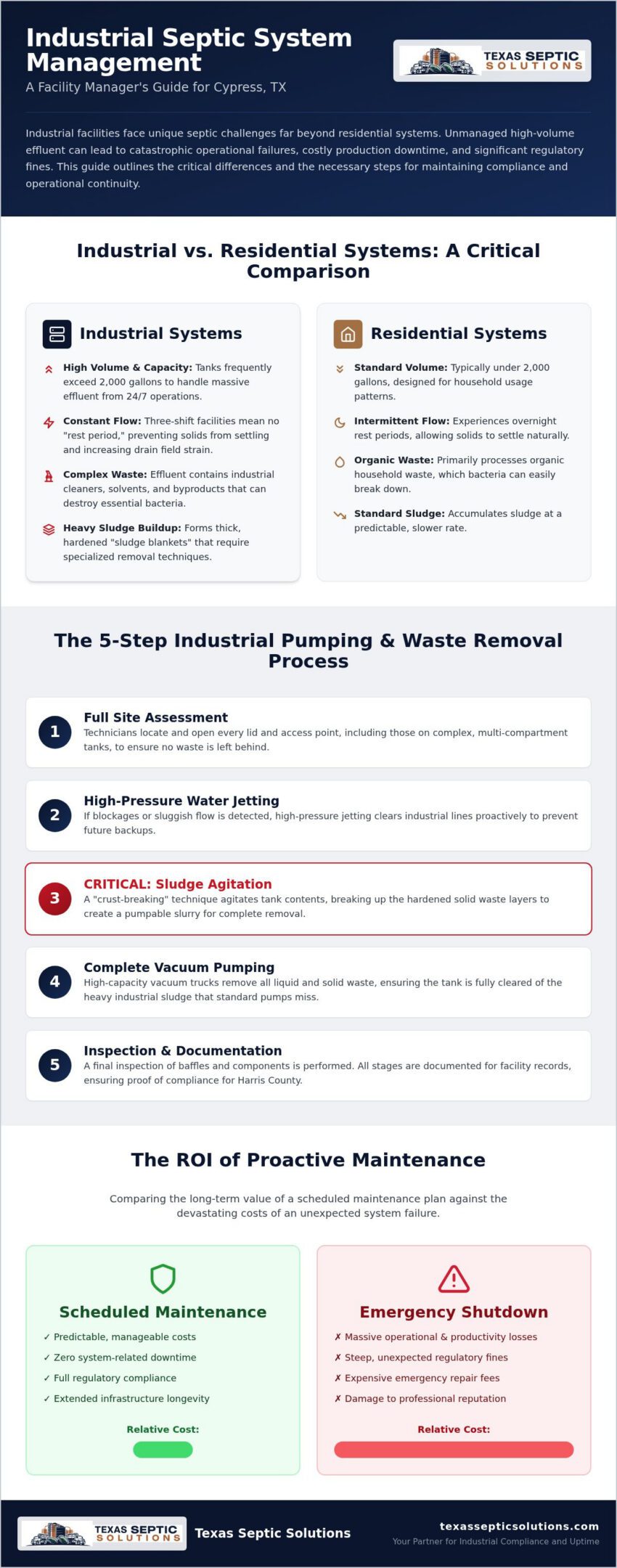
Industrial septic pumping isn’t just a larger version of a residential service call. It’s a specialized operation designed to handle high-volume effluent and non-residential waste streams that would overwhelm a standard home system. When we talk about septic tank pumping for industrial sites Cypress, we’re dealing with tanks that often hold 2,000 gallons or more. Residential-grade equipment usually fails at these sites because it lacks the vacuum power to lift heavy industrial sludge from deep, high-capacity tanks. Understanding the fundamentals of How Septic Tanks Work is a good start, but industrial facility managers must account for the unique stresses of a commercial environment.
Understanding High-Volume Wastewater Challenges
Cypress industrial parks often house 24/7 operations that keep the water moving around the clock. In a home, the system “rests” overnight, allowing solids to settle. In a three-shift manufacturing facility, that rest period doesn’t exist. This constant flow keeps solids suspended and pushes them toward the drain field, which can lead to premature system failure. Heavy sludge accumulation is a common byproduct of industrial processes, and “average” pumping frequencies simply don’t apply here. You need a schedule tailored to your actual output, not a generic recommendation. When you schedule septic tank pumping for industrial sites Cypress, you’re protecting the longevity of your entire infrastructure.
Chemical and Effluent Considerations
The chemical composition of industrial waste is another major hurdle. Industrial cleaners, solvents, and manufacturing byproducts can kill the beneficial bacteria that a septic system relies on to function. When these bacteria die, the digestion process stops, and your tank fills with raw waste much faster than expected. Harris County has specific disposal requirements for this type of effluent. It’s vital to identify non-organic waste early to ensure specialized handling. This isn’t just about keeping the drains clear; it’s about maintaining regulatory compliance and avoiding the environmental penalties that come with improper waste management.
The Industrial Pumping Process: Agitation and Complete Waste Removal
Industrial pumping isn’t a “hose and go” job. It requires a technical site assessment to locate every access point on these massive tanks. Many industrial systems in Harris County feature complex, multi-compartment designs. If a provider only opens one lid, they are essentially ignoring half of your waste. We ensure every chamber is accessible before the vacuum starts. This level of detail aligns with Federal guidance on septic systems, which emphasizes the importance of thorough maintenance for environmental safety and long-term functionality.
Step-by-Step Breakdown of a Professional Industrial Pump
We start by opening all compartments to ensure no sludge remains in the secondary chambers. If our technicians detect sluggish flow or blockages in the industrial lines, we use high-pressure water jetting to clear the path. This proactive step prevents backups before they start. Every stage of the process is documented for your facility management records. These logs are essential during environmental audits or when proving compliance to Harris County inspectors. After the pump-out, we perform a final inspection of the baffles and internal components to check for wear or damage that could lead to a system failure.
Agitation: The Secret to Industrial System Longevity
Proper agitation is the difference between a temporary fix and long-term stability for your infrastructure. When performing septic tank pumping for industrial sites Cypress, we prioritize breaking up the solid waste layers. Many site managers don’t realize that simple liquid pumping is a recipe for disaster. Over time, industrial waste forms a “sludge blanket” or a hardened crust at the bottom and top of the tank. If you only remove the liquid, this solid material stays behind, taking up valuable space and eventually flowing into your drain field.
We use a “crust-breaking” technique, which involves agitating the tank contents to create a pumpable slurry. This ensures we remove the heavy solids that standard pumps often leave behind. Proper agitation doesn’t just clean the tank; it extends the time between your required service intervals. By removing the hardened waste layers, you restore the tank’s full capacity and prevent the solid carryover that destroys soil absorption. If your facility is due for a deep clean, a professional septic system pumping service can prevent the solid buildup that leads to expensive repairs. This methodical approach is why septic tank pumping for industrial sites Cypress is a critical part of your facility’s operational health.
Regulatory Compliance and Environmental Safety in Cypress, TX
Operating an industrial facility in Northwest Houston means navigating a complex web of local and state requirements. In Cypress, which falls under Harris County jurisdiction, regulatory compliance isn’t just a suggestion; it’s a mandatory part of your operational license. Beyond the paperwork, the local geography presents its own set of challenges. Cypress is known for high water tables, especially in industrial zones near Highway 290 and the Grand Parkway. When you schedule septic tank pumping for industrial sites Cypress, your provider must account for tank buoyancy. Pumping a high-capacity tank completely empty during a wet season can actually cause the structure to “float” or shift in the saturated soil, leading to catastrophic pipe failures.
Harris County Permitting for Industrial Sites
Harris County has streamlined its oversight through the ePermits portal, but the reporting requirements for industrial sites remain rigorous. Every commercial on-site sewage facility (OSSF) in the county is required to maintain a continual maintenance contract with a licensed provider. As we move through 2026, inspectors are placing a higher premium on digital record-keeping. Your routine pumping documentation serves as your primary defense during an environmental inspection. These records prove that you’re managing effluent levels responsibly and preventing soil contamination. Staying ahead of these regulatory updates ensures your facility avoids the steep fines that Harris County levies for non-compliance or lapsed maintenance contracts.
Environmental Liability and Waste Disposal
The legal responsibility for your waste doesn’t end when the truck leaves your property. As a facility manager, you’re part of a “cradle-to-grave” chain of custody for all industrial effluent. This is why choosing a partner based solely on the lowest bid is a significant risk. Many “budget” pumping services skip legal disposal protocols to save on tipping fees, but if that waste is traced back to your site, your business holds the liability. According to TCEQ regulations on waste disposal, industrial systems are strictly prohibited from processing hazardous or non-domestic waste without specific secondary permits.
Ensuring your partner is licensed for industrial-scale waste transport is the only way to protect your business from third-party negligence. Professional septic tank pumping for industrial sites Cypress includes providing you with a full waste manifest. This document tracks the exact volume of waste removed and confirms its delivery to a licensed treatment facility. By maintaining these records, you’re not just following the law; you’re building a verifiable history of environmental stewardship that protects your company’s reputation and its bottom line.
The ROI of Maintenance: Avoiding Industrial Downtime in Cypress
Protecting your facility’s bottom line requires a shift from reactive fixes to proactive asset management. In high-output environments, a single day of system-related downtime can cost thousands in lost production and idle labor. When you invest in regular septic tank pumping for industrial sites Cypress, you aren’t just paying for waste removal; you’re buying operational insurance. This routine care prevents the accumulation of solids that lead to catastrophic failures, ultimately helping you avoid the massive expense of a full septic system replacement. Catching a small issue during a scheduled pump-out is always more affordable than dealing with a flooded facility at midnight.
The Cost of Reactive Repairs in High-Stakes Environments
Emergency calls in high-stakes environments often command premium rates for after-hours labor and specialized high-vacuum equipment. Beyond the direct service bill, the hidden costs of a backup include employee safety risks and extensive biohazard cleanup fees. One Cypress warehouse recently reported saving significant overhead costs simply by switching to a structured maintenance plan. By catching issues like baffle wear or high sludge levels early, they eliminated the “emergency” from their facility management vocabulary. This neighborly approach to expert care ensures that your focus stays on your business, not your plumbing.
Building a Predictable Maintenance Schedule
Building a predictable schedule depends on your facility’s specific flow, occupancy, and waste types. We recommend scheduling pump-outs during off-peak hours or weekend shifts to ensure your production never skips a beat. Integrating these services into your overall septic system maintenance Texas strategy creates a reliable paper trail for stakeholders and regulators alike. It’s a straightforward way to manage your utility budget without surprises.
Watch for early warning signs like slow floor drains, gurgling pipes, or unusual odors near the tank. These often signal that your system is reaching its capacity before a full-blown backup occurs. If you want to move away from the stress of emergency repairs, our team can help you design a custom septic system maintenance schedule that fits your production cycle. Reliable septic tank pumping for industrial sites Cypress is the most effective way to ensure your facility remains a safe, functional environment for your entire team.
Why Texas Septic Solutions is the Preferred Industrial Partner in Cypress
We understand that your industrial facility is more than just a set of blueprints; it’s a vital engine for the local economy. Our approach to septic tank pumping for industrial sites Cypress is built on a foundation of local pride and professional accountability. We don’t just show up to pump; we arrive as your long-term maintenance partner, equipped with high-capacity vacuum trucks specifically designed for the heavy sludge and large-scale waste loads common in manufacturing. Our team operates with a “can-do” attitude, ensuring that your utility systems remain the last thing on your mind so you can focus on your production goals.
Cypress-Specific Expertise and Rapid Response
Location matters when a system backup threatens your operations. Our fleet is strategically positioned near Highway 290 and the Grand Parkway, allowing us to provide rapid response to the major industrial zones in Northwest Houston. We know the local infrastructure inside and out, from the clay-heavy soils to the high water tables that characterize the Cypress area. This local knowledge is crucial for safely managing tank buoyancy and ensuring structural integrity during a pump-out. We don’t just follow a checklist; we adapt our methods to the unique environmental conditions of your specific site.
Because many local facilities run 24/7, we provide 24/7 emergency service to act as a safety net for three-shift operations. If a problem arises at 3:00 AM, you won’t be left waiting for business hours to resume. We also maintain direct experience with Harris County inspectors, helping you navigate the ePermits portal and ensuring your documentation is always audit-ready. This familiarity with local compliance standards takes the guesswork out of regulatory reporting, keeping your facility in good standing with the county and avoiding unnecessary administrative delays.
Comprehensive Industrial Septic Care
Our capabilities extend far beyond a standard pump-out. We offer a one-stop model for all your utility needs, ranging from routine maintenance to complex septic system repair. We don’t believe in one-size-fits-all solutions. Instead, we develop customized maintenance plans tailored to your site’s specific waste volume and effluent profile. Whether you manage a large-scale warehouse or a specialized manufacturing plant, we provide the stability and promptness your operations demand. If you are ready to secure your facility’s future with a partner who values your uptime as much as you do, Contact Texas Septic Solutions for an industrial system audit today.
Secure Your Facility’s Operational Future
Managing a high-volume facility requires a proactive approach to infrastructure. You have learned that industrial systems demand specialized agitation techniques to remove solids that standard pumping leaves behind. Staying ahead of Harris County compliance through digital manifests isn’t just about avoiding fines; it’s about protecting your long-term ROI and preventing catastrophic downtime. By prioritizing regular septic tank pumping for industrial sites Cypress, you ensure your three-shift operations never skip a beat.
Texas Septic Solutions stands ready as your locally owned and operated partner. As Harris County compliance experts, we provide the high-capacity equipment and 24/7 emergency service necessary to keep your facility running smoothly. We take the stress out of utility management so you can focus on your core business goals. Don’t wait for a system backup to threaten your production schedule or invite regulatory scrutiny.
Schedule Your Cypress Industrial Septic Pumping Service Now and gain the peace of mind that comes with professional, local expertise. We are here to ensure your facility remains a safe and efficient environment for years to come.
Frequently Asked Questions
How often should an industrial septic tank be pumped in Cypress?
Most industrial facilities require pumping every 12 to 24 months, but your specific flow rate and waste type dictate the actual schedule. Harris County regulations mandate that commercial sites maintain a continuous maintenance contract with a licensed provider. We analyze your tank size and daily effluent levels to establish a frequency that prevents solid carryover. Regular monitoring ensures you meet local standards while protecting your drain field from premature failure.
What happens if our industrial septic tank alarm goes off during a shift?
A triggered alarm typically indicates a high-water condition or a pump failure that requires immediate attention. You should immediately reduce or stop water usage across the facility to prevent a backup into your production area. Since industrial systems handle higher volumes, an alarm is a critical warning that your tank’s capacity is reached. Our team provides rapid response to troubleshoot the control panel, floats, or pumps to get your system back online quickly.
Can you pump industrial septic tanks after business hours to avoid downtime?
We provide flexible scheduling, including after-hours and weekend service, to ensure your operations continue without interruption. Many Cypress manufacturing plants operate on multi-shift schedules, making mid-day service calls impractical. By performing septic tank pumping for industrial sites Cypress during your off-peak hours, we eliminate the risk of service vehicles blocking loading bays or production lines. This approach allows your team to stay focused on their primary tasks while we handle the utility maintenance.
Does Harris County require specific documentation for industrial septic pumping?
Yes, Harris County requires detailed documentation for every commercial and industrial pump-out. You must maintain records of your maintenance contract and waste manifests that prove legal disposal at a licensed facility. These documents are managed through the county ePermits portal and are essential during annual inspections. We provide comprehensive digital records of every service call, ensuring you have the necessary proof of compliance to satisfy local environmental health department requirements.
What is the difference between commercial and industrial septic waste?
Commercial waste typically mirrors residential effluent, consisting mostly of organic matter from office restrooms or small kitchens. Industrial waste is more complex, often containing higher concentrations of chemicals, industrial cleaners, or manufacturing byproducts that can disrupt the natural bacterial balance. Because industrial systems handle much larger volumes of wastewater, they require specialized high-capacity equipment and more rigorous agitation techniques to ensure all heavy solids and non-organic materials are thoroughly removed during the pumping process.
Are there specific Cypress soil conditions that affect industrial septic systems?
Cypress is known for clay-heavy soils and a high water table, which significantly impacts how industrial systems drain. Heavy clay doesn’t absorb water as quickly as sandy soil, meaning your system has less room for error during heavy rain or peak usage. Additionally, the high water table in Northwest Houston requires expert handling during a pump-out to prevent tank buoyancy issues. We use our local expertise to ensure your system remains stable and functional despite these challenging geological factors.
How do I know if my industrial septic system needs a pump-out or a repair?
Slow floor drains, persistent odors, or gurgling pipes often signal that your tank is full and requires a pump-out. However, if you notice standing water over the drain field or a constantly running pump alarm, you likely need a professional repair. We perform a thorough inspection of the baffles, pumps, and filters during every service call. This helps distinguish between routine maintenance needs and mechanical failures, allowing us to address the root cause before it leads to a shutdown.
Do you offer emergency 24/7 pumping for industrial facilities in Cypress?
We offer 24/7 emergency septic tank pumping for industrial sites Cypress to support facilities that never stop. Whether you face a midnight pump failure or an unexpected backup during a weekend shift, our technicians are available to provide a rapid response. We understand that industrial downtime is incredibly expensive, so we prioritize emergency calls to minimize the impact on your production. Our team arrives fully equipped to handle high-volume waste and restore your facility’s functionality at any hour.