
Cost to Install a Conventional Septic System in Texas: 2026 Pricing Guide
What if the lowest quote you receive for your property development ends up being the most expensive mistake of your project? Many Texas landowners assume a standard setup is a given, but the reality of your local terrain can quickly shift your financial plans. It’s stressful to face the “hidden fee” trap after you’ve already started digging. Understanding the true cost to install a conventional septic system in Texas requires looking past the initial estimate and into the specifics of your soil and county regulations.
We know that budgeting for a 2026 installation feels like a moving target, especially with evolving TCEQ standards and local permit shifts like those recently seen in Kerr County. You deserve a reliable price range that doesn’t leave you guessing when the bill arrives. This guide gives you a clear, realistic breakdown of installation expenses, from the impact of soil “perc” rates to the often-confusing world of county-specific permits. We’ll show you exactly what to expect so you can choose a local installer who handles the paperwork and keeps your project on track without any nasty surprises.
Key Takeaways
- Establish a realistic 2026 budget with our breakdown of the $6,500 to $13,000 base price range for standard gravity-fed systems.
- Learn how soil composition and “perc” tests act as the ultimate deciders for the cost to install conventional septic system Texas residents should expect.
- Identify why your home’s bedroom count, rather than the number of bathrooms, is the critical factor in sizing your septic tank and drain field.
- Get a clear overview of county-specific permit fees and TCEQ regulations to avoid unexpected delays and hidden costs in East Texas.
- Compare the upfront savings of conventional systems against the mandatory maintenance contracts required for aerobic alternatives.
Understanding Conventional Septic System Costs in Texas (2026)
A conventional septic system is the time-tested standard for rural and suburban Texas properties. This system relies on a simple, effective design consisting of a watertight septic tank and a gravity-fed drain field. Wastewater flows from your home into the tank, where solids settle. The remaining liquid then moves into underground trenches to be naturally filtered by the soil. It’s a reliable choice for homeowners who want a low-maintenance utility solution without the complexity of motorized parts.
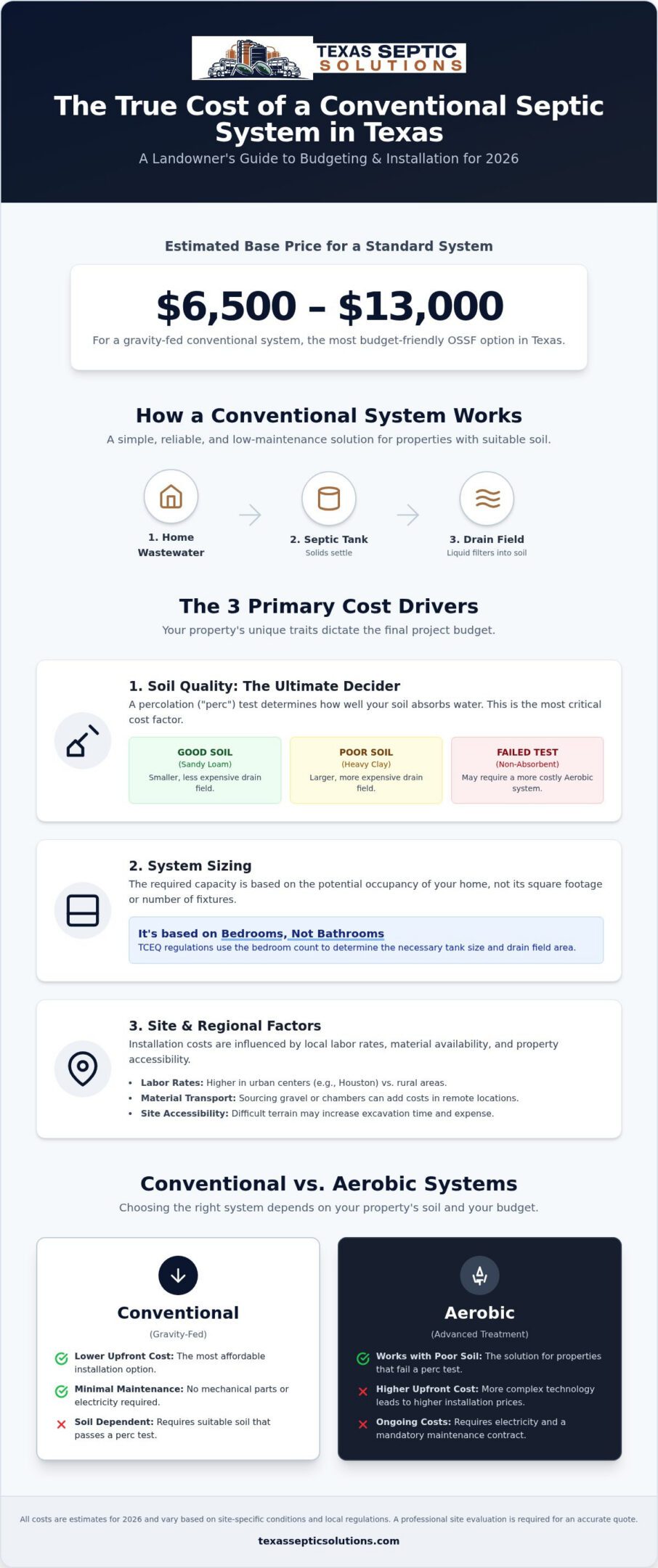
Industry data for 2026 suggests that the base price range for these systems typically falls between $6,500 and $13,000. While every property is unique, the cost to install conventional septic system Texas residents pay is generally the most budget-friendly OSSF option available. An On-Site Sewage Facility (OSSF) is any system designed to treat and dispose of wastewater on the same property where it’s produced, following strict Texas Commission on Environmental Quality (TCEQ) standards. Because conventional setups use gravity instead of electricity or pumps to move effluent, they’re significantly cheaper to install and maintain than aerobic alternatives.
Not every lot qualifies for this traditional setup. Success depends entirely on your land’s ability to absorb water. If your property features sandy or loamy soil with plenty of space, you’re likely a prime candidate for a conventional system. However, if your land consists of heavy clay that holds water like a bathtub, a conventional setup won’t pass local inspections. Soil is the ultimate decider here.
What is Included in a Standard Installation Quote?
When you receive a professional estimate, it should cover the three core pillars of the project. First is the septic tank itself. You’ll usually choose between a precast concrete tank, which is heavy and durable, or a high-density plastic model that’s easier to transport to remote sites. Next, the quote includes the heavy machinery labor required for excavation. Digging the tank pit and the long trenches for the drain field is a precision job. Finally, the price covers the essential “media” for your trenches, such as perforated piping and the gravel or synthetic chambers that allow water to seep into the ground.
Why Texas Prices Vary by Region
Your location in the Lone Star State plays a major role in your final bill. In fast-growing areas like Houston or Cypress, higher labor rates and tighter scheduling can drive up costs. Conversely, in more rural spots like Cleveland or Shepherd, you might find more competitive labor pricing, though transport fees for materials could offset those savings. Material availability also shifts the needle. In some parts of East Texas, high-quality drainage gravel is easy to source. In other areas, installers might use synthetic leaching chambers, which can be more expensive upfront but often require less labor to install. This regional flexibility ensures your system is tailored to the local environment and your specific budget goals.
The 3 Primary Drivers of Your Septic Installation Budget
When calculating the cost to install conventional septic system Texas residents must prioritize three main factors. While the basic components of a tank and drain field remain consistent, your property’s specific characteristics dictate the final estimate. We find that most budget shifts occur because of what’s happening underground, the size of your household, and how easily our crews can reach the dig site. Understanding these drivers helps you avoid the stress of unexpected mid-project expenses.
Soil Testing: The Percolation (Perc) Factor
In regions like Cleveland, Huffman, and Shepherd, soil is the ultimate price decider. A professional site evaluation, which typically costs between $300 and $800 in 2026, determines how quickly your land can process wastewater. If you’re lucky enough to have sandy loam, your drain field can be relatively compact. However, the heavy clay common in many East Texas pockets doesn’t absorb water well. This requires a much larger drain field to meet safety standards, increasing both labor and material costs.
Various laws in Texas apply to septic systems to ensure environmental safety. If your soil fails the percolation test entirely, you might be forced to upgrade to an aerobic system. This is why we always recommend starting with a professional site evaluation before you fall in love with a specific construction plan. It’s the only way to get a realistic view of your land’s capabilities.
Sizing Your System for Long-Term Use
Many homeowners are surprised to learn that the Texas Commission on Environmental Quality (TCEQ) bases system size on the number of bedrooms in a home, not the number of bathrooms. A standard 2 to 3-bedroom home usually requires a 1,000-gallon tank. If you’re building a 5-bedroom family estate, you’ll likely need a 1,500-gallon tank or larger. This sizing directly impacts the septic system replacement cost down the road if you decide to add an addition to your home later. It’s always cheaper to size it correctly now than to dig everything up and expand in five years. A larger system naturally requires more excavation, more piping, and a larger volume of gravel or leaching chambers.
Several variables influence the final cost to install conventional septic system Texas homeowners receive in their quotes, including property layout. If your drain field must be placed far from the house due to well setbacks or property lines, the extra piping and trenching add up. Additionally, site accessibility matters. In wooded areas or tightly packed neighborhoods in Cypress, moving heavy machinery into place can take more time and precision. We focus on straightforward solutions that respect your property’s boundaries while ensuring your system remains dependable for decades.
Conventional vs. Aerobic: A Cost-Benefit Analysis
Choosing the right setup is a balance between your property’s physical needs and your long-term financial goals. While we established that the cost to install conventional septic system Texas residents pay typically averages around $7,000 for standard lots, aerobic systems are a much larger investment. An aerobic system functions like a small-scale municipal treatment plant, using oxygen to break down waste rapidly. This mechanical complexity drives upfront prices to $12,000 or more, nearly doubling your initial layout compared to a traditional gravity-fed system.
The financial gap continues to widen when you look at monthly operations. Conventional systems are passive. They rely on gravity to move effluent, which means they don’t require a power source. Aerobic systems, however, require a constant supply of electricity to run air compressors and pumps 24/7. Over a decade of use, these small daily energy costs add up to a significant sum that conventional system owners never have to consider. When you factor in that conventional systems often last 30 years or more with proper pumping, the return on investment is hard to beat.
Total Cost of Ownership Over 10 Years
When you look at the big picture, the upfront savings of a conventional system are just the beginning. Texas law requires all aerobic systems to be under a mandatory septic system maintenance plan. These contracts usually cost between $250 and $400 every year. With a conventional system, you can skip these recurring service contracts entirely. Repairs are also generally more affordable because you aren’t replacing expensive aerators, control panels, or specialized spray heads that can fail over time.
There’s also the hidden cost of consumables. Aerobic systems often require regular additions of chlorine or bleach tablets to disinfect effluent. Conventional systems rely on natural anaerobic bacteria that live in your tank and soil, performing their job for free. While the cost to install conventional septic system Texas property owners face is lower, the true value lies in these avoided long-term expenses.
When the Decision is Made for You
Sometimes, the choice between these two systems isn’t yours to make. The Texas Commission on Environmental Quality (TCEQ) and local county authorities enforce strict rules based on environmental safety. If your site evaluation reveals a high water table, rocky terrain, or heavy clay that simply won’t absorb water, an aerobic system becomes a requirement rather than an option. Many Houston suburbs and lakeside properties in East Texas fall into this category. If your land fails the initial percolation test, we can help you pivot your budget and design a system that keeps your property compliant and safe.
Permits, Site Prep, and Hidden Costs in East Texas
The cost to install conventional septic system Texas property owners encounter involves more than just the hardware of tanks and pipes. While the mechanical components are straightforward, the administrative and physical preparation of your land can add several layers to your final bill. Navigating the Texas Commission on Environmental Quality (TCEQ) requirements is a mandatory part of the process that ensures your system won’t contaminate local groundwater. In 2026, we’re seeing permit and evaluation fees generally range between $500 and $1,500, depending on your specific county’s fee structure and the complexity of the site evaluation.
Harris, Liberty, and Montgomery counties each have unique nuances when it comes to OSSF (On-Site Sewage Facility) applications. Some counties act as “Authorized Agents” for the TCEQ, meaning they handle the permitting and inspections locally, while others require state-level oversight. This administrative phase typically takes between 4 and 10 weeks from the initial application to the final inspection. We handle this paperwork for our clients to prevent delays that often stem from incomplete submissions or misunderstood local codes.
Permit and Inspection Fees
Your 2026 budget must account for the site evaluation, system design, and the permit application fee. A professional site evaluator must document your soil profile and landscape before any dirt is moved. It’s also important to note that septic system repair permits often follow a different fee schedule than new installations. If you’re building on a new lot, your permit is a comprehensive document that covers the design’s alignment with state health and safety codes. Once the installation is complete, an inspector must visit the site to verify the tank depth, pipe slope, and drain field placement before the system is backfilled and cleared for use.
Site Preparation Challenges
Physical site prep is where many “hidden” costs hide. If you’re building in heavily wooded areas like Shepherd or Cleveland, land clearing and tree removal are significant early expenses. You can’t have large trees near your drain field because roots will eventually seek out the moisture and clog your pipes. Leveling the ground is another critical step. Conventional systems rely on gravity, so the slope of your land must be precisely managed to ensure effluent flows correctly from the house to the tank and then to the field. If your property has steep slopes or rocky outcrops, the extra labor for specialized excavation equipment will increase your quote.
Don’t forget the finishing touches that protect your investment. We highly recommend installing risers, which are extensions that bring your tank lids up to ground level. These typically cost a few hundred dollars but save you significant money during future pumping and maintenance because no one has to dig up your yard to find the access ports. High-quality, heavy-duty lids are also essential for safety, especially if the tank is located near a driveway or high-traffic area. For a clear, line-item estimate that covers every detail of your project, contact our local team today.
Choosing a Texas Septic Installer: Ensuring Your ROI
Your choice of contractor is the final, most critical factor in determining the actual cost to install conventional septic system Texas residents face. A low-ball estimate might look attractive on paper, but it often hides the reality of permit delays or poor design that leads to premature failure. In the 2026 market, ROI isn’t just about the initial price; it’s about the decades of trouble-free service your system provides. Hiring a TCEQ-licensed OSSF installer isn’t just a legal requirement. It’s your insurance policy against environmental fines and property damage.
Local expertise in East Texas soil is a financial safeguard you shouldn’t overlook. An installer who understands the specific clay pockets in Huffman or the high water tables in Shepherd will design a system that actually works for your land. They know how to navigate the “Authorized Agent” process in Harris or Liberty counties, preventing the weeks of permit delays that drive up project costs. Transparency in a quote is the hallmark of a professional. If a contractor can’t explain every line item, from excavation hours to material types, they might be planning to hit you with “unforeseen” fees later.
Questions to Ask Your Septic Contractor
Before you sign a contract, you need to know exactly what you’re paying for. Ask these direct questions to ensure your budget stays on track:
- Are permit fees and soil tests included in this quote? Some installers leave these out to make their base price look lower, leaving you to pay hundreds extra later.
- How do you handle unexpected rock or high water during excavation? You want to know if there’s a flat rate for challenges or if the clock starts ticking the moment they hit a snag.
- What is the warranty period for the tank and the drain field? A reputable installer stands by their work and the materials they use, providing a clear path for resolution if something goes wrong.
The Texas Septic Solutions Advantage
We take pride in being the neighborly expert for families in Cleveland, Houston, and the surrounding communities. Our team doesn’t just drop a tank in the ground and walk away. We provide comprehensive care, from the initial site design to ongoing septic system maintenance. We’ve seen every soil challenge Texas has to offer, and we use that experience to ensure your system is built for the long haul.
You get peace of mind with our 24/7 emergency response for all new installations. If a heavy storm hits or you have a concern at 3 AM, we’re ready to help. We believe in straightforward, honest communication that respects your property and your budget. Get a transparent quote for your Texas septic installation today and let us handle the stress of your 2026 project.
Ready to Start Your 2026 Septic Project?
Planning your property’s utility needs doesn’t have to be a guessing game. While the specific soil on your land and the requirements of your local county are the biggest factors in your final budget, a conventional system remains the most cost-effective choice for qualifying properties. By opting for this traditional gravity-fed setup, you avoid the mandatory maintenance contracts and higher electricity bills that come with aerobic alternatives. Getting a realistic view of the cost to install conventional septic system Texas homeowners should expect starts with a professional site evaluation that accounts for every local regulation.
Our team of TCEQ Licensed Installers is proud to serve Cleveland, Houston, and the surrounding areas with dependable expertise. We handle the stressful permit process and provide 24/7 emergency service availability to ensure your home stays functional long after the initial installation is complete. Don’t let hidden fees or permit delays stall your progress. We’re here to provide the straightforward communication and local knowledge you need for a successful build.
Request a Professional Septic Installation Quote today and take the first step toward a reliable, long-term wastewater solution for your Texas home.
Frequently Asked Questions
Is a conventional septic system legal in all parts of Texas?
Conventional systems are legal throughout Texas provided your property meets the minimum requirements set by the Texas Commission on Environmental Quality (TCEQ). These rules focus on soil depth and separation distances from water sources. However, certain “Authorized Agents” or local river authorities may mandate aerobic systems in areas with high water tables or sensitive aquifers. We always verify your specific county orders and deed restrictions before recommending a conventional setup.
How much does a perc test cost in Texas for 2026?
For 2026, a professional soil site evaluation and percolation test typically costs between $300 and $800. This fee covers the physical inspection of the land and the formal report required for your permit application. This step is a critical part of determining the cost to install conventional septic system Texas residents must pay, as it dictates the exact size and type of drain field your land can support.
Can I install my own septic system in Texas to save money?
Texas law generally requires a licensed OSSF installer for all septic projects to ensure environmental safety. While a few counties offer limited exemptions for individuals building their primary residence, the technical requirements for excavation and pipe slope are extremely strict. Most property owners find that the risk of a failed final inspection or future environmental fines far outweighs the temporary savings of a DIY attempt. We recommend hiring professionals to protect your investment.
How long does it take to install a conventional septic system in Houston?
The physical installation of a conventional system usually takes between two and four days once the heavy machinery arrives on site. However, the entire timeline in the Houston area often spans four to ten weeks. This duration includes the mandatory site evaluation, the professional design period, and the county’s review of your permit application. Weather delays and inspector availability in fast-growing counties can also influence the final project schedule.
Will a conventional system affect my property value compared to aerobic?
A well-functioning conventional system often adds more value to a property than an aerobic one because of the lower long-term maintenance costs. Homebuyers appreciate that conventional setups don’t require mandatory service contracts or monthly electricity expenses for air pumps. As long as your system is properly sized and has a documented history of maintenance, it will be seen as a reliable utility asset rather than a recurring financial burden during a sale.
What happens if my septic tank alarm goes off right after installation?
If your alarm sounds shortly after installation, it’s often related to a float switch adjustment or a sudden surge in water usage as the system stabilizes. It could also indicate that heavy rains have saturated the ground during the backfilling process. Since we offer 24/7 emergency support, you should call us immediately to diagnose the issue. We’ll check the electrical connections and tank levels to ensure everything is operating as designed.
Do I need to pump a new conventional septic system every year?
You don’t need to pump a new conventional system annually. Most systems in Texas require pumping every three to five years, depending on your household size and water habits. Pumping too frequently is an unnecessary expense, while waiting too long can lead to solids escaping into your drain field and causing a total system failure. We can help you set a realistic schedule based on your actual usage during the first year of operation.
Are there any Texas grants or loans for septic system replacement?
Some Texas homeowners may qualify for low-interest loans or grants through the USDA Rural Development program or local Councils of Governments. These programs are typically aimed at low-income households or properties in environmentally sensitive areas. While these funds aren’t available for every project, they are worth investigating if you’re facing a mandatory replacement. We can provide the technical documentation needed to support your application for these financial assistance programs.