
Commercial Septic Tank Maintenance Schedule: The 2026 Facility Manager’s Checklist
Could your entire commercial operation survive a three day closure just because of a preventable plumbing failure? For most facility managers in East Texas, a sewage backup isn’t just a mess; it’s a direct threat to the bottom line and a source of significant regulatory stress. You likely already know that staying ahead of wastewater issues is better than reacting to them, but the shifting landscape of TCEQ requirements and evolving technology can make it difficult to know exactly where to start.
We’re here to help you regain control with a professional commercial septic tank maintenance schedule designed for 2026. By following this checklist, you can eliminate the fear of unexpected repair costs and ensure your system remains fully compliant with state laws. We’ll walk through the specific inspection frequencies required for aerobic systems, how to align pumping cycles with your actual facility usage, and the latest smart monitoring tools that provide long term reliability. Whether you’re managing a retail center in Houston or an industrial site in Cleveland, this guide ensures your facility stays open and your budget stays predictable.
Key Takeaways
- Learn how to navigate TCEQ regulations and mandatory aerobic system inspections to keep your facility fully compliant and avoid legal penalties.
- Discover how to build a custom commercial septic tank maintenance schedule that aligns pumping frequency with your specific business wastewater load rather than generic estimates.
- Identify the daily and monthly indicators that signal system stress before they escalate into costly business closures or emergency repairs.
- Understand the technical metrics professional inspectors use, like sludge-to-scum ratios, to verify the structural health of your concrete or poly tanks.
- Gain peace of mind by establishing a 24/7 emergency response plan that protects your high-stakes operations from sudden system failures.
The Critical Importance of a Commercial Septic Maintenance Schedule
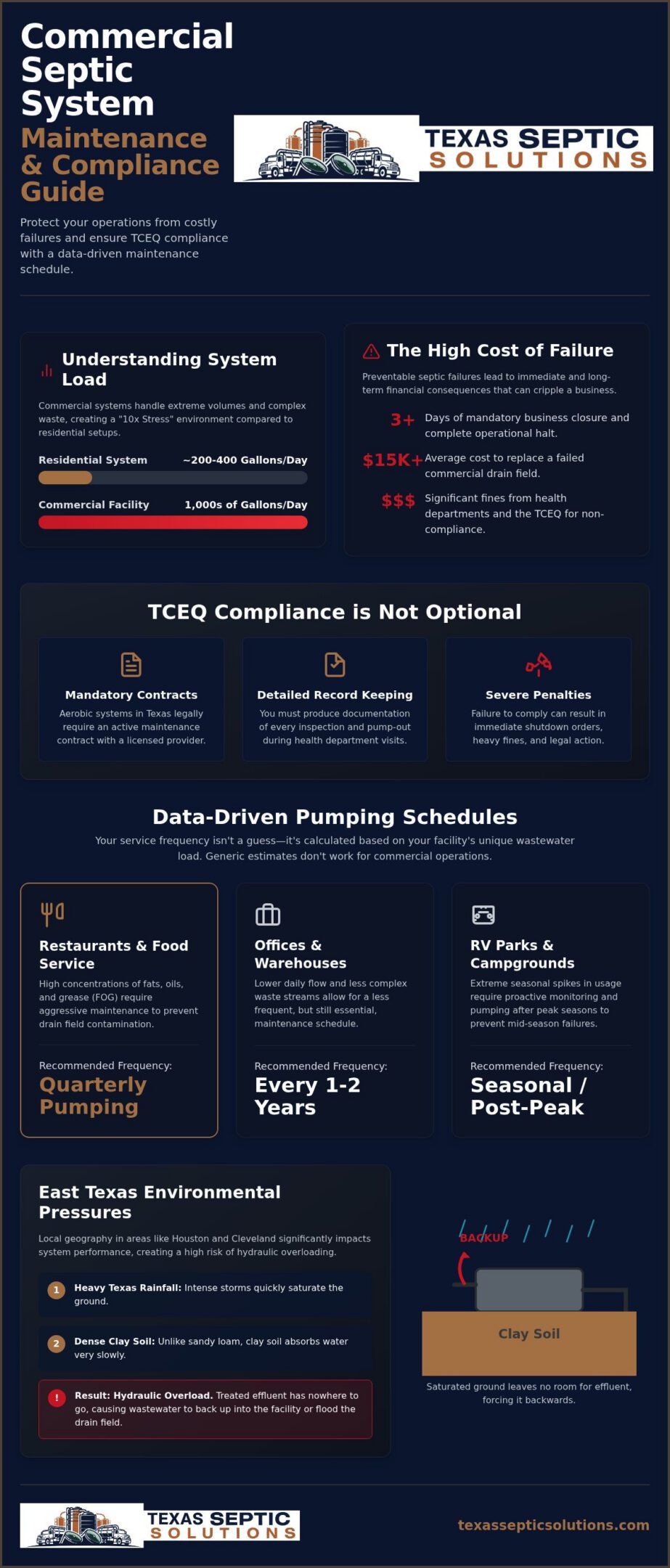
Commercial septic systems aren’t just larger versions of home setups. They are high performance utilities that handle massive daily volumes. A standard household might flush a few hundred gallons a day, but a busy restaurant or RV park in East Texas can easily push thousands of gallons through the pipes. This volume creates a “10x stress” environment where solids don’t have as much time to settle. Without a rigorous commercial septic tank maintenance schedule, this constant pressure quickly turns into a system failure that stops your business in its tracks.
When a system backs up, business stops immediately. You can’t run a commercial kitchen or a hotel without working drains. Beyond the immediate loss of revenue, chronic neglect leads to catastrophic drain field failure. Replacing a drain field can cost upwards of $15,000 based on national averages. Protecting the structural integrity of your system isn’t just about plumbing; it’s about preserving your property’s market value. A certified maintenance history is a major asset during any commercial real estate appraisal or sale.
Commercial vs. Residential: Understanding the Load
Commercial facilities introduce complex waste streams that residential systems simply aren’t built for. Restaurants deal with high concentrations of fats, oils, and grease (FOG), while industrial sites often introduce harsh cleaning agents. These chemicals can disrupt the delicate biological balance required for How Septic Systems Work, effectively “killing” the beneficial bacteria that break down solids. To manage this, commercial designs often utilize multi compartment tanks and larger capacities to allow more time for separation and treatment. If your business type changes, your load changes, making your schedule even more critical.
The Legal Stakes: TCEQ Compliance and Beyond
In Texas, the Texas Commission on Environmental Quality (TCEQ) sets strict standards for commercial wastewater management. For aerobic systems, state law requires an active maintenance contract with a licensed provider. Failing to produce documentation during a health department inspection can lead to heavy fines or immediate shut down orders. Staying compliant means keeping detailed records of every pump out and inspection performed. It’s not just a suggestion; it’s a legal requirement to keep your doors open and your operations legal in 2026.
Determining Your Service Frequency: The Data-Driven Framework
Your commercial septic tank maintenance schedule shouldn’t be based on a guess. It should be based on math. To calculate your ideal service frequency, we look at the intersection of tank capacity and daily wastewater flow. While the EPA Septic Care Guidelines provide a solid baseline, commercial facilities in East Texas face unique environmental pressures that require a more tailored approach. A 2,500 gallon tank might seem large, but if it’s serving a 24 hour truck stop, it will reach capacity much faster than a 1,000 gallon tank at a small local boutique.
Business-Specific Pumping Intervals
Different industries demand different levels of care. Restaurants, for example, deal with high levels of fats, oils, and grease (FOG). Even with grease traps, these solids accumulate quickly. We typically recommend quarterly pumping for food service providers to prevent grease from migrating into the drain field. In contrast, office buildings or warehouses with low employee counts might only need deep inspections every one to two years. RV parks and campgrounds present a different challenge: seasonal spikes. During peak travel seasons, these systems handle maximum capacity, making high frequency monitoring essential to prevent a mid season backup. If you’re managing a venue that hosts large events, you should schedule a pump out immediately following your busiest month to clear out the sudden influx of solids.
Environmental Factors in Houston and Cleveland
Geography plays a massive role in how your system performs. In areas like Houston and Cleveland, the heavy clay soil doesn’t absorb water as quickly as sandy loam. When we experience heavy Texas rainfall, the ground becomes saturated, leaving nowhere for your treated effluent to go. This often leads to hydraulic overloading. Hydraulic overloading occurs when a system is forced to process more liquid than it was designed to handle, causing wastewater to back up or flood the drain field. High water tables in coastal-adjacent regions further complicate this. Your drain field requires more frequent monitoring to ensure it isn’t drowning during the rainy season. To stay ahead of these local challenges, integrating local soil conditions into your commercial septic tank maintenance schedule is the only way to ensure long term reliability. If you’re seeing slow drains after a storm, it’s time to consult with a local septic expert before the problem escalates.
The Essential Commercial Maintenance Checklist
A successful commercial septic tank maintenance schedule relies on a mix of quick visual checks and professional technical audits. While the previous sections focused on why frequency matters, this checklist outlines exactly what needs to happen on the ground. By staying proactive, you can catch minor issues before they turn into the kind of backups that force a business closure. Following EPA septic system care guidelines helps establish a baseline for these tasks, ensuring your facility remains safe and operational.
Daily observations are your first line of defense. Train your staff to watch for slow drains or unusual odors in restrooms. Monthly, you should transition to a more structured internal audit. This includes reviewing your water bills for unexplained spikes, which often indicate a hidden leak that is drowning your septic system. Quarterly, the focus shifts to the mechanical heart of the setup, where we verify that pumps, floats, and aerators are cycling correctly. Finally, an annual professional deep dive provides a “State of the System” report, giving you a clear picture of the tank’s structural health and sludge levels.
Weekly and Monthly In-House Tasks
Monitoring your equipment is a simple way to prevent disaster. If you hear your septic tank alarm, it’s usually a sign that water levels are too high or a pump has failed. Don’t ignore it. Walk your drain field area weekly to look for surfacing sewage or patches of lush, unusually green vegetation, which are classic signs of a failing leach field. Monthly record keeping of these observations creates a paper trail that is invaluable during TCEQ inspections or when troubleshooting a recurring issue with your service provider.
Technical Component Maintenance
The mechanical parts of a commercial system face constant wear. Cleaning effluent filters is a critical task that prevents solid waste from escaping the tank and clogging your leach field pipes. We also recommend testing all electrical components and backup power systems quarterly to ensure they’ll perform during a Houston area storm. For safety and accessibility, verify the integrity of manhole covers and risers. Ensure they are locked and haven’t suffered any cracks or structural shifts. Keeping these components in top shape ensures the system remains reliable even under the heavy loads typical of East Texas commercial operations.
Professional Inspections: What the Neighborly Experts Look For
Maintaining total property security is just as important as protecting your underground utilities. For those who also manage properties in North Texas, Gate Tech Pros provides specialized care for automatic gate systems, illustrating how every critical component of a commercial facility benefits from professional oversight.
Professional inspections are the backbone of a reliable commercial septic tank maintenance schedule. While your facility team handles daily visual checks, our technicians use specialized tools to verify what is happening deep below the surface. We focus on the “sludge to scum” ratio to determine exactly how much capacity your tank has left. If the bottom sludge layer rises to within 12 inches of the outlet pipe, your system is at risk of pushing solids into the drain field, which often leads to expensive failures. We also perform structural integrity checks, looking for hydrogen sulfide corrosion in concrete tanks or shifting and bowing in poly tanks.
For aerobic systems, the technical requirements are even stricter. In Texas, TCEQ regulations typically require these systems to be inspected every four months by a licensed provider. We test air pressure from the compressor to ensure the bacteria have enough oxygen to treat the waste. We also verify chlorine residual levels to guarantee the effluent is properly disinfected before it leaves the system. Finally, we conduct drain field stress tests to confirm the local East Texas soil is still absorbing liquid at the required rate, preventing the “swampy” conditions that signal a failing leach field.
Advanced Troubleshooting for Large Systems
Large scale commercial systems often suffer from “short circuiting.” This occurs when wastewater moves too quickly through the tanks, bypassing the necessary treatment stages and heading straight for the exit. We use high resolution camera inspections to look inside commercial lateral lines for hidden blockages or structural collapses. If we identify issues in aging infrastructure, we evaluate specific septic system repair needs to stabilize the system. Catching these problems early during a scheduled visit prevents the need for a 24/7 emergency response later.
The Pumping Process: More Than Just Emptying the Tank
When your schedule dictates a pump out, the process must be thorough to be effective. We use back flushing techniques to break up the heavy “mat” of solids that settles at the bottom of the tank. This ensures we remove all waste rather than just the liquid on top. During the pump out, we inspect the inlet and outlet baffles. These T shaped pipes are critical because they keep solids where they belong. If they are missing or damaged, your system cannot function correctly. We handle all waste disposal in strict accordance with Texas law, providing you with the necessary manifests to prove your facility is in full environmental compliance. If your system is due for its next check, schedule your professional commercial inspection to keep your operations running smoothly.
Partner with Texas Septic Solutions for Commercial Success
Managing a commercial facility is demanding enough without the looming threat of a utility failure. We specialize in providing customized maintenance plans for businesses across Cleveland, Houston, and Cypress, ensuring your operations remain uninterrupted. Our approach ensures your commercial septic tank maintenance schedule is a living strategy that protects your specific infrastructure. We bring seasoned expertise to both aerobic and anaerobic commercial installations, providing a one stop solution from initial setup to long term care. By partnering with us, you’re choosing a team that understands the high stakes of commercial wastewater management.
We offer 24/7 emergency septic service because we know that critical failures don’t wait for business hours. For high stakes operations like medical clinics, hotels, or restaurants, this immediate response serves as a vital safety net. Beyond emergency care, we prioritize streamlined reporting for your facility management records. Every professional inspection, pump out, and minor repair is documented clearly. This provides you with a ready to use paper trail for TCEQ compliance and health department audits, saving you time and reducing administrative stress during annual reviews.
Why Local Expertise Matters in East Texas
We live and work in the same communities you serve. This gives us a deep understanding of the unique environmental challenges in our region, from the heavy clay soils in Cleveland to the high water tables surrounding Houston. We don’t just apply generic formulas; we use our local knowledge to anticipate how seasonal Texas rainfall will impact your system’s performance. Our “Neighborly Expert” approach is built on accountability and long term relationships. We’ve earned our reputation with property managers throughout East Texas by being the reliable authority they can call when things get tough.
Ready to Secure Your System?
Securing your facility’s future starts with shifting from a reactive mindset to a proactive one. Implementing a professional commercial septic tank maintenance schedule allows you to stabilize your maintenance budget and ensure long term reliability. You can start a professional septic system maintenance plan today to protect your investment and avoid the high costs of emergency repairs. Having a dependable local partner on your side gives you the peace of mind to focus on your business while we handle the wastewater. Don’t wait for a backup to disrupt your week. Contact Texas Septic Solutions for a commercial consultation and let’s build a maintenance calendar that works for your facility.
Secure Your Facility’s Future with Proactive Management
Mastering your wastewater system doesn’t have to be a source of constant stress. By shifting from a reactive mindset to a data-driven approach, you ensure your business remains open and your budget stays predictable. We’ve covered how to align your pumping frequency with actual usage and the technical markers our experts look for during inspections. Remember that compliance with TCEQ standards is your best defense against unexpected shutdowns and environmental penalties.
Implementing a robust commercial septic tank maintenance schedule is the most effective way to protect your infrastructure and property value. As your local partner serving Houston, Cleveland, and Cypress, we bring the expertise needed to navigate East Texas soil conditions and regulatory requirements. Our team is ready to support you with 24/7 emergency response and comprehensive care tailored to your specific facility needs.
Protect your business with a Professional Commercial Maintenance Plan. We are here to help you keep your facility running smoothly and legally through 2026 and beyond.
Frequently Asked Questions
How often should a commercial septic tank be pumped compared to a residential one?
Commercial systems typically require pumping every one to three years, whereas residential setups often last three to five years. This increased frequency is due to higher wastewater volumes and complex waste streams. High-usage businesses, such as restaurants, may even need quarterly service to manage solids effectively. Your specific commercial septic tank maintenance schedule should be based on your actual flow rates and tank capacity to prevent overflows and system stress.
What are the TCEQ requirements for commercial septic system inspections in Texas?
In Texas, aerobic septic systems are required by the TCEQ to be inspected every four months by a licensed provider. This interval can be extended to every six months if your system uses approved electronic monitoring. State law also mandates that owners maintain an active maintenance contract. These regulations ensure that high-volume commercial systems don’t contaminate local groundwater or create public health hazards in our East Texas communities.
Can a commercial septic system handle grease and oils from a restaurant?
A commercial septic system can handle grease and oils only if it’s paired with a properly sized and maintained grease trap. Without this secondary treatment, fats, oils, and grease (FOG) will bypass the tank and clog your drain field pipes. This leads to hydraulic failure and expensive repairs. Regular grease trap cleaning must be a core part of your maintenance routine to protect the biological health of your septic tank.
What are the warning signs that my commercial septic tank is about to fail?
Common warning signs include slow-clearing drains, gurgling sounds in the plumbing, or persistent sewage odors around your property. You might also notice unusually lush, green patches of grass or standing water over the drain field area. If your septic alarm sounds, it’s a clear indicator of a mechanical failure or a high-water event. Catching these symptoms early during a routine inspection prevents a full system collapse and business closure.
Does my business need a specialized permit for a large-capacity septic system?
Yes, if your system serves 20 or more people per day, it’s classified as a large-capacity septic system by the EPA. These are regulated under the Safe Drinking Water Act’s Underground Injection Control program as Class V wells. You must meet federal requirements to protect underground water sources. Additionally, local Texas health departments may have specific permitting and documentation rules that go beyond standard residential requirements for these high-volume setups.
What happens if a commercial septic system fails during business hours?
If a failure occurs during business hours, you’ll likely need to close your doors immediately to comply with health and safety codes. A sewage backup is a biohazard that prevents you from serving customers or hosting employees. This is why we offer 24/7 emergency septic service across Houston and Cleveland. Having a professional team on call ensures that repairs happen quickly, minimizing your lost revenue and getting your facility back online.
Are aerobic systems better for commercial properties than traditional anaerobic tanks?
Aerobic systems are often superior for commercial properties because they provide a higher level of wastewater treatment, making them ideal for poor soil or high-strength waste. However, they are more complex and require more frequent inspections and electricity to run the aerators. Traditional anaerobic tanks are simpler and cheaper to maintain but may not meet the environmental standards required for large-scale operations or specific TCEQ commercial zones.
How much does a commercial septic maintenance plan typically save a business over five years?
A professional maintenance plan can save a business tens of thousands of dollars by preventing catastrophic drain field failure, which can cost over $15,000 to replace. It also eliminates the risk of heavy fines and revenue loss from closures. By following a commercial septic tank maintenance schedule, you avoid the high-pressure expenses of sudden mechanical failures and extend the total lifespan of your critical infrastructure.