
Commercial Septic System Inspection Checklist for Cypress, TX Properties (2026)
Did you know that Harris County requires aerobic septic inspections every three months, a standard significantly stricter than the Texas state minimum? Managing a septic system inspection for commercial property Cypress TX involves more than just checking boxes. It’s about protecting your bottom line and your reputation. We understand that local property managers often feel the weight of these regulations, especially with the constant worry about Harris County Public Health fines or the nightmare of a system failure during peak business hours. It’s stressful to juggle complex aerobic versus anaerobic requirements while trying to keep your operations running smoothly.
We’ve developed a professional 20-point checklist designed to help you master these complexities and ensure your business remains compliant and operational throughout 2026. This guide breaks down the latest TCEQ rule updates, specific Harris County design requirements, and the exact steps needed to prove your system’s integrity for insurance or future sales. By following this roadmap, you’ll minimize long-term repair costs through early detection and maintain total peace of mind as a responsible Cypress property owner.
Key Takeaways
- Understand the updated 2026 Harris County standards for commercial wastewater and how they impact your facility’s legal compliance.
- Master the 20-point mechanical and structural checklist to streamline your next septic system inspection for commercial property Cypress TX.
- Learn the critical differences between routine maintenance and the high-stakes inspections required for commercial real estate transactions.
- Discover how to prepare your property by organizing maintenance logs and clearing access ports to avoid inspection delays.
- Identify early warning signs of system failure to prevent costly business downtime and expensive emergency repairs.
Understanding Commercial Septic Regulations in Cypress and Harris County
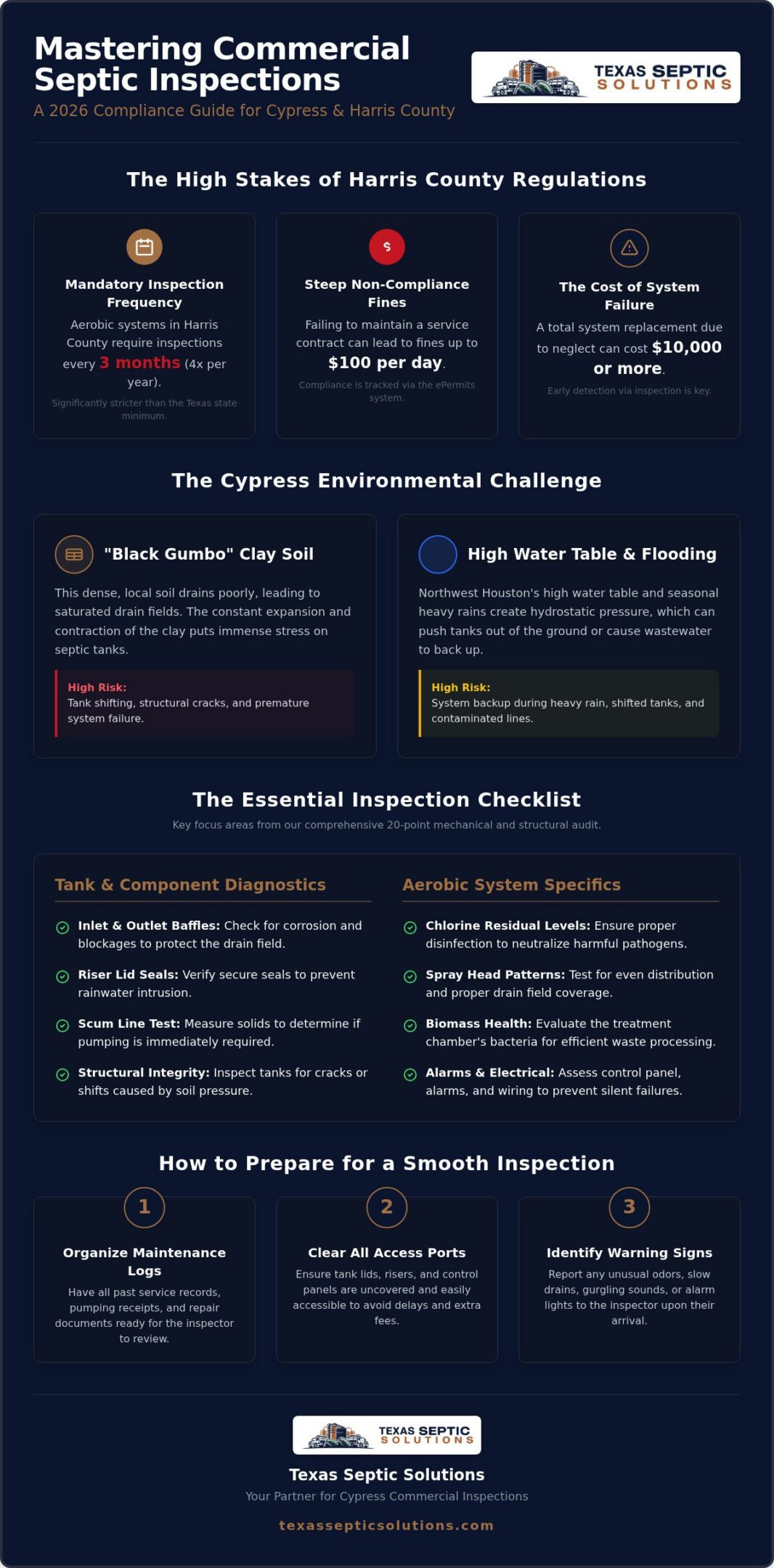
Harris County acts as the TCEQ’s “Authorized Agent,” meaning local inspectors have the final word on your facility’s operation. As of 2026, updated 30 TAC Chapter 285 rules are in full effect, placing a heavier emphasis on performance-based permitting. For businesses, this means your effluent discharge levels are under a microscope. A standard septic tank system for a retail center or office complex handles significantly more stress than a home system. Because of this high volume, Harris County requires professional engineering for food service designs and either an engineer or a licensed sanitarian for other commercial sites. Regularly scheduling a septic system inspection for commercial property Cypress TX is the only way to stay ahead of these mandates.
Harris County Public Health Compliance
Businesses located along the Highway 290 corridor and near the Grand Parkway face specific scrutiny due to rapid development and sensitive local watersheds. If you operate an aerobic system, Harris County mandates an inspection every three months. This is four times a year, which is more frequent than the state’s minimum requirement. Failing to maintain a continuous service contract with a licensed provider is a major pitfall. Inspectors use the ePermits system to track compliance, and missing a single report can lead to fines reaching $100 per day. We help property managers avoid these penalties by ensuring all mechanical components meet the 2026 standards during every visit.
Environmental Factors Unique to Northwest Houston
Cypress is famous for its “black gumbo” clay. This dense soil doesn’t drain well, often leading to saturated drain fields if the system isn’t perfectly calibrated. When you combine this with the high water table common in Northwest Houston, your system’s structural integrity is constantly tested. Seasonal flooding in the Houston area adds another layer of risk. Heavy rains can cause hydrostatic pressure to shift tanks or backup lines. A professional inspection doesn’t just look at the pumps; it evaluates how these environmental stressors are affecting your tanks and lines. We check for cracks or shifts caused by the expanding and contracting clay, helping you avoid a total system failure that could cost $10,000 or more to replace. Staying proactive with your septic system inspection for commercial property Cypress TX is simply good business in this climate.
The Essential 20-Point Mechanical and Structural Inspection Checklist
A thorough septic system inspection for commercial property Cypress TX goes far beyond a simple visual check. It requires a deep dive into the mechanical heart and structural skeleton of your wastewater setup. Following Texas septic system regulations ensures your business avoids environmental hazards and costly shutdowns. We look at everything from the thickness of your tank walls to the precise timing of your pump cycles. Our goal is to catch small issues before they become five-figure repairs.
Tank and Component Diagnostics
We start by inspecting the inlet and outlet baffles. These components prevent solids from entering the drain field, and corrosion here is a common cause of system failure. We also verify that riser lids are securely sealed. This prevents surface water from Northwest Houston’s heavy rains from overwhelming your tank. The scum line test measures the distance between the bottom of the outlet pipe and the top of the floating scum layer to determine if the tank requires immediate pumping. We also check the structural integrity of the primary and secondary tanks for any signs of shifting or cracking caused by our local clay soil.
Aerobic System Specifics for Businesses
High-traffic businesses rely on aerobic systems to treat waste quickly. During an inspection, we verify chlorine residual levels in the disinfection chamber to ensure harmful pathogens are neutralized. We also test spray head patterns for even distribution and evaluate the health of the biomass in the treatment chamber. If the bacteria aren’t thriving, the system won’t process waste efficiently. We also assess the control panel, alarms, and electrical wiring. A faulty alarm might not seem urgent, but it’s your only warning before a backup occurs. If you notice odors or alarm lights, our team provides expert septic system repair to get your facility back on track.
Drain Field and Soil Absorption Assessment
The drain field is where the magic happens, but it’s also where many commercial systems fail. We probe the area for hydraulic overloading, which happens when a business exceeds its designed daily flow. We also look for invasive roots that can crush lateral lines. Finally, we check for soil compaction. This often occurs when vehicles drive over the drain field area, a common issue in Cypress industrial parks where parking is tight. We analyze the distribution box to ensure effluent is flowing evenly across all lines, preventing “hot spots” that lead to surfacing sewage.
Compliance vs. Real Estate: Choosing the Right Inspection Type
Understanding the difference between a routine compliance check and a comprehensive real estate evaluation is vital for any Cypress business owner. A standard maintenance visit ensures you meet the minimum Harris County standards, but it rarely uncovers the deep-seated issues that a buyer or insurer needs to know. In 2026, the stakes are higher than ever. With updated TCEQ rules in place, choosing the wrong type of septic system inspection for commercial property Cypress TX can lead to missed liabilities or unexpected permit denials during a title transfer.
Real Estate Transaction Inspections
When you’re buying or selling a commercial property, a “pass” on a county audit isn’t enough. We perform load testing to simulate peak business usage. This involves introducing a specific volume of water into the system to see how the drain field and pumps handle a high-volume day. For a potential buyer, this verifies that the system has the capacity for their specific operations. We also review years of historical maintenance records to spot recurring mechanical failures. These “hidden” issues often impact property valuation. Discovering a failing pump or a saturated lateral line during due diligence can save a buyer from a $10,000 replacement shortly after closing. A thorough septic system inspection for commercial property Cypress TX provides the proof of integrity needed for a smooth sale.
Preventative Maintenance Audits
Routine compliance audits are your best defense against business downtime. These regular check-ins focus on keeping your operating permit active and avoiding those $100-per-day Harris County fines. By catching a worn compressor or a clogged spray head early, these audits often prevent the need for extensive septic system repair. We recommend setting up a structured septic system maintenance plan tailored to your facility’s specific effluent output. In high-use industrial environments, the ROI of early detection is clear. Spending a few hundred dollars on a professional audit is a small price to pay compared to the thousands lost during a total system backup that forces your doors to close. Whether it’s a routine quarterly check or an emergency diagnostic after an alarm sounds, we provide the clarity you need to keep your business running.
Preparing Your Cypress Commercial Facility for a Professional Audit
Setting the stage for a septic system inspection for commercial property Cypress TX makes the entire process smoother and more cost-effective. When our team or a Harris County inspector arrives, every minute spent searching for a buried lid is a minute not spent testing your system’s health. Taking a proactive approach to preparation ensures we can complete the audit quickly, allowing your business to return to normal operations without delay. By organizing your site, you ensure that every part of the septic system inspection for commercial property Cypress TX is handled with precision.
Administrative and Documentation Prep
Start by gathering your facility’s site maps and “as-built” drawings. These documents show the exact layout of tanks, lines, and the drain field, which is essential for a thorough evaluation. We also need to know about any recent changes in occupancy or high-volume events. For instance, if your retail center recently added a high-traffic restaurant, the effluent load has likely shifted. If you have been dealing with a septic tank alarm going off, have those dates and details ready. Having your previous Harris County permit records and maintenance logs organized creates a professional impression and proves you are committed to compliance.
Physical Site Preparation
Clear any brush, debris, or overgrowth from the tank area and the drain field. Access ports must be visible and unobstructed. If your lids are buried, uncovering them beforehand saves labor costs during the visit. We also need a clear path for heavy service vehicles. If we need to perform a pump-out or high-volume load test, our equipment requires stable ground and enough space to maneuver. This is especially important for properties near Highway 290 where construction or tight parking lots can limit access.
Don’t forget to identify the location of grease traps if you are in the food service industry, as these are often integrated into the overall waste management audit. Ensure that all electrical sub-panels and control boxes are unlocked and accessible for safety testing. Finally, notify your staff about the upcoming audit. We may need to restrict water usage for short periods to perform accurate load testing or component checks. A quick heads-up to your team prevents confusion and ensures the inspection proceeds without interference. If you’re ready to get your facility in top shape, you can schedule your commercial septic service with our local experts today.
Texas Septic Solutions: Your Partner for Cypress Commercial Inspections
Texas Septic Solutions stands as the reliable local authority for every septic system inspection for commercial property Cypress TX. We don’t just check the mechanics; we understand how Northwest Houston’s unique environment impacts your facility’s infrastructure. Our team navigates the specific Harris County regulatory hurdles that often trip up providers who lack local expertise. We provide clear, actionable reporting that helps property managers make informed decisions without the stress of deciphering technical jargon. If our audit identifies an issue, our transition from diagnostic inspection to professional repair or pumping is seamless, ensuring your business stays operational.
Why Cypress Businesses Trust Our Expertise
Cypress facility managers rely on us because we understand that waste management is critical to business continuity. We offer 24/7 emergency service because system failures don’t wait for standard business hours. Whether you’re managing a high-volume restaurant or a large-scale warehouse, we’ve seen and solved every effluent challenge imaginable. Our proactive approach helps you avoid a massive septic system replacement cost by identifying minor wear before it causes a total collapse. We treat your property with the same care we’d give a neighbor, ensuring your utility systems remain sturdy and responsive under any load.
Next Steps: Scheduling Your Commercial Audit
When you schedule a septic system inspection for commercial property Cypress TX with our team, you’ll receive a detailed final report that outlines your system’s current health and compliance status. This document serves as vital proof of integrity for your records, insurance providers, or potential buyers. We don’t just hand over a checklist; we consult on long-term septic system maintenance Texas strategies to keep your facility running efficiently for years. Our goal is to build a long-term partnership based on trust and results. Contact our Cypress team today to discuss your facility’s specific needs and receive a customized service quote. We’re ready to help you stay compliant, protected, and fully operational.
Secure Your Business Continuity Today
Managing a commercial facility in 2026 means staying one step ahead of strict Harris County requirements. We’ve seen how proactive maintenance and a thorough 20-point checklist prevent the high-cost failures that force businesses to close. Whether you’re navigating a complex real estate transaction or simply keeping your quarterly permits active, our team provides the local expertise needed to stay compliant. Maintaining a reliable septic system inspection for commercial property Cypress TX is a strategic investment in your facility’s future.
Texas Septic Solutions is here to be your long-term partner in waste management. As Harris County regulatory experts, we understand the specific soil and flooding challenges unique to Cypress, Houston, and Cleveland, TX. We offer 24/7 emergency service availability to ensure you’re never left stranded by a system failure. Don’t wait for an alarm to signal a crisis when you can protect your property right now. Schedule Your Commercial Septic Inspection with Texas Septic Solutions Today. We look forward to helping you keep your business running smoothly and safely.
Frequently Asked Questions
How often does a commercial septic system in Cypress need to be inspected?
Commercial aerobic systems in Cypress must be inspected every three months according to Harris County standards. This schedule is more frequent than the standard Texas state minimum to ensure high-volume systems function correctly. If your business uses a conventional anaerobic system, your specific permit will dictate the frequency. Staying on top of this quarterly requirement is critical for maintaining your “Authorization to Operate” and avoiding daily fines from local environmental health departments.
Do commercial septic inspections in Harris County require a special license?
Yes, inspections must be performed by a professional holding a valid TCEQ license. In Harris County, the regulatory environment is strict. For food establishments, the design and certain oversight must involve a Professional Engineer. For other commercial properties, a Licensed Registered Sanitarian or a Professional Engineer is required. We maintain all necessary local and state credentials to ensure your septic system inspection for commercial property Cypress TX meets every legal standard.
What is the difference between a residential and commercial septic inspection?
The primary difference lies in the volume of effluent and the complexity of the components. Commercial systems often handle high-strength waste, especially in restaurants, which requires specialized filtration and larger tanks. While a residential check focuses on basic functionality, a commercial audit evaluates mechanical stress, high-volume pump cycles, and strict Harris County reporting compliance. The regulatory scrutiny for businesses is significantly higher due to the potential environmental impact of larger waste volumes.
Can a failed septic inspection lead to business closure in Cypress?
A failed inspection can lead to business closure if the system poses an immediate public health threat. Harris County Public Health has the authority to revoke your operating permit if sewage surfaces or if the system cannot process waste safely. Beyond closure, ongoing violations can result in fines of up to $100 per day. We prioritize rapid septic system repair to address failures quickly and keep your facility compliant and open for business.
How much does a commercial septic inspection cost for a Cypress property?
The cost of an inspection depends on the size of your system, its location, and the depth of the audit required. A standard regulatory compliance check for an aerobic system is typically less involved than a full “due diligence” inspection for a property sale. Factors like tank accessibility and the need for specialized load testing also influence the final quote. We provide customized estimates based on your facility’s specific wastewater design and usage patterns.
What happens if the inspector finds a leak in my commercial septic tank?
If a leak is discovered, it’s considered a critical failure that requires immediate attention to prevent soil contamination. We’ll document the location and severity of the leak in your official report. Depending on the tank material, we may recommend a specialized repair or, in cases of severe structural compromise, a full tank replacement. Our 24/7 emergency service team is equipped to handle these urgent repairs to minimize your business downtime and environmental liability.
Does my Cypress business need a grease trap inspection along with the septic audit?
If your business processes food, you definitely need a grease trap inspection alongside your septic audit. Grease is the leading cause of commercial drain field failure in Cypress. Fats, oils, and grease can clog lateral lines and kill the beneficial bacteria in your treatment chamber. We evaluate the entire waste stream to ensure your grease trap is effectively protecting your septic system inspection for commercial property Cypress TX from premature and costly damage.
How long does a full commercial septic inspection typically take?
A standard commercial inspection typically takes between two and four hours. The duration varies based on the number of tanks, the complexity of the control panels, and how well the site is prepared. If all access ports are uncovered and maintenance logs are ready, the process is much faster. More intensive audits, such as those involving hydraulic load testing for a real estate transaction, may take longer to ensure all components handle peak flow.