
Commercial Septic System Design in Texas: The 2026 Professional Guide
What if the most expensive part of your new Texas development isn’t the foundation or the framing, but a single overlooked line in a TCEQ permit? For many business owners in Houston or Cleveland, the thought of navigating state regulations and high-strength waste requirements is enough to stall a project before it even starts. You’re right to feel that pressure. A system that fails to meet the updated 2026 standards for commercial septic system design Texas doesn’t just lead to hefty fines; it can shut your doors entirely during a peak season.
Mastering your facility’s wastewater needs is about more than just staying legal; it’s about protecting your investment and ensuring your operations never skip a beat. We’ll show you how to navigate the engineering and permitting maze with the confidence of a local expert. This guide breaks down the latest Chapter 285 updates, explains the critical thresholds for high-strength sewage, and provides a clear roadmap for a system that grows alongside your business. You’ll gain the clarity needed to avoid emergency repairs and keep your facility running smoothly for years to come.
Key Takeaways
- Understand how the 2026 TCEQ Chapter 285 updates impact your permit and how local Authorized Agents in counties like Harris and Liberty manage enforcement.
- Learn the critical differences between residential and commercial septic system design Texas, specifically focusing on how to manage high-strength waste and fluctuating daily flows.
- Discover why Biochemical Oxygen Demand (BOD) is the most important metric for restaurants and RV parks to prevent system failure and regulatory fines.
- Get a step-by-step breakdown of the site evaluation process, from analyzing Huffman’s sandy loams to handling the heavy clays found in Cypress.
- See why professional installation and accurate “as-built” drawings are essential for long-term reliability and simplifying future maintenance or repairs.
Fundamentals of Commercial Septic System Design in Texas
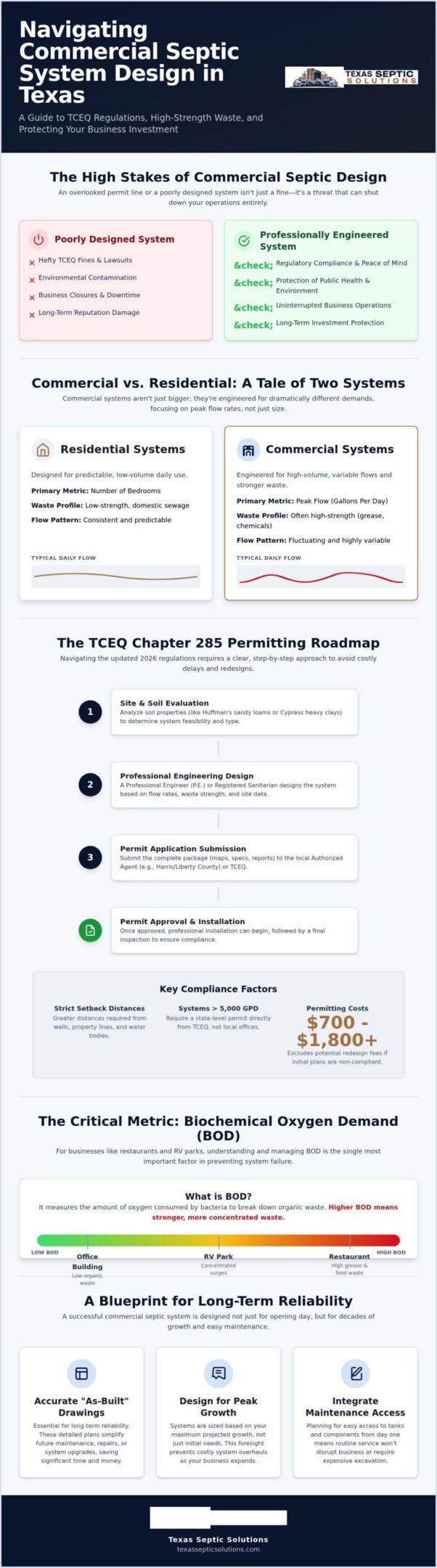
Texas law defines a commercial On-site Sewage Facility (OSSF) as any system serving a structure that isn’t a single-family dwelling or any system handling over 5,000 gallons per day. For business owners, commercial septic system design Texas is a high-stakes engineering task that requires local expertise. These On-site sewage facilities (OSSF) are the backbone of rural and suburban business infrastructure. Unlike residential setups, these systems must be designed by a Professional Engineer (P.E.) or a Registered Sanitarian. This requirement exists because the complexity of commercial waste often exceeds the capacity of standard residential designs, requiring precise calculations to protect public health.
Investing in a professional design isn’t just about following the law; it’s about risk management. A poorly designed system can lead to environmental contamination, which brings heavy fines from the TCEQ and potential lawsuits. If wastewater surfaces in a parking lot or leaches into a nearby creek, your business faces immediate closure and long-term reputational damage. A reliable design serves as a shield against these liabilities, ensuring your facility remains operational and compliant from day one.
Commercial vs. Residential: The Scale of Design
Residential design usually relies on the number of bedrooms, but commercial design focuses on peak flow rates and gallons per day (gpd). A retail center might see hundreds of visitors on a Saturday but remain empty on Tuesday. If your designer uses a “one size fits all” approach, the system will likely fail during those peak hours. We prioritize integrating septic system maintenance Texas into the initial plans. Designing for easy accessibility ensures that technicians can perform routine pumping and inspections without disrupting your business flow or requiring expensive excavation later.
The Impact of Business Type on System Choice
Your specific industry dictates the technology your system needs. An industrial warehouse has a much different wastewater profile than a high-traffic RV park in East Texas. RV parks deal with intense seasonal surges and concentrated waste that can overwhelm standard treatment tanks. Occupancy rates are the driving force here. We calculate tank sizes based on your maximum projected growth, not just your opening day numbers. This foresight ensures your commercial septic system design Texas remains compliant as your customer base expands, preventing the need for a total system overhaul just a few years down the road.
Navigating TCEQ Regulations and Local Permitting
Permitting a commercial project in Texas is a multi-layered process. The Texas Commission on Environmental Quality (TCEQ) establishes the baseline through 30 Texas Administrative Code Chapter 285. However, if your business is in Harris or Liberty County, you’ll likely deal with an Authorized Agent (AA). These are local government entities granted the power to implement and enforce OSSF rules. In Spring 2026, the TCEQ completed a rulemaking project to update Chapter 285, aiming for better clarity and consistency. Your commercial septic system design Texas must align with these updated standards to avoid processing delays. Expect the design-to-permit phase to take several weeks. Local offices will require a complete package including site maps, professional engineering specs, and comprehensive soil reports.
TCEQ Chapter 285 Compliance Standards
Setback distances are non-negotiable. For commercial drain fields, these distances from property lines, wells, and water bodies are often stricter than residential requirements. If your site requires an Aerobic Treatment Unit (ATU), 2026 standards mandate specific sizing to handle variable commercial flows. This is especially true for systems with flows exceeding 5,000 gallons per day, which require a state-issued permit directly from the TCEQ rather than a local office. To stay ahead of these requirements, you can consult Texas A&M OSSF Information for research-based guidance on system selection. Ensuring your design is compliant from the start prevents the typical $700 to $1,800 total permitting cost from ballooning due to expensive redesign fees.
Working with Local Authorities in Cleveland and Houston
Navigating the permit offices in Cleveland or Houston requires a proactive approach. Harris and Montgomery County inspectors look for specific details that often trip up developers. Application fees for a septic permit usually range from $200 to $500 depending on the county, so you don’t want to pay for a rejected submission. Common denial reasons include incomplete site evaluations or failing to account for high-strength waste profiles. We always recommend a pre-design consultation with local inspectors to catch potential issues early. This collaborative step ensures that your commercial septic system design Texas meets local expectations before the first shovel hits the ground. If you’re feeling overwhelmed by the regulatory paperwork, our team at Texas Septic Solutions can guide you through every regulatory hurdle to keep your project on schedule.
Engineering for High-Strength Waste and Variable Flows
Designing for a business is complex because the waste itself is often more aggressive than what you find in a typical home. In the world of commercial septic system design Texas, we focus heavily on Biochemical Oxygen Demand (BOD). BOD measures the amount of dissolved oxygen needed by organisms to break down organic matter in the water. While residential waste is relatively predictable, a restaurant, bakery, or food processing facility produces “high-strength” sewage. According to current 2026 standards, any wastewater with a BOD exceeding 140 mg/L falls into this category. If your design doesn’t account for this organic load, the beneficial bacteria in your system will suffocate, leading to biomat failure and foul odors that can drive customers away.
Managing this waste requires more than just a larger tank; it requires specialized pre-treatment components. Grease traps are the first line of defense for food service establishments, catching fats, oils, and grease (FOG) before they reach the main treatment area. For businesses with “peak flow” events, such as wedding venues or churches, the engineering must also handle massive surges of water in a short window. Without proper planning, a Saturday night event could flood the drain field, causing a backup that ruins the occasion and leads to costly emergency repairs.
The Science of High-Strength Sewage
Fats, oils, and grease are the primary enemies of a healthy commercial septic system. When FOG enters the treatment tank, it floats to the top and can eventually carry over into the drain field, sealing the soil and preventing drainage. In sensitive East Texas watersheds, engineering solutions often include nitrogen reduction components to meet strict environmental goals. Because these systems work harder to process concentrated waste, they are not “set it and forget it” utilities. This is why we emphasize the importance of robust septic system maintenance plans. A custom plan ensures your pre-treatment components are functioning and your BOD levels remain within the system’s design capacity.
Advanced Treatment Technologies
To handle high volumes and high-strength waste, many businesses opt for aerobic treatment units over traditional anaerobic setups. Aerobic systems use forced air to speed up the breakdown of organic matter, providing a higher level of treatment. We also frequently implement flow equalization tanks. These tanks act as a buffer, holding large surges of wastewater and releasing them into the treatment system at a steady, manageable rate over 24 hours. This prevents the system from being overwhelmed during busy hours. Finally, for many commercial projects, a disinfection stage using UV light or chlorine is required to ensure the final effluent is safe and compliant with commercial septic system design Texas regulations before it’s released back into the environment.
Site Evaluation and Soil Testing in East Texas
Every successful commercial septic system design Texas begins well below the surface. You can’t judge a property’s suitability for wastewater treatment by looking at the grass; you have to look at the dirt. In East Texas, the soil profile changes every few miles. A site evaluation isn’t just a box to check for the permit office. It’s a specialized investigation that determines whether your business can use a standard gravity system or if you’ll need a more advanced aerobic setup. Our process starts with identifying the soil texture and structure to see how well it can move and treat water.
During the evaluation, we look for the “restrictive horizon.” This is the depth where water movement is stopped by solid rock, dense clay, or a seasonal high groundwater table. If we find a restrictive horizon within the first two feet of soil, a conventional deep-trench system is immediately ruled out. The results of this testing dictate your entire engineering budget. Knowing these details early prevents you from buying a property or starting a design that the soil simply cannot support.
Soil Morphology and Percolation Testing
While many people still ask for a “perc test,” modern commercial septic system design Texas relies on soil morphology. A percolation test only tells us how fast water drops in a hole on one specific day. Soil morphology involves digging profile holes, often six feet deep, to analyze the actual layers of the earth. This is critical in areas with “Blackland Prairie” soils. These heavy, gumbolike clays are notorious for expanding when wet and shrinking when dry. In places like Cypress, these Type IV soils have very low hydraulic conductivity. Because they don’t absorb water efficiently, they almost always require an aerobic treatment unit with surface spray or drip irrigation to remain compliant with state standards.
Topography and Landscape Considerations
We also evaluate the “lay of the land” to protect your investment. If your drain field is at the bottom of a slope, it could be flooded by rainwater runoff, causing the system to back up into your building. We also have to plan for your specific business operations. For a retail center or warehouse, we must ensure the drain field is protected from heavy commercial vehicle traffic. Compacting the soil with a delivery truck can crush pipes and ruin the soil’s ability to breathe. If you’re planning for future growth, we can design the layout to accommodate parking lot additions or building expansions down the road. To get your project started on solid ground, schedule your professional site evaluation with our local experts today.
Implementation and Reliability: The Texas Septic Solutions Strategy
After your soil is tested and the permits are signed, the project moves from paper to the ground. Transitioning from a theoretical commercial septic system design Texas to a functional, buried utility requires a high level of precision. We don’t just follow a general outline; we execute the engineer’s blueprint to the letter. This stage is where your investment becomes a reality. Every tank level, pipe slope, and electrical connection must be perfect to ensure the system operates as intended. For East Texas business owners, this means having a team that understands the local landscape and the specific demands of our regional climate.
Reliability isn’t just about the day of installation. It’s about how the system performs five or ten years down the road. We prioritize the creation of “as-built” drawings for every project we complete. These documents are essentially a treasure map of your underground infrastructure, showing the exact location of every component. If you ever need to expand your parking lot or perform a minor upgrade, these drawings save you from expensive “guess-and-check” excavation. This level of detail is what separates a professional installation from a generic one.
From Blueprint to Installation
We manage the installation timeline with your business operations in mind. If you’re running a high-traffic retail center in Houston or a quiet RV park in Shepherd, we coordinate our work to minimize disruption. Our team ensures that every design specification is met during construction, from the depth of the drain field to the placement of pre-treatment components. The process concludes with system commissioning, where we test every pump, float, and alarm under real-world conditions. A final inspection by the local Authorized Agent confirms that your commercial septic system design Texas is fully compliant and ready for service.
Safeguarding Your Business Operations
For a business, a septic backup is more than a mess; it’s a liability that can halt revenue. We recommend 24/7 emergency monitoring for all our commercial clients. These systems alert us to potential issues, like a high-water alarm or a pump failure, before they turn into a crisis. Having a reliable partner for septic system repair ensures that if something does go wrong, you have an expert on-site immediately. We also help you move away from “calendar-based” pumping to a schedule based on your actual usage. By monitoring the sludge levels in your tanks, we can determine exactly when you need service, preventing unnecessary costs while protecting your system’s long-term health. This proactive strategy keeps your business operational, compliant, and focused on growth.
Securing Your Business Infrastructure for the Long Term
Navigating the complexities of commercial septic system design Texas requires a blend of engineering precision and local soil expertise. Your system isn’t just a utility; it’s a critical asset that keeps your business running smoothly. By aligning with the 2026 TCEQ standards and prioritizing professional site evaluations, you protect your investment from regulatory fines and costly downtime. We’ve seen how the right design prevents the stress of high-strength waste issues in restaurants and surge flow failures in event venues.
Our team provides 24/7 emergency septic service to ensure your operations never skip a beat. We specialize in expert design and installation throughout Houston, Cleveland, and Cypress, offering comprehensive maintenance plans tailored to your specific commercial flow rates. Don’t leave your facility’s functionality to chance when you can have a reliable local authority on your side. Schedule Your Commercial Septic Design Consultation today. We’re ready to help you build a system that supports your growth for years to come.
Frequently Asked Questions
Do I need a different permit for a commercial septic system in Texas?
Yes, commercial permits are distinct from residential ones and involve a more rigorous approval process. They are governed by TCEQ Chapter 285 but are usually managed by local Authorized Agents in counties like Harris or Liberty. If your facility’s flow exceeds 5,000 gallons per day, you’ll need to obtain a state-level permit directly from the TCEQ. The application requires professional engineering plans and site evaluations that go far beyond standard home permits.
How much space is required for a commercial septic drain field?
Space requirements depend on your projected daily water usage and the specific soil type on your property. A high-traffic restaurant needs a much larger footprint than a small retail shop with limited restrooms. In East Texas, where dense clay is common, you might need even more area for secondary treatment or surface irrigation. A professional site evaluation will determine the exact square footage needed to ensure the soil can process the effluent safely.
What is high-strength waste, and does my business produce it?
High-strength waste refers to wastewater with elevated levels of organic matter, fats, oils, and grease. If your business is a restaurant, bakery, or food processor, you produce it. The TCEQ defines high-strength sewage as having a Biochemical Oxygen Demand (BOD) over 140 mg/L. This type of waste requires specialized pre-treatment components, like grease traps, to prevent it from clogging your drain field and causing an expensive system failure.
Can I use a residential septic design for a small office building?
No, you cannot use a residential design for any commercial structure in Texas. Even if your office building has low occupancy, the state classifies it as a commercial OSSF. This means your commercial septic system design Texas must be prepared by a Professional Engineer or a Registered Sanitarian. These professional designs account for commercial peak flow patterns and specific waste strengths that residential systems aren’t built to handle.
How often does a commercial septic tank need to be pumped?
Pumping frequency is based on your specific business volume rather than a set calendar date. While many homes pump every few years, a busy commercial facility might require pumping every quarter or even monthly. We recommend monitoring sludge levels during your routine maintenance visits. This data-driven approach ensures you aren’t overspending on service while preventing solids from overflowing into your treatment components and ruining your drain field.
What happens if my commercial septic alarm goes off after hours?
If your alarm sounds, it indicates a high-water level or a pump failure that needs immediate attention. You should silence the alarm and limit water use inside the building to prevent a backup. Because businesses can’t afford downtime, we provide 24/7 emergency septic service across the Houston and Cleveland areas. Our technicians can quickly diagnose the issue and restore functionality before your business opens its doors the next day.
How does East Texas clay soil affect my commercial septic design?
Dense clay soils, often called “Type IV” soils, don’t absorb water quickly. This significantly impacts your commercial septic system design Texas because traditional gravity drain fields often fail in these conditions. To remain compliant, we frequently design aerobic systems with surface spray or drip irrigation. These technologies treat the water to a higher standard before distributing it over a larger surface area where evaporation can assist the soil.
What is the average lifespan of a commercial septic system in Texas?
A well-maintained commercial system typically lasts between 20 and 30 years. However, this lifespan depends heavily on the quality of the initial design and the consistency of your maintenance plan. Systems that process high-strength waste without proper pre-treatment or those that aren’t pumped regularly will fail much sooner. Investing in professional installation and routine care is the best way to maximize the longevity of your business’s infrastructure.