
Commercial Kitchen Septic System Repair & Compliance: The 2026 Houston Guide
Imagine it’s a Friday night at 7:00 PM, your dining room is packed, and suddenly, the floor drains in your kitchen start to overflow. It’s the ultimate nightmare for any restaurant owner, often leading to an immediate health department closure and thousands in lost revenue. When you’re facing a crisis like this, finding reliable commercial kitchen septic system repair Houston experts becomes your only priority. We know that the pressure of balancing TCEQ standards with local Harris County health rules feels like a constant uphill battle. You’re likely more worried about the next surprise inspection or a failing grease trap than your actual menu.
We understand that your business depends on a system that stays invisible and functional. This guide provides a clear expert compliance checklist to help you navigate the complex technical and regulatory requirements of the Greater Houston area. You’ll learn how to maintain a fully permitted, high-capacity system that prevents operational downtime during your busiest shifts. We’ll walk through the 2026 grease trap mandates, the latest Harris County permit requirements, and a proactive maintenance roadmap designed to stop failures before they start.
Key Takeaways
- Identify the unique challenges of high-strength wastewater and FOG to protect your system’s biological health and prevent sudden backups.
- Distinguish between indoor grease traps and large outdoor interceptors to ensure your facility meets strict Texas sizing and flow rate standards.
- Follow a professional compliance roadmap for commercial kitchen septic system repair Houston businesses need, including site evaluations and engineered designs.
- Calculate peak flow and tank capacity using TCEQ Chapter 285 guidelines to keep your kitchen running smoothly during high-volume service hours.
- Implement a mandatory maintenance and pumping schedule to avoid health department closures and expensive emergency repairs.
Why Commercial Kitchen Septic Systems Differ from Residential
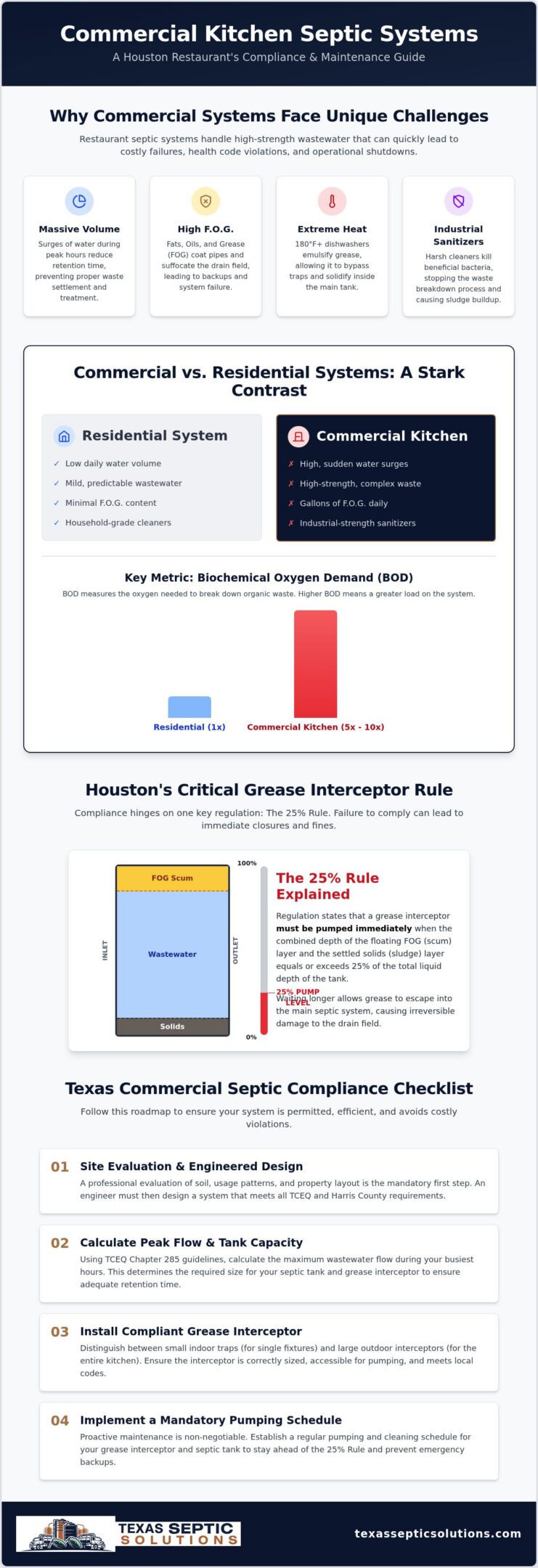
A standard home septic system handles a few hundred gallons of relatively mild waste from showers, toilets, and laundry. A restaurant kitchen, however, produces what industry professionals call high-strength wastewater. This isn’t just a matter of volume; it’s about the chemical and biological makeup of the effluent. If you’re currently searching for commercial kitchen septic system repair Houston, it’s likely because these unique stressors have pushed your system beyond its design limits. Commercial systems must process significantly more organic matter in a much shorter timeframe.
The most significant difference is the concentration of Fats, Oils, and Grease (FOG). While a home might see occasional grease from a frying pan, a commercial kitchen generates gallons of it every single day. This waste requires a specialized Grease trap (grease interceptor) to catch solids and oils before they ever reach the main septic tank. Without a properly functioning interceptor, FOG enters the secondary treatment stages, coating pipes and eventually suffocating the soil in your drain field. Once the soil is sealed by grease, the system can no longer absorb liquid, leading to surface ponding and backups.
High-temperature commercial dishwashers also play a disruptive role that residential systems never face. These machines often operate at 180°F or higher to meet strict health codes. This extreme heat emulsifies grease, allowing it to stay liquid and bypass your interceptor. Once that water cools down inside your septic tank, the grease hardens into a thick scum layer. Combined with the massive surges of water during a dinner rush, the system simply doesn’t have enough time to settle and treat the waste properly. This lack of “retention time” is a leading cause of system failure in Houston food service establishments.
Understanding BOD and TSS in Food Service
Kitchen owners need to understand two critical metrics: BOD (Biochemical Oxygen Demand) and TSS (Total Suspended Solids). BOD measures how much oxygen is needed by bacteria to break down organic matter in the water. Restaurant waste can have BOD levels five to ten times higher than residential waste. High TSS means more solid particles are floating in the liquid. If these levels aren’t managed through aggressive maintenance and proper design, you’ll face rapid drain field clogging. These metrics are exactly what local authorities scrutinize during your Texas septic permit approval process.
The Impact of Industrial Sanitizers
Sanitation is non-negotiable in a kitchen, but the chemicals that keep your surfaces clean are often “septic killers.” Harsh industrial sanitizers, like chlorine or quaternary ammonium, are designed to kill bacteria on contact. Unfortunately, they don’t distinguish between the germs on your counters and the beneficial bacteria in your septic tank. When these good microbes die off, the anaerobic breakdown process stops. This leads to foul odors, sludge buildup, and a need for more frequent pumping. To keep your system healthy, look for septic-safe commercial detergents and balance your cleaning protocols. If the biological balance is already destroyed, professional commercial kitchen septic system repair Houston services can help restore the system’s functionality.
Grease Interceptor Requirements for Houston Kitchens
In the Greater Houston area, grease management isn’t just a suggestion; it’s a legal requirement. You’ll generally deal with two types of equipment: small indoor grease traps under sinks and large outdoor grease interceptors buried underground. While traps handle single fixtures, interceptors manage the entire kitchen’s effluent. These large units must remain easily accessible for regular septic tank pumping and cleaning. If your interceptor is buried under a new patio or heavy landscaping, you’re setting yourself up for a compliance nightmare during your next inspection.
Compliance often hinges on the “25% Rule.” This regulation states that if the combination of floating grease and settled solids reaches 25% of the tank’s total wetted height, it must be pumped immediately. Waiting longer allows grease to escape into the main septic system, necessitating expensive commercial kitchen septic system repair Houston services to clear clogged lines. Following the Texas Administrative Code on Sanitation ensures your kitchen stays within legal discharge limits and avoids the $250 to $2,000 daily fines common in the City of Houston for grease violations.
Sizing Your Grease Interceptor Correctly
Sizing isn’t about the square footage of your kitchen; it’s about the volume of water you discharge at peak hours. We calculate this using fixture units, which account for every sink, dishwasher, and floor drain connected to the line. A common mistake in Cleveland and Cypress is installing a unit based on average flow rather than peak surges. This leads to insufficient retention time, the period required for grease to cool and separate from water. If water moves too fast, grease stays emulsified and flows straight into your septic tank, causing a system-wide failure.
Venting and Flow Control Standards
Proper venting is the only thing standing between your kitchen and a dining room that smells like a sewer. Without correct air pressure, the interceptor can’t drain effectively. Additionally, we use flow control devices to regulate the speed of incoming wastewater. These small components prevent “slug loading,” where a massive dump of water from a large sink wash-out overwhelms the interceptor’s ability to separate grease. If you’re noticing slow drains or foul odors, don’t wait for a health inspector to find the problem. Proactive commercial kitchen septic system repair Houston can save your business from a forced closure during the dinner rush.
Calculating Peak Flow and Tank Capacity for Compliance
Getting your flow calculations right is the difference between a system that lasts decades and one that fails in its first year. When we perform a commercial kitchen septic system repair Houston, we often find that the original system was undersized for the restaurant’s actual volume. Calculating Gallons Per Day (GPD) isn’t just about counting sinks. We look at your seating capacity, the type of meals you serve, and your peak operational hours. A high-volume diner serving three meals a day has a vastly different impact on a septic system than a cafe that only opens for lunch.
TCEQ Chapter 285 provides the strict guidelines we follow for these non-residential flow calculations. These rules ensure your system can handle “Peak Hour” flow, which is the maximum amount of water your kitchen discharges during its busiest rush. If your system is designed only for average daily flow, a busy Friday night will push wastewater through the tank too quickly. This prevents solids from settling and can lead to immediate backups. Restaurants operating 24 hours a day face even tighter requirements. They don’t have the “rest periods” that allow a system’s biology to recover overnight.
Seating Capacity vs. Real-World Usage
Texas regulatory standards use specific multipliers to estimate water usage. Full-service establishments typically have a higher GPD requirement per seat than fast-food locations. We also factor in employee water usage and the heavy demand on public restrooms during peak times. Design Flow is the engineered maximum daily volume. If your actual usage consistently hits this limit, your system is at a high risk of failure without aggressive maintenance.
Tank Material and Structural Integrity
In the tight layouts of many Houston commercial properties, septic tanks are often located under parking lots or drive-thru lanes. This placement demands high structural integrity. While plastic tanks are excellent for many applications, reinforced concrete is often the better choice for high-traffic areas due to its superior load-bearing capacity. We also prioritize tanks with advanced internal baffling designs. These baffles create a longer path for the water to travel, which improves effluent clarification. This extra step ensures that only the cleanest possible liquid reaches your secondary treatment system, protecting your long-term investment. Beyond your plumbing infrastructure, protecting your indoor environment is also a priority; for businesses with limited space, Comfort Boys Air and Heating provides efficient cooling solutions that fit into any floor plan.
The Texas Commercial Septic Compliance Checklist
Staying compliant with Texas Commission on Environmental Quality (TCEQ) regulations is about more than just avoiding fines. It’s about ensuring your business never has to close its doors due to a preventable utility failure. For any restaurant owner, the permitting process for a new system or a major commercial kitchen septic system repair Houston project follows a strict five-step hierarchy. Skipping even one of these steps can lead to a “red tag” from the health department, halting your operations immediately.
- Step 1: Site Evaluation and Soil Perc Test. A licensed professional must analyze your property’s soil. In the Houston area, our heavy clay often requires more complex drainage solutions.
- Step 2: Professional Design. TCEQ Chapter 285 requires that commercial food service systems be designed and sealed by a Professional Engineer (PE) or a Registered Sanitarian (RS).
- Step 3: Permit Submission. Your plans go to the Authorized Agent, which is typically the health department in Harris, Montgomery, or Liberty County.
- Step 4: Licensed Installation. Only a TCEQ-licensed installer with a commercial endorsement should handle the physical build.
- Step 5: Final Inspection. Before you can begin service, the county must conduct a final walk-through to grant your “Authority to Construct” sign-off.
Navigating Local Houston Permits
Permit nuances vary significantly between Cleveland, Cypress, and Shepherd. For example, Harris County often requires additional documentation for “Food Service Facility” designations that smaller counties might overlook. If you are upgrading an older facility to meet modern standards, you may need a specific septic system repair permit that accounts for increased kitchen output. Always ensure your application accurately reflects your maximum seating capacity to avoid future legal disputes. If you’re unsure about your current permit status, reaching out for a professional commercial kitchen septic system repair Houston consultation can clarify your requirements.
Soil Conditions and Drain Field Design
Commercial drain fields in East Texas face a unique challenge. Because of the high-strength wastewater discussed earlier, these fields are often two to three times larger than residential ones. The dense clay common in our region doesn’t absorb liquid quickly. To compensate, we often design systems with Advanced Treatment Units (ATUs). These units pre-treat the water to a much higher standard before it ever hits the soil. This tech is a lifesaver for Houston restaurants with limited land space who still need to meet high-volume discharge requirements. To ensure these systems remain undisturbed, True Tree Service provides eco-friendly solutions for managing trees that might otherwise interfere with your underground infrastructure.
Running a successful restaurant in the Houston area requires constant attention to detail, but your septic system shouldn’t be a source of daily stress. Effective management starts with a rigorous pumping schedule. In the City of Houston, grease traps must be fully evacuated at least every 90 days to stay compliant. If you ignore this, you risk violating the 25% Rule mentioned earlier, which can lead to fines ranging from $250 to $2,000 per day. To avoid these penalties, you need a septic system maintenance plan that is specifically tailored to your kitchen’s high-volume output.
Quarterly inspections act as your first line of defense against unexpected health code closures. During these visits, we check the structural integrity of your tank and the functionality of your effluent filters. We also verify that your waste manifests are complete and accurate. You’re required to keep these records on-site for five years. If an inspector walks in and you can’t produce those documents, you’re looking at significant fines regardless of how clean your system actually is. Consistent maintenance keeps your system invisible so you can focus on your customers.
Signs of Impending Commercial System Failure
Don’t wait for a total backup to call for help. Often, the first sign of trouble is slow-draining sinks in the kitchen while customer restrooms continue to flush normally. This usually indicates a localized grease clog in the interceptor lines. If you hear your septic tank alarm going off during a busy shift, it means the water level has reached a critical point and your pump or drain field is struggling to keep up. You might also notice foul odors or soft, green patches of grass near your interceptor area. These are clear indicators that you need professional commercial kitchen septic system repair Houston services immediately.
Protecting Your Business with Texas Septic Solutions
We know that a septic failure doesn’t happen on a convenient schedule. That’s why 24/7 emergency service is a non-negotiable part of our support for Cleveland and Houston restaurants. When the dinner rush is in full swing and your drains stop moving, you don’t have time to wait for Monday morning. Our team is built for high-pressure situations, providing the rapid response needed to keep your doors open and your kitchen compliant. Professional pumping and repair ensure your drain field remains healthy for the long term, preventing the catastrophic costs of a full system replacement. If you’re ready to secure your facility’s future, contact Texas Septic Solutions for a commercial design consultation and let us handle the technical details while you run your business.
Secure Your Kitchen’s Future with Expert Compliance
Running a high-traffic kitchen is demanding enough without the added stress of utility failures or regulatory fines. We’ve seen how managing high-strength wastewater and staying ahead of the 25% rule for grease interceptors are essential for long-term success. By following the compliance checklist and prioritizing peak flow calculations, you protect your business from the catastrophic downtime of a health department closure. Whether you’re upgrading an existing facility or need an urgent commercial kitchen septic system repair Houston relies on during a crisis, having a dependable partner makes all the difference.
Texas Septic Solutions stands as your local Houston and Cleveland regulatory expert. We provide the 24/7 emergency service restaurants need to stay operational around the clock. Our team of licensed TCEQ commercial installers is ready to handle everything from routine pumping to complex system designs. Don’t let a preventable backup derail your dinner rush. Get a Professional Commercial Septic Consultation today to ensure your system is as resilient as your business. Your kitchen deserves a system that works as hard as you do.
Frequently Asked Questions
What is the difference between a grease trap and a grease interceptor?
Grease traps are smaller units, typically under 50 gallons, installed directly under kitchen sinks. Grease interceptors are large, high-capacity underground tanks located outside the building. While a trap handles a single fixture, an interceptor manages the entire facility’s wastewater. Both are critical for preventing fat and oil from entering your main tank, which helps you avoid the need for emergency commercial kitchen septic system repair Houston businesses often face when systems are neglected.
How often does a restaurant septic tank need to be pumped in Texas?
In the City of Houston, grease traps and interceptors must be fully pumped and cleaned at least every 90 days. However, you must follow the 25% rule. This means if solids and grease reach 25% of the tank’s capacity, it needs immediate service regardless of the date. Following this schedule prevents backups during peak hours and ensures you stay compliant with local health department regulations and waste manifest requirements.
Can I use a standard residential septic system for my small cafe?
No, a standard residential system isn’t designed to handle the high-strength wastewater produced by a cafe. Commercial waste contains significantly higher levels of organic matter and grease that would quickly overwhelm residential biological processes. You need a system engineered for commercial flow rates and grease management. Using the wrong system leads to rapid drain field failure and expensive fines from the health department for non-compliance with TCEQ Chapter 285.
What happens if my commercial kitchen septic system fails a health inspection?
Failing an inspection usually results in a “red tag” and immediate closure of your food service operations. You’ll likely face daily fines ranging from $250 to $2,000 until the issue is resolved. To reopen, you must perform the required commercial kitchen septic system repair Houston authorities mandate and pass a follow-up inspection. It’s much cheaper to maintain your system than to lose days of revenue while your doors are locked.
Do I need a special permit for a commercial septic system in Houston?
Yes, commercial establishments are classified as “special waste generators” in Houston. You’re required to have a specific commercial permit from Harris County or your local authorized agent. This process involves submitting a design sealed by a Professional Engineer or Registered Sanitarian. You must also maintain waste manifests for five years to prove that your grease trap waste is being disposed of correctly at a licensed facility.
Why is my commercial septic tank alarm going off during busy shifts?
Your alarm typically indicates a high-water condition, meaning the tank is filling faster than it can drain. This often happens during busy shifts when water usage from dishwashers and sinks hits its peak. It could signal a clogged effluent filter, a failing pump, or a drain field that’s become saturated. When the alarm sounds, you should reduce water usage immediately and call for professional service to prevent a full kitchen backup.
How does the TCEQ define a ‘large’ commercial septic system?
The TCEQ generally applies standard On-Site Sewage Facility (OSSF) rules to systems handling less than 5,000 gallons per day. Systems that exceed this 5,000-GPD threshold are considered large systems and fall under different state regulations. Most independent restaurants fall under the standard OSSF rules, but they still require engineered designs because kitchen waste is technically high-strength rather than residential-strength, regardless of the total daily volume.
What are the common causes of drain field failure in commercial kitchens?
The most common cause is grease bypass, where fats and oils enter the drain field and seal the soil. This prevents water from soaking into the ground. Hydraulic overloading is another major factor, occurring when the kitchen’s water volume exceeds what the soil can absorb. Finally, using too many harsh industrial sanitizers can kill the beneficial bacteria needed to break down waste, leading to a system-wide collapse and surface ponding near your disposal area.