
Commercial Kitchen Septic Requirements Texas: 2026 Compliance Guide
Texas has over 60,000 food service establishments, and every single one is just one grease clog away from a mandatory health department shutdown. You’ve worked hard to build your restaurant, so the last thing you want is to face thousands in TCEQ fines or a sudden backup during the dinner rush. Staying on top of commercial kitchen septic requirements Texas feels like a full-time job, especially when you’re trying to figure out if your grease trap is sized correctly for your septic tank. It’s stressful to worry about whether your facility meets the latest 2026 standards while you’re focused on serving your customers.
We understand that the technical side of wastewater shouldn’t get in the way of your business. This guide simplifies the complex world of TCEQ Chapter 285 regulations and grease interceptor mandates. You’ll learn how to calculate the right system size, understand the 25% rule for pumping, and prepare for your next local health department inspection with confidence. We’re going to break down the essential steps to keep your kitchen compliant, your pipes clear, and your doors open.
Key Takeaways
- Identify how Title 30 TAC Chapter 285 dictates your system design to ensure full compliance with the Texas Commission on Environmental Quality.
- Master the specific commercial kitchen septic requirements Texas regarding grease interceptors to prevent structural clogging and system failures.
- Navigate the permitting process with ease by preparing comprehensive site evaluations and engineering blueprints for your local Authorized Agent.
- Protect your investment by establishing a high-frequency maintenance schedule that accounts for the heavy organic loads of a professional kitchen.
- Implement effective staff protocols for food scrap management to significantly reduce the strain on your On-Site Sewage Facility.
Understanding Commercial Kitchen Septic Systems in Texas
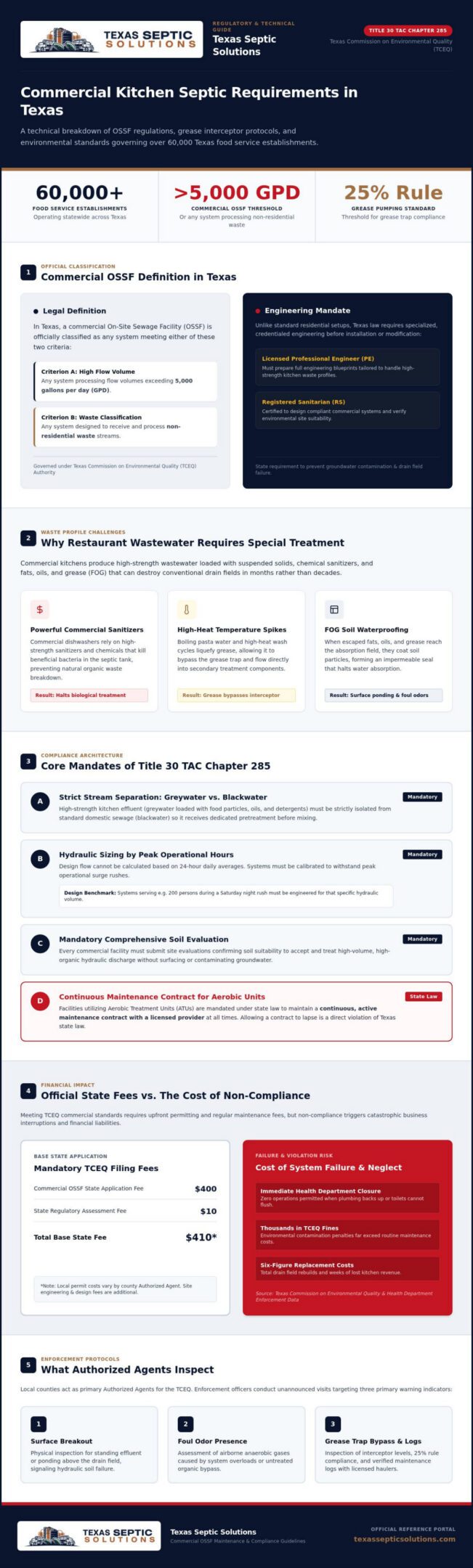
Running a restaurant in the Lone Star State means managing more than just a menu. You’re also managing a complex waste stream that can quickly overwhelm standard infrastructure. Commercial kitchens generate high-strength wastewater that packs a much heavier organic load than a standard home. In Texas, a commercial OSSF is officially defined as any on-site sewage system that processes non-residential waste or handles flow volumes exceeding 5,000 gallons per day, requiring specialized engineering to protect the local groundwater. Understanding commercial kitchen septic requirements Texas is the first step toward avoiding a utility disaster.
Why Food Service Wastewater Requires Special Treatment
Your kitchen isn’t just sending water down the drain. It’s sending a cocktail of food particles, cleaning chemicals, and high-temperature liquids. High concentrations of suspended solids can clog traditional drain fields in a matter of months rather than decades. Standard residential designs aren’t built for this. Commercial dishwashers use powerful sanitizers that can kill the beneficial bacteria your septic tank needs to break down waste. Temperature spikes from boiling pasta water or high-heat cycles also liquefy grease. This allows it to bypass a standard grease trap and enter your secondary treatment components. Once fats, oils, and grease (FOG) reach the drain field, they form a waterproof seal that prevents the soil from absorbing water, leading to surface ponding and foul odors.
The Risk of Non-Compliant Commercial Waste Systems
Cutting corners on commercial kitchen septic requirements Texas puts your entire livelihood at risk. If your system fails, the resulting backups often lead to an immediate health department closure. You can’t serve food if you can’t flush the toilets or wash the dishes. Beyond the local level, environmental contamination can trigger severe state-level financial penalties from the TCEQ. These fines often dwarf the cost of proper maintenance. Ignoring compliance also accelerates your total septic system replacement cost. Replacing a commercial-grade system is a major capital expense that most small businesses aren’t prepared to handle unexpectedly. We’ve seen how a single neglected grease interceptor can lead to six-figure repair bills and weeks of lost revenue. Staying compliant isn’t just about following rules; it’s about protecting your bottom line.
TCEQ Regulations for Texas Commercial OSSFs
The Texas Commission on Environmental Quality (TCEQ) oversees every drop of wastewater processed by businesses in the state. For restaurant owners, this means adhering to Title 30 Texas Administrative Code (TAC) Chapter 285. This chapter serves as the legal foundation for all On-Site Sewage Facilities (OSSFs). You cannot simply install a tank and hope for the best. Every commercial facility must have a system designed by a licensed professional engineer or a registered sanitarian. These experts ensure the system handles the unique chemical and organic profile of your kitchen waste. One of the most important commercial kitchen septic requirements Texas mandates is the strict separation of greywater and blackwater streams. This ensures that high-strength kitchen effluent gets the specific pretreatment it needs before mixing with standard sewage.
Core Mandates of 30 TAC Chapter 285
Compliance begins with accurate data. Designers must calculate flow rates based on peak operational hours rather than simple daily averages. If your establishment serves 200 people during a Saturday night rush, your system must accommodate that specific hydraulic load. Additionally, a comprehensive soil evaluation is required to prove suitability for high-volume discharge. For businesses utilizing aerobic treatment units, TCEQ rules are even stricter. You must maintain a continuous maintenance contract with a licensed provider. Failing to keep this contract active is a direct violation of state law. Currently, the state-level application fee for a commercial OSSF is $400, plus a $10 regulatory fee, though local permit costs will vary by county.
The Legal Role of Authorized Agents in Texas
While state rules provide the framework, local counties often act as the primary “Authorized Agents.” These local departments handle the permitting process and conduct regular inspections. You should expect enforcement officers to perform unannounced visits to check your system’s functionality and maintenance records. They look for signs of surface breakout, odors, or grease bypass. The stakes are high. A single major violation can result in the immediate suspension of your food service license. You don’t want to find out your system is failing during a busy shift. If you notice slow drains or unusual smells, reaching out for emergency septic service can save your license and your reputation. Staying proactive with these local agents ensures your business remains a pillar of the community.
Grease Trap and Interceptor Requirements for Texas Restaurants
Grease is the primary threat to any commercial waste system. TCEQ mandates that every food service installation intercepts fats, oils, and grease (FOG) before they ever reach the primary OSSF components. This serves a critical function by protecting your downstream septic tank from structural clogging and biological failure. Without a functional interceptor, grease forms a thick scum layer that prevents proper oxygen exchange and eventually migrates into your drain field. We also focus heavily on proper venting during the design phase. Without it, toxic hydrogen sulfide gases build up; these gases can corrode your plumbing and create dangerous air quality issues inside your facility.
Sizing Your Commercial Grease Interceptor
Sizing isn’t a guessing game. You must calculate minimum capacity using the TCEQ-approved plumbing fixture method or specific seat count formulas. This involves totaling the flow rates of all connected sinks, floor drains, and dishwashers. You also have to account for heavy-duty appliances like tilt kettles and commercial wok lines that discharge massive amounts of grease and hot water simultaneously. The goal is to ensure enough retention time so wastewater can cool down. If the water stays hot, grease remains liquefied and flows right through the trap into your septic system, which directly violates commercial kitchen septic requirements Texas. A properly sized unit allows the FOG to rise to the top and solids to settle at the bottom before the water exits.
Hydromechanical vs. Gravity Grease Interceptors
Choosing the right hardware is vital for long-term reliability and code compliance. Hydromechanical units are typically smaller and installed indoors near specific kitchen warewashing stations. They use a combination of baffles and air intake to separate grease efficiently. In contrast, large gravity interceptors are massive tanks buried outdoors between the kitchen and the main septic unit. These rely purely on volume and time for separation. Selecting the wrong type for your specific wastewater volume or kitchen layout is a common mistake that violates commercial kitchen septic requirements Texas. We often see businesses struggle when they outgrow a small indoor unit, leading to constant backups and health code citations. We recommend evaluating your menu and projected volume before deciding, as a gravity interceptor often provides a more robust solution for high-volume Texas BBQ or heavy-fryer kitchens. Alongside managing wastewater from heavy cooking equipment, operators can also discover Commercial Canopy Fan Pro for guidance on commercial kitchen ventilation and canopy systems designed to handle demanding culinary environments.
- Hydromechanical units: Best for low-volume, point-of-use applications.
- Gravity interceptors: Required for high-volume discharge and long-term OSSF protection.
- Venting: Essential for gas management and pipe longevity.
Permitting and Approval Process for Texas Kitchens
Getting your restaurant approved involves a strict, multi-stage permitting process. You cannot skip steps or rush the local authorities without risking costly delays. The journey to compliance follows a specific sequence of regulatory milestones:
- Step 1: Secure a comprehensive site evaluation and soil profile report from a licensed professional.
- Step 2: Submit detailed engineering blueprints and system designs to your local Authorized Agent.
- Step 3: Obtain the official Authorization to Construct before breaking any ground or hiring excavators.
- Step 4: Schedule open-trench inspections so local officials can verify pipe slopes and tank placement prior to covering any system components.
- Step 5: Secure the final Notice of Approval, which legally allows you to operate the system.
Following this sequence is the only way to satisfy the commercial kitchen septic requirements Texas enforces at both the state and county levels.
Navigating Greater Houston County Variations
Where you build matters just as much as what you build. Local county rules vary significantly across the Greater Houston area. For example, Montgomery County Environmental Health enforces distinct commercial flow criteria that might require a larger tank than you expect. Harris County Public Health takes it a step further, requiring separate, detailed plan reviews specifically for food service establishments before they look at the plumbing. If you’re establishing a kitchen in Liberty or San Jacinto counties, you will bypass local county offices and deal directly with specific regional TCEQ field offices. Knowing these local boundaries keeps your project from getting stuck in bureaucratic limbo.
Required Documentation for Commercial OSSF Approval
Your application package must be flawless to pass review. You need to submit certified plumbing isometric drawings that clearly map out all grease pathways and drain connections. Reviewers also look at your water meter sizing data and projected daily seating charts to verify your estimated wastewater volume. Finally, you must include a signed septic system maintenance plan with a licensed provider to prove you have a strategy for long-term care. If you’re ready to get your project moving without the paperwork headaches, you can partner with us for a new septic system installation tailored to your specific county rules. We handle the technical details so you can focus on opening your doors.
Maintaining Commercial Septic Systems to Ensure Compliance
Maintaining a commercial system is a marathon, not a sprint. Once your Notice of Approval is in hand, the real work of staying compliant begins. Commercial kitchen septic requirements Texas dictate that you must operate your system in a way that prevents environmental hazards. For a busy restaurant, this means a maintenance schedule much tighter than any residential property. You’ll need to keep a meticulous log of every pump-out and inspection. Local health inspectors will ask for these records during their unannounced visits; having a clear paper trail shows you’re a responsible operator who takes public health seriously. We recommend keeping these logs in a dedicated binder near your health permit for easy access.
Staff behavior is the biggest variable in system longevity. You can have the best engineering in the world, but it won’t survive a crew that pours fryer grease down the floor drains. Implement strict kitchen protocols that prioritize food scrap management. This includes “scrape, don’t rinse” policies for all plates and cookware. You should also limit the use of heavy degreasers and bleach, as these chemicals can kill the beneficial bacteria in your tank, leading to a “dead” system that smells and fails to treat waste. Partnering with a professional for routine septic system maintenance Texas ensures that these biological levels stay balanced.
Establishing a Commercial Pumping Schedule
Frequency is your best defense against a backup. You must adhere to the 25 percent rule for grease interceptor pumping. This means the trap must be cleaned out whenever the total volume of grease and solids exceeds 25 percent of the trap’s capacity. Some jurisdictions, like Houston, also mandate a minimum 90-day pumping cycle regardless of the load. For your main septic tank, plan on pumping quarterly or semi-annually depending on your customer volume. Don’t overlook your effluent filters. These should be monitored monthly to prevent “blinding,” where fine particles clog the mesh and cause water to back up into the kitchen sinks. Regular cleaning of these filters takes minutes but can save you thousands in emergency repairs.
Proactive Solutions from Texas Septic Solutions
We know that a pump truck blocking your drive-thru at noon is bad for business. Our team offers specialized commercial pumping tailored to restaurant schedules, ensuring we’re in and out during your off-peak hours. We also provide rapid diagnostic support to resolve commercial system alarms before they turn into full-scale failures. Whether you need a 24/7 response for a sudden backup or a long-term strategy for commercial kitchen septic requirements Texas, we’re here to help. Contact Texas Septic Solutions for reliable commercial installation, repair, and compliance management. We’ll handle the waste so you can focus on the food.
Secure Your Kitchen’s Future with Proactive Compliance
Mastering commercial kitchen septic requirements Texas is more than just a regulatory hurdle; it’s a vital part of your business’s operational health. By focusing on proper grease interceptor sizing and adhering to the multi-stage permitting process, you protect your facility from unexpected shutdowns and environmental fines. Remember that a well-maintained system is a silent partner in your success, keeping your drains clear while you focus on serving your community. Don’t let a preventable backup or a missed inspection log threaten the hard work you’ve put into your establishment.
We’re here to take the stress out of wastewater management. As licensed TCEQ compliance specialists, we provide comprehensive grease trap and OSSF management designed for the unique demands of the food service industry. Whether you need a new installation or a reliable partner for ongoing care, our team offers 24/7 emergency response across the Greater Houston area to ensure you’re never left in a bind. Schedule a Commercial Septic Consultation with Texas Septic Solutions today. You’ve built a great business; let’s work together to keep it running smoothly for years to come.
Common Questions About Texas Commercial Septic Compliance
What are the minimum grease trap requirements for a Texas restaurant?
Texas mandates that all food service facilities install grease interceptors to capture fats, oils, and grease before they reach the septic system. These units must meet specific capacity standards based on your kitchen’s plumbing fixture units or total seat count. In areas like Houston and Cypress, you’ll need to follow local plumbing codes that ensure the trap provides enough retention time for wastewater to cool and separate effectively before exiting the tank.
How often must a commercial kitchen septic tank be pumped in Texas?
Commercial systems require significantly more attention than residential ones in Cleveland or Huffman. You should plan to pump your main septic tank quarterly or semi-annually, depending on your daily wastewater volume. Grease traps often require even more frequent service. Many local jurisdictions mandate a minimum pumping frequency of every 90 days to prevent solids from migrating into the drain field and causing a total system failure or health code violation.
Can a commercial kitchen share a septic system with a residential property?
It’s rarely a good idea to share a system between a home and a business. Commercial kitchen waste is considered high-strength because of the grease and organic load, which can quickly destroy a residential drain field. TCEQ regulations typically require separate systems or a significant redesign to handle the combined flow. If you’re operating a business in Shepherd, you’ll likely need a dedicated commercial OSSF designed specifically for food service effluent to remain compliant.
What happens if my restaurant septic tank alarm goes off during service?
Don’t panic, but you must act quickly to avoid a shutdown. Immediately reduce water usage by stopping dishwashers and high-flow sinks. Check your tank levels or look for signs of a backup in the floor drains. Since a system failure can lead to an immediate health department closure, you should call for emergency septic service right away. Our team provides rapid response across Greater Houston to diagnose the issue and get your kitchen back to full capacity.
Does TCEQ require a licensed engineer for commercial kitchen septic design?
Yes, the commercial kitchen septic requirements Texas mandates state that all commercial systems must be designed by a licensed professional engineer or a registered sanitarian. Because restaurant wastewater contains high levels of organic matter and grease, a standard residential design won’t work. These professionals ensure your system is properly sized for peak flow hours, protecting both your business and the local environment from potential contamination or system overflows that could trigger heavy fines.
What chemicals should a commercial kitchen avoid to protect the septic system?
Avoid pouring large amounts of bleach, caustic drain cleaners, or heavy-duty degreasers down your drains. These chemicals kill the beneficial bacteria that break down waste inside your septic tank. When the biological balance is disrupted, solids don’t decompose properly, leading to clogs and foul odors. We recommend using septic-safe cleaning products and training your staff in Huffman or Cypress to keep non-biodegradable items and harsh solvents out of the waste stream entirely.
How does the Texas 25 percent rule apply to commercial grease traps?
The 25 percent rule is a critical part of commercial kitchen septic requirements Texas. It states that you must pump your grease trap whenever the combined volume of floating grease and settled solids reaches 25 percent of the tank’s total capacity. Waiting longer allows grease to escape the trap and enter the main septic tank, which leads to expensive repairs and drain field blinding. Regular monitoring ensures you stay ahead of this threshold and pass your local health inspections.