
Can I Build a Deck Over My Septic Tank? A Texas Homeowner’s Guide
A dream deck can quickly turn into a massive headache if it’s sitting directly on top of your underground utilities. You’ve likely spent hours measuring your backyard, only to realize your septic system is right in the path of your new outdoor living space. It’s natural to wonder, “can I build a deck over my septic tank,” but the answer involves more than just local building permits. In Texas, the rules are strict because blocking access to your tank or drain field doesn’t just violate regulations; it puts your entire home’s plumbing at risk of a total failure.
We understand the frustration of limited yard space and the fear of accidentally crushing expensive components. This guide provides a clear roadmap for Texas homeowners looking to balance backyard aesthetics with system safety. You’ll learn about specific TCEQ setback requirements, the dangers of soil compaction, and structural designs that allow for easy septic pumping and repairs. We’ll help you create a plan that protects your investment, avoids future repair costs, and ensures your deck remains a place for relaxation rather than a barrier to essential maintenance.
Key Takeaways
- Learn why the answer to “can I build a deck over my septic tank” depends on soil compaction and the structural integrity of your specific tank model.
- Discover why drain fields are strict no-build zones where structures can “smother” the soil bacteria needed for safe wastewater treatment.
- Identify the specific clearance requirements pumper trucks need to ensure you aren’t hit with massive emergency repair costs due to restricted access.
- Get practical design solutions, such as removable deck panels, that satisfy both your backyard aesthetic goals and professional maintenance needs.
- Understand the vital importance of reviewing your septic map and securing a professional inspection before you start any backyard construction.
The Hidden Risks of Building a Deck Over Your Septic Tank
Building a deck is a major investment in your home’s value and your family’s quality of life. However, placing that structure directly above your wastewater system introduces hazards that aren’t always visible from the surface. To understand the danger, you first need a clear picture of what a septic tank is and how it functions as a living biological filter. When homeowners ask, “can I build a deck over my septic tank,” they often overlook how the sheer weight of wood and hardware affects the ground below. Beyond the risk of physical damage, a poorly placed deck can disrupt the delicate balance of bacteria and airflow your system needs to stay healthy.
Weight and Structural Integrity
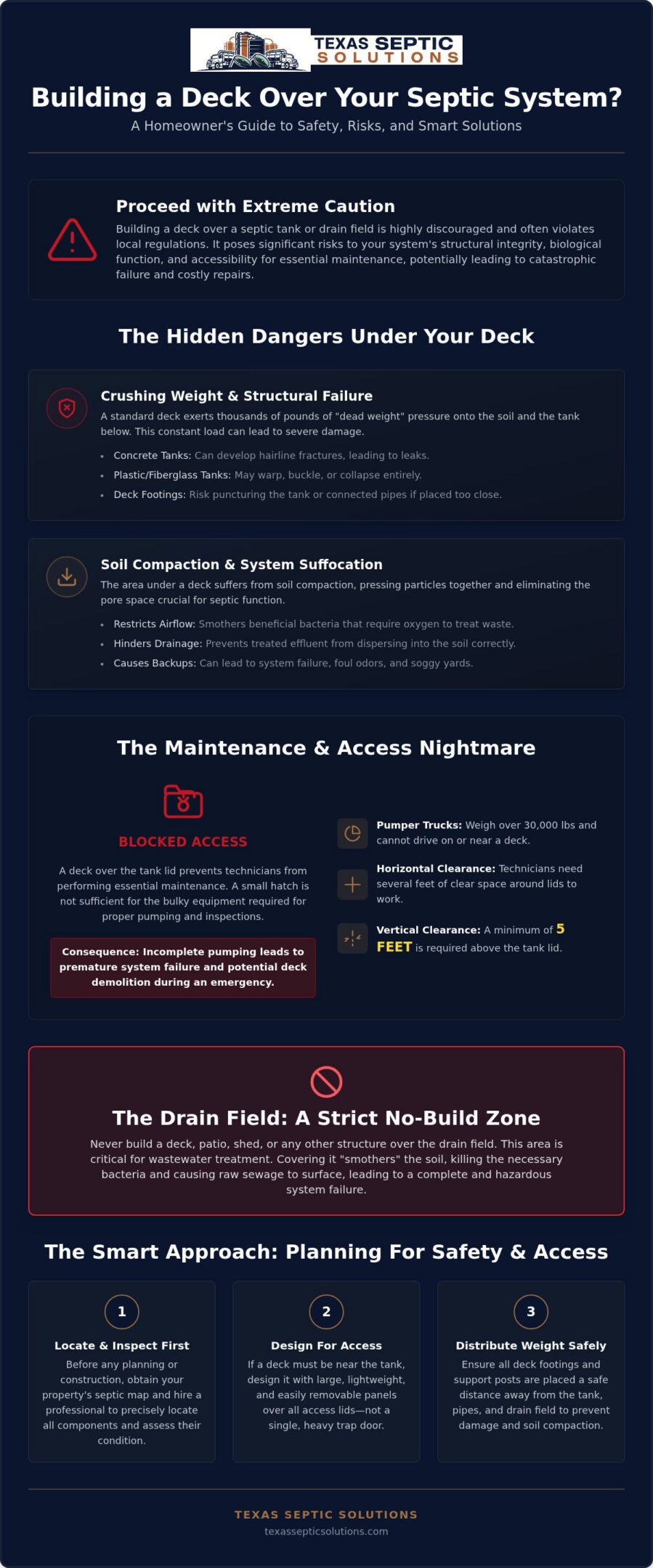
The primary concern is “dead weight.” A standard deck can weigh thousands of pounds, and that pressure doesn’t just sit on the grass. It transfers through the soil directly to your tank. Concrete tanks can develop hairline fractures over time, while plastic or fiberglass models may warp or collapse entirely under the strain. If you choose an anchored design, the footings must be dug deep, which creates a high risk of puncturing the tank or the delicate distribution lines. Even a “floating” deck that sits on the surface isn’t entirely safe because it still distributes weight across a broad area.
Soil compaction is the process where soil particles are pressed together, reducing pore space and hindering the natural drainage and airflow essential for septic function.
When soil becomes compacted, it loses its ability to treat effluent effectively. This can lead to a backup in your home or a soggy, smelly mess in your yard. It’s a common reason we see systems fail prematurely. If you’re determined to build, you must consider how the load is distributed to avoid crushing the very infrastructure that keeps your home running.
Biological and Environmental Impact
Beyond the physical structure, a deck changes the environment of the soil. By blocking sunlight and reducing airflow, the area beneath the deck stays perpetually damp. This trapped moisture can cause metal components to rust and wooden risers to rot faster than they would in the open air. Aerobic systems are especially sensitive to this because they rely on a constant exchange of oxygen to break down waste. Covering these systems with a deck can effectively “smother” the beneficial bacteria, leading to foul odors and system backups that require emergency septic service.
Landscaping choices around a new deck also play a role. Many homeowners plant shrubs to hide the deck’s underside, but these roots can seek out the moisture in your septic lines. This leads to root intrusion, which can clog pipes and crack tank walls. You must ensure your deck design allows for the natural venting process of the septic system to continue unimpeded.
Maintenance Access: Why Your Pumper Truck Needs Clearance
When you’re planning your backyard oasis, it’s easy to forget that your septic tank is a piece of active machinery. It requires regular septic system maintenance to function properly. If you’re asking, “can I build a deck over my septic tank,” you have to consider the technician who will eventually arrive to pump it. A simple trap door might seem like a clever workaround, but modern pumping equipment is bulky and requires significant room to operate safely.
Technicians don’t just drop a small straw into the tank. They use large, heavy-duty vacuum hoses that aren’t very flexible. They need to see the entire opening to ensure the tank is cleaned thoroughly. If a deck is too low or a hatch is too small, the technician might not be able to reach the corners of the tank. This leaves solids behind that can lead to a system failure. In the worst-case scenario, you might face the high cost of deck demolition during an emergency septic repair because we simply can’t get to the problem.
The 5-Foot Rule and Vertical Clearance
Most professionals recommend at least 5 feet of vertical clearance and several feet of horizontal space around the manhole covers. Technicians need to stand, move around, and leverage heavy tools to remove lids. Remember that a vacuum truck can weigh over 30,000 pounds when full. It cannot drive onto your deck or even close to the tank if the soil is soft. Keeping septic system maintenance easy for your provider ensures the job is done right the first time without extra labor fees.
Visual Inspection Limitations
A deck doesn’t just block physical access; it blocks your view. One of the best ways to catch a problem is by noticing a faint odor or a patch of unusually green, spongy grass. If these signs are hidden under floorboards, you won’t know there’s a leak until it’s a catastrophe. You might even miss a septic tank alarm going off if the structure muffles the sound. By the time you realize something is wrong, the damage to your yard and system could be extensive.
Before you commit to a design and wonder “can I build a deck over my septic tank” safely, think about how it will look in five years when the tank needs service. If you aren’t sure where your access points are, contact a local expert to map your system first.
Deck vs. Drain Field: Understanding the No-Build Zones
While you might find creative ways to work around the tank itself, the drain field is a completely different story. It is a strict “No-Build” zone for any permanent structure. If you are still asking, “can I build a deck over my septic tank” while eyeing the area where your leach lines run, the answer is a firm no. This area of your yard acts as a natural filter. Covering it doesn’t just block access; it fundamentally changes how the soil treats wastewater. Citing the University of Nebraska Extension, building over a septic tank or its drain field makes inspection and maintenance nearly impossible and often leads to system failure.
In East Texas, our soil types play a massive role in this equation. Homeowners in Houston or Cypress often deal with heavy clay soil that already struggles with drainage. Clay doesn’t breathe well, and adding a deck on top prevents sunlight and wind from helping with evaporation. On the other hand, sandy soils in other parts of the state might seem more forgiving, but they are highly susceptible to compaction from the weight of deck footings. If you ignore these soil factors and smother your drain field, you’ll eventually face the high price of a septic system replacement when the soil can no longer process effluent.
The Function of the Leach Field
A leach field relies on a delicate balance of evaporation, transpiration, and oxygen exchange. The “good” bacteria that break down waste need oxygen to survive. When you cover the ground with a deck, you create an anaerobic environment where these bacteria die off. This leads to a thick layer of sludge called a biomat that eventually clogs the soil entirely. Additionally, the risk of deck footings piercing your lateral lines is high. Even a small nick in a pipe can cause a localized blowout, resulting in a soggy, foul-smelling yard and a very expensive repair bill.
Setback Requirements in Texas
The Texas Commission on Environmental Quality (TCEQ) sets statewide minimums for on-site sewage facilities, typically requiring a 5-foot setback for structures. However, local authorities in areas like Cleveland or Cypress often enforce even stricter rules to protect groundwater. Before you dig your first post hole, you must locate your lines. Using your original septic map is the best way to ensure you aren’t “can I build a deck over my septic tank” into a legal or functional disaster. We always recommend marking the exact location of every lateral line to ensure your deck remains a safe distance away.
Planning Your Deck: Structural Solutions for Maintenance
If you have decided to move forward after weighing the risks, you need a plan that prioritizes accessibility. The question of “can I build a deck over my septic tank” shifts from a legal “no” to a technical “if.” You can proceed if you engineer the structure to be temporary and non-intrusive. Success depends on following a specific sequence of steps before you buy your first piece of lumber.
- Consult your septic map and building office: Verify the exact location of your tank and lines. In most Texas jurisdictions, a building permit is required for decks over 200 square feet or those more than 30 inches above the ground.
- Design for full access: Every septic lid must be accessible. This means creating panels that can be moved without specialized tools.
- Use “floating” footings: Avoid digging deep holes near the tank. Deck blocks or surface footings reduce the risk of puncturing a line or the tank wall.
- Maintain vertical clearance: Leave at least 12 inches between the top of the tank and your deck joists. This allows for airflow and prevents moisture buildup.
- Schedule a pre-build inspection: Have a professional verify your layout to ensure you aren’t accidentally blocking a future repair route.
Designing Removable Sections
A small hatch is not enough for a technician carrying heavy vacuum hoses. You should design removable panels that are at least 3 feet by 3 feet. Using heavy-duty hinges is often better than screws; over time, screws strip or rust, making the panel impossible to open during an emergency. Make sure the panels are light enough for two people to lift safely. If a technician has to spend an hour just trying to open your deck, your maintenance bill will reflect that extra labor. Clear, easy access is the only way to ensure your system gets the thorough cleaning it needs.
Footing Placement and Safety
The “Angle of Repose” is a critical concept in engineering. It refers to the way soil distributes weight. You must place your footings far enough away from the tank walls so the pressure doesn’t cause a cave-in. Never use the septic tank itself as a support for a deck post. This “point loading” can crack a concrete lid in seconds. If possible, use non-permanent materials like pavers or gravel for the areas closest to the tank. This makes it much easier to restore your yard after a major repair. Before you finalize your blueprints, request a professional site consultation to ensure your deck doesn’t become a liability.
Ensuring Long-Term Health: The Professional Inspection
You’ve done the research and sketched your plans. Now comes the most critical step: professional validation. While the question “can I build a deck over my septic tank” often focuses on the physical design, the timing of your project is just as important. You should never start construction without a baseline inspection of your current system. This ensures you aren’t building a beautiful structure on top of a ticking time bomb that requires immediate, invasive repair.
The Pre-Construction Pumping
We highly recommend scheduling a full pump-out before the first deck board is laid. This isn’t just about routine care; it’s a strategic move. Once the tank is empty, we can inspect the interior walls for hairline fractures or signs of wear that might worsen under new weight loads. It’s also the ideal time to install or repair risers and lids. If your tank is older, verifying its structural health is non-negotiable. We’ll ensure every component is in perfect condition so you don’t have to worry about dismantling your new deck six months later to fix a pre-existing leak. Checking for root intrusion now also prevents future blockages that could be masked by your new structure.
Legal and Resale Considerations
Don’t underestimate the impact of an unpermitted or poorly designed structure on your property value. In Texas, an improperly placed deck can easily kill a home sale. Most lenders for VA, FHA, and USDA loans require a septic inspection before closing. If an inspector sees a deck blocking access to the tank, they’ll likely flag it as a major liability. This can lead to buyers demanding the deck’s removal or a massive price concession. Keeping a solid septic system maintenance plan on file, along with photos of your removable access panels, proves to future buyers that you’ve prioritized the home’s infrastructure. It shows you aren’t just asking “can I build a deck over my septic tank,” but rather “how can I build it responsibly.”
Final Septic-Friendly Checklist:
- Are all tank lids accessible via removable panels that two people can lift?
- Is there at least 12 inches of vertical clearance to allow for proper airflow?
- Have you confirmed that no footings are sitting within the tank’s pressure zone?
- Is the drain field completely clear of any structures or heavy landscaping?
- Do you have a copy of your septic map to show the building inspector?
Ready to plan your backyard? Contact Texas Septic Solutions for a professional site evaluation today.
Secure Your Home’s Future Before You Build
Building a backyard deck shouldn’t come at the expense of your home’s most vital utility. You’ve learned that the answer to can I build a deck over my septic tank involves careful planning and engineering removable access panels. More importantly, you now know that the drain field must remain a strict no-build zone to prevent system failure. A deck that prioritizes professional maintenance today is the only way to avoid a costly emergency repair tomorrow.
Texas Septic Solutions is here to help you navigate these regulations with confidence. As a family owned and locally operated business, we’ve provided expert installation and repair since 2026. We understand the specific soil conditions in East Texas and offer 24/7 emergency support when you need it most. Before you dig your first post hole, let us verify your layout to keep your system healthy for years to come. Schedule a Septic Inspection Before You Build today and start your project with total peace of mind.
Frequently Asked Questions
Can I build a deck over an aerobic septic system?
You can build over an aerobic tank if you include removable panels, but never build over the spray field. Aerobic systems in Texas require inspections every four months by law, so technicians need constant access to the control panel and aerator. If your deck smothers the air intake or blocks the pump, the system will fail. Access is vital.
How much clearance do I need between my deck and the septic tank?
You need a minimum of 12 inches of vertical clearance between the tank lid and the deck joists. This gap provides the airflow necessary to prevent component rot and allows for visual inspections. For horizontal clearance, keep at least 5 feet of open ground around the tank. This gives our technicians enough room to stand. It’s essential for safety.
Will building a deck over my septic tank void my warranty?
Most manufacturers and installers will void your warranty if you build a structure over any part of the system. Warranties usually require unobstructed access for maintenance and repairs. If a failure occurs and a deck prevents immediate access, the installer isn’t liable for the damage. Always check your specific contract before starting construction to protect your investment.
What is the best material for a deck built near a septic system?
Pressure-treated wood or composite materials are the best choices because they resist the high moisture levels found near septic components. However, the framing is more important than the surface material. Use lightweight, removable panels for the sections directly over the lids. Avoid heavy masonry or stone that puts excessive weight on the soil and makes professional pumping impossible.
Do I need a permit to build a deck near my septic tank in Texas?
Yes, most Texas counties require a building permit for decks over 200 square feet or those higher than 30 inches. Local authorities in Houston or Cypress will specifically check if your plan answers the question of “can I build a deck over my septic tank” while following TCEQ setback rules. Submit a site plan showing the septic components to avoid legal issues.
Can I put a hot tub on a deck that is over a septic tank?
No, you should never place a hot tub on a deck section over a septic tank. A filled hot tub weighs thousands of pounds and creates massive point loads that can crush a concrete or plastic tank. Additionally, the risk of a leak or accidental drainage into the septic area can oversaturate the soil and lead to a total system backup.
How do I find my septic tank lids if I want to build a deck?
You can find your lids by consulting the as-built drawing provided during installation or by using a soil probe to feel for the tank top. If you don’t have a map, look for the main sewer line exiting your home and follow it. For a definitive answer to “can I build a deck over my septic tank” without hitting a line, hire a professional.
What should I do if my deck is already built over my septic tank?
You should immediately retrofit the deck with removable access panels over the manhole covers. If you wait until a backup occurs, you might have to tear the deck apart during a high-pressure emergency. Schedule a professional inspection to see if the weight has caused structural damage. If you don’t take proactive steps now, the deck becomes a major liability during a failure.