
Alternatives to Sweet Septic for Commercial Service in Southeast Texas
For a Southeast Texas business, a septic backup isn’t just a mess; it’s a forced closure that bleeds revenue every hour the doors stay locked. You’ve likely relied on the same provider for years, but when response times lag or maintenance documentation doesn’t meet TCEQ standards, that loyalty starts to feel like a liability. Many local property managers are now looking for reliable alternatives to Sweet Septic for commercial service to ensure their high-strength wastewater systems get the specialized attention they require.
It’s frustrating to pay premium rates only to receive residential-level service or discover hidden fees in your pumping quotes. You deserve a partner that understands the high stakes of commercial operations and the necessity of 24/7 reliability. This guide will show you how to transition to a provider that prioritizes emergency readiness and transparent, predictable billing. We’ll explore the critical differences between residential and commercial care, how to verify compliance expertise, and what to look for in a service agreement that protects your facility’s functionality.
Key Takeaways
- Commercial septic systems face unique stresses from high-volume waste, making specialized expertise essential for avoiding health code violations and closures.
- When exploring alternatives to Sweet Septic for commercial service, look for a partner that provides 24/7 emergency availability to protect your business around the clock.
- Reliable maintenance plans must include detailed documentation for TCEQ compliance and transparent, predictable costs for pumping and routine repairs.
- Switching providers involves a strategic review of your current contract and a comprehensive system audit to identify hidden issues before they become emergencies.
- A local expert who understands Southeast Texas soil and regulations offers a more responsive, tailored approach to your facility’s specific wastewater needs.
Evaluating Commercial Septic Service: Why Businesses Seek Alternatives
Running a business in Southeast Texas involves managing dozens of moving parts. Your septic system shouldn’t be the one that keeps you up at night. Commercial systems operate on a completely different scale than the standard residential setup. They face constant stress from high-volume usage and complex waste compositions. When these systems fail, the consequences are immediate. You aren’t just looking at an inconvenience; you’re looking at a direct threat to your revenue. Local business owners often search for alternatives to Sweet Septic for commercial service when they realize their current provider is stretching themselves too thin between residential calls and complex industrial needs.
Frequent backups are the most common sign that a system is being underserved. In a commercial setting, a single backup can trigger health code violations or force a temporary closure. If your current provider misses a pumping window because they are busy with backyard tanks, your facility pays the price. Specialized commercial expertise is mandatory for businesses in Cleveland and Houston that can’t afford a single hour of downtime.
The Risk of Residential-First Providers
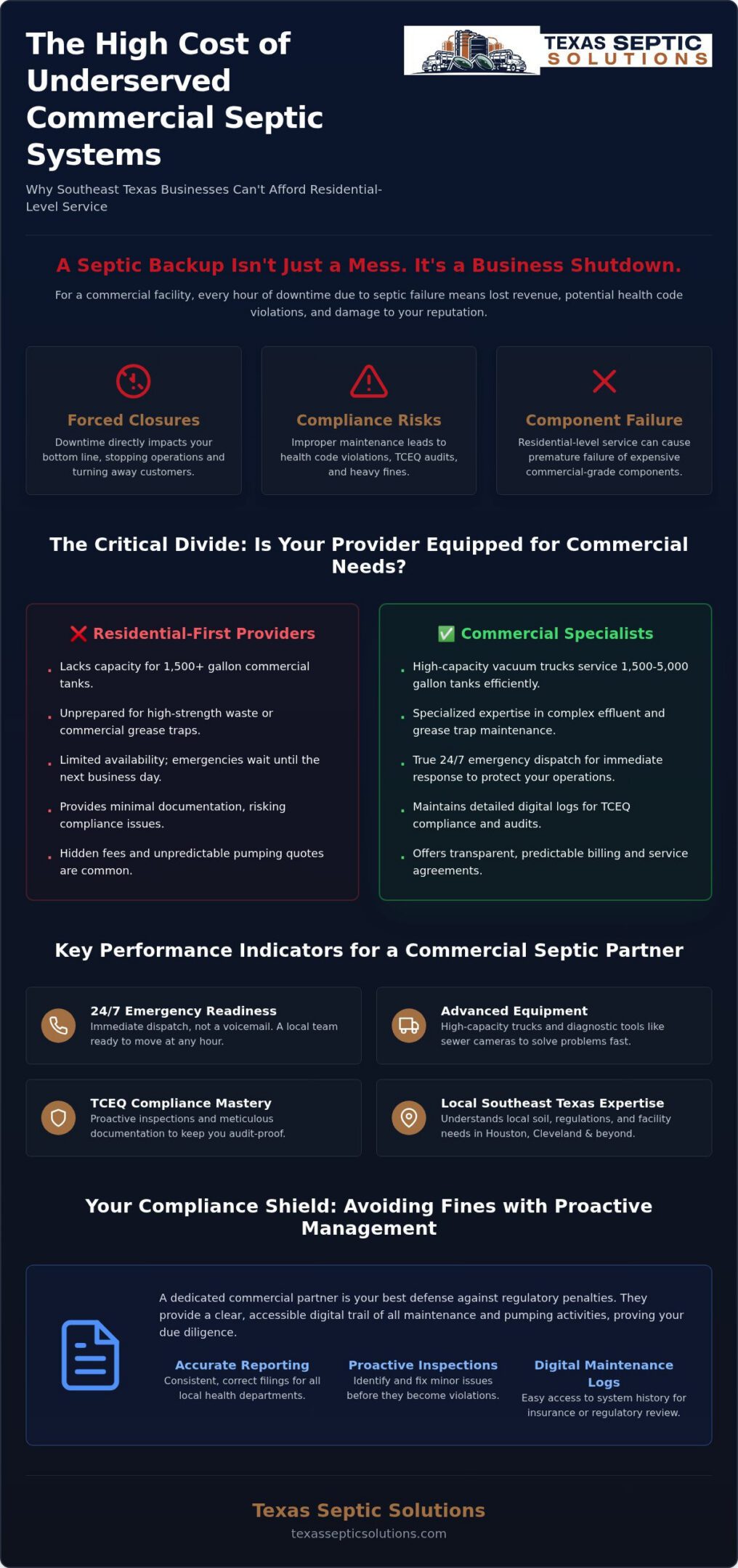
Many septic companies use the same equipment for every job, but a residential truck often lacks the capacity for 1,500+ gallon commercial tanks. If a technician is only used to handling household waste, they might be completely unprepared for commercial-grade grease traps. These traps require specific maintenance to prevent fats, oils, and grease from reaching your drain field. Technicians who don’t understand commercial effluent flow rates can inadvertently cause system imbalances. This leads to premature component failure and expensive, avoidable repairs.
Regulatory and Compliance Pressure in Southeast Texas
Local health departments in areas like Houston and Cleveland have strict requirements for commercial wastewater management. You need more than just a functioning tank; you need a partner who understands the paperwork. A professional partner helps you avoid heavy fines by conducting proactive inspections and maintaining a clear digital trail. This documentation is your best defense during an audit. It proves your business is following a consistent pumping and maintenance schedule. Relying on a provider that offers alternatives to Sweet Septic for commercial service ensures you have a dedicated team focused on these high-stakes compliance details.
- Accurate Reporting: Consistent documentation for all local health department filings.
- Proactive Inspections: Identifying small leaks or mechanical issues before they trigger a violation.
- Digital Maintenance Logs: Easy access to your system’s history for insurance or regulatory reviews.
Key Performance Indicators for Commercial Septic Partners
Identifying the right partner means looking past the logo on the truck. You need a provider that treats your facility like the specialized asset it is. When vetting alternatives to Sweet Septic for commercial service, focus on their ability to handle high-strength wastewater and their commitment to 24/7 availability. A commercial system isn’t just a larger version of a home tank; it’s a complex utility that requires a “one-stop” service model. Your partner should be capable of handling everything from new septic system installation to routine pumping and emergency repairs without outsourcing to third parties.
Response Time and Emergency Readiness
For a commercial client, 24/7 service shouldn’t be a voicemail box that gets checked on Monday morning. It means having a technician dispatched immediately when an alarm sounds or a drain slows down. Local dispatch is critical for businesses in Cypress, Huffman, and Shepherd. If your provider is coming from across the state, you’re losing hours of operation while you wait. Emergency response is a non-negotiable for commercial continuity. You need a team that understands the urgency of a backup at a restaurant or an office park and has the staff ready to move at any hour.
Equipment and Technical Capability
Commercial systems often involve 1,500 to 5,000-gallon tanks that a standard residential truck can’t empty in one trip. Your provider must utilize high-capacity vacuum trucks and advanced diagnostic tools, such as sewer cameras, to find blockages quickly. They should also demonstrate expertise in both aerobic and anaerobic commercial systems. These setups have different mechanical needs and chemical balances. Specialized maintenance plays a vital role in extending the life of expensive commercial drain fields, which can cost tens of thousands of dollars to replace if they’re neglected. Proactive care prevents the soil from becoming clogged with solids that shouldn’t have left the tank.
Transparency in pricing is another major indicator of a professional partner. You should receive clear, predictable quotes for septic system maintenance plans that include pumping, filter cleaning, and mechanical inspections. Avoid providers that hide environmental fees or disposal surcharges in the fine print. Reliable local authorities will show you exactly what you’re paying for, ensuring your maintenance budget remains stable year after year.
Comparing Service Models: Texas Septic Solutions vs. Industry Standards
Texas Septic Solutions operates on a “one-stop” service model that consolidates installation, repair, and maintenance under a single point of accountability. This differs significantly from the fragmented industry standard where you might deal with one company for pumping and a completely different contractor for mechanical repairs. When you’re evaluating alternatives to Sweet Septic for commercial service, look for a partner that takes full responsibility for the entire system lifecycle. Local ownership in Cleveland, TX, ensures that your service provider isn’t just a distant voice in a national call center. We’re members of the same community, and that proximity leads to better response times and a deeper sense of responsibility toward local businesses. Large commercial properties specifically benefit from dedicated account management. Having one point of contact means your maintenance schedules are never missed, and your compliance documentation is always organized and ready for a surprise inspection.
Proactive Maintenance vs. Reactive Repair
Many businesses fall into the trap of a reactive model, only calling for help once a drain stops or an alarm sounds. This “call-when-it-breaks” approach is almost always more expensive and disruptive than scheduled septic system maintenance. Regular inspections allow our technicians to catch small issues, such as worn-out aerator pumps or clogged filters, before they escalate into a total system failure. Baffle inspections are equally critical; a broken baffle can allow heavy solids to enter the drain field, which often results in permanent damage that costs thousands to fix. Professional pumping at the right intervals keeps the system’s biology balanced and protects the soil health of your drain field.
Local Expertise in Texas Soil Conditions
The clay-heavy soils found throughout Houston and Cleveland present unique drainage hurdles that generic service models often ignore. Unlike sandy soils that drain quickly, the local clay holds moisture and can expand or contract significantly based on the season. This puts physical pressure on underground tanks and distribution lines. A local provider understands how regional weather patterns, like the sudden heavy rains common in East Texas, impact septic levels and drainage capacity. They know how to maintain systems that can handle these fluctuations without backing up into your building. National franchises often use generic maintenance templates that don’t account for these environmental specifics. Choosing alternatives to Sweet Septic for commercial service means finding a team that knows exactly how East Texas soil behaves during a summer dry spell or a spring deluge.
Switching Your Commercial Septic Provider: A Seamless Transition Guide
Changing your service provider doesn’t have to disrupt your daily operations. If you’re exploring alternatives to Sweet Septic for commercial service, start by reviewing your current contract. Look for specific termination clauses or notice periods to avoid unnecessary penalties. Once you’ve cleared the legal path, focus on the technical handover. Your new partner should be ready to step in without a gap in coverage. Ensure they carry the proper commercial insurance and licensing required for high-volume systems in Southeast Texas. This protects your business from liability during major repairs or routine pumping.
Conducting a Final System Audit
A baseline inspection is the most important step in a smooth transition. It protects you from inheriting problems caused by the previous provider’s neglect. A professional audit should evaluate tank levels, pump health, and the functionality of all high-level alarms. This is the time to identify any necessary septic system repair needs before they turn into midnight emergencies. By documenting the system’s state on day one, you establish clear accountability for your new service team and ensure your facility starts on a clean slate.
Establishing Your New Maintenance Schedule
Starting on a clean slate often extends beyond the septic system to the entire physical plant. For businesses completing renovations or new construction projects, coordinating with specialized janitorial teams like RPS Building Services ensures that every corner of the facility—not just the wastewater system—is professional and ready for operation.
Every business is different. A restaurant with high water usage needs a different pumping frequency than a quiet warehouse. Your new septic system maintenance plan must be tailored to your actual usage data while strictly following TCEQ requirements. Set up a clear 24/7 emergency contact protocol with your facility managers. Everyone on your team should know exactly who to call when a system alert triggers. This proactive setup ensures that alternatives to Sweet Septic for commercial service provide the reliability you’ve been missing.
Don’t leave your history behind. Request all permit documentation and pumping records from your previous provider. A digital trail of maintenance is essential for local health department audits. If the old provider is slow to respond, your new partner can often help you retrieve these records from local regulatory offices to keep your compliance status current.
Ready to upgrade your facility’s care? Contact Texas Septic Solutions to schedule your initial commercial system audit and secure a partner that values your business continuity.
Why Texas Septic Solutions is the Premier Choice for Houston Area Businesses
Texas Septic Solutions stands out as the premier choice because we’re built for the specific challenges of Southeast Texas. While national franchises or global treatment manufacturers offer generic solutions, they can’t match the responsiveness of a local neighbor. When you’re searching for alternatives to Sweet Septic for commercial service, you need a team that understands the heavy clay in Cleveland and the strict regulatory environment in Houston. We’ve spent years building deep roots in communities like Cypress, Huffman, and Shepherd. This local presence allows us to be on-site quickly, preventing a minor mechanical glitch from becoming a catastrophic business closure. We don’t just treat you like a contract number; we treat you like a fellow business owner who depends on functional utilities to stay operational—and if you want to support another local Houston staple, check out El Palenque for a quality dining experience.
Our team handles the entire lifecycle of your wastewater system. We manage everything from the initial design-to-installation phase for new commercial builds to high-capacity pumping for established facilities. If your system triggers an alert, our rapid response for emergency septic repair service ensures your doors stay open. We maintain a fleet of heavy-duty equipment specifically designed for the large-scale tanks common in commercial settings. Professional pumping isn’t just about emptying a tank; it’s about protecting the environment and ensuring your drain field doesn’t suffer from solids carryover. We provide a level of technical precision that residential-only companies simply can’t replicate.
Partnering for Long-Term System Health
Our primary goal is to extend the lifespan of your infrastructure. Replacing a commercial septic system is a massive capital expense that most businesses would rather avoid. Through expert maintenance and transparent communication, we help you manage costs while staying in full compliance with TCEQ standards. You won’t find hidden fees or vague surcharges on our invoices. Instead, you’ll get straightforward advice from a seasoned local authority who has seen every possible scenario in the field. This commitment to honesty is why so many property managers view us as the top choice among alternatives to Sweet Septic for commercial service.
If you’re ready to experience a higher standard of care, we invite you to schedule a consultation for your property. We’ll evaluate your current usage, audit your equipment, and build a plan that prioritizes your business’s continuity. Choosing a new partner is about more than just switching trucks; it’s about gaining peace of mind. Let us protect your facility so you can focus on serving your customers.
Secure Your Business with Reliable Septic Care
Choosing a septic partner is about protecting your business continuity and ensuring long-term compliance. You’ve learned that commercial systems require high-capacity equipment and a deep understanding of local soil conditions. By conducting a thorough system audit and establishing a proactive maintenance schedule, you can avoid the revenue-draining backups that plague underserved facilities. When you explore alternatives to Sweet Septic for commercial service, look for a team that treats your property with the technical precision it deserves.
Texas Septic Solutions provides the stability you need. We’re licensed and insured for commercial work, bringing local Cleveland and Houston expertise to every job site. Whether you need a routine pump or 24/7 emergency service, we’re ready to respond. Don’t wait for a mechanical failure to disrupt your operations. Take the first step toward a more dependable system today.
Get a Commercial Septic Service Quote for Your Business and experience the peace of mind that comes with a dedicated local authority.
Frequently Asked Questions
What is the difference between residential and commercial septic service?
Commercial systems handle much higher waste volumes and high-strength effluent, such as fats, oils, and grease from restaurants. These systems require larger tanks, specialized mechanical components like heavy-duty aerators, and more frequent inspections. While residential systems are designed for single-family use, commercial setups must withstand constant usage from employees and customers. This necessitates robust equipment and technicians who understand industrial flow rates and complex distribution systems.
How often should a commercial septic tank be pumped in Texas?
Pumping frequency depends on your facility’s specific waste volume and tank capacity. While a home might go years between services, a busy restaurant or office building often requires pumping every few months to once a year. High-traffic businesses in Cleveland and Houston should monitor sludge levels regularly. We recommend a professional audit to establish a custom schedule that prevents solids from reaching and damaging your drain field.
Can I switch septic providers if I have an existing maintenance contract?
You can switch providers, but you should first review your current agreement for termination clauses or notice requirements. Most contracts require a 30 to 60-day written notice to cancel. Many local property managers look for alternatives to Sweet Septic for commercial service when they require faster emergency response times or more detailed documentation. Once you provide notice, your new partner can perform a baseline audit to take over care.
What are the signs that my commercial septic system is failing?
Common red flags include slow drains, gurgling pipes, or persistent sewage odors inside your building. Standing water or unusually lush, green grass over the drain field are also major indicators of trouble. If your septic alarm sounds, it’s an immediate sign of a mechanical failure or a high-water emergency. Catching these problems early through routine inspections prevents the need for a total system replacement and avoids forced business closures.
Does Texas Septic Solutions handle grease trap cleaning for restaurants?
We provide comprehensive care for commercial septic systems, which includes the maintenance of integrated grease traps. These traps are essential for preventing fats and oils from clogging your septic tank and distribution lines. Regular cleaning ensures your restaurant stays compliant with local health department standards and prevents foul odors. We integrate this service into your broader maintenance plan to keep your entire wastewater system functioning without interruption.
What should I do if my commercial septic alarm goes off after hours?
Silence the alarm but treat the situation as an immediate emergency. You should limit your water usage right away to prevent a backup into your facility. Call a provider that offers 24/7 emergency septic service to have a technician dispatched. They’ll need to inspect the pump, float switches, or electrical components to identify why the water level is high. Fast action protects your property from expensive water damage.
Are there specific TCEQ regulations for commercial septic systems in Houston?
TCEQ mandates strict permitting, design, and maintenance standards for all On-Site Sewage Facilities (OSSF). Commercial systems often require more frequent maintenance reporting and specialized inspections than residential ones. Property managers must keep detailed digital logs of all inspections and pumping activities to prove compliance during audits. Choosing alternatives to Sweet Septic for commercial service ensures you have a partner who prioritizes this essential regulatory paperwork for your jurisdiction.
How much does a commercial septic maintenance plan cost?
Maintenance costs vary based on the complexity of your system, the size of your tanks, and the required frequency of inspections. A high-volume restaurant will have different needs and costs than a small retail warehouse. We provide transparent, predictable quotes based on your specific usage and equipment type. This model helps you budget for routine care and prevents the massive, unexpected expenses associated with emergency system failures and soil contamination.