
24/7 Emergency Septic Service for Houston Restaurants
It’s 7:00 PM on a Friday night, your dining room is packed, and suddenly, the floor drains in your kitchen start backing up with foul-smelling water. This is the nightmare scenario every local owner dreads. You know that a backup isn’t just a mess; it’s a direct threat to your health permit and your reputation in the Houston community. When your drains fail, the clock starts ticking on a potential temporary closure. You need emergency septic service for restaurants Houston managers can rely on to act fast and keep the kitchen running.
We understand that your livelihood depends on keeping those doors open. In this guide, you’ll discover the immediate steps to take during a septic failure to minimize damage and protect your staff. We will also explain how to choose a 24/7 repair team that provides a clear diagnosis and ensures your system meets the strict standards of Harris County and the TCEQ. From handling foul odors to avoiding massive, unbudgeted repair costs, we have the local expertise to help you get back to serving your customers in Houston, Cypress, and Shepherd.
Key Takeaways
- Learn the immediate “60-minute protocol” to stop water flow and isolate your site, preventing further damage to your kitchen and dining area.
- Understand the “Zero Tolerance” rule used by Houston health inspectors and how a rapid response protects your business from mandatory closure.
- Identify the critical differences between a simple tank backup and a mechanical component failure to ensure you request the right emergency septic service for restaurants Houston providers offer.
- Discover how high-volume effluent and the “FOG” factor (fats, oils, and grease) uniquely impact commercial systems compared to residential setups.
- Find out how partnering with a local expert familiar with Houston, Cypress, and Shepherd regulations keeps your system compliant with TCEQ standards.
The High Stakes of Septic Emergencies for Houston Restaurants
A septic emergency in a commercial kitchen isn’t just a plumbing inconvenience; it’s a business-critical failure. While a residential backup might mean a quiet night at home, a restaurant failure threatens food safety, employee health, and your legal right to operate. In the fast-paced Houston food scene, a single hour of downtime can ripple through your weekly revenue. Understanding how septic systems work in a high-volume environment is the first step toward preventing a total shutdown.
Houston’s unique geology adds another layer of risk. Our region is famous for “Houston Gumbo” clay, a heavy soil that doesn’t drain well. During peak hours, when your kitchen is processing hundreds of gallons of water, this clay can become saturated. If your system isn’t functioning perfectly, the effluent has nowhere to go but back up through your floor drains. When this happens, you need emergency septic service for restaurants Houston specialists provide to clear the system before the health department arrives.
The economic impact of a closure is often far greater than the cost of a repair. Losing a busy Friday night shift doesn’t just mean losing that night’s sales; it means paying staff who can’t work and potentially losing customers forever. Proactive intervention is always the more affordable path compared to the thousands of dollars in lost revenue and potential fines.
Health Department Compliance and Septic Failures
Houston health inspectors follow a “Zero Tolerance” policy regarding sewage. If wastewater is backing up into your kitchen or public areas, it’s considered an immediate health hazard. Harris County, acting as a TCEQ Authorized Agent, requires businesses to report significant overflows. Failing to manage these issues can lead to fines ranging from $200 to $2,000 per occurrence. A professional repair invoice from a licensed emergency septic service for restaurants Houston provider is your best defense. It serves as documented proof that the issue was remediated by experts, which is often required to keep your health permit in good standing. Without this documentation, you risk permanent permit suspension for recurring, unaddressed issues.
Operational Risks Beyond the Bathroom
Many owners think septic issues only affect the restrooms, but in a restaurant, the entire plumbing network is connected. A backup often starts at the lowest point, which usually means your kitchen floor drains and dishwashers. This creates a severe risk of cross-contamination. If wastewater reaches food prep areas, you must discard all exposed inventory immediately. Beyond the physical mess, the foul odor associated with a failing system can lead to devastating social media reviews. In the age of instant online feedback, protecting your reputation is just as vital as protecting your pipes.
Common Culprits: Why Commercial Septic Systems Fail in Houston
Commercial septic systems face pressures that residential setups never encounter. The “FOG” factor is a primary driver for emergency septic service for restaurants Houston managers frequently request. Even with well-maintained grease traps, small amounts of fats, oils, and grease eventually bypass the primary capture system. Once these substances reach your septic tank, they solidify into a thick scum layer that prevents proper effluent filtration and leads to rapid system failure.
Volume is another major hurdle. A busy restaurant might process more wastewater during a four-hour dinner rush than a typical suburban home does in an entire week. This relentless flow doesn’t give solids enough time to settle at the bottom of the tank. Additionally, the industrial-strength sanitizers required by Federal sanitation and sewage disposal regulations can backfire on your system’s health. These chemicals often kill the beneficial bacteria responsible for breaking down organic waste, creating a biological “dead” zone that accelerates tank filling.
Mechanical stress rounds out the list of common failures. During peak hours, your effluent pumps cycle on and off with high frequency. This constant operation leads to premature motor wear or burnt-out electrical components. If you suspect your pump is struggling to keep up with the kitchen’s output, it’s wise to contact Texas Septic Solutions before a minor glitch becomes a total kitchen shutdown.
The Impact of Houston’s Heavy Rainfall
Localized flooding in areas like Cypress and Shepherd can quickly saturate commercial drain fields. When the ground is already waterlogged, it loses its ability to absorb the high volume of wastewater leaving your facility. This creates a “back-up” effect where water has nowhere to go but back into your building. Houston clay soil expands significantly when wet, which can exert enough physical pressure to crush older or brittle pipes buried beneath your property.
Aerobic System Vulnerabilities
Most modern restaurants in the Houston area rely on aerobic treatment systems, where the air compressor acts as the heart of the operation. If the aerator fails, the treatment process stops, leading to foul odors and cloudy effluent in your spray field. You must stay alert for warnings from your control panel. A septic tank alarm going off during business hours is a critical signal that your system’s holding capacity is reaching its limit and requires immediate professional attention.
Emergency Pumping vs. Mechanical Repair: Which Do You Need?
When your kitchen hits a standstill, you need to know if you’re facing a quick fix or a major overhaul. Diagnostic triage is the first step when you call for emergency septic service for restaurants Houston professionals provide. Pumping is often the immediate answer for an unexpected surge in volume or a temporary blockage. It acts as a necessary “reset button” for your system. However, if the water level rises again within a few hours of service, you’re likely dealing with a deeper mechanical failure rather than just a full tank.
Mandatory repairs are necessary when the system’s core components stop functioning. If your effluent pump has burned out or your electrical control panel has fried, pumping the tank won’t solve the core problem. Professional septic system repair is required to fix failed pumps, broken baffles, or electrical malfunctions. Addressing these mechanical failures promptly is the only way to prevent another emergency call in the middle of next week’s dinner rush. Ignoring a mechanical fault can lead to sewage surfacing in your yard or, worse, backing up into your food prep areas.
Identifying a Full Tank vs. a Clogged Line
Understanding the symptoms of your failure helps you communicate more effectively with your repair team. If only one set of fixtures, like the bar area or a single bathroom, is backing up, you’re likely dealing with a main line clog. This is often caused by debris or a localized grease buildup. Conversely, if multiple floor drains, prep sinks, and toilets fail simultaneously across the entire building, the tank is likely full or the discharge system has failed. Emergency pumping is the standard first step in any commercial diagnostic process. It lowers the water level so technicians can actually see the components and identify the root cause of the failure.
Mechanical Failures in High-Traffic Systems
High-volume commercial environments in Houston, Cypress, and Shepherd put extreme strain on mechanical parts. Float switch malfunctions are common; these small components tell your pump when to kick on. If they stick or fail, the tank will overflow regardless of how recently it was pumped. Broken T-baffles are another serious concern. These structures prevent solids from entering the drain field. If they break, grease and debris can bypass the tank and cause permanent, expensive damage to your soil. Enrolling in a proactive septic system maintenance plan is the most effective way to identify these issues before they become business-stopping crises.
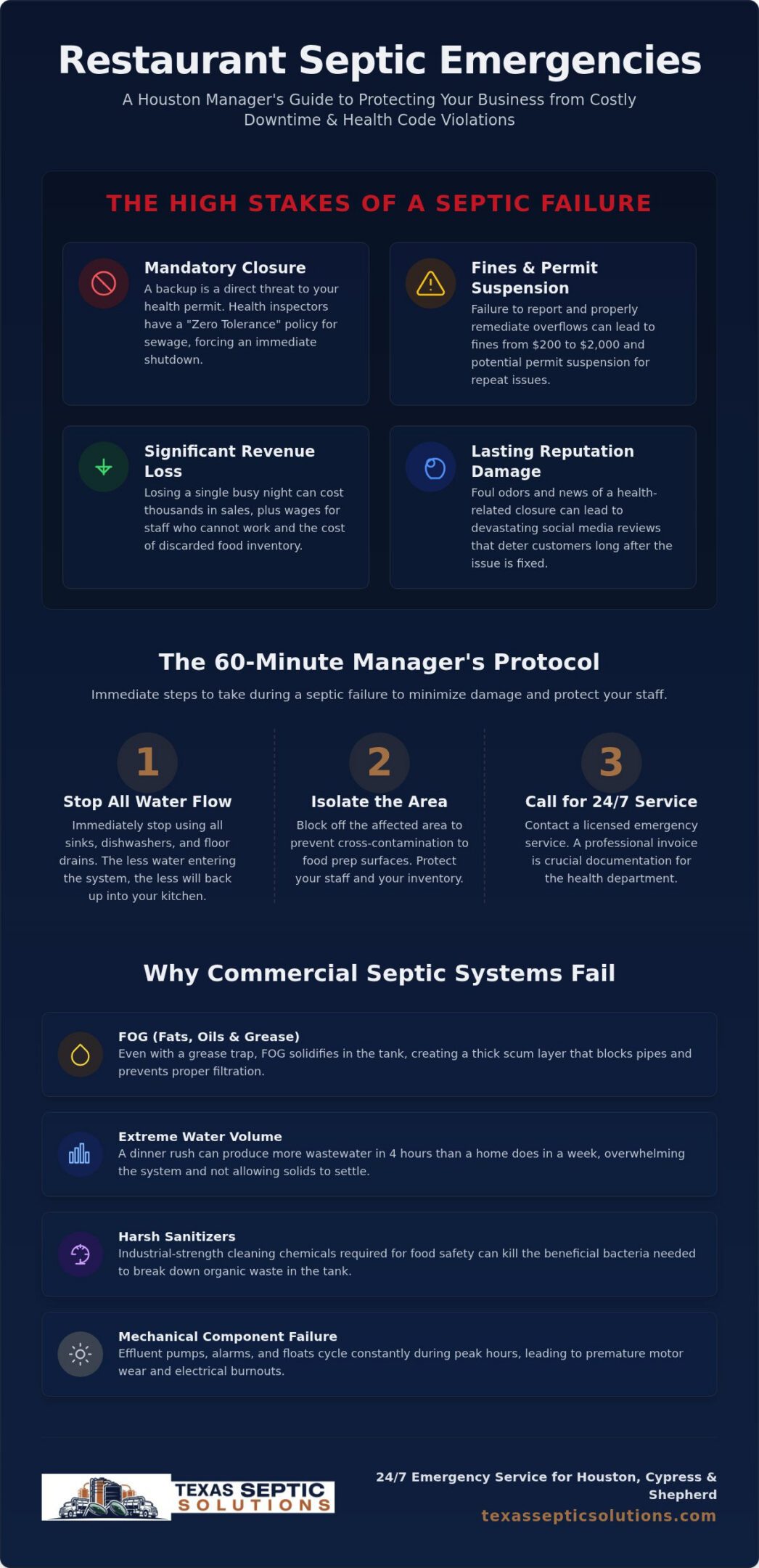
The 60-Minute Manager’s Protocol for Septic Emergencies
When a backup occurs, the first 60 minutes are vital for containing the mess and protecting your health permit. Start by stopping the flow of water immediately. This means shutting down high-volume commercial dishwashers and prep sinks that drain directly into the system. You should also isolate the affected areas, closing off restrooms or outdoor spray fields where effluent might be surfacing. Keeping customers away from these zones is essential for maintaining food safety standards and avoiding liability issues.
Documentation is your best defense against future citations or insurance disputes. Take clear photos of the backup and the alarm panel display. These records prove to Harris County officials that you took proactive steps to manage the crisis. Communicate clearly with your team; tell them the situation is being handled by a professional emergency septic service for restaurants Houston team. For customers, a simple “temporary maintenance” sign is usually enough to maintain professionalism without causing a panic. Maintaining a calm atmosphere prevents a minor utility issue from turning into a public relations disaster.
Immediate Water Mitigation Steps
If the backup is severe and uncontrollable, shut off the main water supply to the building. This prevents accidental usage that could worsen the indoor flooding. Switch your kitchen to disposable service ware immediately to eliminate the need for dishwashing during the downtime. This simple shift can keep your kitchen operational for a limited time while you wait for repairs. Managers should also inspect the grease trap interceptor as a secondary point of failure to ensure the backup isn’t localized there.
Preparing for the Technician’s Arrival
You can significantly speed up the diagnostic process by clearing the way for the service truck. Ensure your septic tank lids are accessible by moving outdoor seating, clearing landscaping, or removing any vehicles parked over the tank area. Locate your electrical panel and any septic blueprints or previous service manifests you have on file. Assign one point person to stay on-site to meet the 24/7 responder and authorize the necessary emergency septic service for restaurants Houston businesses require. If you’re facing a critical failure right now, contact Texas Septic Solutions for immediate assistance in Houston, Cypress, or Shepherd.
Why Texas Septic Solutions is Houston’s Commercial Choice
When your business is on the line, you don’t need a generic plumber; you need a partner who understands the unique demands of the Houston food service industry. Texas Septic Solutions has built a reputation as the “Neighborly Expert” by providing emergency septic service for restaurants Houston owners can trust at any hour. We prioritize commercial calls because we know that every minute your kitchen is down, your revenue and reputation are at risk. Our team arrives ready to resolve the issue immediately, allowing you to focus on your guests while we handle the waste.
Our team doesn’t just offer a quick pump and leave you to figure out the rest. We provide a one-stop solution for every stage of your system’s life cycle. Whether you need a midnight pump-out to clear a backup or a complete septic system replacement, we have the heavy-duty equipment and technical skill to handle the job. We believe in transparent communication, providing clear explanations of the failure and the required fix without hidden fees or confusing jargon. Our fleet is specifically outfitted with high-capacity vacuum pumps and advanced diagnostic tools that can pinpoint blockages in complex commercial lines, saving you time and preventing unnecessary digging.
Built for Houston’s Toughest Conditions
Houston and the surrounding areas like Cypress and Shepherd present some of the most challenging soil conditions in East Texas. Our technicians are deeply familiar with the way “Gumbo” clay behaves, especially during our frequent heavy rainfall events. We design our response around these localized drainage challenges. Standard residential pumps often struggle with the high-volume effluent and grease loads of a commercial kitchen, but our trucks are equipped for these industrial demands. We are committed to keeping our local food scene running safely and efficiently by providing specialized emergency septic service for restaurants Houston managers depend on during a crisis.
Long-Term Support Beyond the Emergency
An emergency visit is often a wake-up call for a better upkeep strategy. We help you move from reactive repairs to proactive care through our septic system maintenance Texas programs. These scheduled inspections are designed to catch float switch issues or aerator failures before they cause a shutdown. We also provide the meticulous documentation and manifests you need for health department inspections and insurance claims. We treat your restaurant like our own, ensuring your facility remains compliant and your doors stay open for the community.
Protecting Your Houston Restaurant’s Reputation and Health Permit
A septic backup doesn’t have to mean a permanent “Closed” sign on your front door. By following a strict mitigation protocol and understanding the difference between a simple tank pump-out and a mechanical failure, you can navigate a crisis with minimal downtime. High-volume commercial systems in Houston, Cypress, and Shepherd face unique pressures from grease and heavy clay soil that residential setups simply don’t encounter. Quick action today prevents expensive health code violations and protects the business you’ve worked so hard to build.
When the kitchen floor drains start to slow or the alarm panel begins to wail, you need a partner who understands the urgency of the food service industry. Texas Septic Solutions is ready to help with 24/7 emergency dispatch and specialized commercial diagnostic equipment. Our licensed and insured local technicians are built for high-pressure situations, ensuring your system is restored quickly and correctly. Don’t let a utility failure ruin your dinner rush. Contact Texas Septic Solutions for 24/7 Emergency Restaurant Service and get the emergency septic service for restaurants Houston managers trust. We’re here to keep your kitchen running and your customers happy.
Frequently Asked Questions
Do I have to close my restaurant if the septic system backs up?
Yes, you typically must close your doors immediately. Health codes in Harris County and the City of Houston consider sewage backups an imminent health hazard. You cannot safely prepare food or allow staff to work in an environment with surfacing wastewater. Closing protects your health permit from permanent suspension. Once an emergency septic service for restaurants Houston team remediates the issue and the area is sanitized, you can usually reopen.
How quickly can an emergency septic technician reach my Houston restaurant?
We prioritize commercial calls in Houston, Cypress, and Shepherd to minimize business downtime. Our 24/7 dispatch team is built for rapid response, often reaching your site within a few hours depending on traffic and current dispatch volume. We understand that every hour of closure is a direct loss of revenue. Our goal is to provide immediate diagnostic triage and pumping to get your kitchen back on its feet as fast as possible.
Can a grease trap overflow cause my septic system to fail?
A grease trap failure is a primary culprit for downstream septic issues. If the trap is full or bypassed, fats, oils, and grease enter the septic tank and solidify. This creates a thick scum layer that prevents proper waste breakdown and can clog the outlet filter. While we provide the emergency septic service for restaurants Houston businesses need, keeping your grease trap on a strict 90 day cleaning schedule is the best prevention.
What is the most common cause of septic alarms in commercial kitchens?
High water alarms are usually caused by a pump failure or a stuck float switch. In a high volume restaurant, the effluent pump cycles frequently and can wear out faster than in a residential home. If the pump stops working, the tank fills past its safe capacity and triggers the alarm. You should immediately reduce water usage and call for professional service to avoid a complete backup into your kitchen floor drains.
Is emergency septic pumping available on weekends and holidays in Houston?
Yes, we provide 24/7 emergency service every day of the year, including weekends and major holidays. Restaurants don’t stop operating on the weekends, and neither do we. Whether it’s a Saturday night dinner rush or a holiday brunch, our local technicians are on standby in Cleveland and Huffman. We are committed to being the reliable local authority that keeps our community’s food service industry running without interruption.
How can I prevent a septic backup during a period of heavy rainfall?
Heavy rain can saturate the “Gumbo” clay soil common in Houston, making it difficult for drain fields to absorb water. To prevent backups during storms, ensure your gutters and surface drainage are directed away from the septic area. You should also minimize unnecessary water usage, such as heavy cleaning or laundry, during the peak of the rain. Regular maintenance ensures your tank has the capacity to handle these weather related surges.
Does my restaurant need a specialized commercial septic tank pump?
Commercial kitchens process significantly more water and organic waste than residential properties. Standard residential pumps are often not rated for the high volume effluent and potential grease carryover found in food service environments. We recommend heavy duty, commercial grade pumps that can handle increased cycling demands. Our technicians can evaluate your current hardware and recommend a replacement that meets the specific flow rates required for your kitchen’s daily output.
What should I do if I smell sewage in the dining area but no drains are backing up?
Foul odors without a visible backup often indicate a venting issue or a failing aerobic aerator. In an aerobic system, the air compressor must run constantly to treat the waste; if it fails, the water becomes anaerobic and smells. You should also check for dry floor drain traps in the restrooms. If the smell persists, it’s a sign that your system’s biological balance is off and requires a professional diagnostic check.