
2026 Houston Septic Tank Guide for Large Families
Imagine it is a humid Saturday afternoon in Cypress, you have a dozen relatives over for a celebration, and suddenly the guest bathroom starts gurgling. It is the specific kind of dread that only homeowners with high-occupancy households truly understand. You already know that your system works significantly harder than the average neighbor’s. With constant laundry cycles and back-to-back showers, the hydraulic load on your tank is relentless. Effective septic tank maintenance for a large family in Houston requires a strategy that accounts for both your household volume and our region’s unique challenges, like heavy clay soil and frequent downpours.
We are here to help you move past the confusion of conflicting pumping schedules and the fear of sudden backups. This guide provides a clear, actionable plan to manage high water loads while protecting your drain field from the stresses of the Gulf Coast climate. You will learn the optimal pumping frequency for large groups, how to navigate the latest 2026 TCEQ standards, and ways to lower your risk of emergency repairs. By the end of this article, you will have a professional maintenance roadmap that keeps your home functional and your family comfortable, no matter how many guests are under your roof.
Key Takeaways
- Understand how Houston’s unique clay soil and heavy rainfall create extra pressure on systems serving high-occupancy homes.
- Learn why proactive septic tank maintenance for a large family in Houston is essential for preventing the “washout effect” that damages drain fields.
- Calculate the correct pumping frequency for your specific tank size to ensure your system handles the daily demands of five or more people.
- Discover simple daily adjustments, such as optimizing your laundry schedule, that protect your system’s biological balance and longevity.
- Identify critical red flags that signal a need for professional repair before a high-usage day turns into a costly sewage emergency.
Why Houston’s Climate and Large Families Stress Septic Systems
Houston is a tough environment for any utility system, but septic systems face a double threat here. You have the local geology working against you and the high demand of a bustling household. Most general advice assumes a family of three living in a place with sandy soil. That simply doesn’t apply to our region. Effective septic tank maintenance for a large family in Houston requires understanding that your system is constantly operating at or near its maximum capacity.
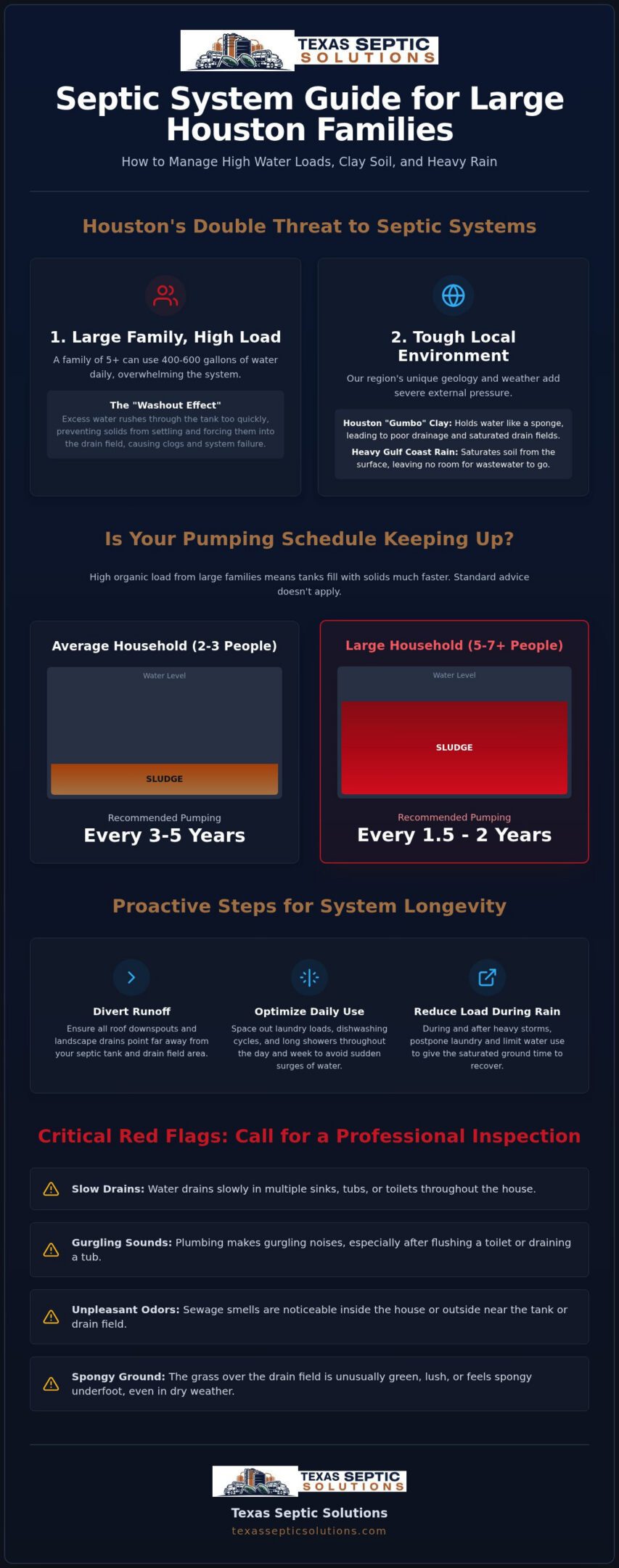
Standard maintenance math often fails when you have five or more people under one roof. For instance, while a typical home might pump every three to five years, a household with seven or more people using a 1,000-gallon tank should consider pumping every 1.5 to 2 years. This is because the organic load, the actual waste and grease, accumulates much faster than the tank’s natural bacteria can process it. Understanding how septic systems work helps clarify why this volume matters; the tank needs time for solids to settle, and high flow rates disrupt that process. When the settlement process is cut short, solids can escape into the drain field, leading to expensive repairs.
The Impact of Houston Clay Soil on Drainage
Our local “gumbo” clay is notorious for its poor percolation, or “perc” rate. Unlike sandy soils that allow water to filter through quickly, Houston clay holds onto moisture like a sponge. When a large family sends hundreds of gallons of water into the drain field daily, the soil often can’t keep up. This leads to “saturated soil syndrome,” where the ground becomes so waterlogged that it can no longer accept treated effluent. During a humid Texas summer, this moisture doesn’t evaporate easily. This leaves your system vulnerable to slow drains or even surfacing sewage in your yard.
Managing Heavy Rainfall and Septic Saturation
Gulf Coast storms add a massive external load to your system. Flash floods can saturate the ground from the top down, leaving no room for your septic water to go. If your gutters or landscape grading direct rainwater toward the drain field, you are essentially asking the soil to handle a double flood. This external pressure can cause water to back up into your house even if your tank isn’t full of solids. Use these steps to protect your system during our rainy seasons:
- Divert runoff: Ensure all downspouts and area drains point away from the septic tank and drain field.
- Watch for “spongy” grass: If the ground over your tank feels bouncy or stays wet long after a storm, the soil is maxed out.
- Limit indoor water use: During heavy rains, postpone laundry and limit long showers to reduce the immediate hydraulic load.
The combination of high indoor usage and extreme outdoor weather makes a proactive approach to septic tank maintenance for a large family in Houston your best insurance against a disaster. Staying ahead of the weather and your family’s water needs is the only way to ensure long term system health.
Understanding Hydraulic Load: How 5+ People Impact Septic Biology
Managing a septic system for a household of five or more is less about “fixing” things and more about managing a living ecosystem. The most critical factor for your home is the hydraulic load. This is the total volume of water entering your system within any 24-hour window. While a couple might use 150 gallons a day, a large family can easily push 400 to 600 gallons through the pipes. This volume matters because your tank relies on gravity and time to separate waste. When too much water rushes in at once, it creates a “washout effect,” where the turbulence prevents solids from settling and forces them directly into your drain field.
Because the organic load—the actual waste—is also higher, the natural bacteria in your tank have to work overtime. In many cases, the high water volume dilutes these beneficial microbes before they can break down the sludge. This is why septic tank maintenance for a large family in Houston requires a more proactive biological strategy than a standard home. If the bacteria can’t keep up, the sludge layer grows rapidly, leaving even less room for water and increasing the risk of a backup. Following established septic system maintenance guidelines is a great starting point for understanding these volume limits.
The Science of Wastewater Separation
Inside your tank, wastewater should ideally separate into three distinct layers: the heavy sludge at the bottom, the clear effluent in the middle, and the “scum” layer of fats and oils on top. High flow rates from multiple showers or simultaneous laundry loads prevent the scum layer from properly forming and thickening. This disruption is dangerous because the scum layer helps trap smaller particles that would otherwise clog your soil. Hydraulic load directly dictates retention time; when water enters too quickly, it forces untreated waste out of the tank before separation can occur. If you suspect your tank is no longer separating waste efficiently, scheduling a professional inspection can help identify issues before the drain field is compromised.
Signs of Biological Imbalance in High-Usage Tanks
A healthy tank shouldn’t be a source of constant worry or foul smells. However, large families often experience bacterial die-offs due to the sheer volume of cleaning products and soaps entering the system. If you notice a persistent “rotten egg” odor near the tank or drains that seem sluggish despite being clear of hair or grease, your system’s biology may be failing. Antibacterial soaps and heavy bleach use are particularly hard on high-occupancy systems. These chemicals kill the very bacteria needed to process the increased waste, leading to a system that fills up with solids much faster than expected. Effective septic tank maintenance for a large family in Houston means being mindful of what goes down the drain to keep those microbes thriving.
Pumping Schedules vs. Maintenance Plans for Houston Households
A standard 1,000 gallon tank is the baseline for many Texas properties, but it was never designed to handle the relentless output of a six or seven person household. When you have a large family, the math changes. A 1,500 gallon tank offers more breathing room, yet even a larger capacity system can fail if you rely on a “wait and see” strategy. In our experience, waiting for a sign of trouble in Houston usually means dealing with a backup during a tropical storm or a major holiday. Proactive septic tank maintenance for a large family in Houston is the only way to avoid the massive septic system replacement cost that comes with a neglected drain field.
Choosing a professional septic system maintenance plan provides a safety net that a simple pumping receipt cannot match. While pumping removes solids, a maintenance plan ensures that your baffles, filters, and pumps are actually functioning. This is especially vital for aerobic systems, which the TCEQ requires to be inspected three times per year. Regular checkups are designed to catch small mechanical issues before they result in your septic tank alarm going off in the middle of the night.
Custom Pumping Frequency for Large Families
The EPA guide to septic system care suggests that most systems need pumping every three to five years. However, high occupancy households in the Houston area often need a tighter schedule due to the “gumbo” clay soil discussed earlier. We often use “sludge judging,” a process of measuring the actual solid layers in your tank, to determine your specific needs. Use the following table as a general starting point for a 1,000 gallon tank:
- 1-2 People: 5 to 6 years
- 3-4 People: 3 to 4 years
- 5-6 People: 2 to 3 years
- 7+ People: 1.5 to 2 years
Houston’s intense heat can also accelerate bacterial activity, which is generally good, but it also means sludge can become more compact and harder to remove if left too long. If you are at the high end of these occupancy numbers, an extra year of frequency is often a cheap insurance policy.
Why Maintenance Plans Beat Emergency Calls
A maintenance plan is about more than just the tank. It includes cleaning the effluent filters that protect your drain field from the “washout effect.” For large families using aerobic systems, these filters can clog quickly with lint and hair. A professional inspector will also check the health of your pump and aerator. These mechanical parts are under constant stress in a high usage home. Catching a worn bearing or a cracked pipe during a scheduled visit is much more affordable than an emergency service call on a Sunday afternoon. This steady oversight keeps your system balanced and your home running without interruption.
The Large Family Septic “How-To”: Daily Habits for System Longevity
Professional service is only one half of the equation. The other half is how your family interacts with your plumbing every day. For a household of five or more, the goal is to avoid “peak flow” surges that drown the tank’s ability to separate waste. When you manage your habits, you effectively lower the daily stress on your system, making septic tank maintenance for a large family in Houston much more manageable and predictable.
The biggest enemy of a high-occupancy system is “Laundry Day.” If you save ten loads of laundry for Saturday, you are essentially flooding your tank with hundreds of gallons of water and detergent in a six-hour window. This massive surge doesn’t just fill the tank; it creates enough turbulence to push solids out into your drain field. Instead, treat laundry as a daily task. Spreading those loads across the week allows the tank enough “rest time” to settle and process effluent properly. Similarly, upgrading to low-flow showerheads and toilets can reduce your total daily water volume by 30% or more, which is a massive relief for a system already pushed to its limits.
Kitchen habits also play a vital role. In Houston, grease blockages cause over 50% of sewage overflows. In a busy kitchen, it is easy to let fat and oil slip down the drain, but these substances never fully break down in your tank. They solidify and shrink the available space for water. We also recommend limiting garbage disposal use. Disposals add finely ground organic matter that stays suspended in the water longer, increasing the risk of solids escaping the tank. If your family’s daily usage has already caused slow drains or odors, schedule a professional septic pumping or inspection to reset your system’s capacity.
Developing a High-Usage Water Schedule
Creating a predictable flow of water helps your system maintain its biological balance. Use these three steps to organize your household’s water habits:
- Step 1: Spread laundry loads. Limit yourself to one or two loads per day rather than a marathon session on the weekend.
- Step 2: Stagger high-volume activities. Avoid running the dishwasher at the same time three people are taking showers. Space these events by at least an hour.
- Step 3: Conduct a monthly leak audit. A single leaking toilet can add 200 gallons of water a day to your tank. Check every fixture on the first of the month.
Septic-Safe Habits for Kids and Guests
Education is your best defense against a backup. Teach everyone in the house the “Only the 3 Ps” rule: only Pee, Poop, and Paper go down the toilet. Even if a product is labeled as “flushable,” it is a myth that can destroy a large-family system. These wipes do not break down like toilet paper; instead, they catch on baffles or clog pumps, leading to 15% of all overflows in the Houston area. During holidays or large family gatherings, remind your guests of these rules. When your home’s occupancy doubles for a weekend, your system’s margin for error disappears, making strict adherence to these habits essential.
Professional Septic Care in Houston: When to Call the Experts
Even with the most disciplined water-saving habits, a household of five or more people pushes a system to its physical limits every single day. There comes a point where DIY scheduling isn’t enough to guarantee long-term functionality. Professional septic tank maintenance for a large family in Houston serves as your insurance policy against the mess and expense of a total system failure. Knowing when to step back and let a professional take over can save you thousands in long-term costs. If you notice persistent issues, it’s time to evaluate whether you need a septic system repair. We often see families wait until sewage is backing up into the tubs, but the warning signs usually appear much earlier.
High-usage systems don’t just fail; they usually give you a series of hints first. For a large family, these signs can escalate quickly due to the sheer volume of wastewater being generated. Our 24/7 emergency response is always available as a safety net, but our goal is to help you avoid those midnight crises through regular, expert oversight. We provide the comprehensive septic system maintenance Texas families rely on to keep their homes running smoothly during holidays, school breaks, and busy weekends.
Emergency Signs You Can’t Ignore
Don’t wait for a total backup to take action. If you notice any of the following red flags, your system is likely struggling to keep up with your family’s hydraulic load:
- System-wide slow drains: If every sink and shower in the house is draining slowly, the problem isn’t a simple clog. It’s a sign that your tank or drain field is full.
- The “Emerald Lawn”: Lush, green patches of grass over the drain field might look nice, but they often indicate that effluent is surfacing rather than filtering through the soil.
- Gurgling plumbing: If your pipes make a gurgling sound when the dishwasher runs or someone takes a shower, air is being trapped by high water levels in the tank.
The Texas Septic Solutions Difference
We take local pride in serving families across Cleveland, Cypress, Huffman, and Shepherd. We understand that a large household has different needs than a weekend cabin. Our specialized pumping equipment is designed to handle high-volume residential tanks efficiently, and our technicians are experts in the specific challenges of East Texas clay. We don’t just pump and leave; we look at the health of your entire system to ensure it’s ready for the next decade of service. Don’t let your septic system become a source of household stress. Contact us for your large family maintenance audit today and get the peace of mind you deserve.
Securing Your Home’s Future with Smarter Septic Management
Managing a high-occupancy household is a constant balancing act, and your septic system shouldn’t be a source of daily stress. By understanding the impact of hydraulic load and adopting smart water-staggering habits, you can protect your drain field from the unique challenges of Houston’s heavy clay soil. Proactive care is always more affordable than emergency repairs. Staying consistent with septic tank maintenance for a large family in Houston is the best way to ensure your system handles every shower, laundry load, and holiday gathering without issue.
Our expert local technicians are ready to provide the specialized oversight your high-usage system requires. Whether you are in Houston, Cleveland, or Cypress, we offer the peace of mind that comes with professional care and 24/7 emergency service availability. You don’t have to navigate these utility challenges alone. Protect your family’s home with a professional maintenance plan from Texas Septic Solutions. We are here to keep your system healthy and your home comfortable for years to come.
Frequently Asked Questions
How often should a family of 5 or 6 pump their septic tank in Houston?
A household of five or six people using a standard 1,000 gallon tank should pump every 2 to 3 years. This schedule is more frequent than the standard recommendation because the organic load accumulates much faster. In Houston, our heavy clay soils don’t drain as quickly, making regular pumping essential to prevent solids from escaping into the drain field. Staying on top of this prevents expensive backups during high usage periods like holidays.
Can I use a garbage disposal if I have a large family and a septic system?
We generally recommend avoiding garbage disposals in high occupancy homes. Disposals grind food into fine particles that stay suspended in the wastewater longer, which can lead to solids flowing out into your drain field. For a large family, the sheer volume of food waste can double the rate of sludge accumulation. If you must use one, you should plan for even more frequent pumping to keep the system healthy.
What happens if my septic tank overflows during a Houston flood?
If your system overflows during a flood, stop all indoor water use immediately to prevent sewage from backing up into your home. Houston flash floods often saturate the ground, leaving no room for your effluent to drain. Don’t have your tank pumped while the ground is still underwater, as the pressure could cause a lightened tank to float or “pop” out of the ground. Wait for the floodwaters to recede before calling for service.
Is it worth getting a larger septic tank for a growing family?
Upgrading to a 1,500 gallon tank is a smart investment for a growing household. A larger tank provides more “retention time,” which allows solids more space and time to settle properly before the water moves to the drain field. This extra capacity is especially helpful for septic tank maintenance for a large family in Houston, as it offers a buffer against the high water spikes caused by multiple showers and laundry loads.
What are the best septic-safe cleaning products for high-usage bathrooms?
Choose biodegradable, phosphate free, and non-antibacterial cleaners to protect your tank’s biological balance. In a busy home, the cumulative effect of harsh chemicals can kill off the beneficial bacteria needed to break down waste. Look for labels that explicitly state “septic safe” and avoid heavy bleach use. Using enzyme based cleaners can also help support the natural breakdown process, which is vital when your system is operating at its maximum capacity.
How do I know if my drain field is failing from too much water?
Watch for spongy or waterlogged patches of grass over your drain field even when it hasn’t rained. You might also notice that drains in the house are gurgling or moving slowly despite having a recently pumped tank. These are signs that your soil is saturated and can no longer accept wastewater. For families in Cleveland or Cypress, these issues often worsen during the humid months when evaporation rates are lower.
Does a large family need a special type of septic system in Texas?
While no special system is required by law, many large families in the Houston area benefit from aerobic treatment systems. These systems use oxygen to break down waste faster and more thoroughly than conventional gravity systems. This is particularly effective in our local clay soil, which struggles with traditional drainage. However, the most important factor for any family remains the size of the tank and the frequency of professional maintenance.
What should I do if my septic alarm goes off during a family gathering?
Immediately reduce your water usage to the absolute minimum and check your breaker box to ensure the pump power hasn’t tripped. An alarm usually indicates a high water condition or a pump failure. Since large gatherings put extreme pressure on your plumbing, this is a critical situation. We provide 24/7 emergency septic service across Huffman and Shepherd to handle these high pressure failures, ensuring your celebration doesn’t end in a utility disaster.