
2026 Houston Septic Guide: Homes with Water Softeners
What if the very system protecting your pipes from Houston’s notoriously hard water is actually the primary threat to your septic drain field? It’s a common dilemma for local homeowners who are caught between the need for soft water and the fear of a total septic failure. When you’re managing septic system care for homes with water softeners Houston conditions require a specific strategy to handle the high mineral content and our unique local soil.
We understand the stress of hearing conflicting advice about whether salt-based softeners will kill your tank’s bacteria or ruin your leach field. You shouldn’t have to choose between scale-free faucets and a functional waste system. Our goal is to give you total confidence that your home’s infrastructure is protected on both ends of the pipe, ensuring your investment stays safe for years to come.
In this 2026 guide, you’ll learn how to balance your water softener’s brine discharge with the health of your septic microbes. We’ll provide a clear plan to prevent salt-induced soil dispersion in our local “gumbo” clay and explain the latest Texas standards for high-efficiency regeneration units. By the end, you’ll have the exact steps needed to maintain both systems without the risk of costly clogs or unexpected failures.
Key Takeaways
- Understand how Houston’s unique mineral-heavy groundwater and softener brine can disrupt the delicate biological balance of your septic tank.
- Discover how specialized septic system care for homes with water softeners Houston focuses on Demand-Initiated Regeneration (DIR) to minimize water waste and salt exposure.
- Compare the benefits of using potassium chloride over standard salt pellets to safeguard your system’s beneficial bacteria and improve soil drainage.
- Identify why routine professional pumping is the most effective way to prevent softener-related sludge from clogging your drain field.
- Learn the latest 2026 Texas standards for water softener discharge to keep your home compliant and avoid expensive emergency repairs.
The Houston Hard Water Dilemma: Why Softeners and Septics Often Clash
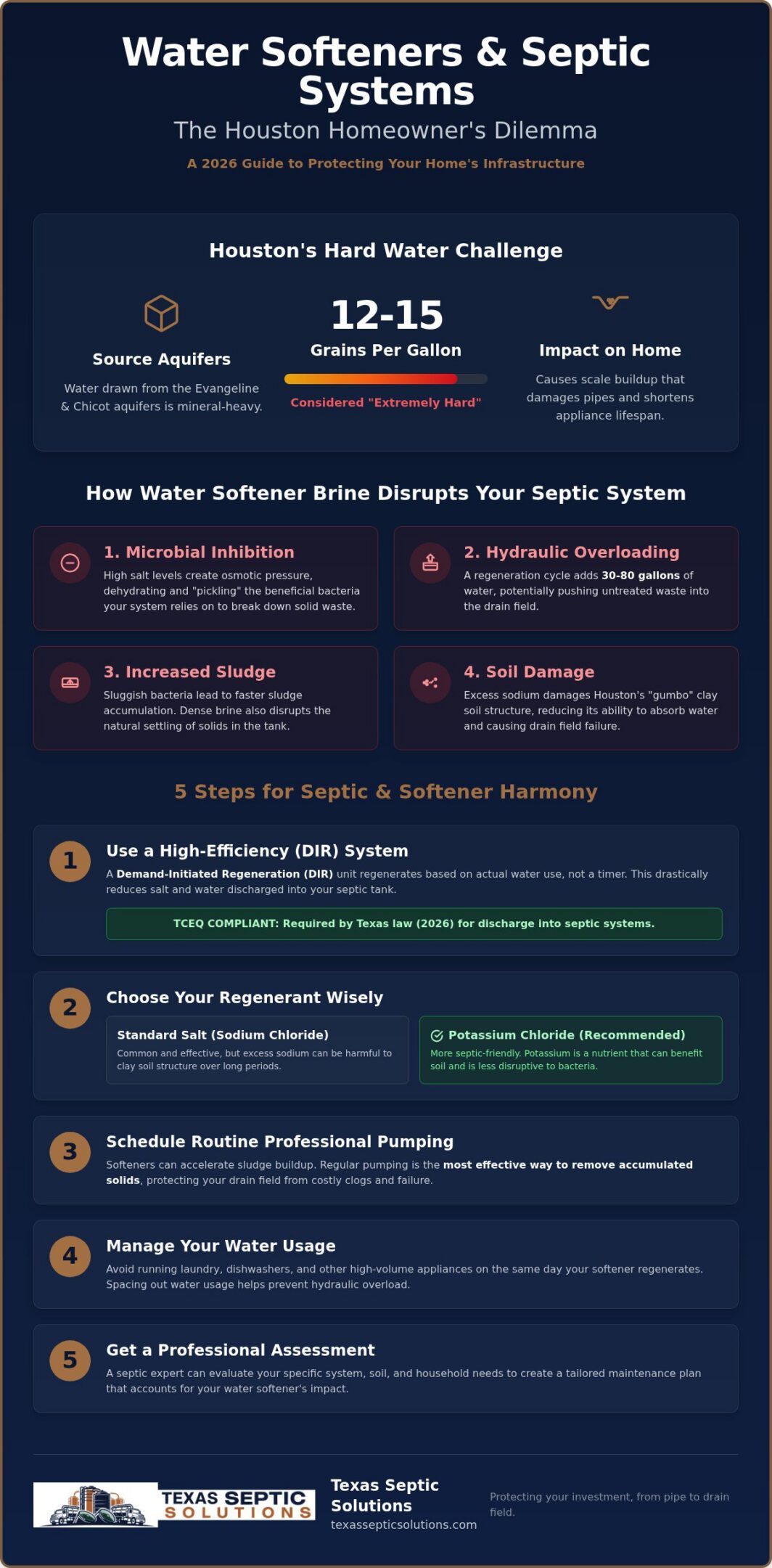
Houston’s water supply primarily draws from the Evangeline and Chicot aquifers. These underground sources deliver some of the hardest water in Texas, often averaging 12 to 15 grains per gallon in our local area. To protect pipes and expensive appliances, most property owners install water softeners. These units use a process called ion exchange to swap hardness minerals like calcium and magnesium for sodium or potassium ions. While this process saves your plumbing, it creates a byproduct known as brine. Proper septic system care for homes with water softeners Houston families use requires a proactive approach to prevent these two systems from working against each other.
The conflict arises because of how this concentrated salt water interacts with your tank’s delicate biology. A basic grasp of how septic systems work reveals that they depend on living bacteria to break down organic waste. Excessive salt levels can dehydrate these microbes, effectively “pickling” the tank and slowing down the treatment process. In aerobic systems, the sudden rush of water during a regeneration cycle can also cause hydraulic overloading, which pushes untreated waste directly into the drain field.
Houston Water Hardness and Your Plumbing
In communities like Cypress and Huffman, minerals are a constant battle for homeowners. Without a softener, dishwashers and laundry machines might only last half their expected lifespan due to heavy scale buildup. However, a typical regeneration cycle can discharge 30 to 80 gallons of brine in a single sitting. This volume is a significant addition for a septic tank already processing daily household waste. Effective septic system care for homes with water softeners Houston residents rely on starts with balancing this appliance protection with long-term system health.
The Legal Landscape for Texas Septic Owners
The Texas Commission on Environmental Quality (TCEQ) provides specific rules for managing this discharge. As of 2026, state law permits softener effluent to enter an on-site sewage facility (OSSF) only if the unit is a demand-initiated regeneration (DIR) model. These modern systems only cycle when the resin is actually exhausted, rather than on a simple timer, which reduces the total salt load. Some Houston suburbs may still encourage bypassing the septic system entirely for softener discharge to protect the local soil from salt accumulation. Maintaining a balanced brine-to-effluent ratio ensures that salt concentrations remain low enough for healthy bacterial digestion without compromising water quality.
How Water Softener Discharge Affects Your Septic Tank’s Biology
Many homeowners worry that a single regeneration cycle will instantly kill every living microbe in their tank. The reality is more nuanced. While salt is a natural antimicrobial, it rarely sterilizes a healthy septic system entirely. Instead, it causes microbial inhibition. When you’re managing septic system care for homes with water softeners Houston property owners should focus on how salt concentrations shift the environment rather than fearing a total bacterial wipeout. These shifts can slow down the breakdown of solids, leading to faster sludge accumulation over time.
Brine is significantly denser than standard household wastewater. When this heavy salt water enters the tank, it can settle at the bottom or create “stratification” layers. This density difference can disrupt the natural settling process, where solids sink and oils float. If the brine isn’t properly diluted, it can even cause hydraulic overloading. This happens when the volume of the regeneration cycle pushes wastewater through the tank too quickly, giving bacteria less time to treat the effluent before it exits to the drain field.
The Science of Bacterial Inhibition
The primary biological threat is osmotic pressure. High salt concentrations in the tank water pull moisture out of the bacterial cells through their cell walls. This dehydrates the “good” bacteria, making them sluggish or dormant. According to Water Quality Association research, while efficient systems minimize this impact, older units can create salt spikes that hit aerobic systems particularly hard. Because aerobic bacteria require more oxygen and a stable environment to thrive, they are often the first to struggle when brine levels fluctuate. Common signs of this biological stress include persistent “rotten egg” odors or drains that seem to lose their pep.
Sodium and Soil Dispersion in Houston Clay
The biggest risk for Houston residents isn’t actually inside the tank; it’s in the soil. Most of our local area sits on “black gumbo” clay. This soil is prone to a chemical reaction called sodium-induced soil dispersion. When sodium ions from softener brine reach the drain field, they can swap places with the calcium and magnesium ions that keep clay particles clumped together. This causes the clay to swell and break apart into fine particles that effectively “seal” the soil. Once this happens, the soil loses its permeability, and the effluent can no longer filter through. This is a leading cause of premature leach field failure in East Texas. If you’re concerned about how your softener is impacting your drain field, scheduling regular septic system maintenance can help identify these soil changes before they become a total system failure.
Evaluating Your Options: High-Efficiency vs. Salt-Free Systems for Septic Health
Choosing the right water treatment setup is the foundation of effective septic system care for homes with water softeners Houston residents can rely on. If your home still uses an old timer-based softener, you’re likely dumping hundreds of gallons of unnecessary brine into your tank every month. Modern alternatives prioritize efficiency, ensuring that your quest for soft water doesn’t come at the cost of a ruined drain field. Balancing appliance protection with wastewater management requires looking closely at how each system handles mineral removal.
One of the first decisions you’ll face is choosing between sodium chloride and potassium chloride. While standard salt (sodium chloride) is cheaper, potassium chloride is often the better choice for Houston’s clay-heavy soil. Potassium is a plant nutrient and doesn’t cause the same soil dispersion issues as sodium. It’s a simple switch that can significantly extend the life of your leach field. Various studies on water softeners and septic systems suggest that when these systems are tuned for high efficiency, the impact on the tank’s biology is negligible.
Demand-Initiated Regeneration (DIR) Benefits
DIR systems are the modern standard for any home on a septic system. Unlike older models that regenerate on a set schedule, DIR units use a meter to track actual water usage. They only cycle when the resin bed is exhausted. This prevents “hydraulic overloading,” a situation we see often in Cypress where a timer-based system cycles during a heavy rainstorm or a laundry day. In fact, Texas state law now requires these demand-initiated units for any softener installed after September 1, 2003. Upgrading to a DIR valve is the most cost-effective way to protect your septic biology. You’ll use less salt, less water, and put far less stress on your tank’s bacterial colonies. This level of efficiency is the gold standard for septic system care for homes with water softeners Houston families need to avoid premature failures.
Salt-Free Alternatives in the Houston Market
If your drain field is already showing signs of struggle, a salt-free “water conditioner” might be the safest path forward. These systems often use Template Assisted Crystallization (TAC) to change the physical structure of minerals so they don’t stick to your pipes. Since they don’t use salt or a backwash cycle, there is zero discharge into your septic tank. However, keep in mind that Houston’s water is exceptionally hard, often exceeding 15 grains per gallon in areas like Cleveland or Huffman. While salt-free systems prevent scale buildup, they don’t provide the “slick” feel of traditional soft water. For homeowners focused on maximum septic longevity, the trade-off is often worth it to keep the leach field completely free of salt-induced damage.
5 Essential Care Tips for Houston Homeowners with Softeners and Septics
Managing a home in the Houston area means dealing with high mineral content that can take a heavy toll on your plumbing. However, protecting your pipes shouldn’t come at the expense of your wastewater system. Implementing a specific routine for septic system care for homes with water softeners Houston homeowners can follow will prevent the most common causes of system failure. These five tips provide a clear roadmap for balancing home comfort with environmental health.
- Upgrade to a DIR Valve: Demand-initiated regeneration is the single most important hardware change you can make. It ensures brine only enters your tank when necessary rather than on a fixed timer.
- Switch to Potassium Chloride: While slightly more expensive than standard salt, potassium chloride is a plant-friendly nutrient. It helps prevent the “sealing” effect that sodium has on our local gumbo clay soils.
- Adjust Pumping Frequency: Saltwater is denser than freshwater. This buoyancy can keep solid waste suspended in the middle of the tank rather than letting it settle. Plan to pump your tank more frequently to remove this suspended sludge before it reaches the drain field.
- Explore Discharge Diversion: If your local building codes and soil conditions allow, routing the softener’s backwash to a separate dry well can remove the salt load from your septic system entirely.
- Use Microbial Boosters: Regularly adding septic-safe bacteria can help your system recover from the osmotic stress caused by brine spikes.
Optimizing Your Softener Settings
Start by checking your local water report or testing your tap water. Houston water hardness typically ranges between 12 and 15 grains per gallon. If your softener is set too high, it’ll regenerate more often than needed, wasting salt and water. Timing is also critical. Ensure the regeneration cycle finishes well before your family’s high-usage hours, like the morning shower rush. This prevents untreated brine from being pushed into the drain field by a sudden surge of household water. Check your brine tank monthly for “salt bridging,” which is a hard crust that prevents the salt from dissolving properly and leads to inefficient cycles.
Septic Maintenance Adjustments
A proactive septic system maintenance plan is your best defense against long-term salt damage. Keep a close eye on your drain field for warning signs. If you notice standing water or unusually lush, green grass even during a dry Houston summer, your soil might be struggling with sodium saturation. This “sealing” effect prevents effluent from soaking into the ground correctly. Additionally, check your septic effluent filter every six months. Salt-induced sludge buoyancy can clog filters faster than normal usage. If you’re unsure about your system’s current health, we can provide a professional septic system inspection to ensure everything is flowing as it should.
Professional Septic Maintenance: Protecting Your System from Salt Damage
Texas Septic Solutions takes a specialized approach to septic system care for homes with water softeners Houston residents can trust. We don’t just pump the tank; we analyze the chemistry of the whole system. Our team understands that a softener malfunction can flood a tank with brine, leading to immediate hydraulic issues. If your softener sticks in a regeneration cycle or begins leaking salt water into the line, you might need emergency septic repair to prevent a total system backup. We provide customized maintenance schedules for homes in Houston, Cleveland, and Cypress, ensuring your pumping intervals match your actual household salt load.
Diagnostic Inspections for Softener Users
Our technicians use specialized field tests to check for “sludge bulking.” This occurs when brine interference prevents solids from settling, causing them to float in the middle of the tank where they can easily enter the effluent filter. During a professional inspection, we also look for early physical signs of soil dispersion in the drain field. By testing the effluent for high sodium levels, we can determine if your softener is cycling too frequently or if the brine-to-effluent ratio is out of balance. This data allows us to recommend specific adjustments to your softener settings before the salt causes permanent soil damage.
Why Proactive Care Saves Thousands
Replacing a failed drain field is one of the most expensive home repairs you’ll ever face in East Texas. When you compare the septic system replacement cost to the price of routine pumping and maintenance, the choice is clear. Routine care removes the concentrated salt layer and suspended solids before they reach your leach field. We act as a guardian for your home’s functionality, offering 24/7 support because we know septic failures don’t wait for business hours. Our goal is to provide the peace of mind that comes with a healthy, balanced system.
Don’t wait for a backup to address your system’s health. Schedule your professional septic inspection with Texas Septic Solutions today!
Secure Your Home’s Future with Smarter Septic Management
Protecting your plumbing from Houston’s hard water doesn’t have to mean sacrificing your septic system’s longevity. By prioritizing demand-initiated regeneration and making the switch to potassium chloride, you can safeguard both your pipes and your drain field. These proactive steps, combined with regular microbial boosts, ensure that your tank’s biology remains resilient against brine spikes. Effective septic system care for homes with water softeners Houston families rely on is all about balance and expert local oversight.
As a locally owned and operated team based in Cleveland, TX, we understand the unique challenges our “gumbo” clay soil presents. We offer expert maintenance for softener-equipped homes and provide 24/7 emergency septic service to handle unexpected failures. Don’t wait for slow drains or standing water to signal a crisis. Take control of your home’s infrastructure today with a partner who knows how to keep your systems in harmony. Protect your septic system—Schedule a Houston-area inspection today!
Your peace of mind is our priority. With the right care plan in place, you can enjoy the benefits of soft water while knowing your septic system is built to last for decades.
Frequently Asked Questions
Is it illegal to drain a water softener into a septic system in Texas?
It is legal in Texas to discharge softener effluent into a septic system, provided the unit uses demand-initiated regeneration (DIR). These systems are designed to conserve water and reduce salt discharge. According to TCEQ standards for 2026, any system installed after September 1, 2003, must meet these efficiency requirements. If you have an older timer-based unit, you might be out of compliance. We recommend upgrading to ensure your setup meets current local regulations in Cypress and Houston.
Can I use potassium chloride in my softener to protect my septic tank?
You can absolutely use potassium chloride instead of sodium chloride. While it costs more per bag, it is significantly better for your septic system care for homes with water softeners Houston properties. Potassium is a plant nutrient that doesn’t cause the same soil dispersion issues as sodium. This is particularly important for the heavy clay soils found in Cleveland and Huffman, where sodium can effectively seal off your drain field over time.
How often should I pump my septic tank if I have a water softener?
Most homeowners with softeners should increase their pumping frequency to every two to three years. Standard recommendations of three to five years often don’t account for the increased sludge buoyancy caused by salt water. Brine can keep solids suspended in the middle of the tank, allowing them to bypass the filter. Regular pumping ensures these solids are removed before they reach your leach field and cause a permanent, expensive clog.
Will a salt-free water conditioner work as well as a softener for Houston water?
Salt-free conditioners prevent scale buildup in your pipes but won’t provide the “slick” feel of soft water. In Houston, where water hardness often exceeds 15 grains per gallon, salt-free systems might struggle to meet expectations. They use Template Assisted Crystallization to neutralize minerals rather than removing them. For homeowners in Shepherd or Cypress focused solely on protecting their septic biology, they are a safe choice, but traditional softeners remain the gold standard for mineral removal.
What are the signs that my water softener is ruining my drain field?
Look for standing water or unusually lush, dark green grass over your leach field even during dry spells. These are classic signs of sodium-induced soil dispersion, where the clay in our Houston soil has become sealed. You might also notice persistent odors or slow-moving drains inside the house. If you see these warnings, it’s time to have a professional evaluate your system before the soil becomes completely impermeable and requires a full replacement.
Can I divert my water softener discharge to a separate drain?
Diverting discharge to a separate dry well is often possible and highly beneficial for your septic tank’s health. This removes the salt load and hydraulic stress from your primary treatment system entirely. However, you must verify local Houston or Harris County building codes before making this change. Some areas have strict rules about where gray water can be discharged. Our team can help you determine the best legal route for your specific property and soil conditions.
Does a water softener affect aerobic septic systems differently than anaerobic ones?
Aerobic systems are generally more sensitive to salt spikes than anaerobic ones. The beneficial bacteria in an aerobic tank require a very stable environment and plenty of oxygen to thrive. A sudden rush of brine can dehydrate these microbes through osmotic pressure, slowing down waste treatment. While both systems are affected by salt, aerobic owners in Cypress and Huffman should be extra diligent about using high-efficiency softener settings to prevent biological crashes and odors.
What should I do if my septic alarm goes off and I have a softener?
First, check if your water softener is currently running a regeneration cycle or if it’s stuck in a “backwash” mode. A malfunctioning softener can send hundreds of gallons of water into your tank, triggering a high-water alarm. If the softener isn’t the obvious cause, silence the alarm and limit your water usage immediately. You should then contact us for emergency septic service to diagnose whether you have a pump failure, a clogged filter, or a serious hydraulic overload.